AegisOps AI
Resolve outages before the war room fills up.
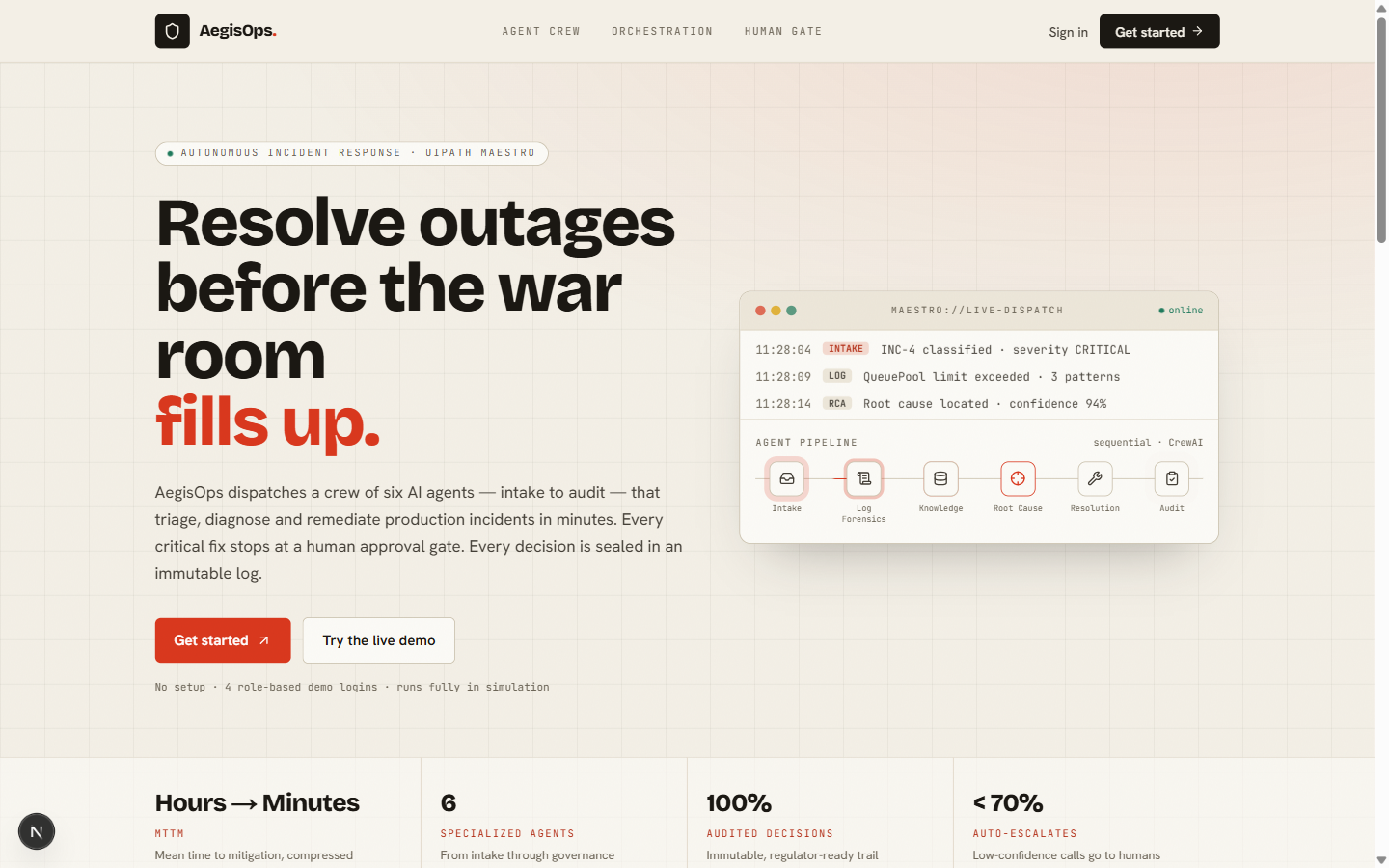
AegisOps AI is a Security/IT Operations command center where a crew of six specialized agents work an incident end-to-end — from intake to a sealed audit trail — coordinated by a UiPath Maestro sequential workflow with human-in-the-loop manager approval gates.
Inspiration
Every on-call engineer knows the 2 a.m. scramble: a critical alert fires, a war room spins up, and ten people copy-paste logs while the clock burns SLA budget. Most of that work is triage — boring, repeatable, and perfect for agents. But the dangerous 20% (running a remediation that could make things worse) needs a human. We wanted automation that knows when to ask.
What it does
A filed incident moves through a sequential pipeline:
- Intake — classifies the ticket and assigns a severity vector
- Log Forensics — scans uploaded logs for fatal traces, builds a timeline
- Knowledge (RAG) — retrieves matching SOPs / runbooks from a vector store
- Root Cause — fuses anomalies + SOPs and scores a confidence %
- Resolution — drafts a fix with rollback safe-fails and a risk grade
- Audit — seals an immutable record of every decision, retry, and override
An escalation gate halts the workflow when severity is critical or
root-cause confidence drops below 70%, routing it to a manager. Approve →
remediation resumes. Reject → it's logged. High-confidence, low-severity
incidents auto-remediate.
How we built it
- Orchestration: a UiPath Maestro–style master workflow drives the agent sequence, the retry loop (up to 3× per agent on transient failure), and the approval gate.
- Agents: six coded CrewAI agents, each owning one stage and handing a structured verdict to the next.
- Backend: FastAPI + SQLAlchemy, JWT auth with role-based access (only managers/admins can approve), background-task dispatch so agent progress streams to the UI in real time.
- Knowledge: ChromaDB vector store for SOP retrieval, with a SQL keyword-matching fallback.
- Frontend: Next.js 15 (App Router) + React 19 + Tailwind v4, an "Operational Broadsheet" editorial design with a live agent-stdout console.
- Simulation mode: the whole platform runs with zero API keys in a
deterministic mode, so judges can
docker compose upand see agents work in under three minutes — no LLM bill, no flaky external calls on stage.
Challenges we ran into
- Knowing when to escalate. Encoding "ask a human" as a deterministic gate ( \( severity = critical \lor confidence < 70\% \) ) instead of a vibe.
- Making async agents visible. Agents are fast; humans need to watch them reason. We stream each agent's execution + result as rows the UI polls.
- Graceful degradation. Any LLM error silently falls back to simulation so a live demo never dies mid-pitch.
What we learned
Multi-agent systems are only as trustworthy as their guardrails and audit trail. The hard part isn't getting agents to act it's getting them to stop and defer, and proving afterward exactly what happened.
What's next
Real-time webhook intake from PagerDuty/Opsgenie, agent-suggested runbook authoring, and a confidence-calibration loop trained on past approvals.
Built With
- chromadb
- crewai
- docker
- fastapi
- jwt
- langchain
- next.js
- postgresql
- pydantic
- python
- react
- sqlalchemy
- sqlite
- tailwindcss
- tanstack-query
- typescript
- uipath-maestro
- zustand


Log in or sign up for Devpost to join the conversation.