-
-
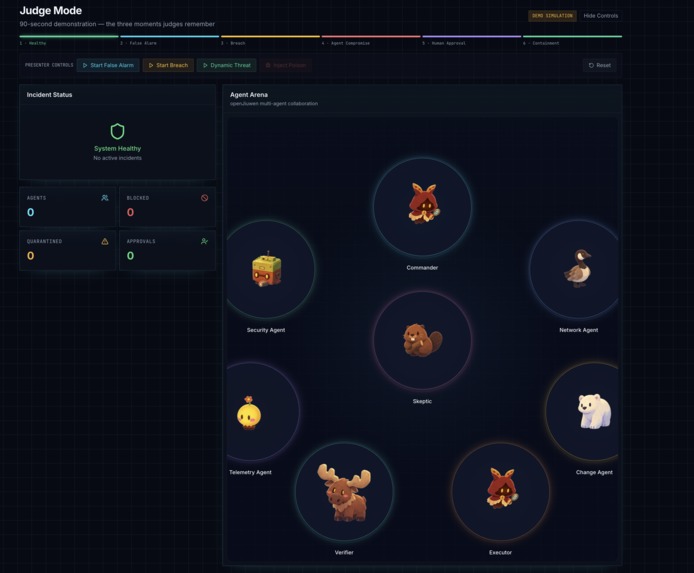
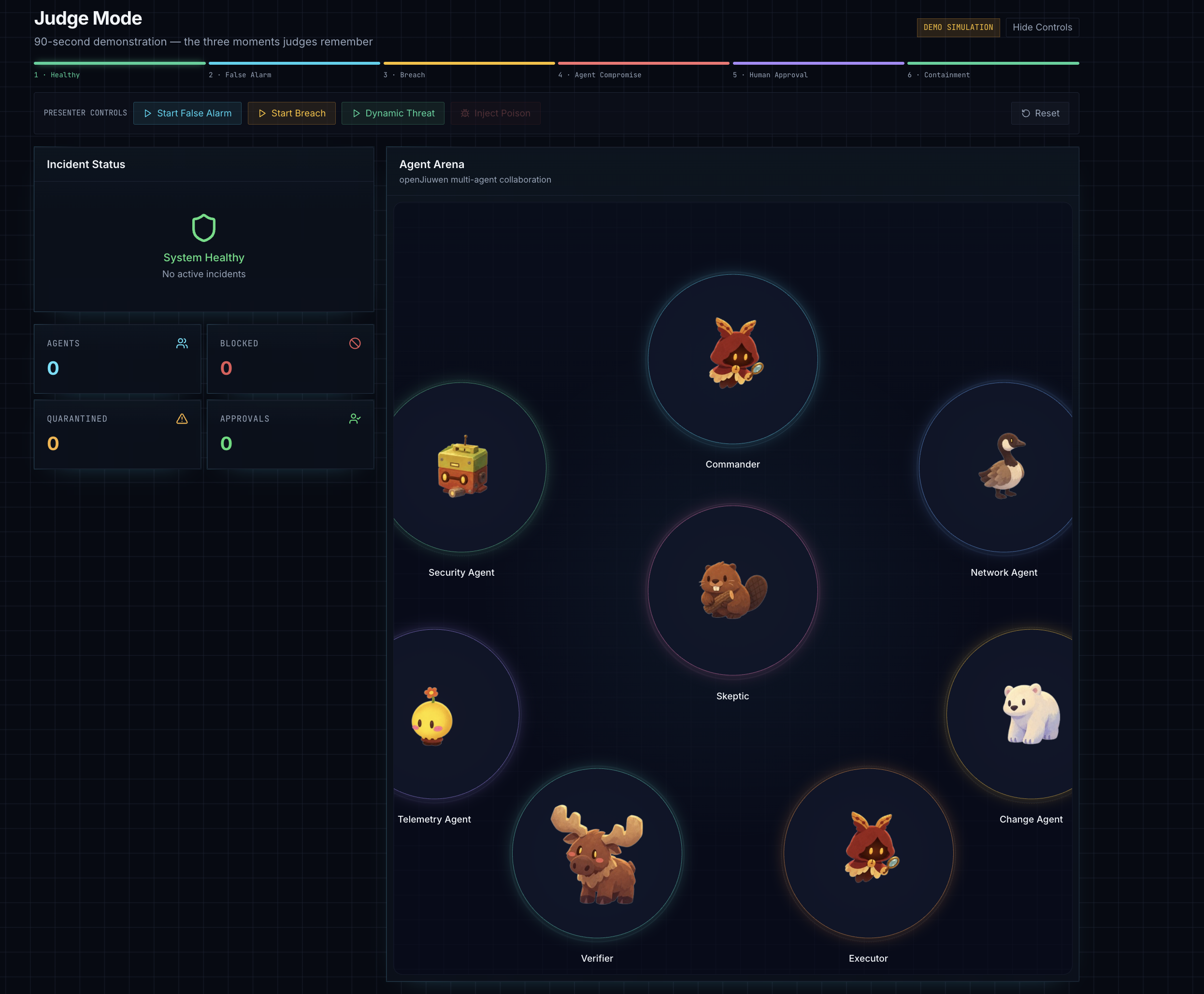
Main Page visualizing the seven ai agents
-

Hacker-made Art for the 7 Agents

AI agents are becoming capable of investigating incidents, operating infrastructure, and making decisions. But intelligence does not automatically equal authority. We built Aegishmesh to address the gap between what an AI agent can recommend and what it should be allowed to do.
Aegishmesh is a zero-trust, multi-agent security control plane. Specialized agents investigate incidents from different perspectives, challenge one another’s conclusions, and produce evidence-backed recommendations. Before any high-impact action reaches production, Aegishmesh checks the agent’s identity, permissions, evidence confidence, policy, risk, human approval, and signed execution capability.
We were inspired by real concerns around autonomous systems: a hallucinating, compromised, or prompt-injected agent should not be able to isolate a production system, disable an account, or cut power on its own. Our goal was to demonstrate that AI agents can be useful without being given unrestricted authority.
We built the project as a full-stack application with a React and Vite frontend, a Node.js backend, and optional Cloudflare Workers deployment. The local runtime uses QVAC for on-device inference with deterministic fallbacks, while the agent architecture supports Huawei openJiuwen for multi-agent task decomposition and OpenAI for evidence adjudication. Pear/Tether provides a path toward sovereign, peer-to-peer deployment, and a Raspberry Pi edge service demonstrates signed-capability enforcement using low-voltage hardware. When Aegishmesh detects something requiring outside evidence, such as a suspicious domain, CVE, vendor advisory, SOC 2 page, or zero-day, the orchestrator can call Browserbase to search public security intelligence, fetch relevant source pages, verify websites through real browser automation, including pages behind anti-bot or even Cloudflare protections. Browserspace helps us return that evidence to the local agents for synthesis.
The core experience is organized around three questions:
- What is happening? Specialist agents investigate telemetry, authentication, network activity, and system changes.
- What does the evidence support? An independent verifier compares findings, challenges assumptions, and evaluates counterfactuals.
- Are we allowed to act? Aegishmesh's policy gate enforces least privilege, risk thresholds, human approval, and one-time signed capabilities.
We learned how difficult it is to coordinate multiple agents while preserving clear responsibility boundaries. It was not enough to generate convincing responses; we needed evidence provenance, trust scores, explicit permissions, audit trails, and deterministic behavior for demos and failure cases. We also learned how important it is to label integrations honestly, distinguishing between live, simulated, local, and disconnected services.
One of our biggest challenges was designing the system so it remained useful when external providers, cloud services, or GPUs were unavailable. We addressed this with layered fallbacks: local inference first, optional cloud providers second, and deterministic rules as a final safety net. Another challenge was making high-impact actions feel realistic while keeping the hardware demonstration safe. We used short-lived, target-specific capabilities and a low-voltage Raspberry Pi setup to show how an approved action could be enforced at the edge without creating physical risk.
The result is Aegishmesh: a demonstrable foundation for governed AI automation where agents can investigate, disagree, and recommend action, while policies and humans retain control over execution.


Log in or sign up for Devpost to join the conversation.