-
-
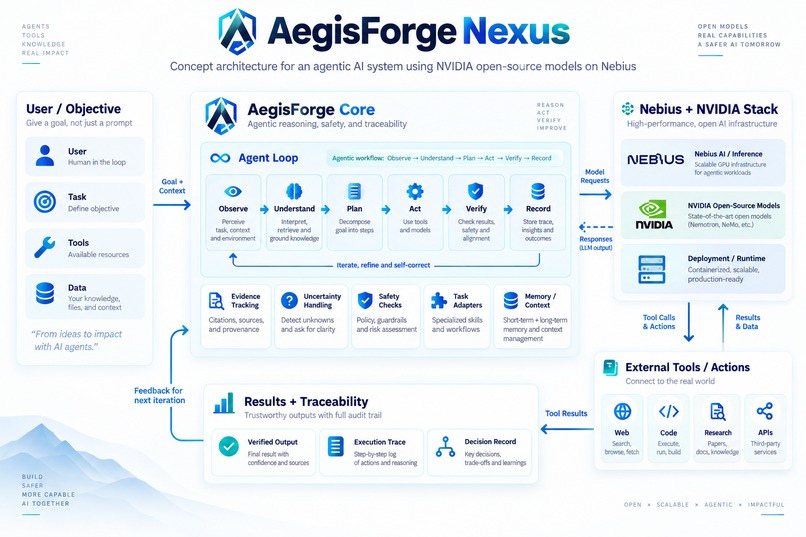
Concept architecture of AegisForge Nexus using Nebius and NVIDIA open-source models for planning, action, and verification.
Inspiration
Inspiration
AegisForge Nexus was inspired by the idea that AI agents should do more than generate answers. They should be able to understand objectives, plan multi-step tasks, use tools, track evidence, evaluate uncertainty, and verify their own outcomes.
The project builds on AegisForge, a modular agent architecture designed around planning, evidence handling, verification, safety checks, and adaptable task workflows.
For this hackathon, the goal is to extend that foundation with NVIDIA open-source models running through Nebius infrastructure and explore how reliable agentic systems can perform complex tasks with greater traceability and control.
What it does
AegisForge Nexus is an agentic AI system designed to turn a high-level objective into a structured sequence of actions.
The intended workflow is:
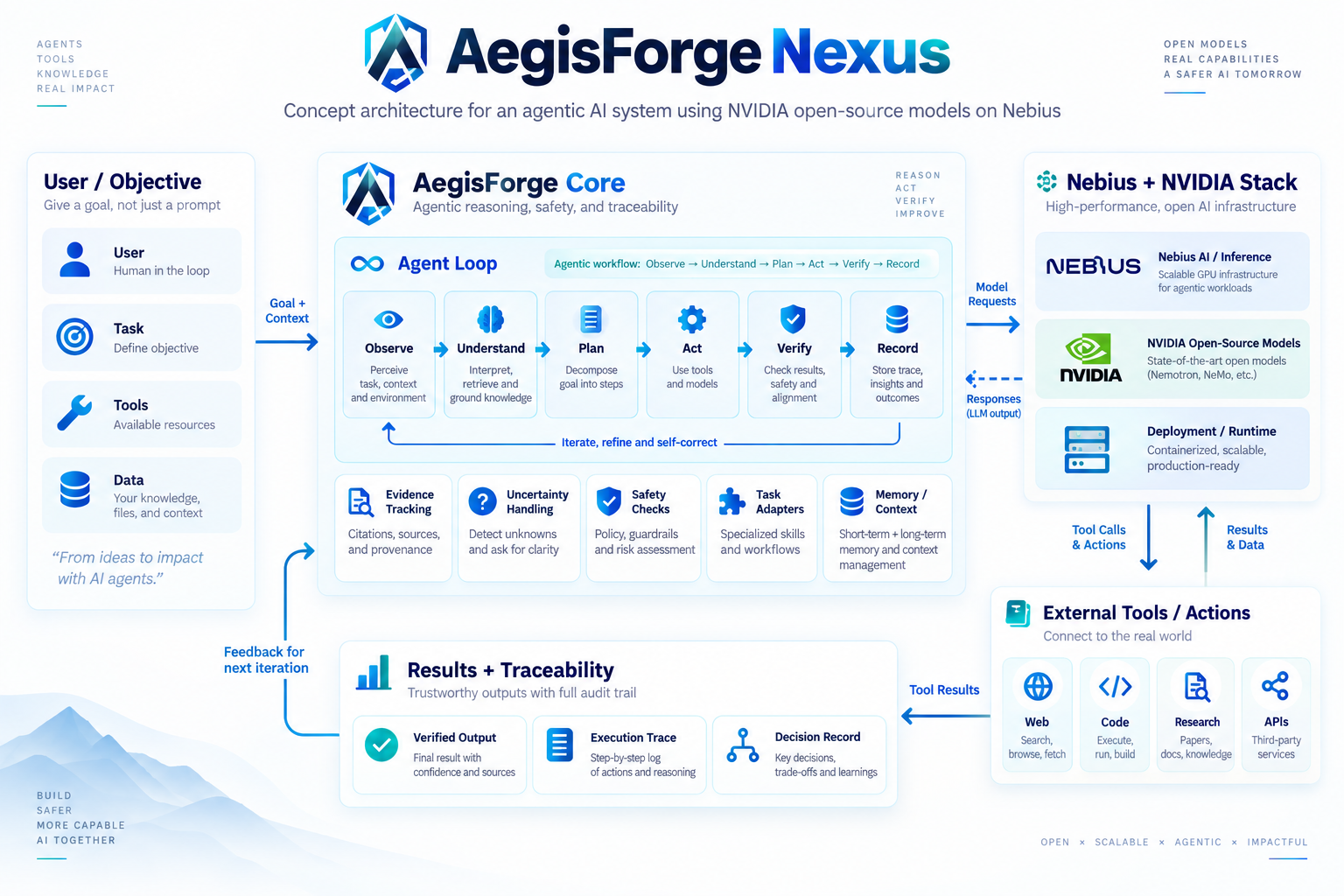
Observe → Understand → Plan → Act → Verify → Record
The system is designed to:
- break complex objectives into smaller tasks;
- select appropriate tools or capabilities;
- maintain structured evidence during execution;
- track uncertainty and intermediate results;
- verify outputs before completing a task;
- preserve a trace of how decisions were made.
Rather than treating the language model as the entire application, AegisForge Nexus uses the model as one component inside a broader reasoning and verification architecture.
How we built it
AegisForge Nexus is being developed primarily in Python.
The project builds on the existing AegisForge architecture, which provides modular components for planning, task execution, evidence tracking, verification, safety checks, and specialized adapters.
For the Nebius × NVIDIA Global AI Hackathon, we are integrating:
- Nebius infrastructure for model inference and/or deployment;
- NVIDIA open-source models as the model layer;
- a structured agent loop for planning and execution;
- evidence and verification mechanisms;
- tool and adapter interfaces for external actions.
The hackathon-specific Nebius and NVIDIA integration is currently under development and will be documented in the final repository.
Challenges we ran into
One of the main challenges is making agentic AI reliable beyond a single model response.
A useful agent needs to decide what information is relevant, determine when external tools are required, distinguish evidence from assumptions, recover from unsuccessful actions, and verify whether an objective was actually achieved.
Another challenge is connecting model inference with a modular agent architecture while keeping the execution trace understandable and reproducible.
We are also working on balancing autonomy with verification so the agent can act independently without treating uncertain information as confirmed fact.
Accomplishments that we're proud of
AegisForge already provides a working foundation for modular agent workflows, including planning, evidence handling, verification, safety-oriented checks, and support for multiple task domains.
For AegisForge Nexus, we have defined how this architecture can be connected to Nebius and NVIDIA open-source models without making the model itself responsible for the entire workflow.
This allows the hackathon project to focus on demonstrating a complete agentic loop rather than building every architectural component from scratch.
What we learned
Building reliable agents requires more than improving prompts.
Planning, evidence, uncertainty, tool execution, and verification need to be treated as separate but connected parts of the system.
We also learned that modularity makes it easier to replace models, tools, and task-specific capabilities without redesigning the whole agent.
The Nebius × NVIDIA integration is an opportunity to test this architecture with scalable model infrastructure and open-source NVIDIA models.
What's next for AegisForge Nexus
The next steps are to complete the Nebius and NVIDIA integration, implement the hackathon-specific use case, connect model inference to the full agent workflow, and evaluate the system on real multi-step tasks.
We also plan to add measurable evaluation, failure-case testing, reproducible setup instructions, a public demonstration, and a documented open-source repository for the final submission.
Built With
- ai-agents
- artificial-intelligence
- fastapi
- llms
- nebius-ai-cloud
- python

Log in or sign up for Devpost to join the conversation.