-
-
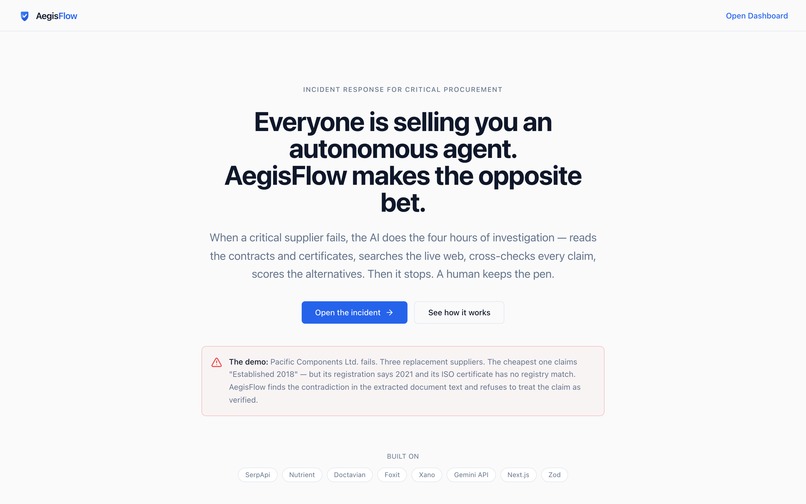
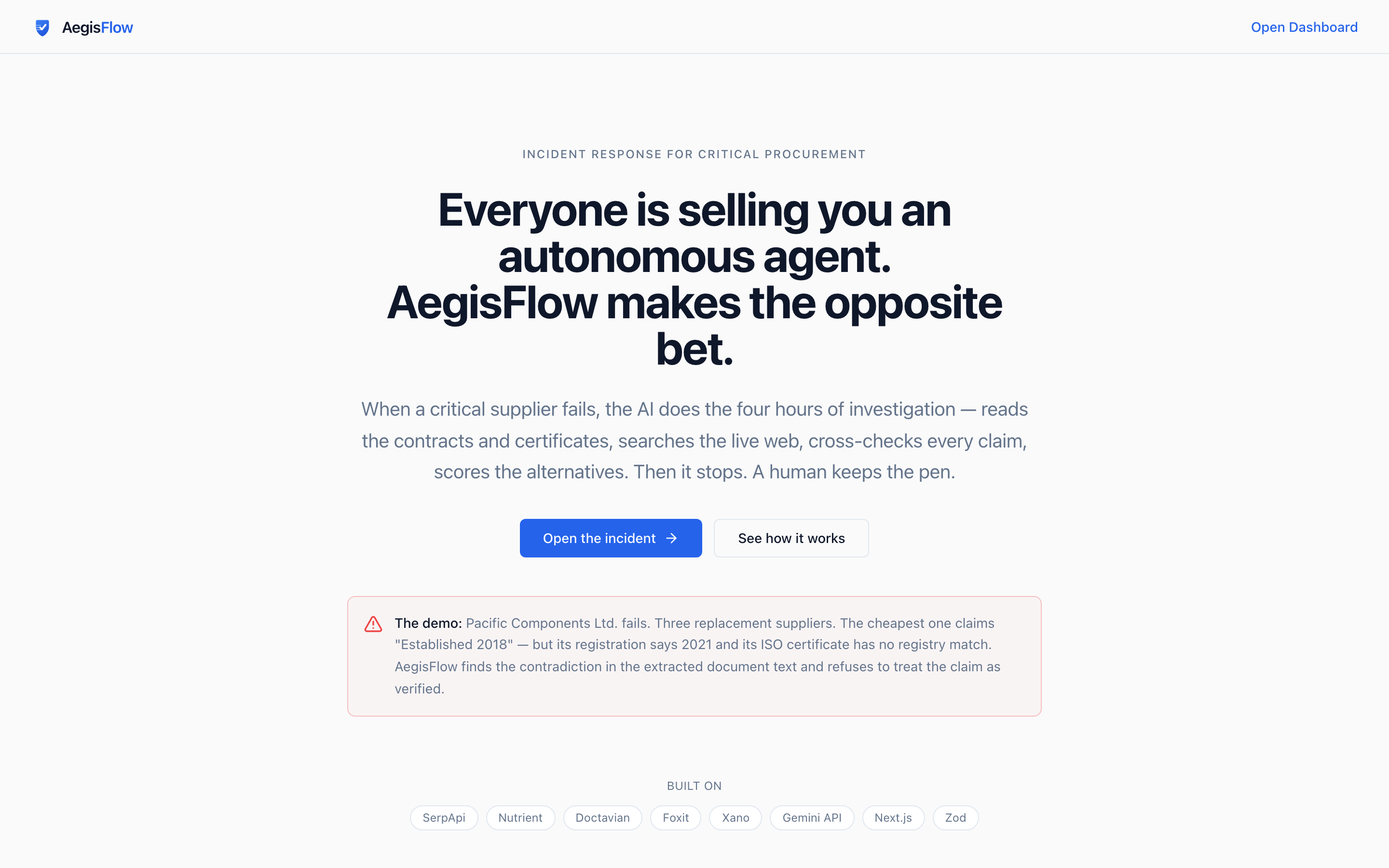
The bet, stated up front: the AI does the whole investigation, then stops at a human. Approve and sign are never the agent's to take.
-
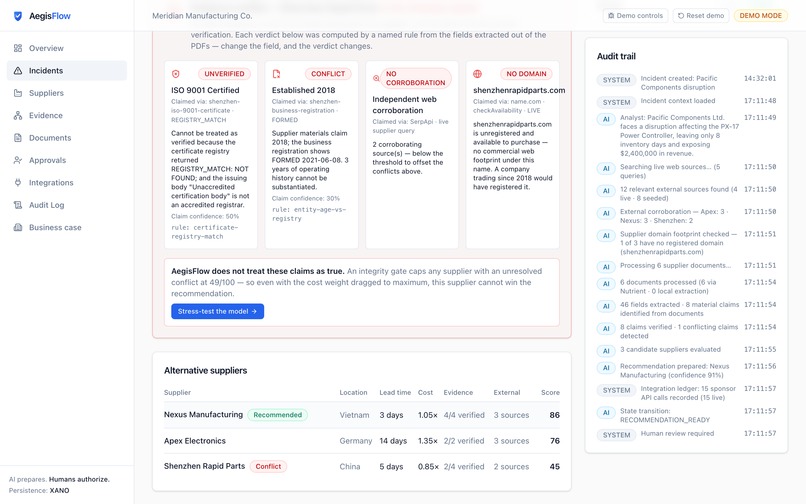
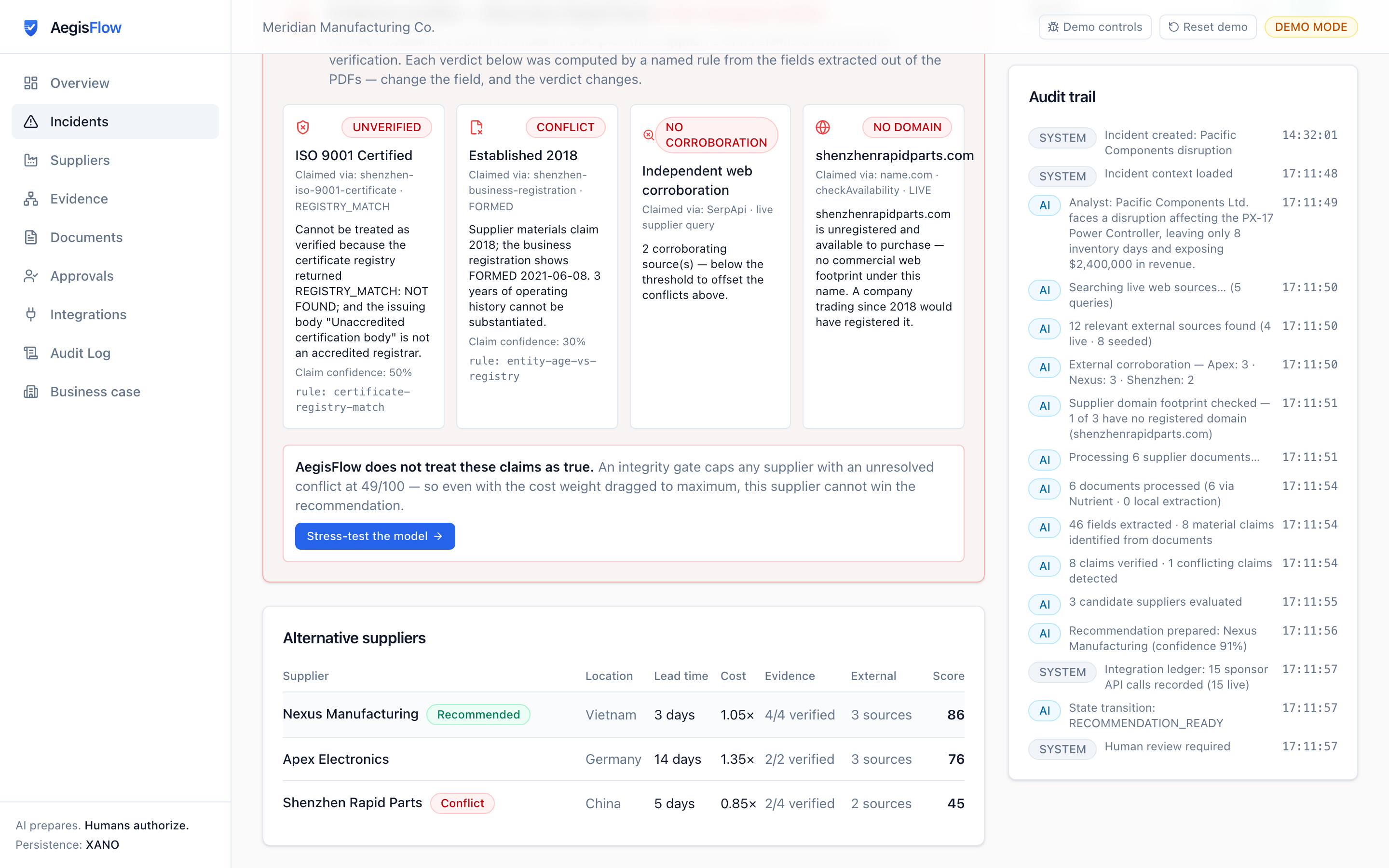
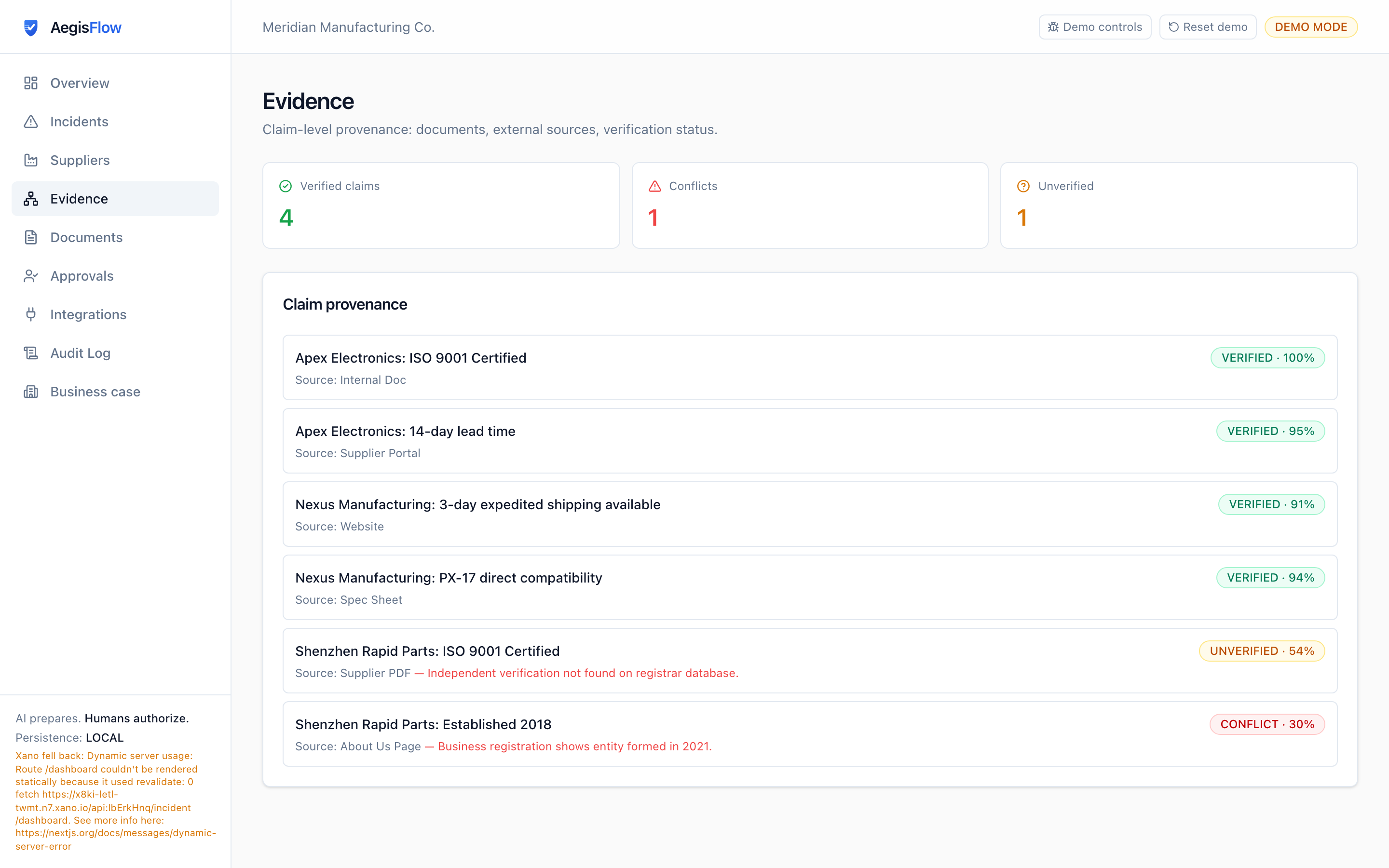
Four independent systems disagree with the cheapest supplier — registration, certificate, web, domain. Each verdict names its rule.
-
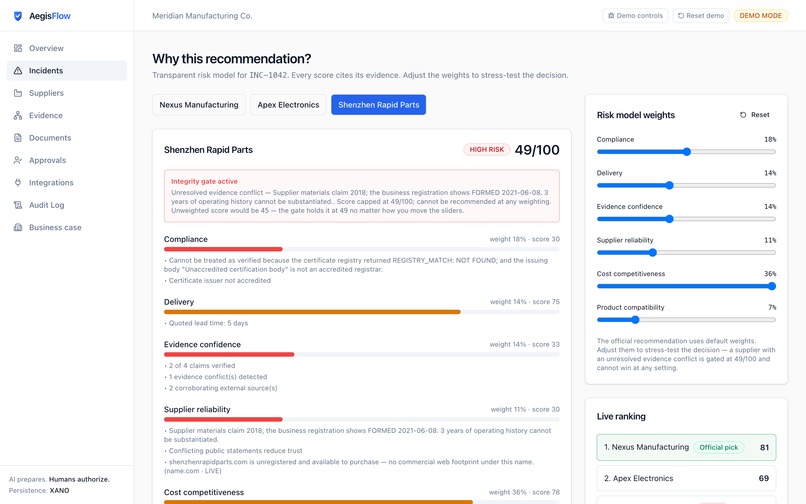
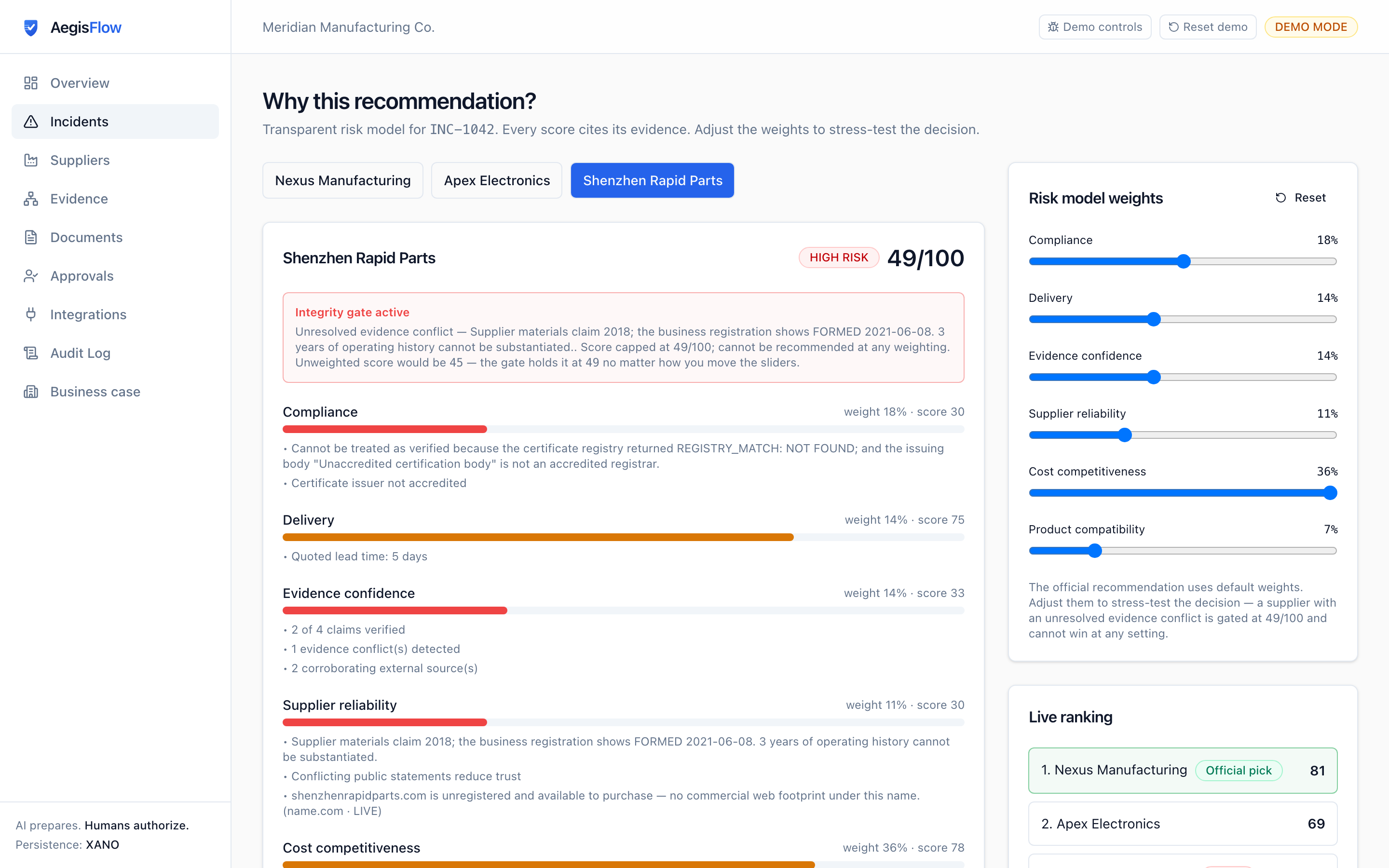
Cost weight at 36%. The conflicted supplier still caps at 49/100 — an integrity gate means you cannot weight your way to a bad call.
-
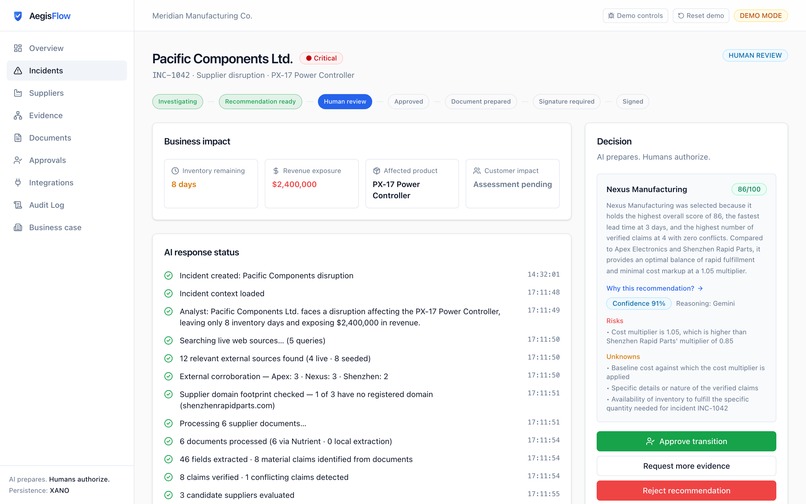
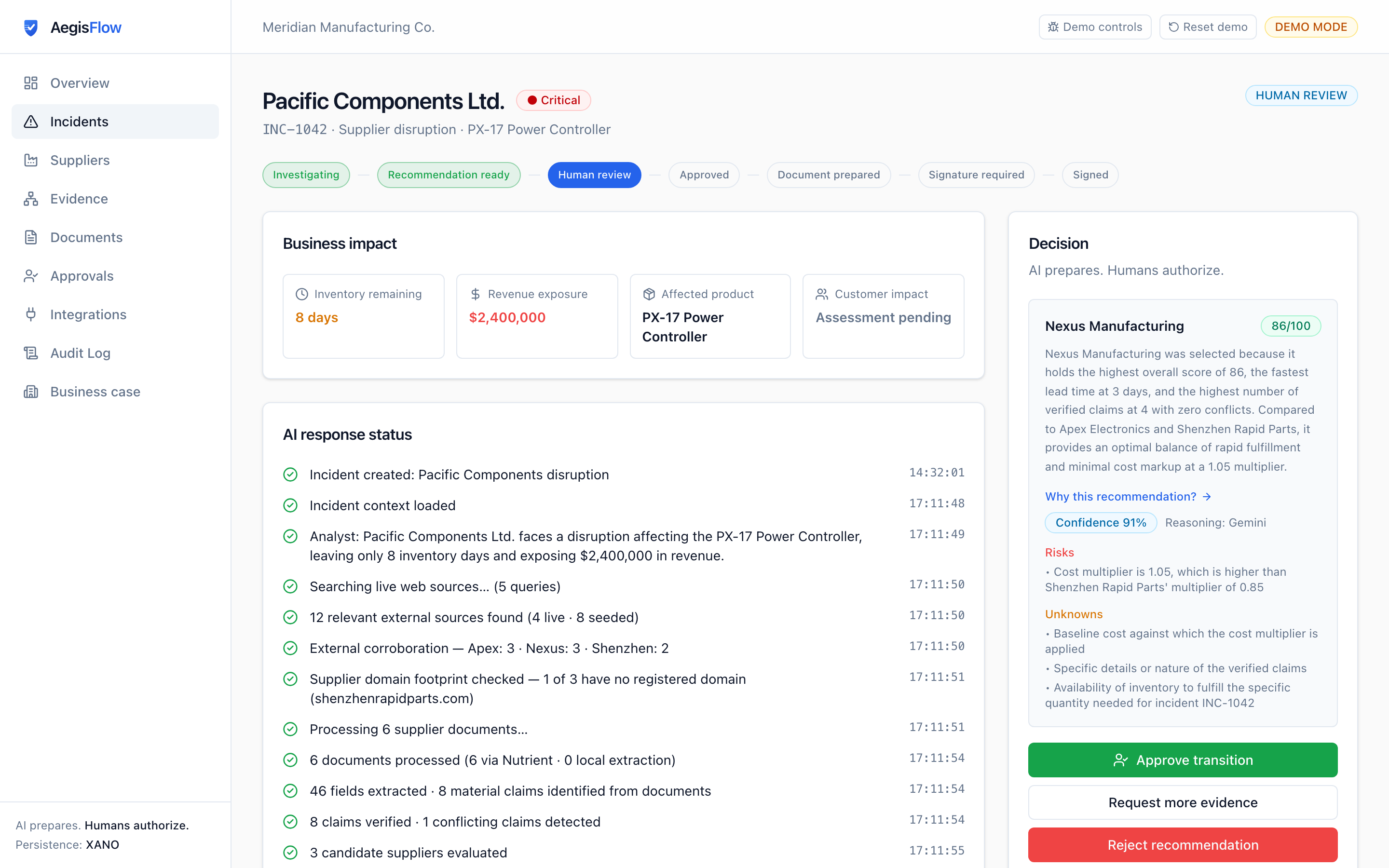
INC-1042: supplier down, 8 days of inventory, $2.4M exposed. Six agents run live sponsor APIs and stream findings into one case file.
-
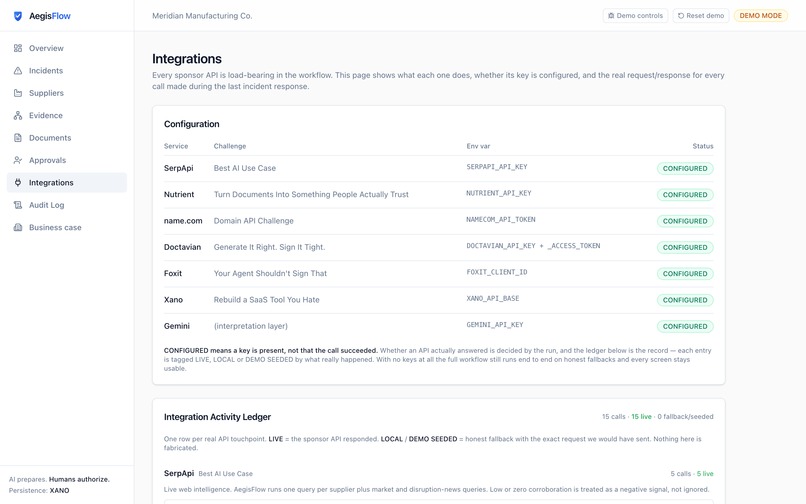
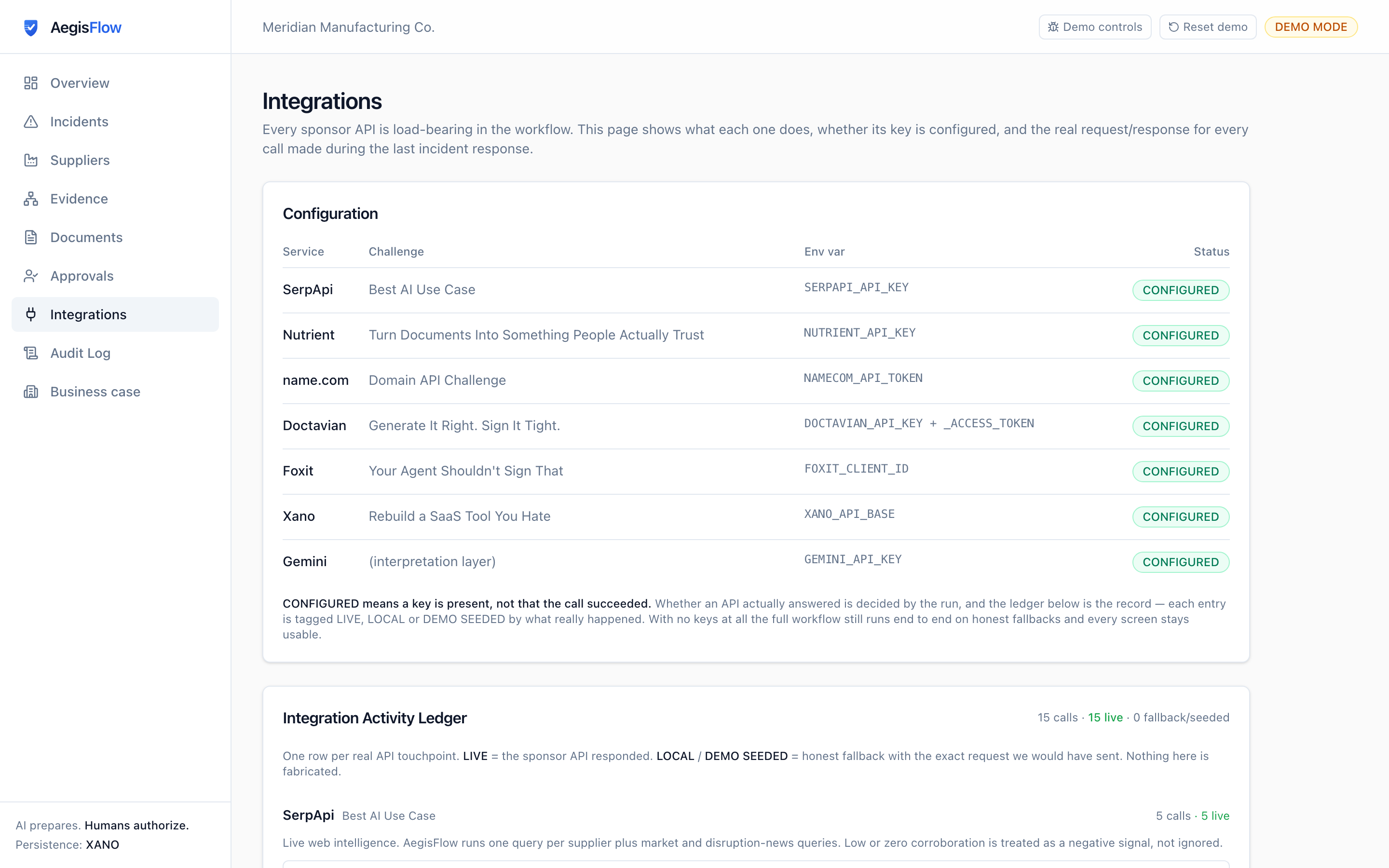
Every sponsor API call on the record with its real request and response, tagged LIVE, LOCAL or DEMO SEEDED. Nothing here is fabricated.
-
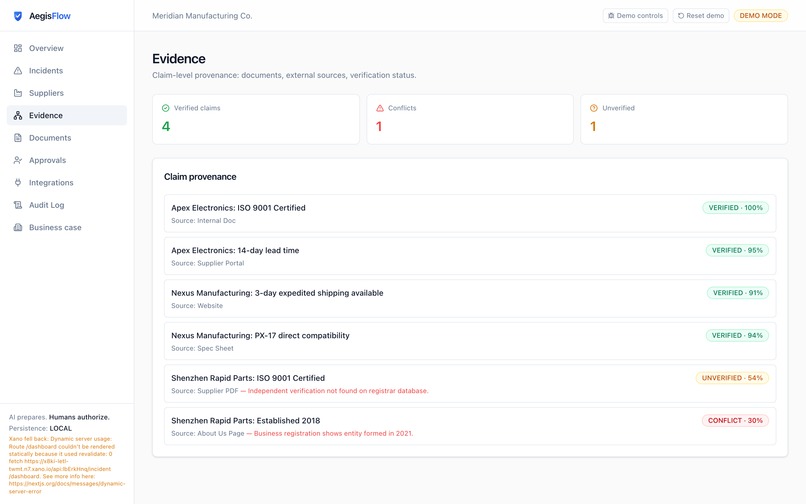
Claim-level provenance: every fact links back to the extracted document and field it came from, and the rule that judged it.
-
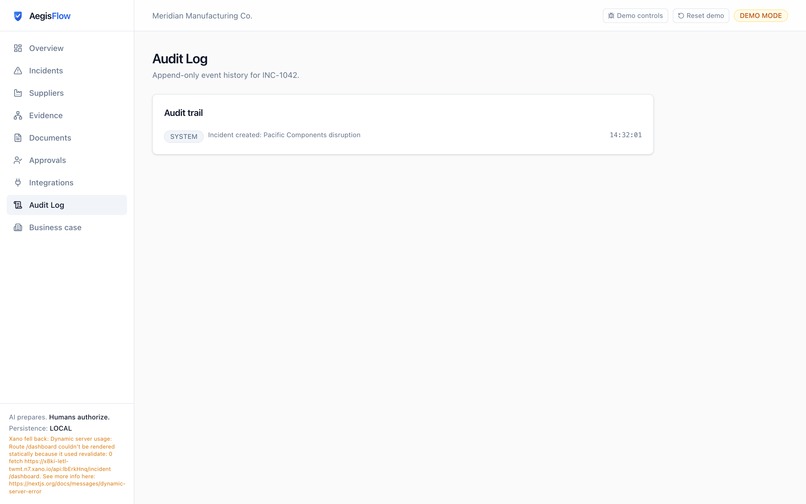
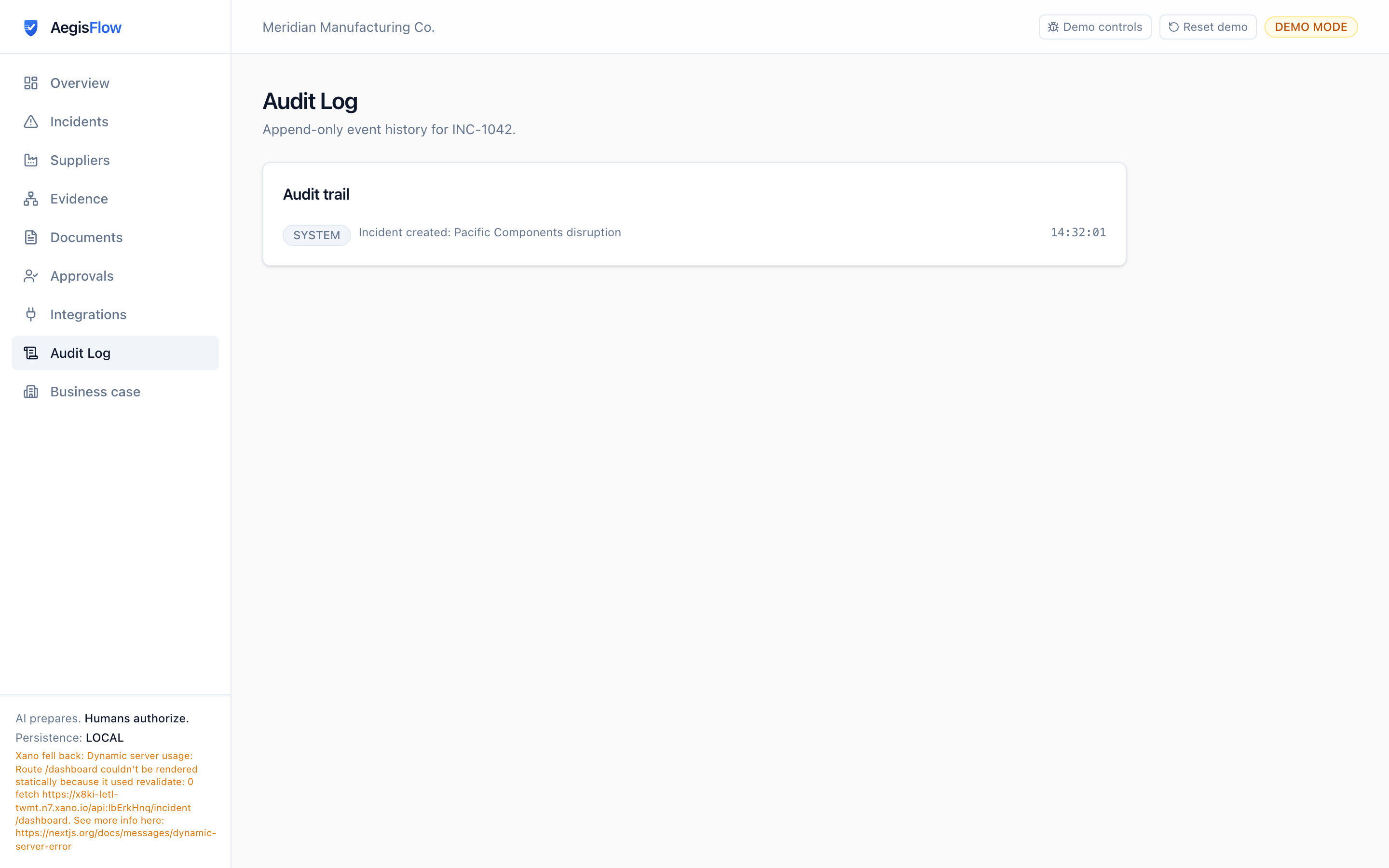
Append-only audit trail in Xano. Every transition carries its actor — SYSTEM, AI or HUMAN — and the human-only moves are enforced.
-
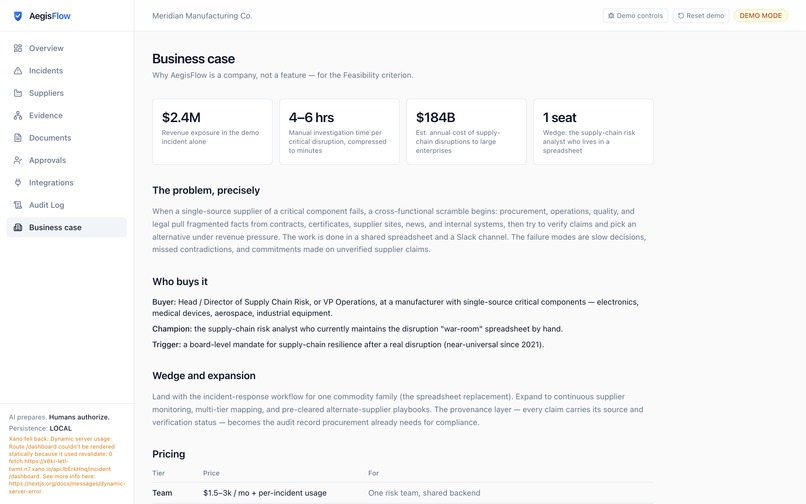
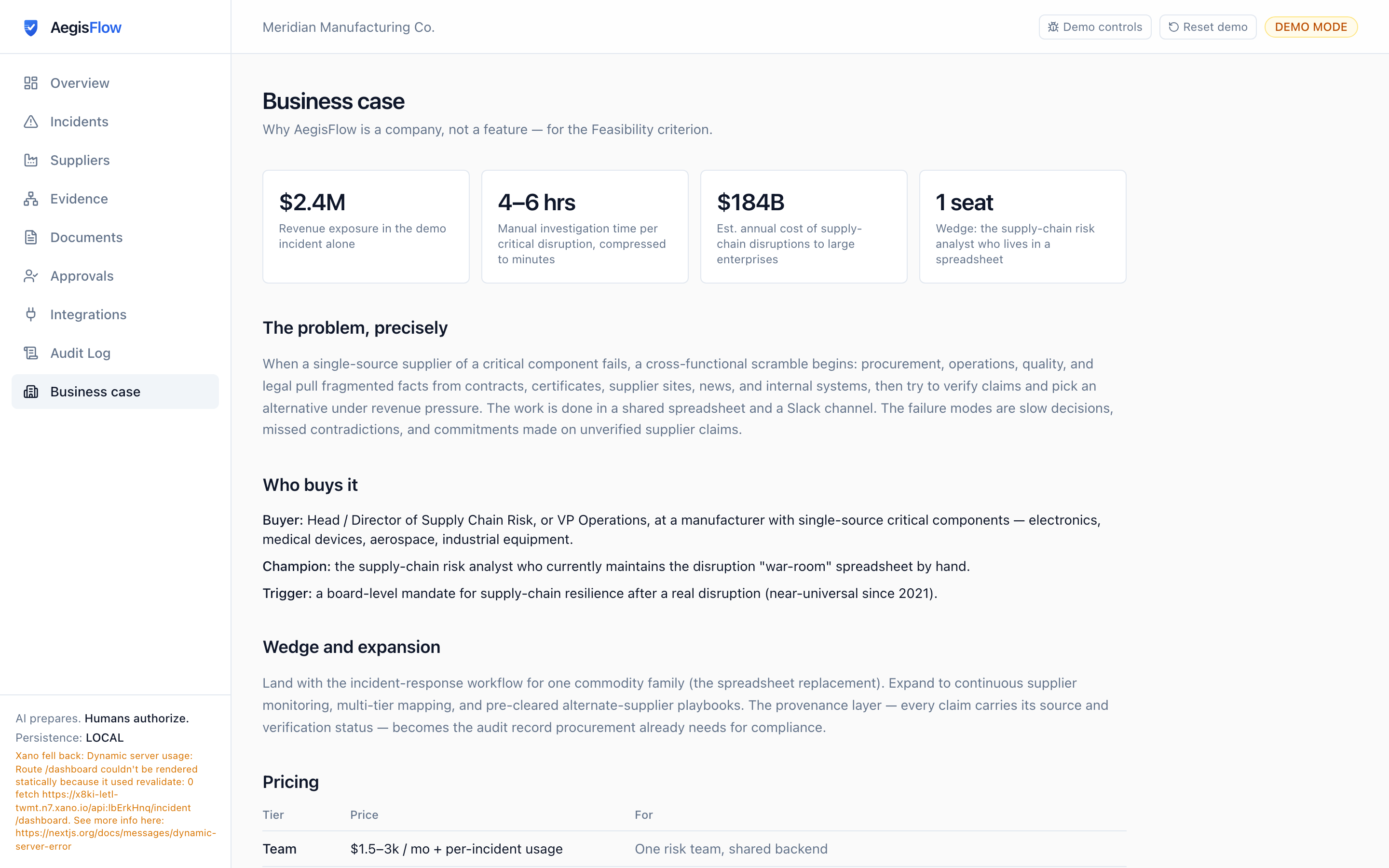
Why it is a company, not a feature: the buyer, the wedge, the pricing, and the arithmetic a Head of Supply-Chain Risk actually runs.
The problem
When a single-source supplier of a critical component fails, a cross-functional scramble begins. Procurement, operations, quality and legal pull fragmented facts out of contracts, certificates, supplier websites, news and internal systems, try to verify what the supplier claims, and pick an alternative — in a shared spreadsheet, under revenue pressure. The failure modes are slow decisions, missed contradictions, and commitments made on unverified claims. One missed eight-day stockout on a $2.4M line dwarfs any software budget.
The bet
Every vendor is selling an autonomous procurement agent. Nobody in a regulated supply chain will let one commit spend.
AegisFlow makes the opposite bet. The AI runs the entire investigation — reads the documents, searches the live web, checks whether each supplier owns the domain it trades under, cross-checks every claim, scores the alternatives — and then stops. Approve, reject and sign are reserved for a human, enforced by a finite state machine and a named guard, not by a prompt.
What it does
Open INC-1042 and press Run Response:
- Analyst frames the disruption (Gemini).
- Web intelligence runs five live SerpApi queries. A query returning zero results is a first-class outcome, scored as absence of corroboration.
- Domain footprint asks name.com whether each supplier's domain is still purchasable. A manufacturer trading since 2018 registered its domain; one whose domain is still for sale has no commercial footprint.
- Document intelligence extracts fields from six supplier PDFs via Nutrient DWS.
- Verification runs named rules over those fields.
- Risk engine scores six transparent dimensions, each citing its evidence.
- Decision produces a recommendation with confidence, risks and unknowns.
Then it stops. On human approval: Doctavian generates the Emergency Supplier Transition Agreement from the structured decision payload, Nutrient stamps it PENDING HUMAN SIGNATURE, and Foxit creates the eSign folder — only after a named guard passes.
The golden scenario
Pacific Components Ltd. fails. The PX-17 Power Controller is at risk: 8 days of inventory, $2.4M exposure. Three alternatives. The cheapest, Shenzhen Rapid Parts at 0.85× baseline, claims "Established 2018".
Four independent systems disagree:
| Source | Finding |
|---|---|
| Business registration (Nutrient) | FORMED: 2021-06-08 — not 2018 |
| ISO 9001 certificate (Nutrient) | REGISTRY_MATCH: NOT FOUND, issuer unaccredited |
| Live web (SerpApi) | almost no independent corroboration |
| Domain system (name.com) | shenzhenrapidparts.com is unregistered and for sale |
A supplier can forge a PDF. Getting all four to agree is much harder.
The part I care about most: the verdicts are computed, not scripted
It would have been easy — and dishonest — to hardcode "this document is the conflicted one". The verification rules match on document type and then read fields:
entity-age-vs-registrycompares the founding year a supplier claims publicly against theFORMEDdate on its own registration.certificate-registry-matchreads the registry match, the issuer's accreditation and the expiry date, independently.product-equivalencechecks the datasheet names the part actually at risk.
No rule mentions a filename. Change FORMED to 2018 and the conflict disappears on the next run. tests/rules.test.ts pins exactly that: same code, mutated fields, different verdicts.
You cannot weight your way to a bad supplier
The risk model is fully transparent and live-adjustable. Drag the cost weight to maximum — the setting that should favour the cheapest supplier — and it still loses. A supplier carrying an unresolved evidence conflict is capped at INTEGRITY_CAP = 49 at any weighting, and the pre-gate score is shown alongside the capped one so the gate is visible rather than hidden.
Your agent shouldn't sign that
Foxit drew this line first: their MCP server exposes ~40 reversible PDF operations as agent tools, and signing is deliberately not one of them. AegisFlow turns that API-design opinion into an enforced property of the application. lib/state/agent-tools.ts registers every document operation with a risk class (REVERSIBLE / IRREVERSIBLE) and the actors allowed to invoke it. esign.createFolder is the only irreversible entry: HUMAN-only, valid from exactly one state. tests/agent-tools.test.ts enumerates every actor × every workflow state and asserts no non-human combination can reach it.
Honesty as a feature
Every sponsor API call — live, local fallback, or seeded — lands in an open Integration Activity Ledger with its real request and response, tagged LIVE, LOCAL or DEMO SEEDED. The configuration table says CONFIGURED, not LIVE, because a key being present is not proof a call succeeded — the ledger is the record. The whole workflow runs end to end with zero keys, on honest fallbacks.
What I learned
Most of the hard problems were not the AI.
Extractors are not interchangeable. Nutrient DWS drops underscores from field names depending on glyph spacing — inconsistently, keeping REGISTRY_MATCH on one certificate while producing VALIDUNTIL and ABOUTPAGECLAIM on another. Going live silently dropped the founding-year conflict, the demo's entire point. Field lookup is now normalisation-tolerant, with a regression test built from DWS's verbatim output.
Serverless breaks background work. Writes went through a paced queue so a rate-limited write never blocked a render — correct on a long-lived server, wrong on Vercel, where the function freezes the moment the response closes. Runs streamed perfectly and persisted nothing.
A silent no-op is worse than an error. The write carrying a run did
if (!row) return; on an empty read — reporting success while discarding everything. It now throws.
Rate limits force you to decide what matters. Xano's free tier is 10 requests per 20 seconds; a run was making triple that, mostly audit rows, starving the one write that carried the result. The audit stream now rides with the evidence in a single request.
Two products can share a name. Foxit ships eSign standalone (OAuth2, own keys) and on the unified platform (header auth, shared keys). I applied the wrong one's docs and concluded the credentials were wrong. They were fine.
What's next
Continuous supplier monitoring rather than incident-triggered investigation; pre-cleared alternate supplier playbooks; and pushing the verification rules from a curated set toward something a risk team can author themselves.
Built With
- doctavian
- finite-state-machine
- foxit-esign
- google-gemini
- name.com
- next.js
- node.js
- nutrient-dws
- playwright
- react
- serpapi
- server-sent-events
- tailwindcss
- typescript
- vercel
- vitest
- xano
- zod


Log in or sign up for Devpost to join the conversation.