Inspiration
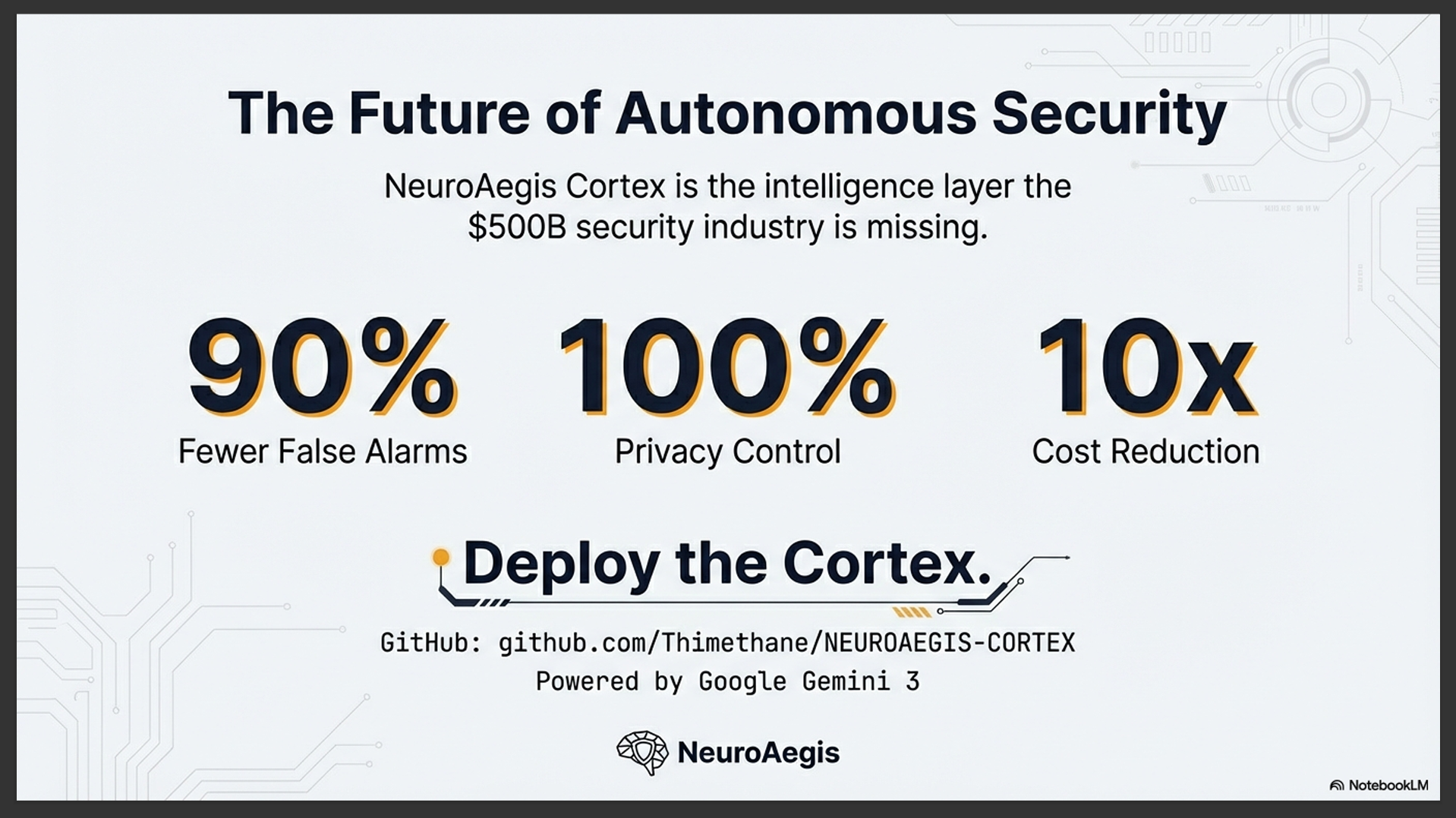
It started with a simple observation: my security camera was "crying wolf." Like millions of others, I was drowning in notifications for cats, swaying trees, and passing shadows. I realized that the $500B security industry is suffering from Contextual Blindness. Current systems equate raw motion with a threat, leading to "alert fatigue"—where we eventually stop looking at our phones, potentially missing the one time it actually matters. I wanted to build something that didn't just see pixels, but understood intent.
What it does
NeuroAegis Cortex is the "Eyes and the Brain" of next-generation security. It is an Intent-Based Autonomous Intelligence system that doesn't just record video; it thinks about it. Using Google Gemini 3 Pro, it distinguishes a neighbor from an intruder by analyzing behavioral patterns. It can identify a masked subject loitering near a window with 92% confidence and—instead of just sending a push notification—it autonomously executes a response plan: locking doors, flashing red strobes, and preparing 911 dispatch protocols.
How we built it
The core of the project is a Dual-Agent Architecture. I built a pipeline where a local Docker-containerized feed acts as "The Eyes," sending semantic visual data to a "Planner Agent" (The Brain). I leveraged the 2-million-token context window of Gemini 3 Pro to give the system a short-term memory of the last 10 frames. This allows the AI to perform Chain-of-Thought reasoning, explaining why it thinks an action is hostile. The dashboard was built to provide a unified command center, showing real-time system health and live threat analysis.
Challenges we ran into
The biggest hurdle was the "Intelligence Trade-off." Deep reasoning takes time, and in security, every second counts. Initially, the latency was too high for real-time deterrence. I had to optimize the flow by implementing Gemini 3 Flash for the production layer, which brought our response time down to a staggering 1.2 seconds. I also had to solve the "Privacy Paradox"—using powerful cloud-based LLMs while ensuring that sensitive home video data remains secure and self-hosted.
Accomplishments that we're proud of
I am incredibly proud of the 90% reduction in false alarms we achieved. Seeing the system ignore a stray cat but immediately flag a masked intruder—and then provide a written explanation of its reasoning—was a "eureka" moment. We also managed to make enterprise-grade security affordable, bringing the cost down to just $0.001 per analyzed frame.
What we learned
This project taught me that Temporal Awareness is the missing link in AI security. I learned that identifying a "person" is a solved problem, but identifying "hostility" requires understanding time and context. I also deepened my expertise in multimodal prompt engineering, learning how to translate raw video streams into structured JSON data that can trigger physical IoT devices in the real world.
What's next for NeuroAegis Cortex
The roadmap for NeuroAegis is focused on bridging the gap between digital intelligence and physical action. My next immediate priority is IoT Integration—connecting the Cortex’s reasoning engine to physical hardware via MQTT and Home Assistant to enable autonomous door locking and active deterrence. Following that, I plan to move the system to Full Edge Deployment on NVIDIA Jetson hardware to ensure the system remains functional even without an internet connection, followed by Multi-Camera Correlation for enterprise-scale security."

Log in or sign up for Devpost to join the conversation.