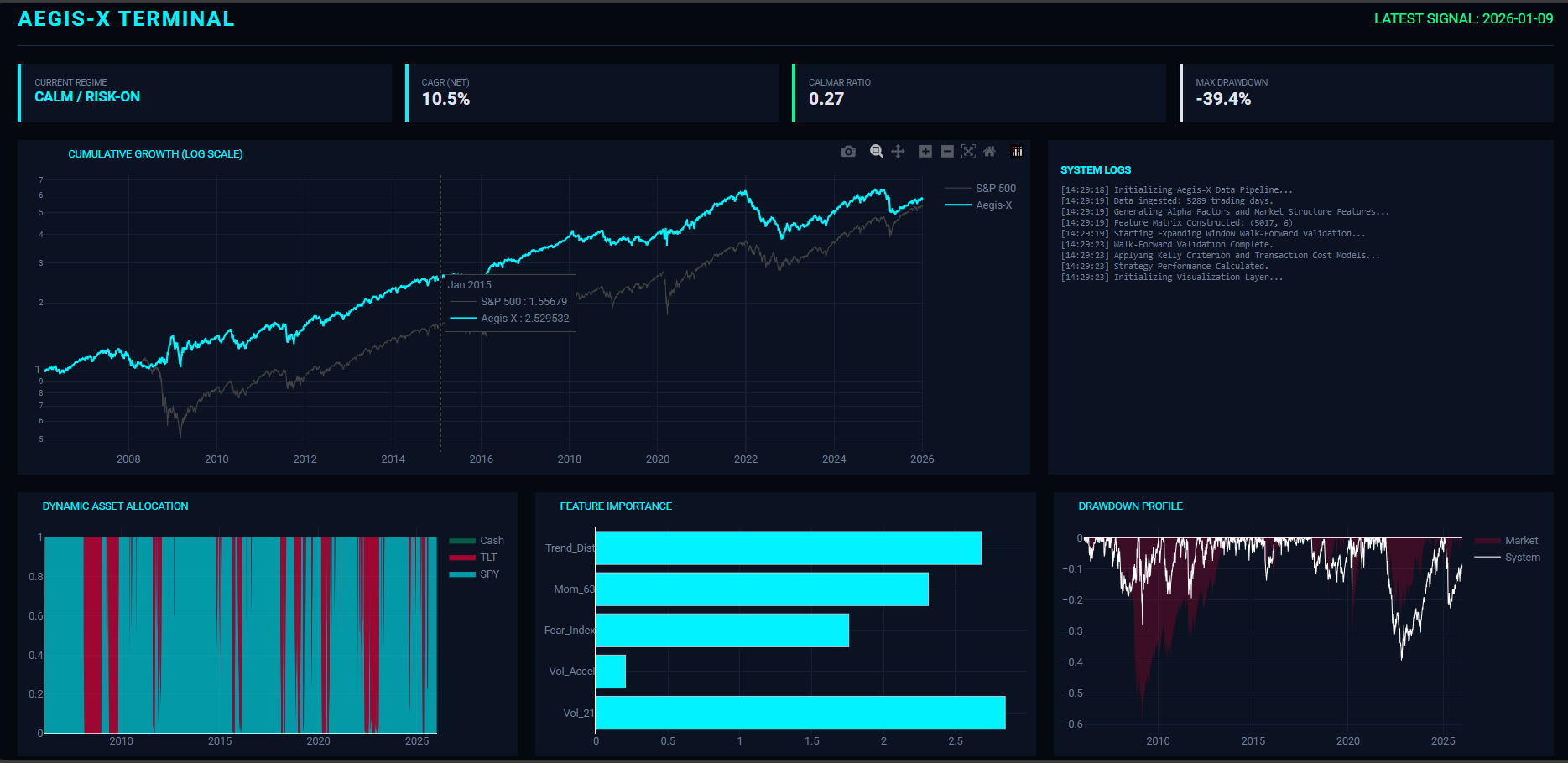
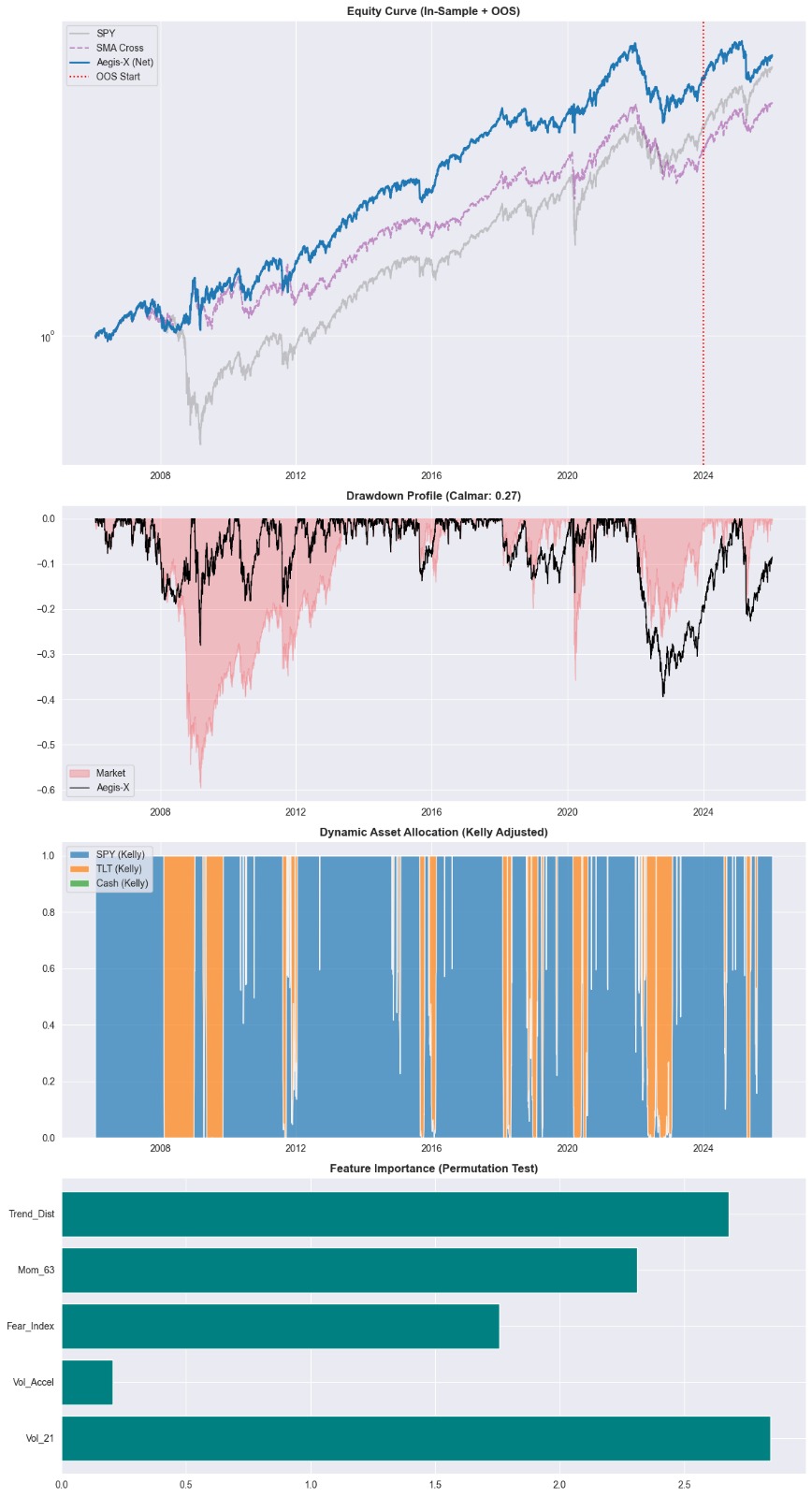
About the Project
Why Aegis-X Exists
Most trading systems fail for a simple reason: they assume markets behave the same way all the time. In reality, markets move through distinct regimes — calm, stressed, and transitional — and strategies that ignore this reality suffer large drawdowns during crises.
Aegis-X was built with a different mindset. Instead of asking “Where will price go next?”, it asks:
“Is this a safe environment to deploy capital?”
The goal is not aggressive profit maximization, but capital survival, drawdown control, and long-term robustness — the same priorities used by professional risk managers.
What the System Does
Aegis-X is a risk-first, regime-adaptive trading system for U.S. markets.
Rather than predicting prices, it uses unsupervised machine learning to detect the current market regime and dynamically adjust exposure.
- In constructive regimes, capital is allocated to Equities (SPY)
- In stress regimes, exposure is reduced or rotated into Defensive assets (TLT / Cash)
This allows the system to step aside during periods of elevated risk instead of riding market crashes.
Core Intelligence (Regime Detection)
The system uses a Gaussian Mixture Model (GMM) to cluster market behavior into latent regimes using structurally meaningful features:
- Realized volatility (21-day, annualized)
- Volatility acceleration
- Medium-term momentum (63-day)
- Distance from long-term trend (SMA-200)
Volatility is computed as:
$$ \sigma_{21} = \sqrt{252} \cdot \mathrm{StdDev}(r_{t-21:t}) $$
The cluster with higher average volatility is deterministically labeled as the Stress Regime, ensuring interpretability and auditability.
How Decisions Are Made (No Black Box)
Instead of binary signals, Aegis-X uses probabilistic confidence:
- The GMM outputs regime probabilities
- Probabilities are smoothed using a persistence filter
- Asset allocation is adjusted continuously, not abruptly
Example (simplified):
if prob_stress > threshold:
    allocate_to = "TLT"
else:
    allocate_to = "SPY"
This reduces over-trading and prevents reaction to short-term noise.
Risk Management & Execution Discipline
The system enforces strict safety constraints:
- No leverage
- Kelly Criterion-based exposure scaling (with conservative caps)
- Volatility-adjusted transaction costs
- One-day execution lag to avoid look-ahead bias
Performance is evaluated using drawdowns, Calmar ratio, and crisis behavior, not just raw returns.
Validation Integrity
To ensure correctness:
- An expanding-window walk-forward backtest is used
- Models are retrained using only historical data available at the time
- A true out-of-sample holdout is preserved
This prevents accidental future leakage — a common flaw in many trading demos.
What Makes This Different
- Focuses on risk control, not prediction hype
- Uses simple, explainable models instead of opaque deep learning
- Explicitly documents limitations (e.g., stock-bond correlation breakdowns)
- Designed with live deployment discipline in mind
Aegis-X is not a trading bot — it is a decision framework built to survive real markets.
Built With
- language:-python-libraries:-pandas
- matplotlib-data:-historical-u.s.-market-data-(spy
- numpy
- risk-based
- scikit-learn
- tlt)-methods:-unsupervised-learning
- walk-forward-validation


Log in or sign up for Devpost to join the conversation.