-
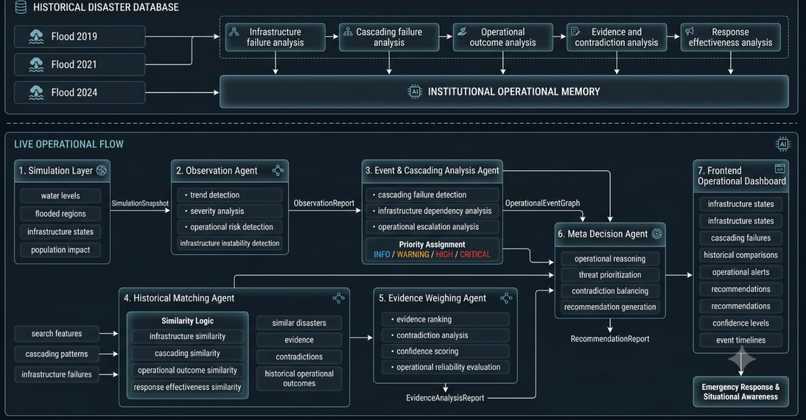
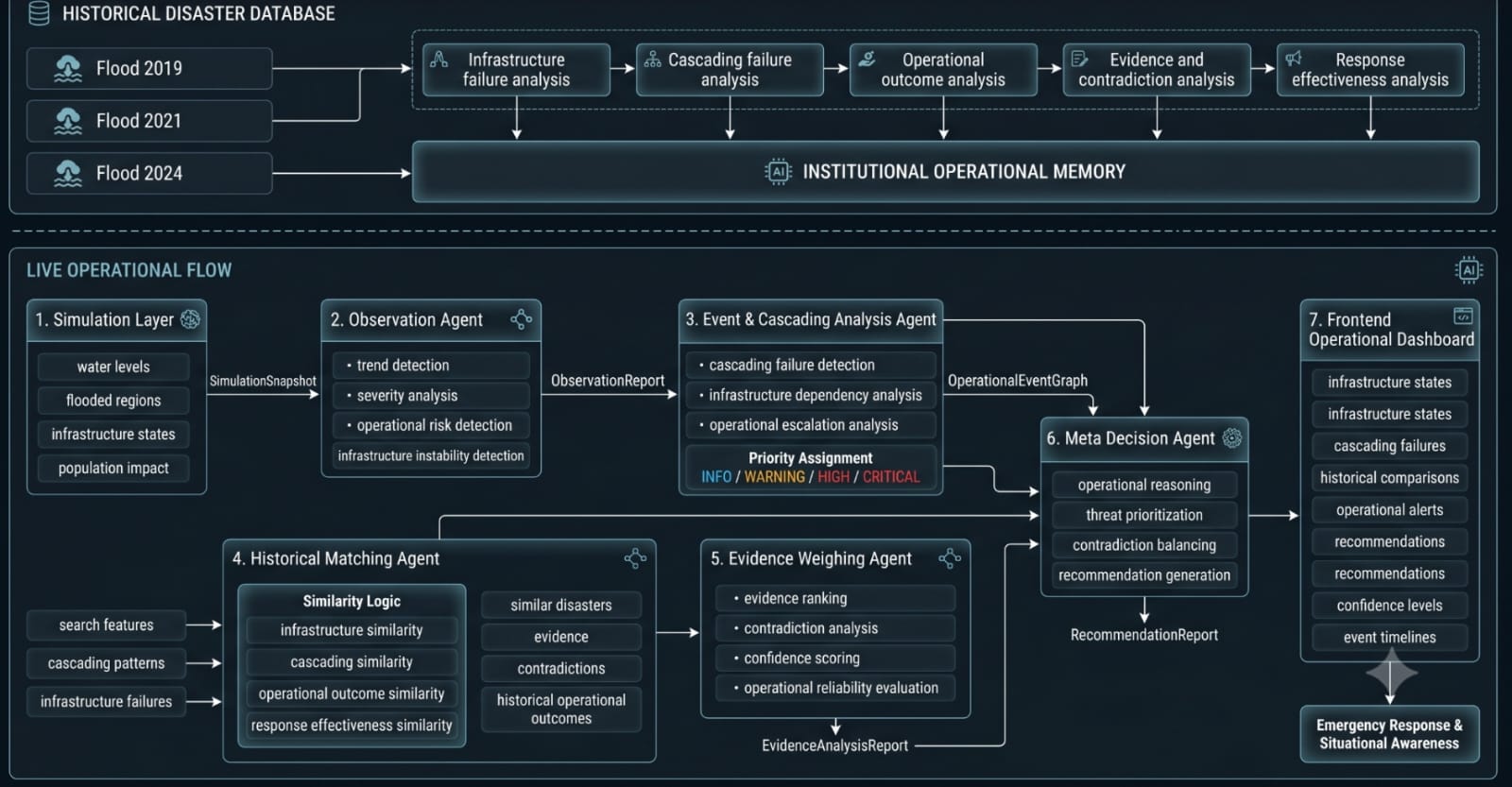
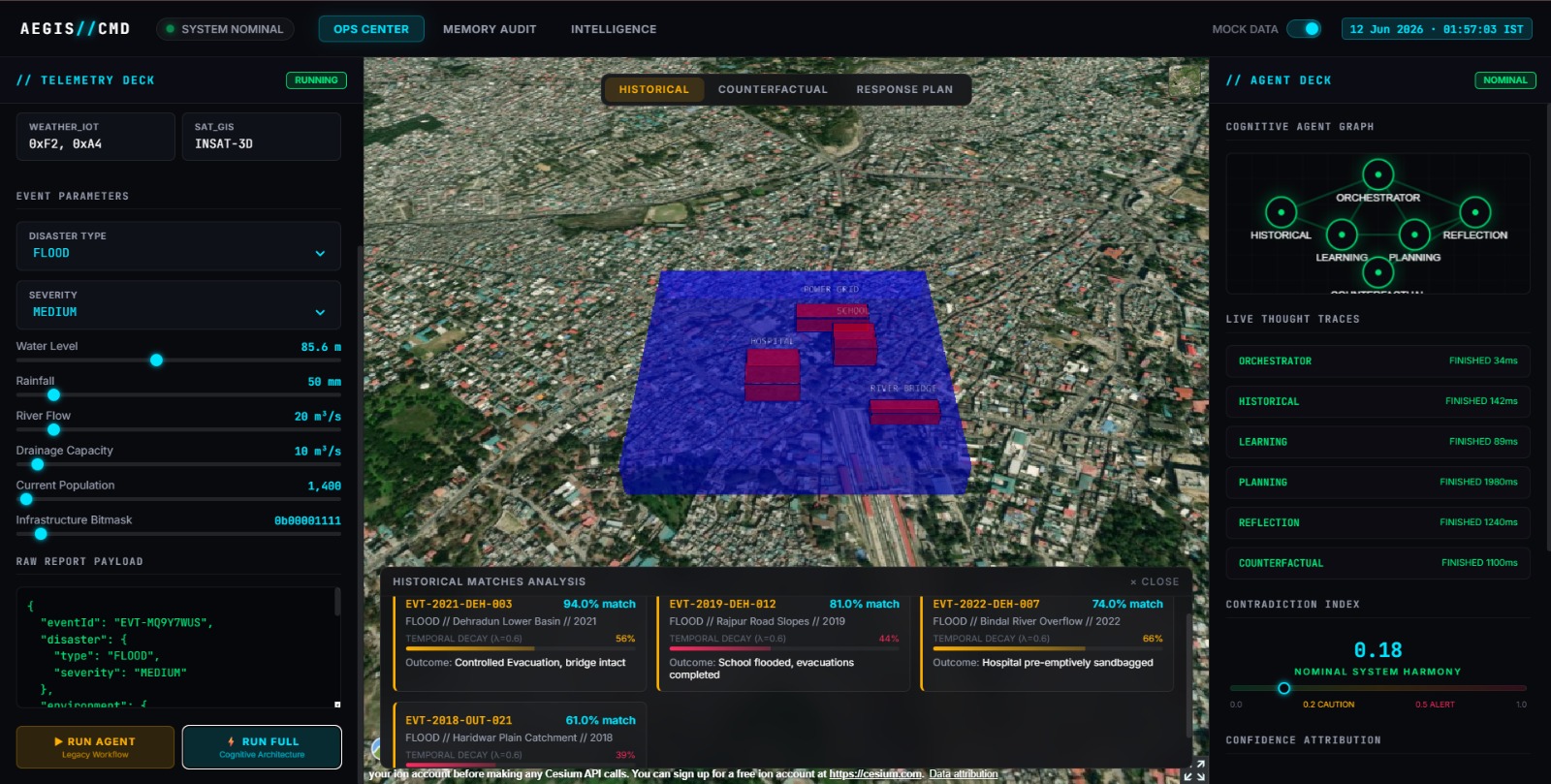
Architectural flow of data in of AEGIS
-
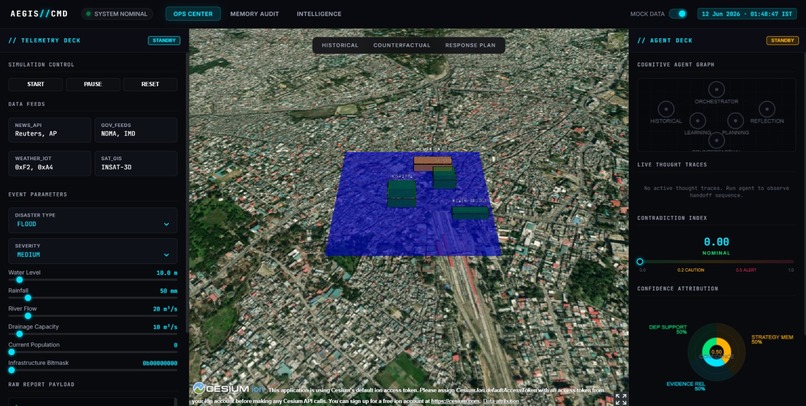
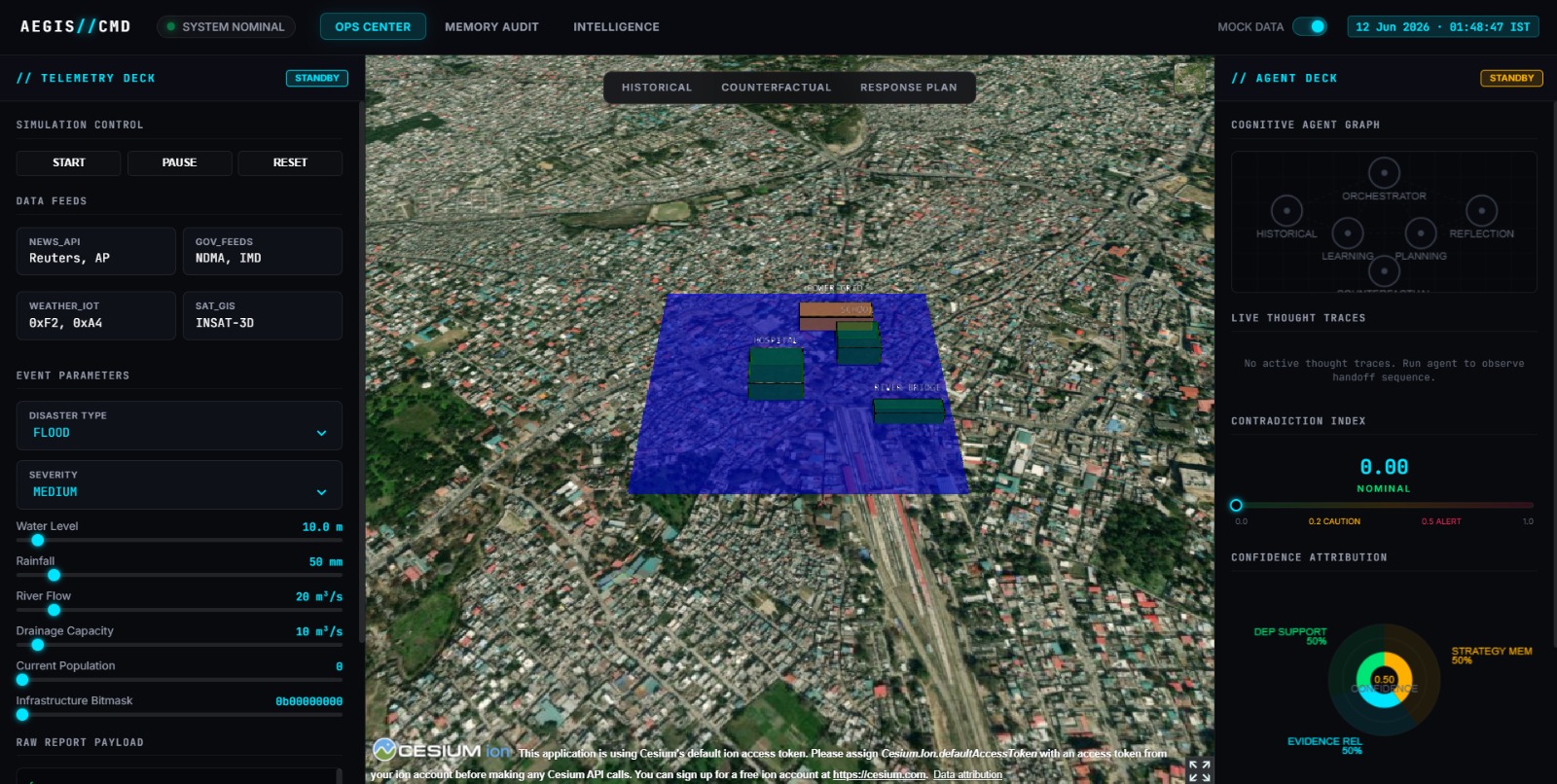
Initial setup of simulation
-
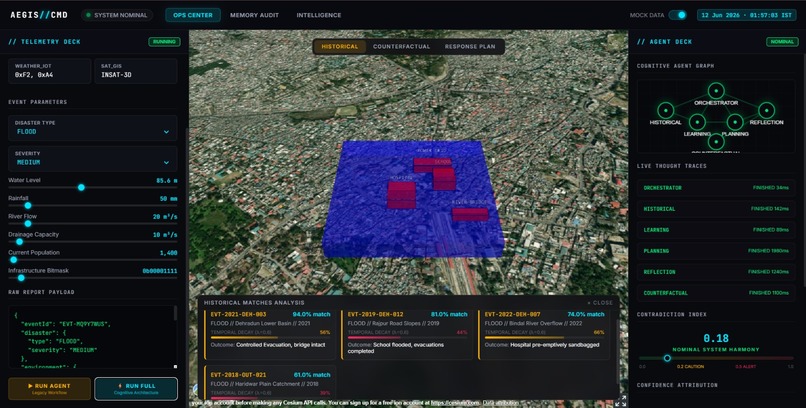
Historical analysis by fetching of data by Elastic
-
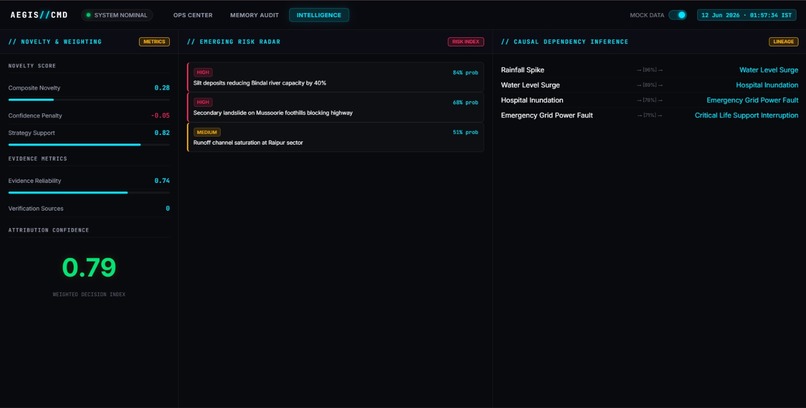
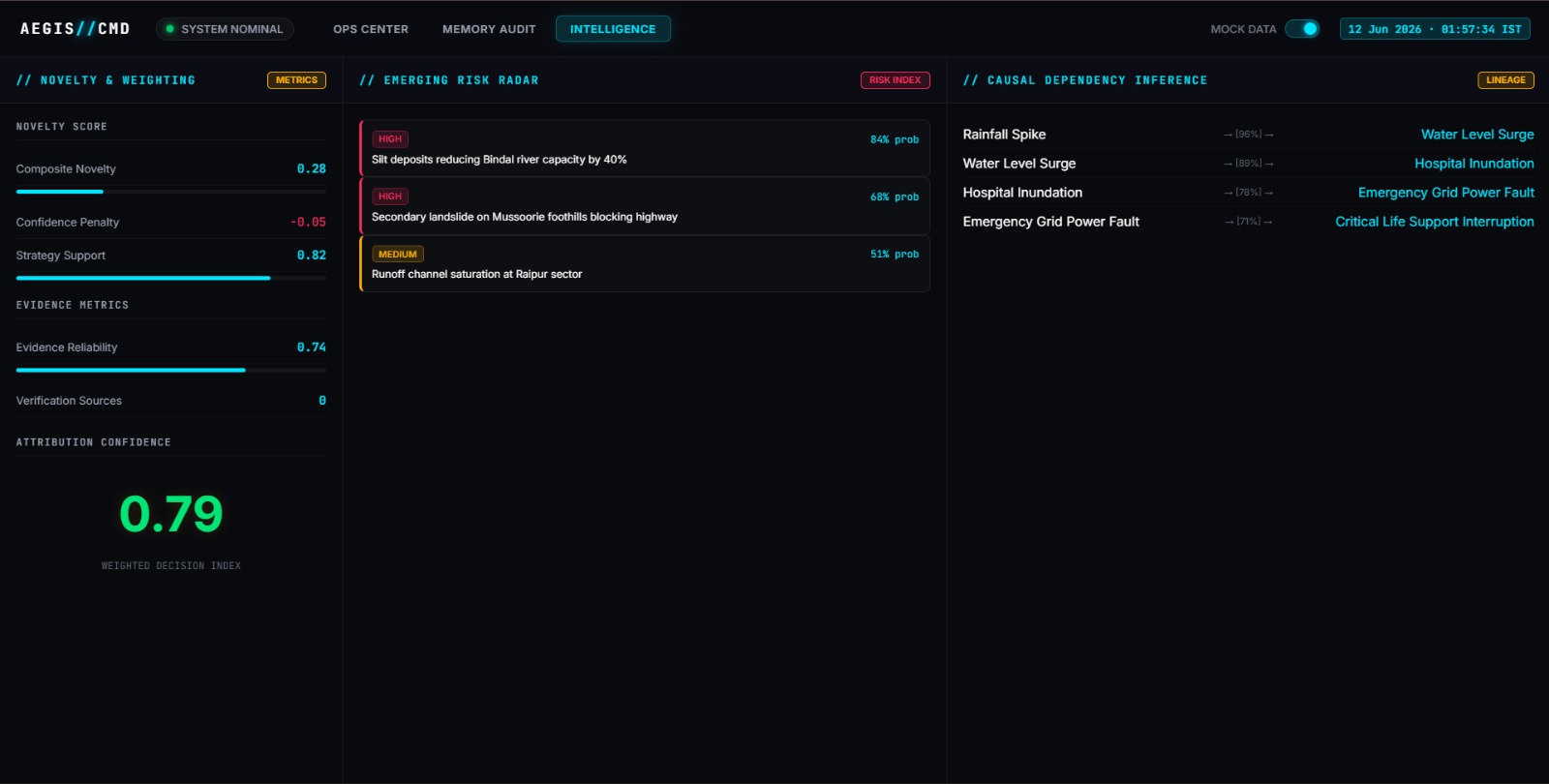
Confidence report and proactive measures
-
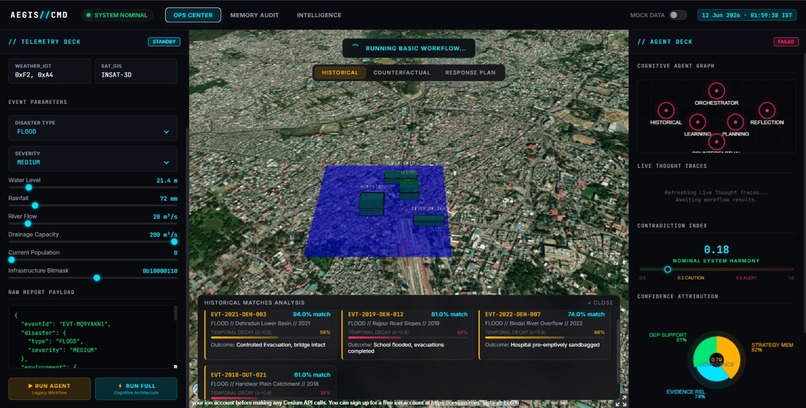
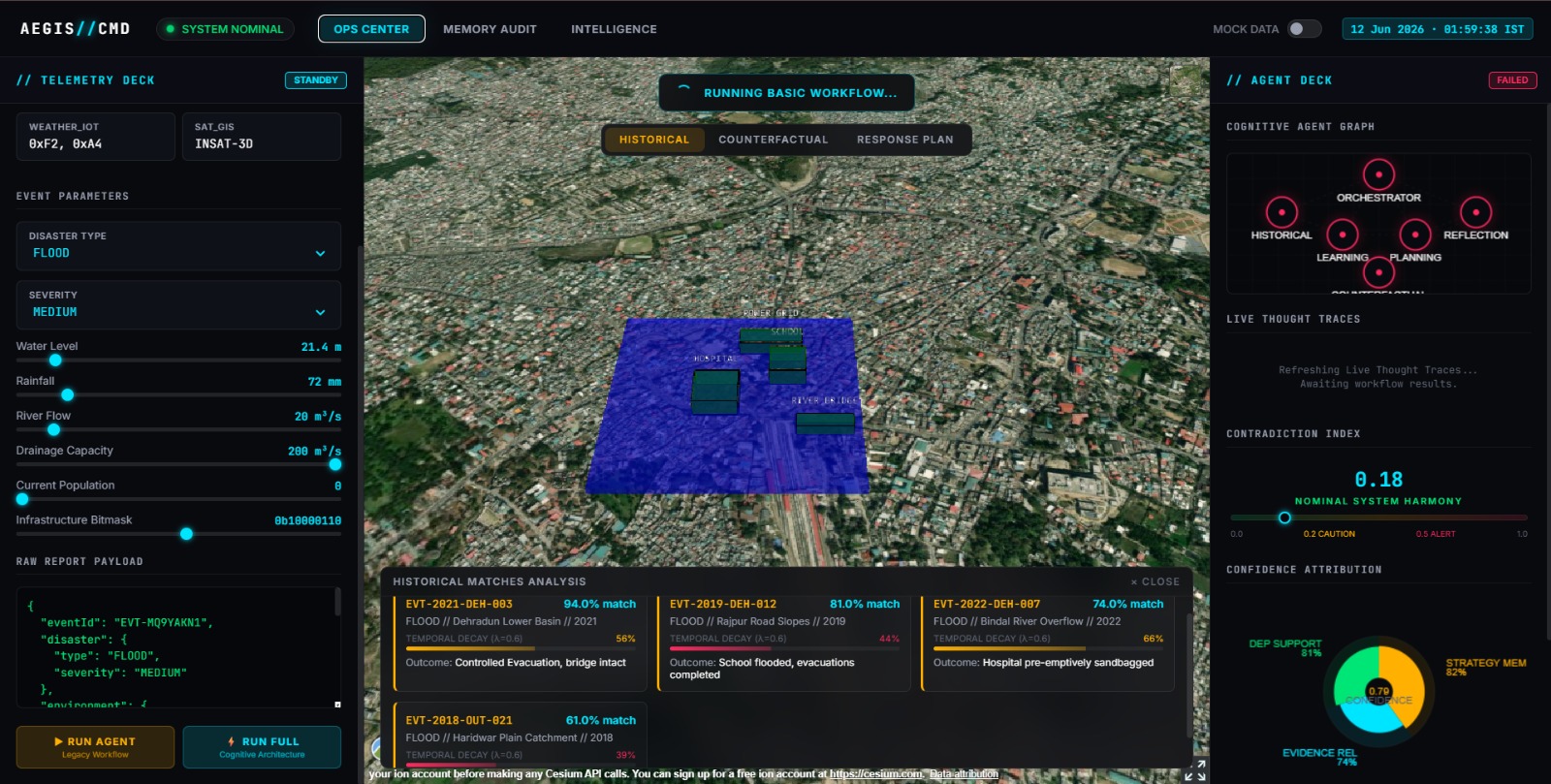
Covering an impossible state can trigger a system loop, exposing past records and repeatedly propagating impossible scenarios (population=0)
-
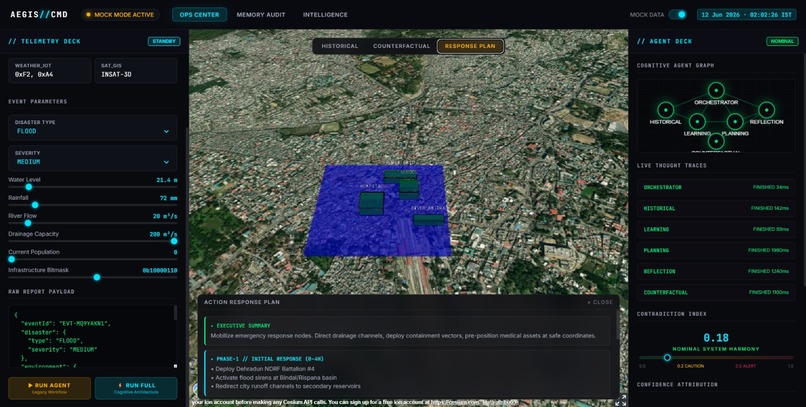
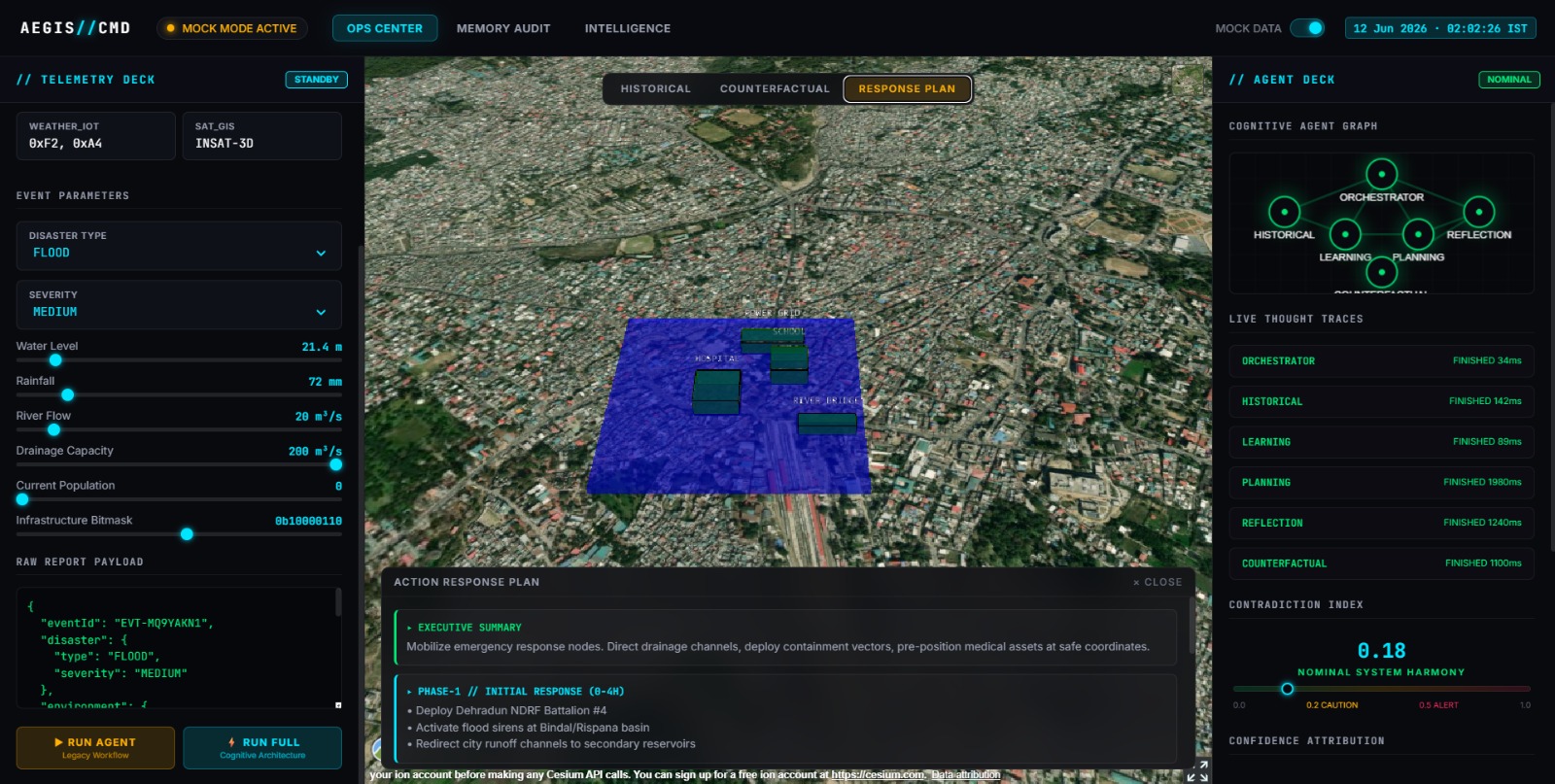
Personalised action response plan generated by AEGIS
AEGIS: Paced Multi-Agent Intelligence for Real-Time, Evidence-Backed Disaster Response
Inspiration
At its core, AEGIS isn't just about parsing data parameters or connecting software nodes—it is about saving human lives and protecting vulnerable communities when every single second counts.
When a massive crisis hits, local residents and emergency workers are forced to navigate an overwhelming, terrifying fog of uncertainty. Families may be stranded, roads become inaccessible, communication networks fail, and critical infrastructure can collapse in cascading chains. In these situations, responders are often overwhelmed with fragmented information and forced to make life-impacting decisions under immense pressure.
As we explored real-world disasters, one question stood out to us:
What if AI could help responders understand a disaster as it unfolds, instead of simply reacting to it?
That question became the foundation of AEGIS.
We wanted to build something that went beyond a traditional dashboard. Rather than simply displaying information, we envisioned a system capable of observing events, reasoning about risks, learning from historical disasters, and assisting decision-makers with meaningful recommendations.
We believe technology should be at its absolute best when human conditions are at their absolute worst. AEGIS is our attempt to turn modern artificial intelligence into a tool that can help communities respond faster, smarter, and more effectively during emergencies.
Building AEGIS
The journey began with a rough architectural idea of how different systems could work together. Initially, we focused on understanding how disaster simulations, AI agents, historical data, and visualization tools could be connected into a single platform. As development progressed, many parts of the original design evolved significantly. New ideas emerged, existing approaches were refined, and several components were redesigned entirely. What started as a simple concept gradually transformed into a much more intelligent and collaborative system.
AEGIS is engineered as a highly decoupled, production-safe system that bridges dense semantic memory retrieval with a deterministic, pipelined cognitive dependency graph. The entire backend application is built using a modern Node.js and Express framework.
The Memory Matrix (Elasticsearch) To ground our artificial intelligence and eliminate the hallucinations common in generic LLM applications, we deployed an advanced memory layer on Elasticsearch (Elastic Cloud). We rejected simple database matching in favor of an analytical historical memory index matrix. This structure consists of specialized, isolated indices:
- Disaster Index: Log of incoming raw incident boundaries.
- Historical Records Index: Long-term archival logs of regional historical crises.
- Outcomes Index: Tracked success parameters of historic interventions.
- Strategy Memory Index: Mapped conceptual framework patterns.
- Knowledge Gap Index: Stores identified missing telemetry tracking parameters.
- Dependency Memory Index: Houses system-to-system cascade failure links.
When a live telemetry payload hits our server, the system triggers a hybrid retrieval pipeline. It executes full-text searches for exact structural matches alongside dense vector mathematical calculations. This determines an explicit similarity coefficient between the active crisis and historical records, evaluating the vector inner product normalized by individual magnitudes using cosine similarity formula
The Cognitive Agent Pipeline The intelligence execution layer is driven entirely on the free tier by Google AI Studio running the high-speed Gemini 2.5 Flash model via the unified, modern @google/genai SDK. Instead of allowing independent models to execute randomly, AEGIS uses a strictly governed, linear pipeline orchestrated by a master node. The data cascades smoothly through the following operational flow:
- OrchestratorAgent: Captures the telemetry snapshot, configures the session, and enforces explicit, structured pacing delays to guarantee completely unthrottled endpoint processing across sub-agents.
- Historical Retrieval & Learning Agents: Pull records matching the current severity threshold, compiling a concrete ledger of past successful versus failed operational strategies.
- Planning Agent: Synthesizes the telemetry arrays (water levels, rainfall rates, infrastructure bitmasks) alongside the historical insights to formulate a prioritized draft of recommendedActions across critical emergency tiers (IMMEDIATE, HIGH, MEDIUM, LOW).
- Reflection Agent: Acts as an automated risk auditor, checking the plan against contradiction analysis and emerging risk rules, evaluating confidence weights, and outputting an uncorrupted payload.
The Command Deck (Frontend UI) The user interface is designed as a dark-themed, high-telemetry operations terminal deployed on Vercel. It maps real-time parameter controls, lists generated agent action items with their accompanying confidence scores, displays live "Thought Traces" indicating agent computation states, and embeds a fully interactive CesiumJS 3D globe to geofence danger zones and highlight critical infrastructure failures visually..
Challenges We Faced
One of the biggest challenges was integrating multiple technologies into a unified system. Each component solved a different problem. Disaster simulation generated dynamic scenarios, AI agents produced analytical insights, Elasticsearch handled historical intelligence, and the visualization layer displayed information to users. Connecting these systems while maintaining a smooth workflow required significant experimentation and iteration.
As first-time developers working on a project of this scale, we also spent a considerable amount of time learning unfamiliar technologies, understanding system architecture, debugging integrations, and adapting our ideas when initial approaches did not work as expected.
Another challenge surfaced immediately upon deploying our backend server container to Render. Because Google AI Studio enforces strict regional data boundaries, its security layer flagged Render's enterprise datacenter IP addresses as unauthorized cloud instances. This caused the @google/genai library to drop connections instantly, throwing disruptive 403 Forbidden credential and geofence errors on boot.
Transitioning the project to alternative enterprise avenues like Google Cloud Platform (GCP) Vertex AI was impossible, as it required setting up complex corporate billing accounts, generating service accounts, and introducing unexpected production costs that violated our strict requirement to remain entirely on the developer free tier.
There were many moments when a solution seemed straightforward in theory but became much more complex during implementation. However, overcoming these challenges became one of the most rewarding parts of the experience.
What We Learned
AEGIS taught us far more than technical skills.
We learned how modern software systems are designed, how different technologies can be integrated into a larger architecture, and how artificial intelligence can be used to support decision-making rather than simply automate tasks.
We gained hands-on experience with backend development, system design, search technologies, geospatial visualization, AI-assisted reasoning, and collaborative problem-solving.
Most importantly, we learned that solving real-world problems requires more than technical knowledge. It requires understanding the people affected by those problems and designing systems with their needs in mind.
This project showed us that technology becomes most valuable when it helps people make better decisions during difficult moments.
Looking Forward
While AEGIS is currently a prototype, we see it as the foundation for something much larger.
In the future, we envision integrating live sensor networks, weather feeds, satellite imagery, emergency communications, and real-time operational data. We also hope to expand the platform's institutional learning capabilities so that every disaster, simulation, and response contributes to a growing body of knowledge.
Our long-term goal is to create an intelligent disaster response platform that can help communities prepare for, understand, and respond to emergencies more effectively.
At its heart, AEGIS is built around a simple idea:
$$ \textbf{Observe → Analyze → Predict → Protect} $$
Because when disasters occur, information matters. Decisions matter.
And sometimes, those decisions can save lives.
Built With
- cesiumjs
- elastic
- elasticsearch
- express.js
- google-ai-studio
- javascript
- node.js
- react
- render
- vercel


Log in or sign up for Devpost to join the conversation.