-
-
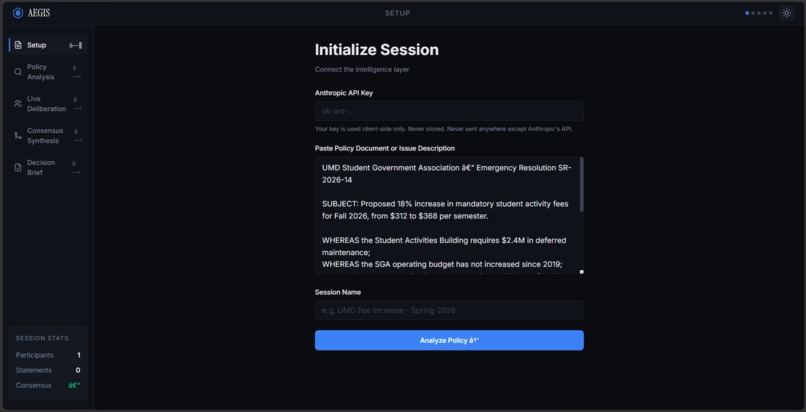
Homepage - Setup
-
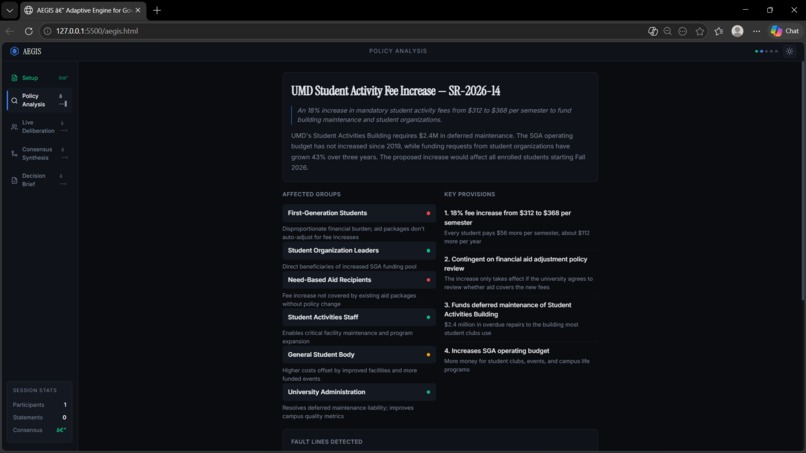
Activities Page
-
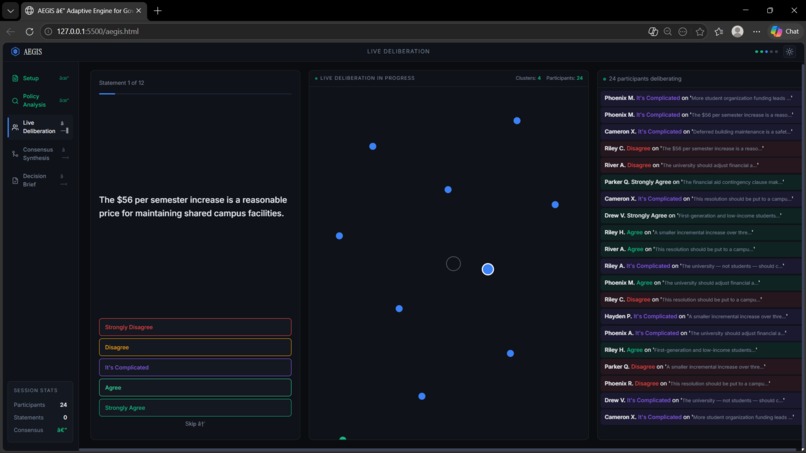
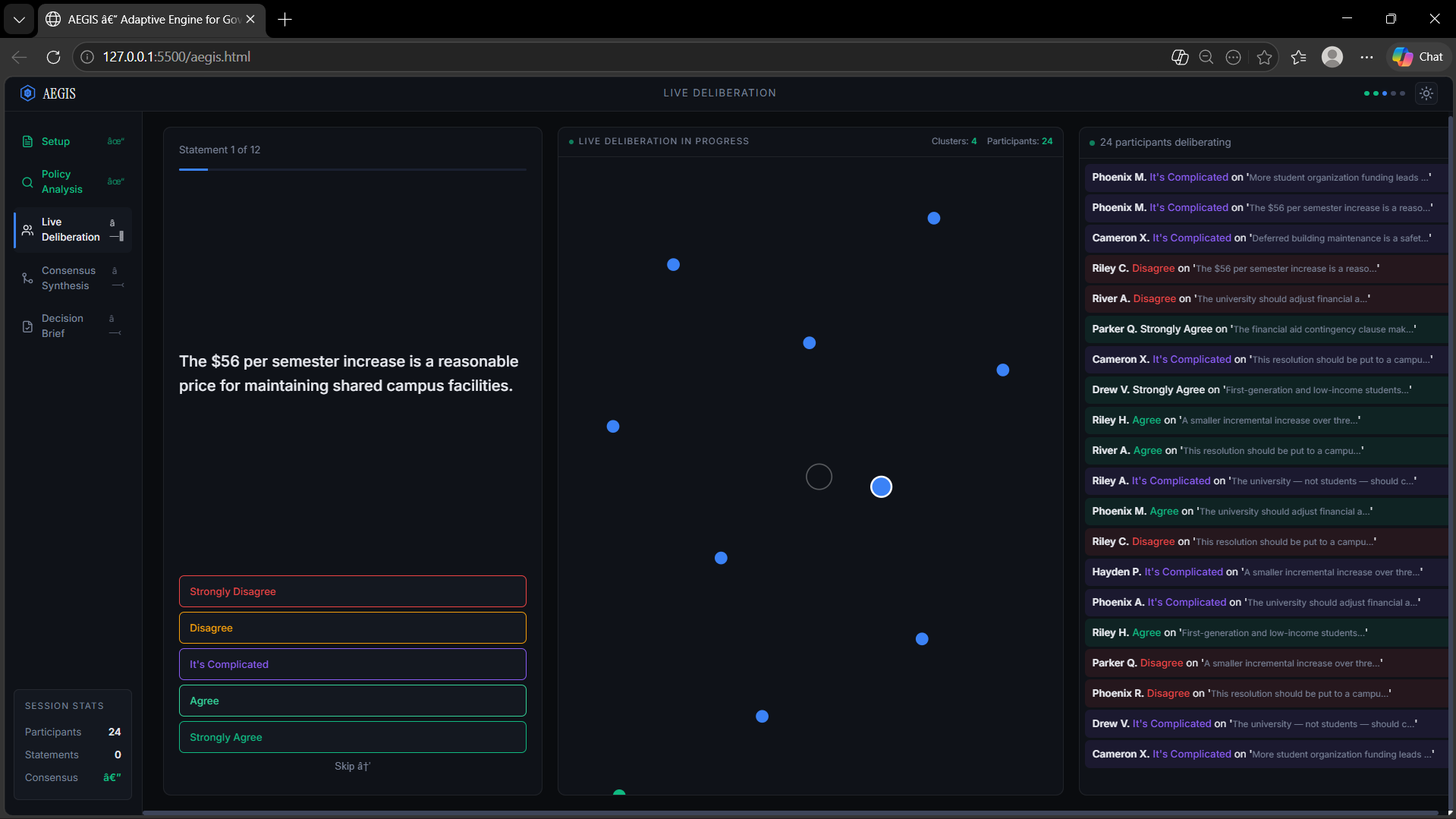
Live Deliberation
-
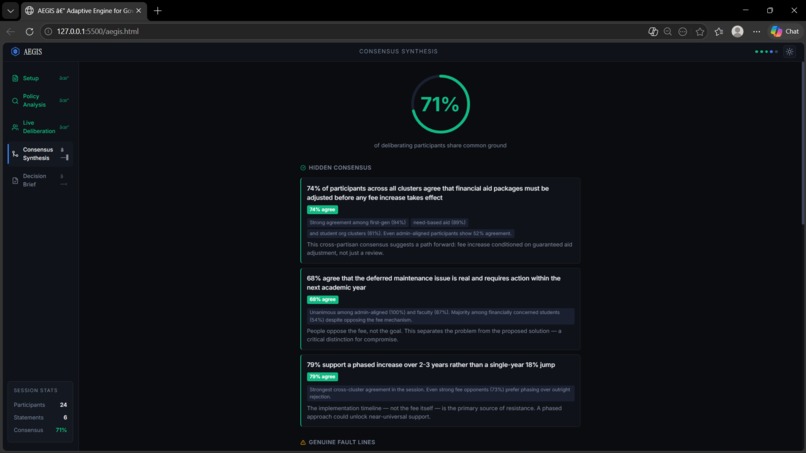
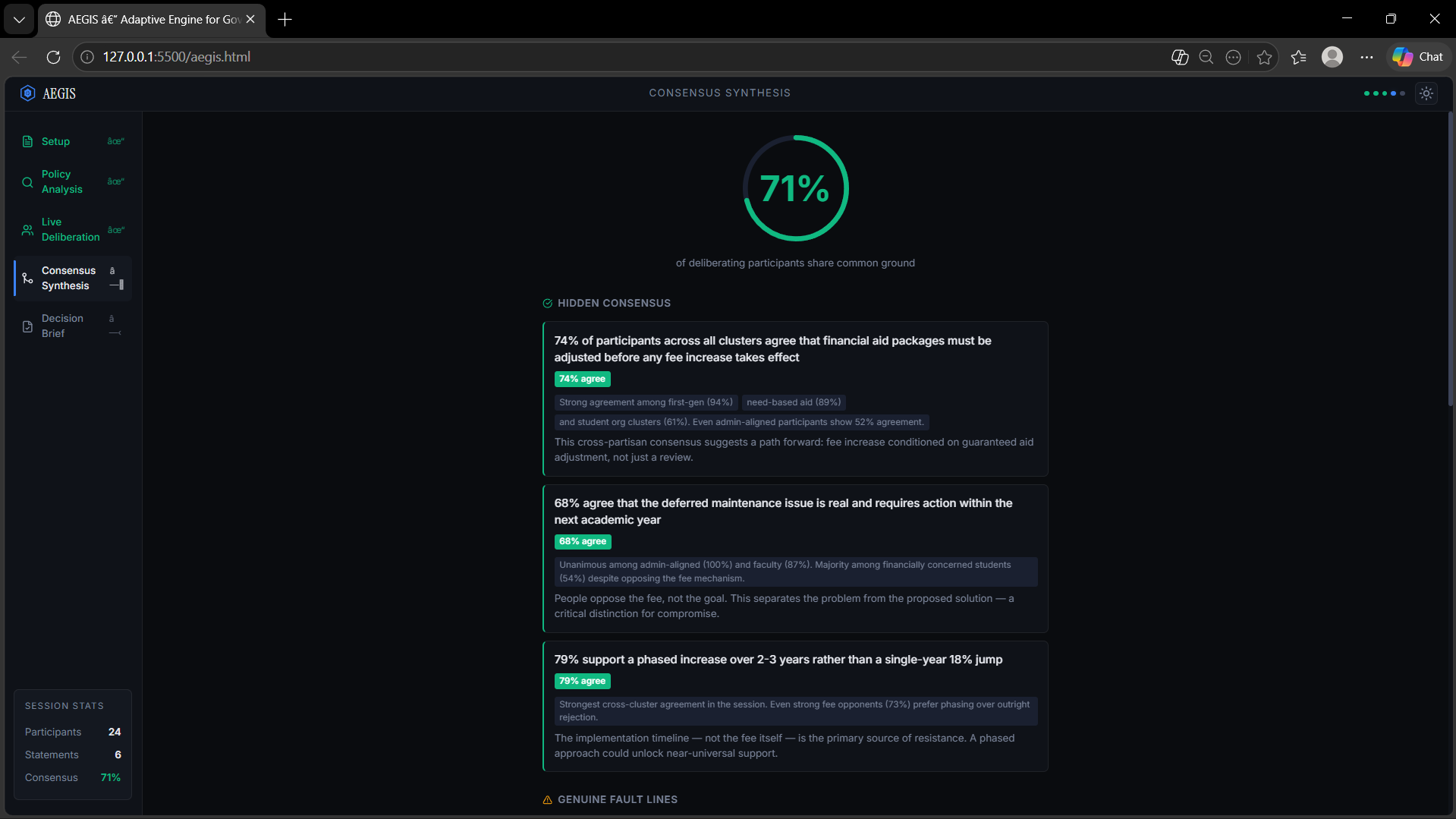
Consensus Synthesis
-
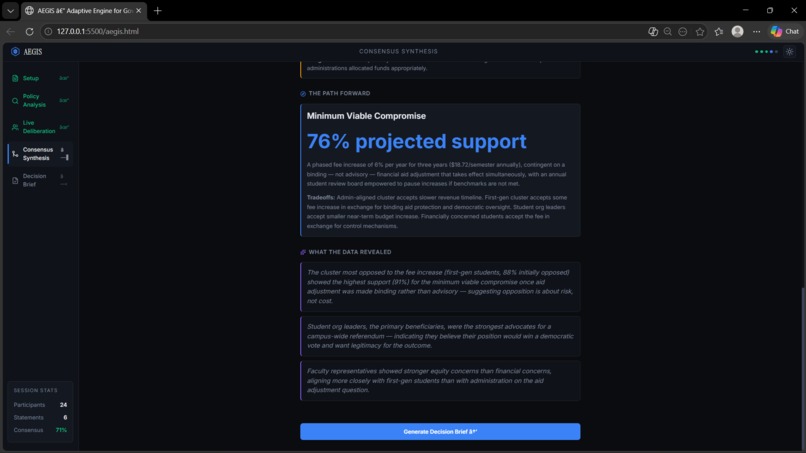
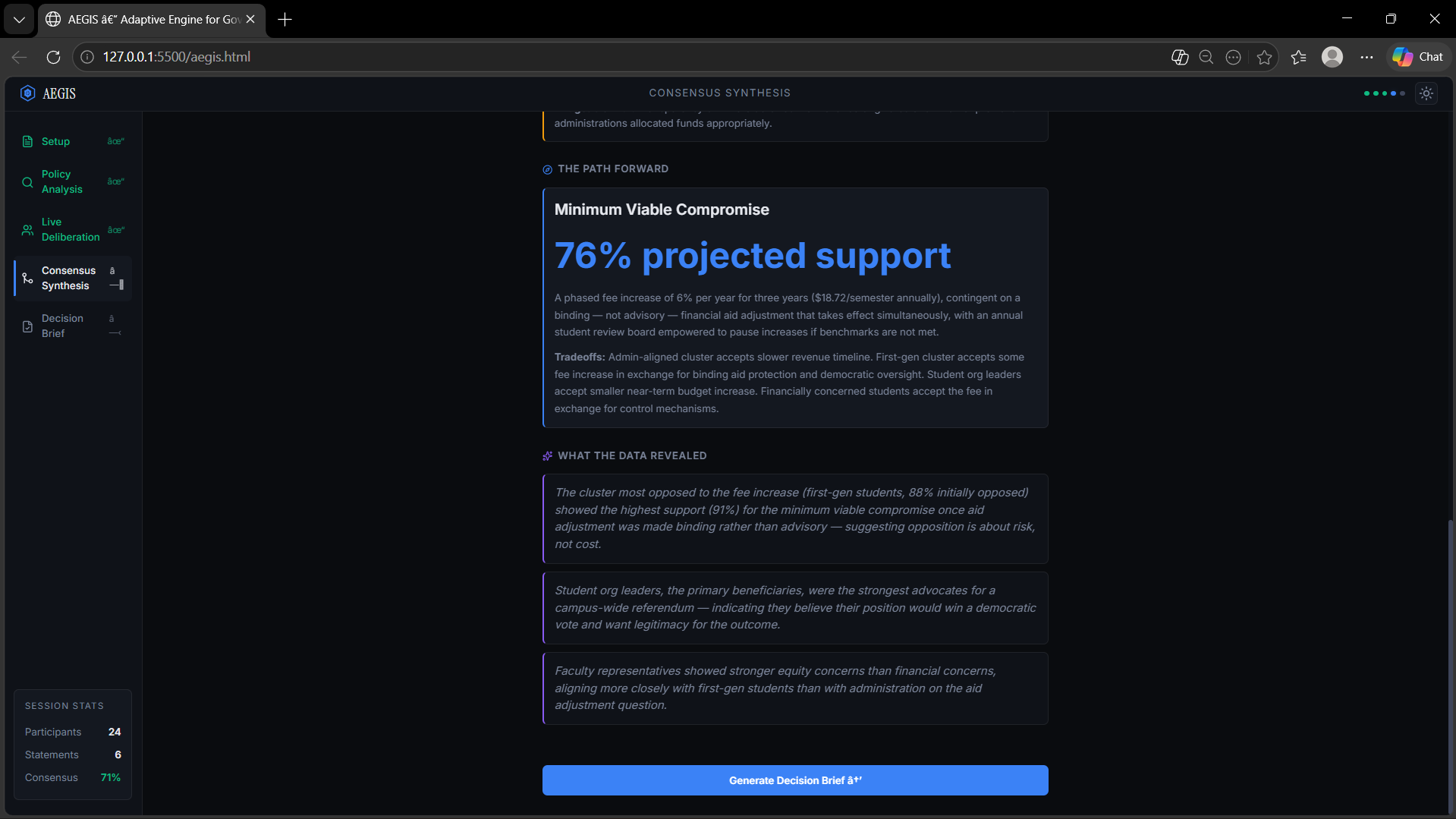
Consensus Synthesis - 2nd Part
-
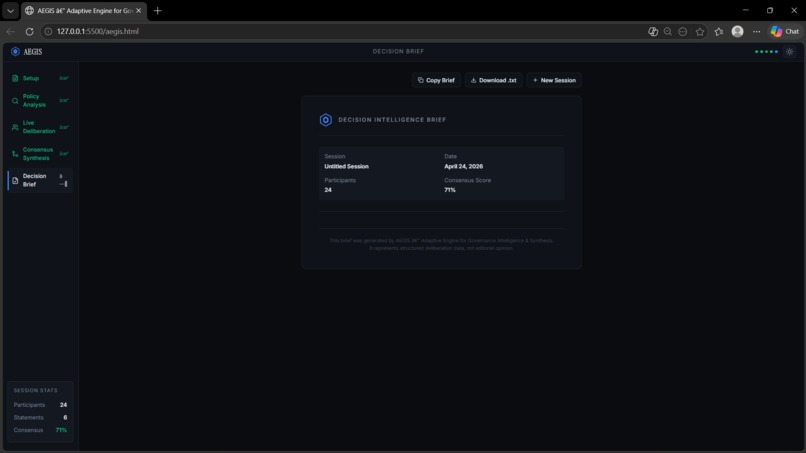
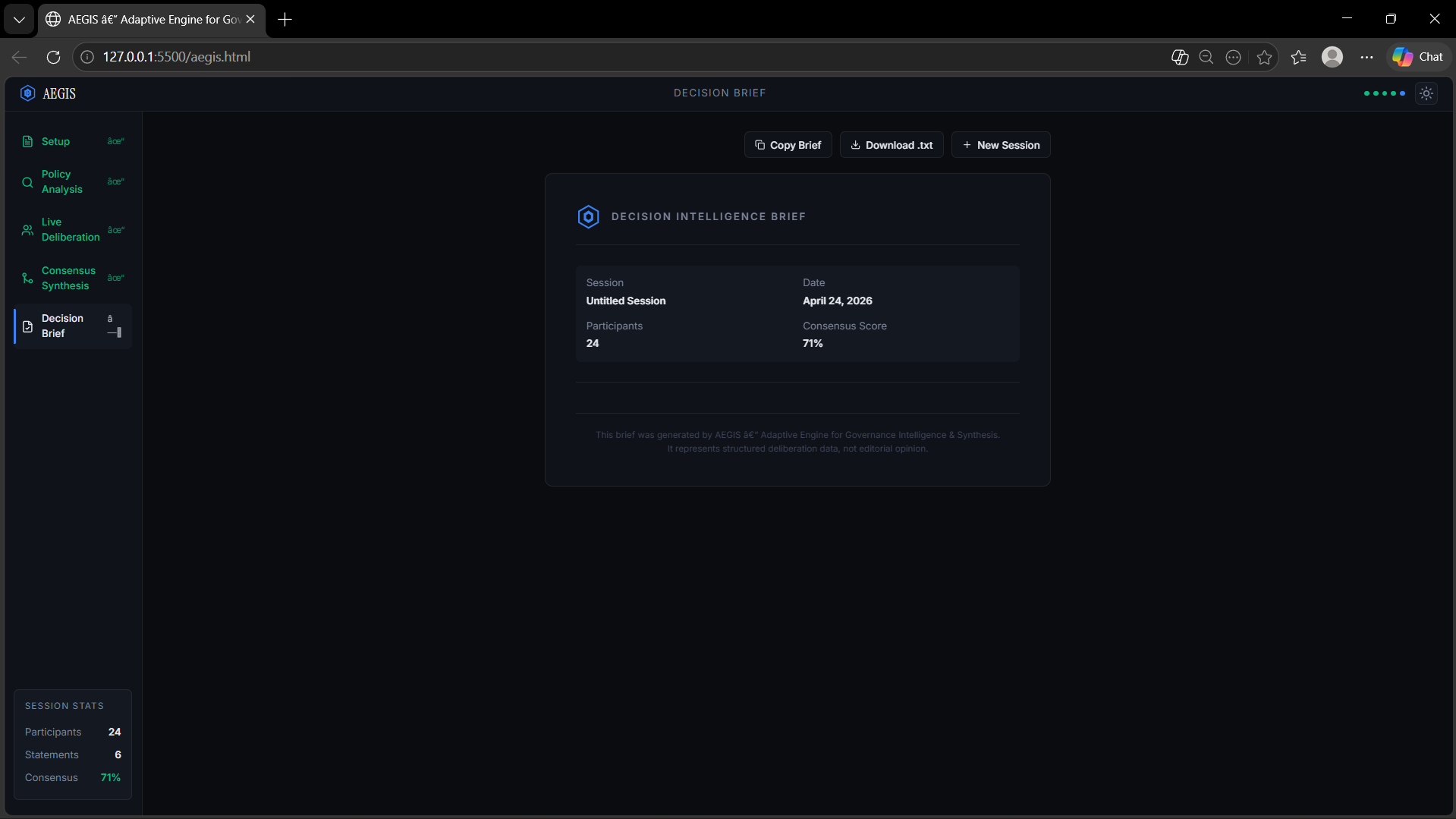
Decision Brief
Inspiration
Dario Amodei's essay "Machines of Loving Grace" asks what it looks like when AI actively strengthens democracy. We asked a harder question: why is democracy broken in the first place?
The answer isn't ignorance. It's infrastructure. Town halls, comment periods, and ballots are 200-year-old technology — designed for a world where information traveled by horse. The "argument layer" of modern democracy (social media, comment sections, public hearings) is optimized to surface conflict and bury consensus.
Research from Taiwan's vTaiwan experiment proved something extraordinary: when you remove the ability to argue and only let people express nuanced positions, hidden consensus emerges. People who think they fundamentally disagree actually agree on 60-70% of specifics. That agreement is real — it's just being buried.
No one has built the tool that surfaces this hidden consensus at scale and delivers it as actionable intelligence to actual decision-makers. That's AEGIS.
What it does
AEGIS is a 5-phase civic deliberation platform:
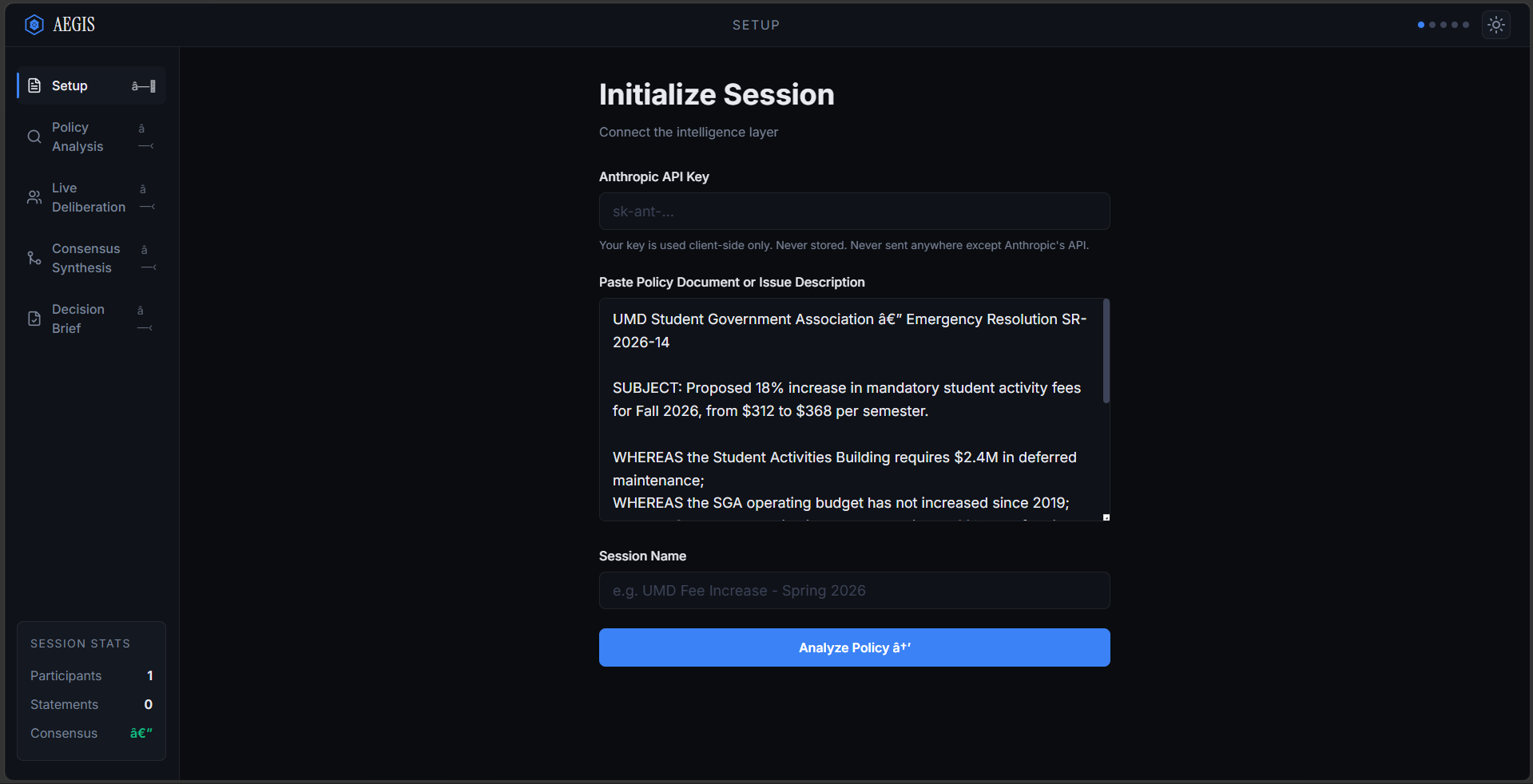
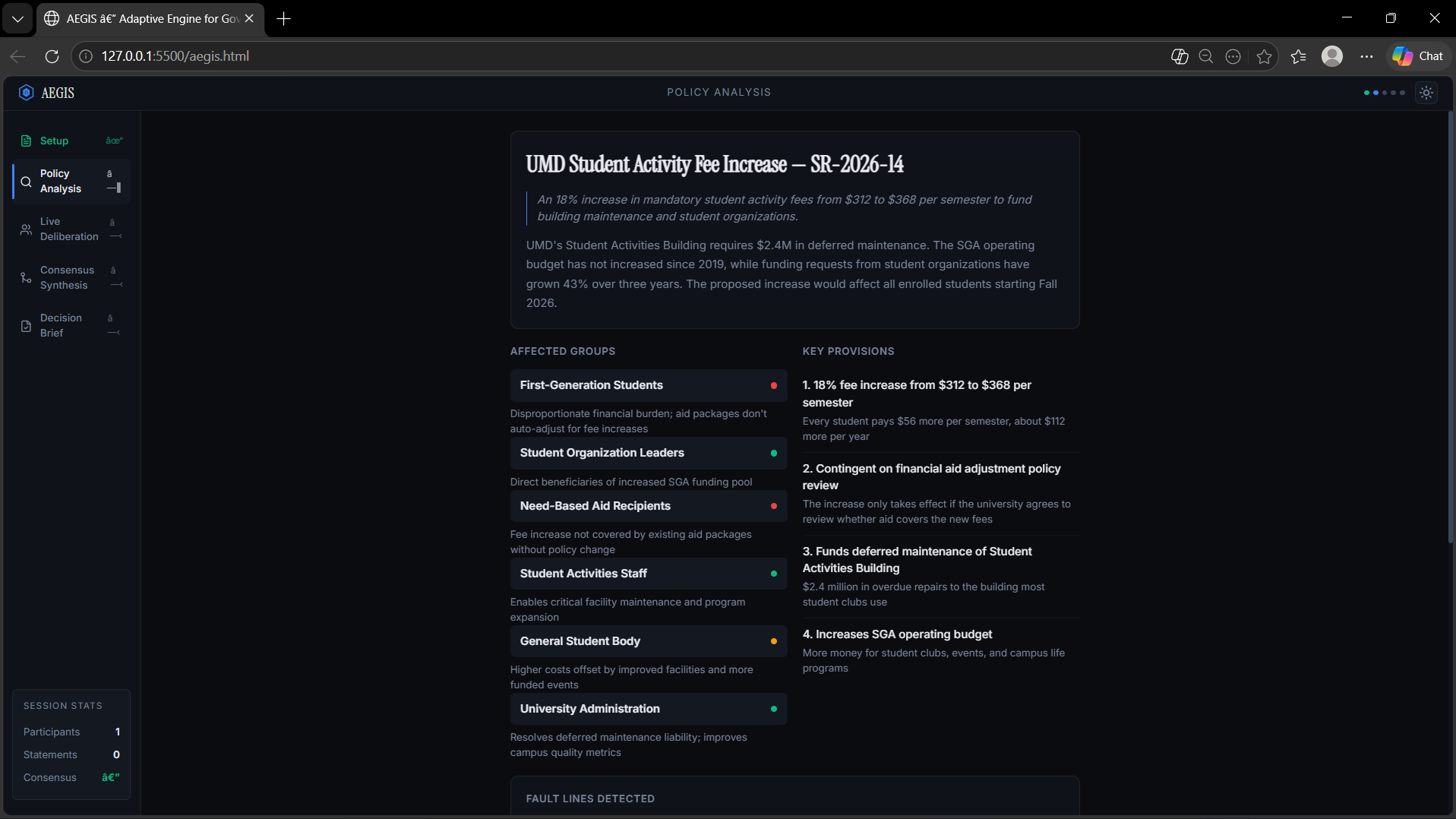
Phase 1 — Policy Intelligence: Paste any policy document. Claude AI instantly breaks it down into plain language, identifies every affected stakeholder group, extracts key provisions, detects genuine fault lines, and runs an automated bias audit on the document's framing.
Phase 2 — Live Deliberation: 24 participants (you + 23 simulated personas representing real community clusters) vote on 12 structured, nonpartisan statements about the policy. A live D3.js force-directed graph visualizes consensus forming in real time — you watch strangers agree with you on things you thought were divisive.
Phase 3 — Consensus Synthesis: AI analyzes all 276 data points across all participants to surface the hidden consensus: what people actually agree on beneath the noise, the genuine fault lines where values truly differ, and the Minimum Viable Compromise — the smallest policy change that maximizes cross-cluster agreement.
Phase 4 — Decision Intelligence Brief: A formatted document ready to hand to actual decision-makers: a city council, a university senate, a campus administration. Not a summary — a structured brief with confidence scores, equity impact assessments, and specific recommended next steps.
How we built it
Single-file static web app (HTML/CSS/JS) with zero backend dependencies. Claude AI powers three structured intelligence layers under strict nonpartisan constraints. D3.js v7 renders the live force-directed consensus topology map. A simulation engine generates 23 participant personas with probabilistic voting profiles across 5 community clusters (financially concerned students, student org leaders, first-gen students, faculty, administration-aligned), each casting votes via randomized setTimeout scheduling to create realistic real-time activity.
Challenges we ran into
Getting Claude to produce consistent, parseable JSON across all three structured output calls required careful prompt engineering with regex fallback parsing. Building the D3 force simulation to feel "alive" — nodes drifting together as consensus forms, cluster rings pulsing — required significant tuning of force parameters and alpha decay. The hardest design challenge was making the deliberation feel genuine rather than mechanical.
Accomplishments that we're proud of
The moment when the consensus topology map lights up and you watch nodes from opposite political clusters drift toward each other on a shared statement — that visual tells the entire story of what AEGIS is doing. We're proud that the core insight is visible, not just readable.
What we learned
Democracy's problem is architectural, not attitudinal. People want to agree more than the systems around them allow. The vTaiwan research wasn't a fluke — it's a proof of concept that better deliberation infrastructure produces better outcomes. AI doesn't fix democracy by explaining it better. It fixes democracy by rebuilding the feedback loop.
What's next for AEGIS
Real authentication and persistent cross-device sessions. Direct API integration with UMD Student Government Association and College Park City Council public comment systems. Multi-language support (30% of UMD students speak a non-English primary language). Longitudinal impact tracking — does structured deliberation actually change decisions over time? We want to find out.
Built With
- claude-ai-(anthropic)
- css
- d3.js
- gemini-api
- google-fonts
- html
- javascript
- live
- lucide-icons
- server
- vs-code

Log in or sign up for Devpost to join the conversation.