-
-
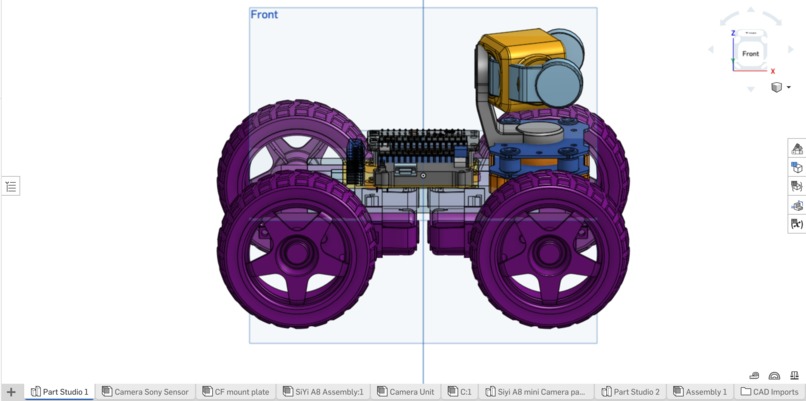
Front CAD view of Aegis, a compact search-and-rescue rover built for hazardous and unknown terrain.
-
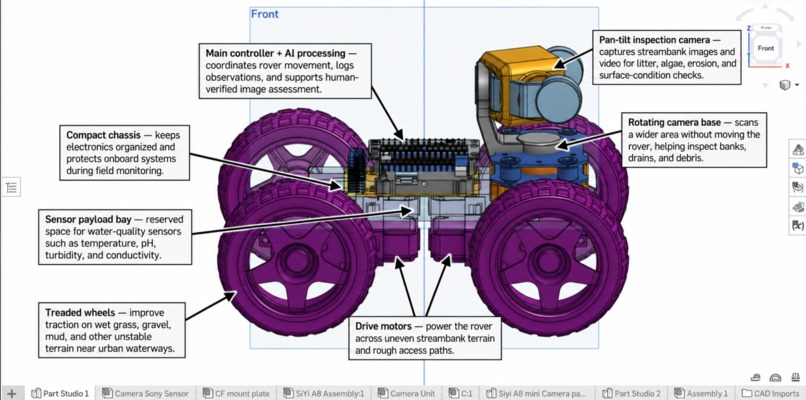
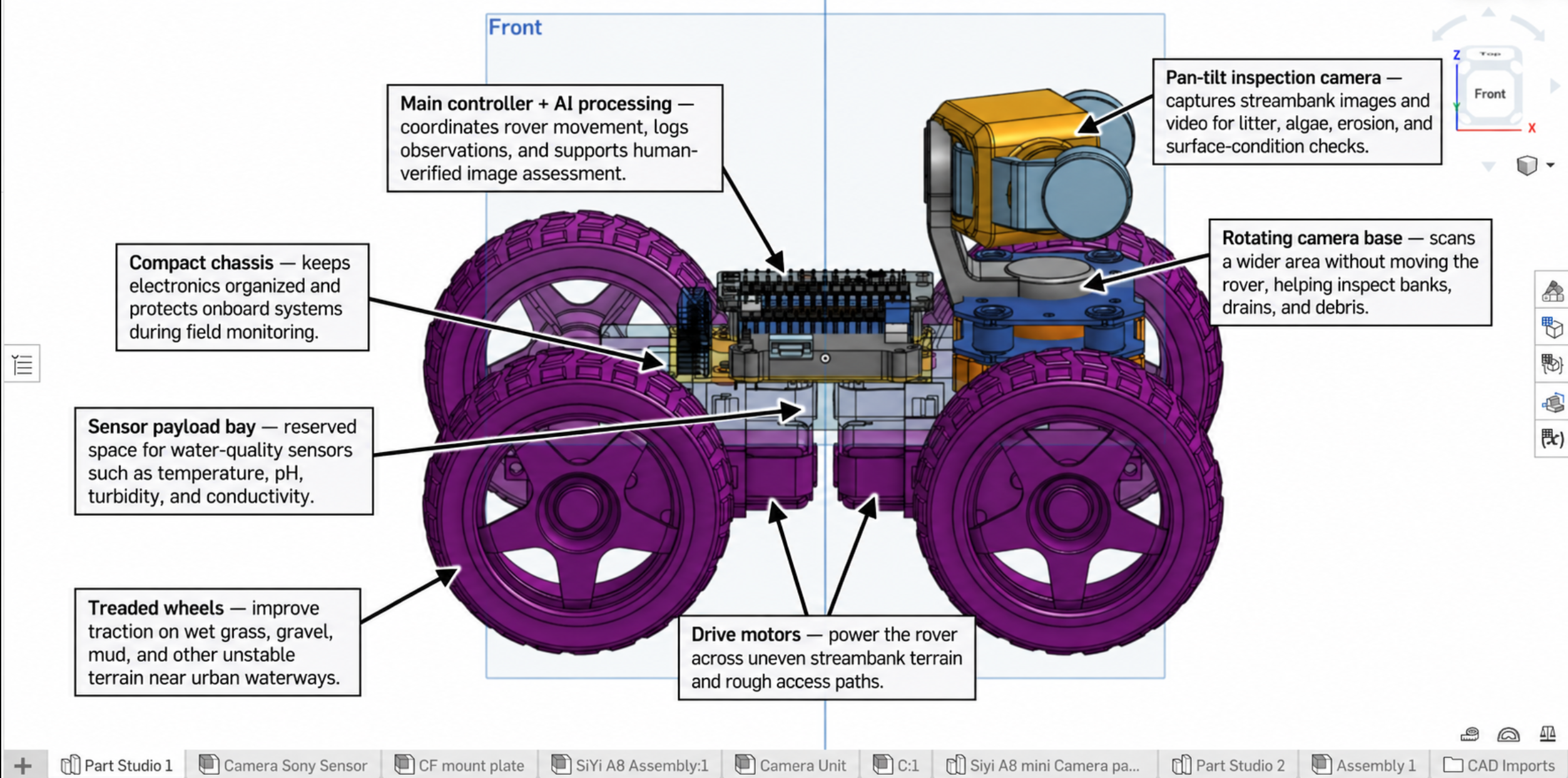
Annotated CAD view of Aegis Aqua showing its camera, AI controller, sensor bay, drivetrain, and stream-monitoring features.
Inspiration
A lot of environmental monitoring still depends on people physically going out to collect observations, which becomes harder around steep streambanks, muddy areas, drainage channels, or places that are simply difficult to reach safely.
That got me thinking about whether a small rover could handle some of that first-pass monitoring instead.
The idea behind Aegis Aqua is to create a rover that can move through rough areas near urban streams, capture visual data, and eventually carry water-quality sensors. Instead of replacing researchers or citizen scientists, the rover is meant to give them another way to collect information from places that are harder to inspect consistently.
What I Built
Aegis Aqua is a compact rover designed for urban freshwater monitoring.
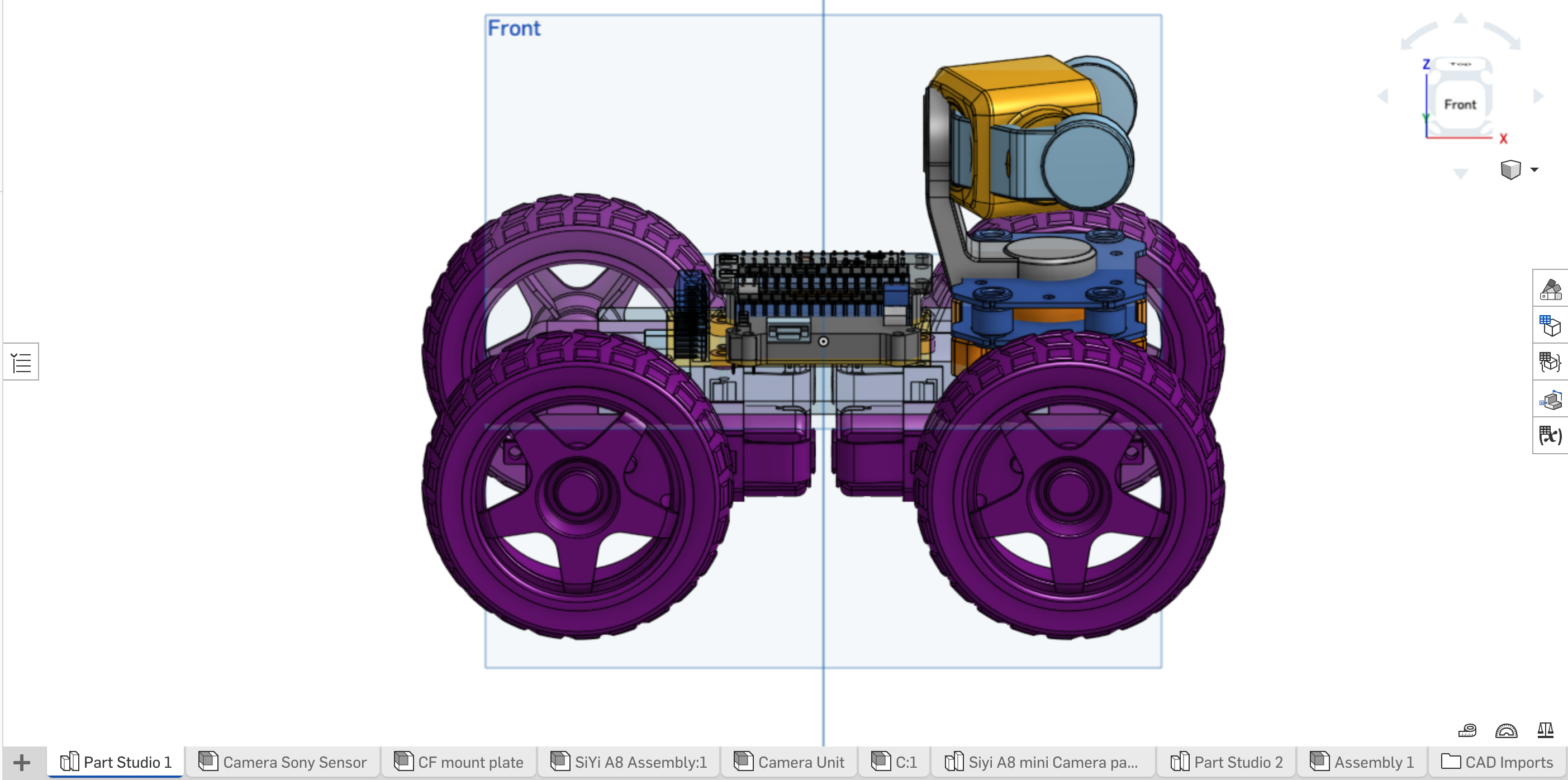
The rover uses four large treaded wheels so it can move over uneven ground like gravel, wet grass, dirt, and rough streambank terrain. At the front is a pan-tilt camera system that can scan the surrounding area without requiring the entire rover to turn.
That camera could be used to document things like visible algae growth, litter, erosion, blocked drains, debris, and other changes along a stream.
The center of the rover holds the main electronics and controller, while space in the chassis is reserved for future water-quality sensors such as temperature, pH, turbidity, and conductivity.
The longer-term goal is to combine those measurements with visual observations and use AI to help flag unusual conditions. The AI would only assist with the assessment, while a person would still confirm or reject the result.
How I Built It
I designed the rover in Onshape.
I started with the basic chassis and four-wheel drivetrain, then worked around the electronics to keep the rover compact. After that, I added the camera system and adjusted the layout so the camera would have a clear view without interfering with the controller or wheels.
One thing I paid attention to was making the design realistic instead of just placing parts wherever they looked good. The motors, wheels, electronics, camera, and sensor space all had to fit together in a way that could actually make sense on a physical rover.
The camera ended up being one of the most important parts of the design because it gives the rover a much wider view of its surroundings without needing to constantly reposition the entire vehicle.
Challenges
The biggest challenge was fitting everything into a small platform.
When I first added the camera assembly, it conflicted with the electronics already in the center of the rover. I had to move components around and rethink how the available space was being used.
I also realized that designing a rover for stream monitoring is different from just designing a robot that can drive. The environment matters a lot. Uneven ground, mud, wet surfaces, visibility, and sensor placement all affect how useful the rover would actually be in the field.
Another challenge was deciding how AI should fit into the project. I did not want the system to automatically decide whether a stream was healthy or unhealthy based on one image. Instead, I designed the idea around AI-supported assessment, where the system can flag something unusual and a human makes the final judgment.
What I Learned
The biggest thing I learned was how connected every design decision is.
Moving one component can affect the camera view, the available sensor space, the center of the chassis, or the clearance around the wheels. It made me think less about individual parts and more about how the entire system works together.
I also learned that environmental monitoring is not just about collecting more data. The data has to be useful, understandable, and reliable enough for someone to act on it.
Aegis Aqua is still a prototype, but I would like to continue developing it with a working sensor package, image-based assessment, data logging, and eventually autonomous navigation along stream environments.
Built With
- 3d-modeling
- cad
- embedded-systems
- onshape


Log in or sign up for Devpost to join the conversation.