-
-
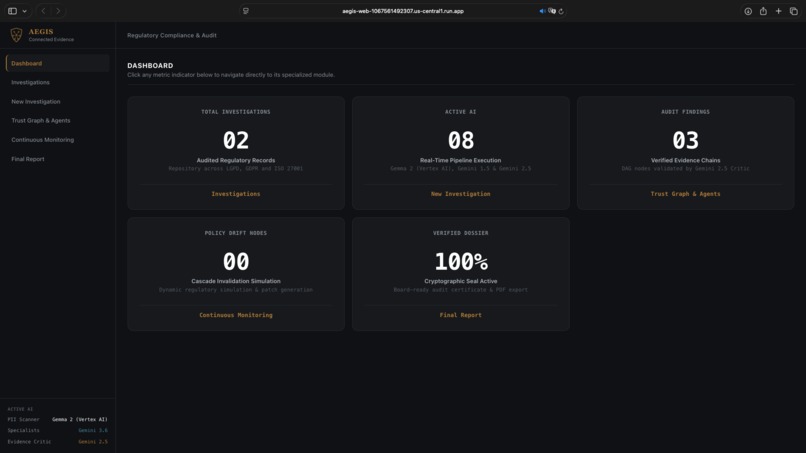
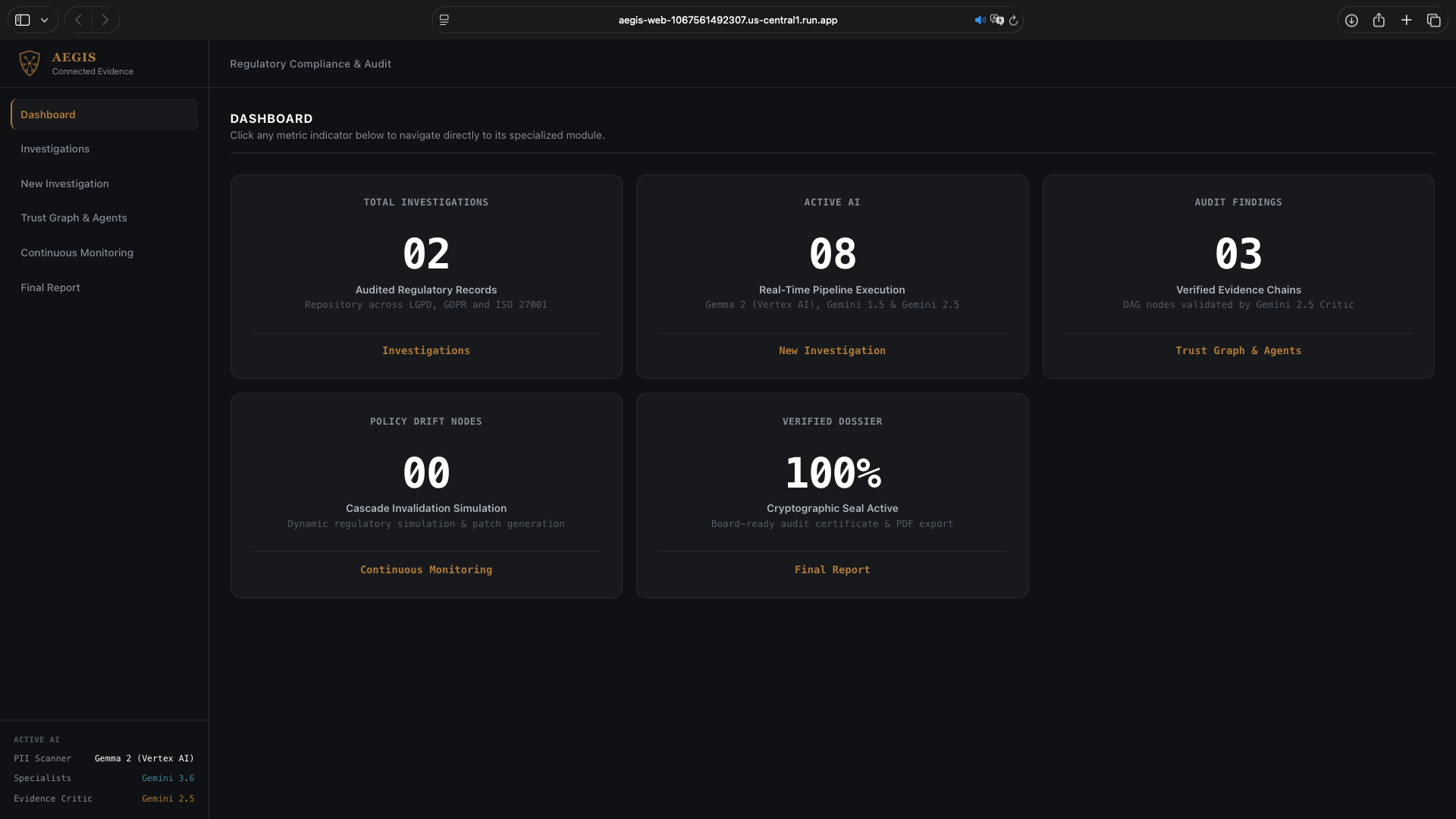
Home & Dashboard
-
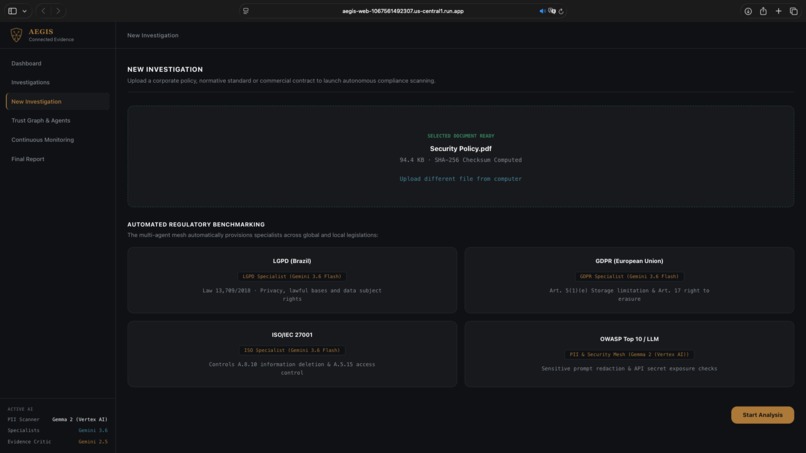
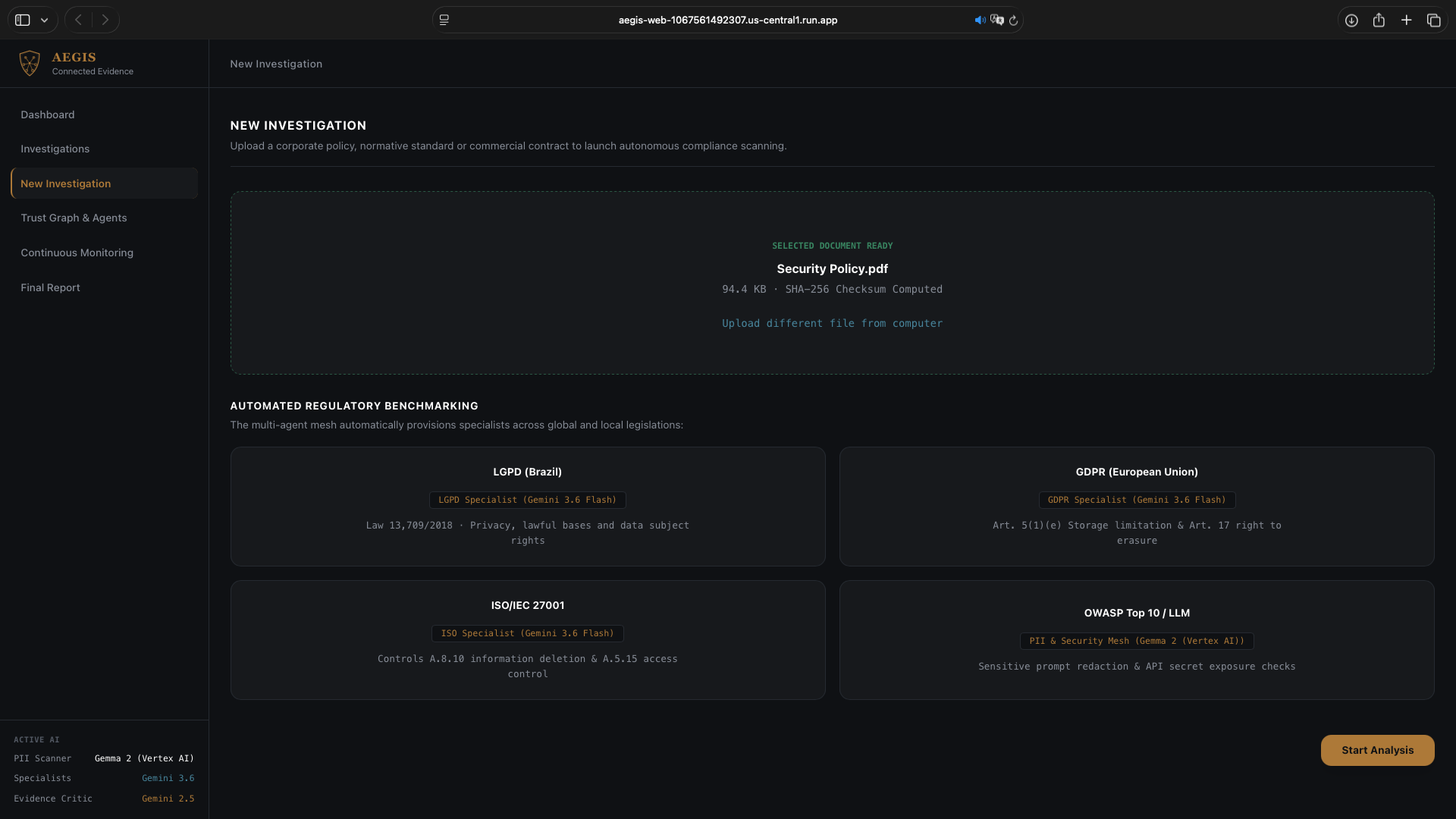
New Investigation
-
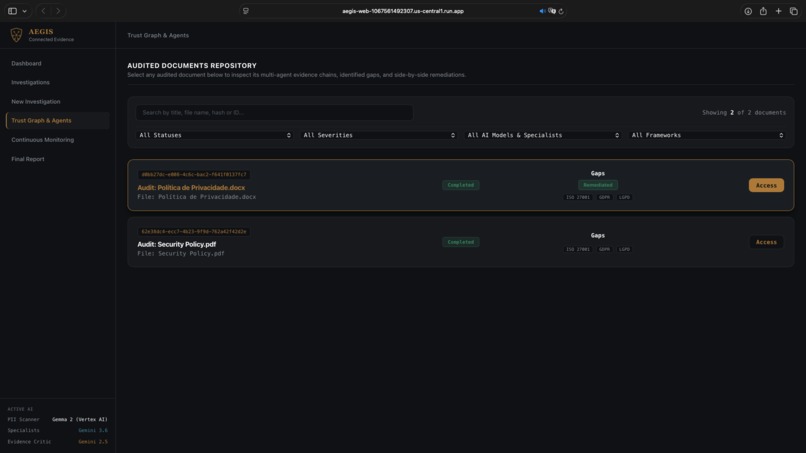
Trust Graph & Agents
-
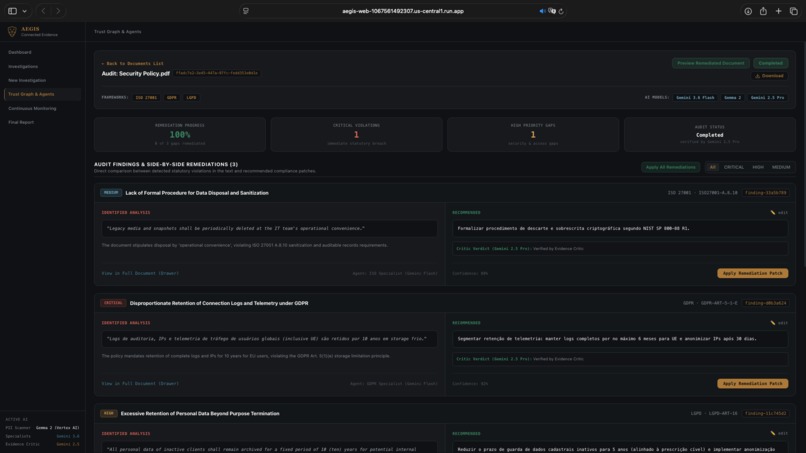
[Findings] Trust Graph & Agents
-
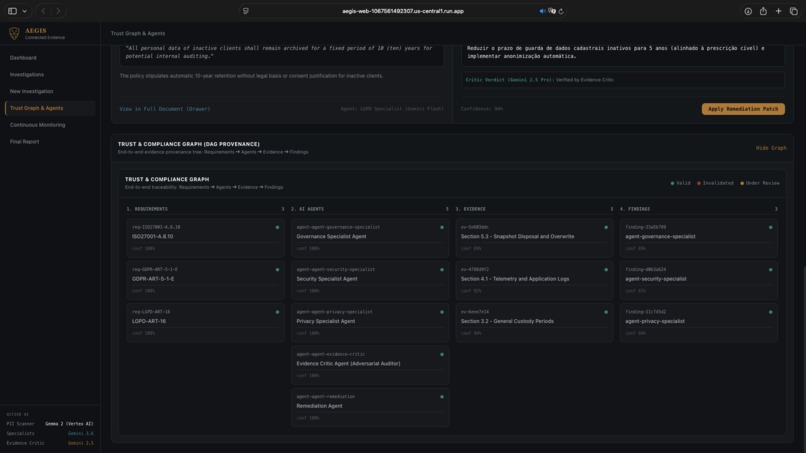
[Graph] Trust Graph & Agents
-
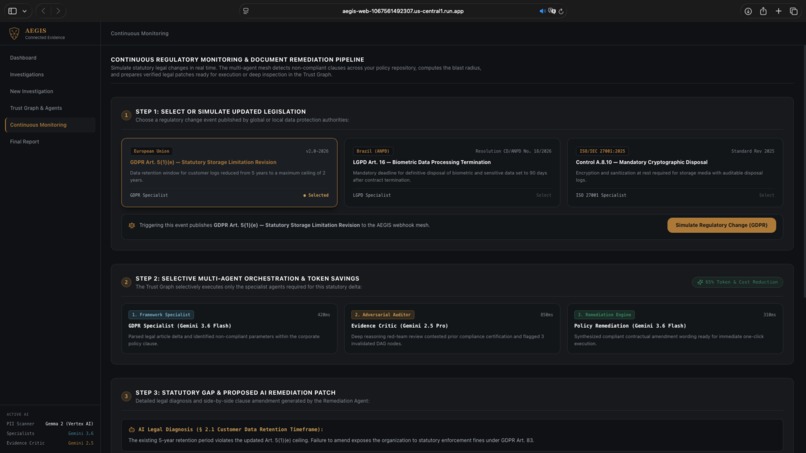
Continuous Monitoring
Inspiration
In modern compliance, the most expensive problem is not the absence of rules — it is the lack of traceability when those rules change.
Companies invest in policies, audits, and internal controls, yet often cannot answer a simple question: when a new requirement comes into force, which evidence becomes invalid, which decisions must be reopened, and which risks cascade through the organization?
This is the kind of issue that usually remains invisible until it is already too late. That is where AEGIS begins. Not as another AI assistant that answers questions about GDPR, LGPD, or ISO 27001, but as an autonomous regulatory governance platform built around a more fundamental principle: compliance is not a static checklist; it is an ongoing process of observation, validation, and response.
The project was inspired by the realities of organizations operating in complex regulatory environments. The challenge was not only to read legal documents, but to ensure that a compliance decision remains trustworthy as evidence ages, rule versions change, and operational context evolves without warning.
What it does
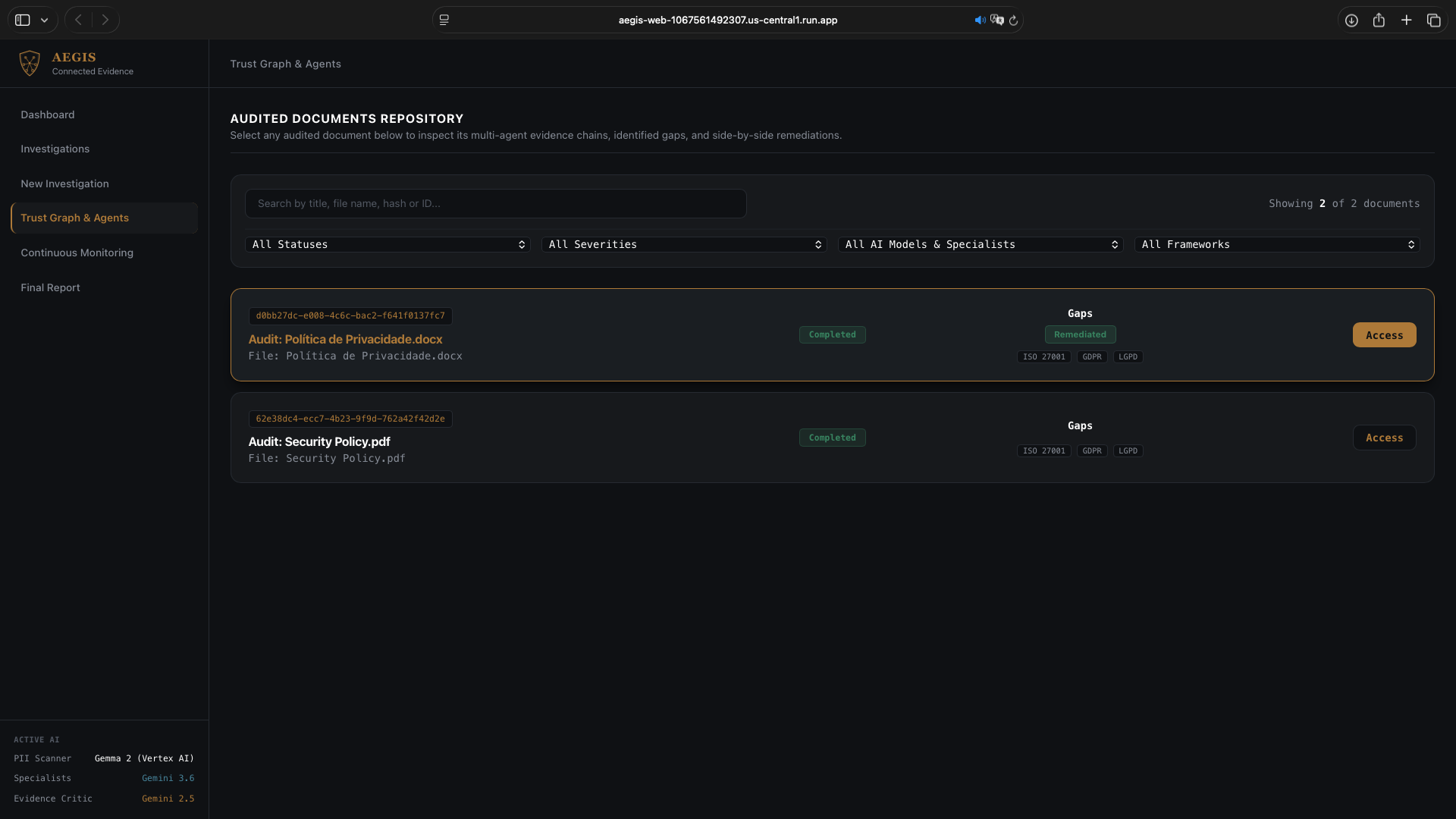
AEGIS is an autonomous regulatory governance platform that combines specialized agents, document analysis, evidence tracking, and dependency logic to monitor compliance in realistic and complex environments.
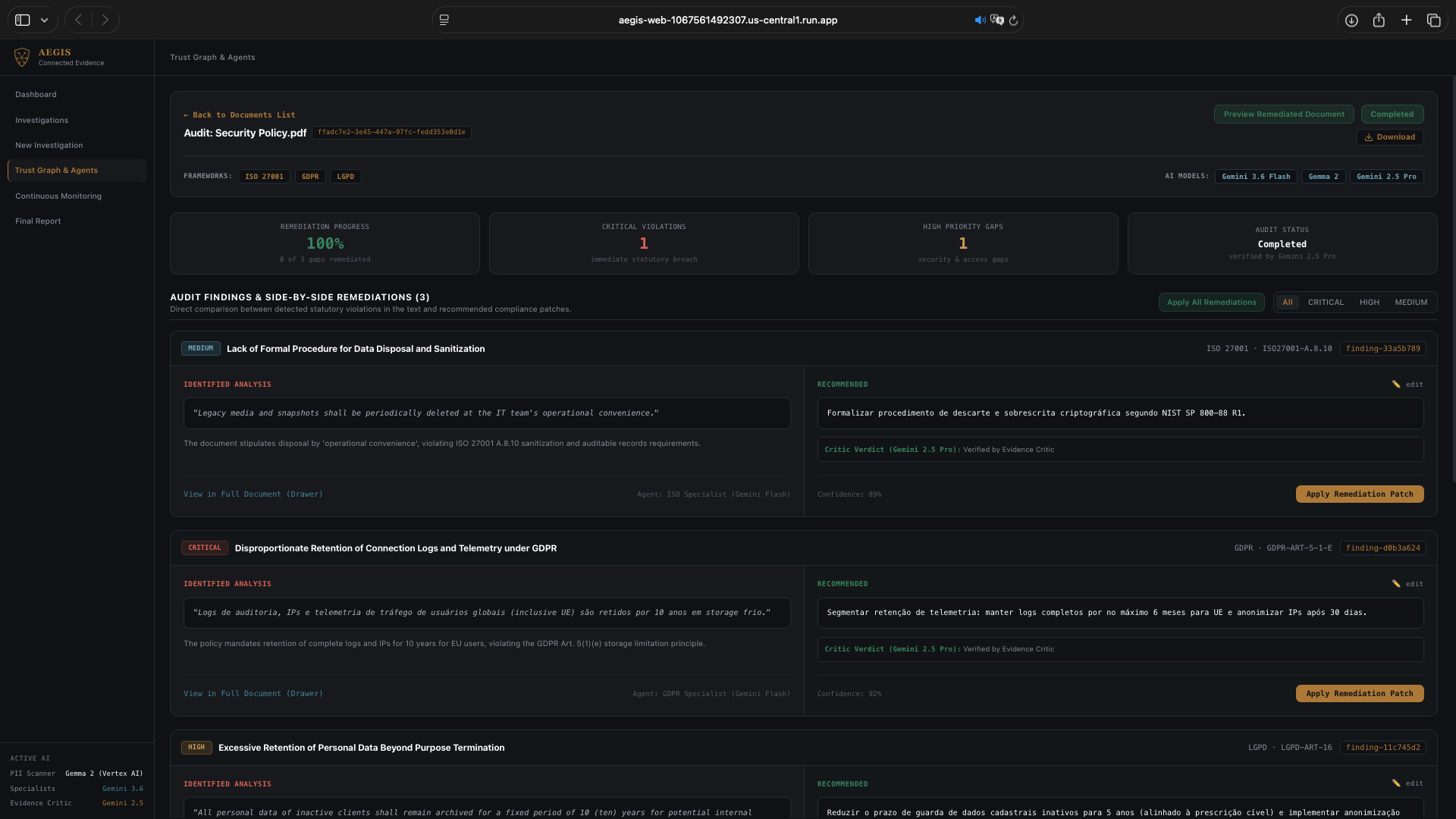
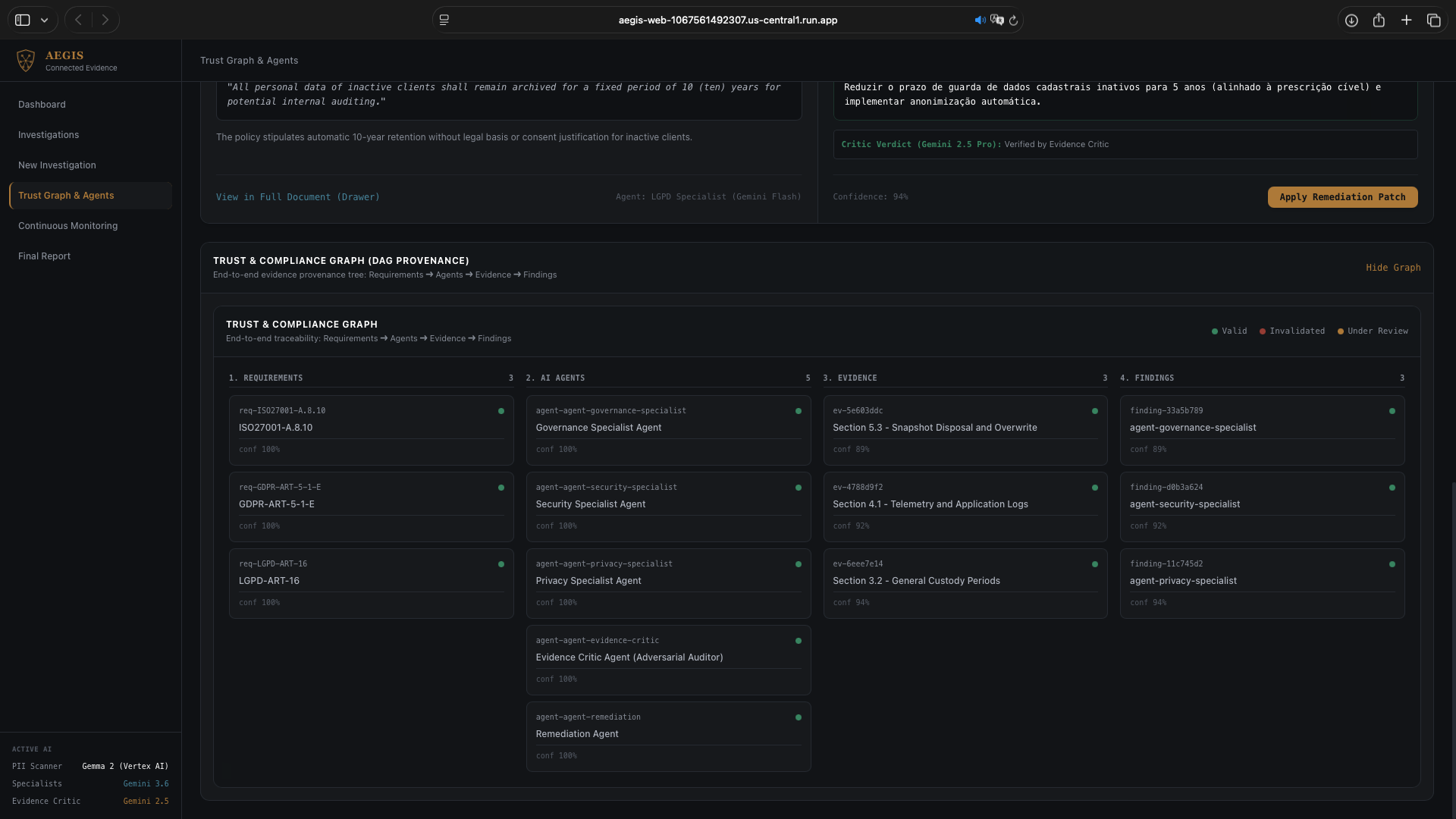
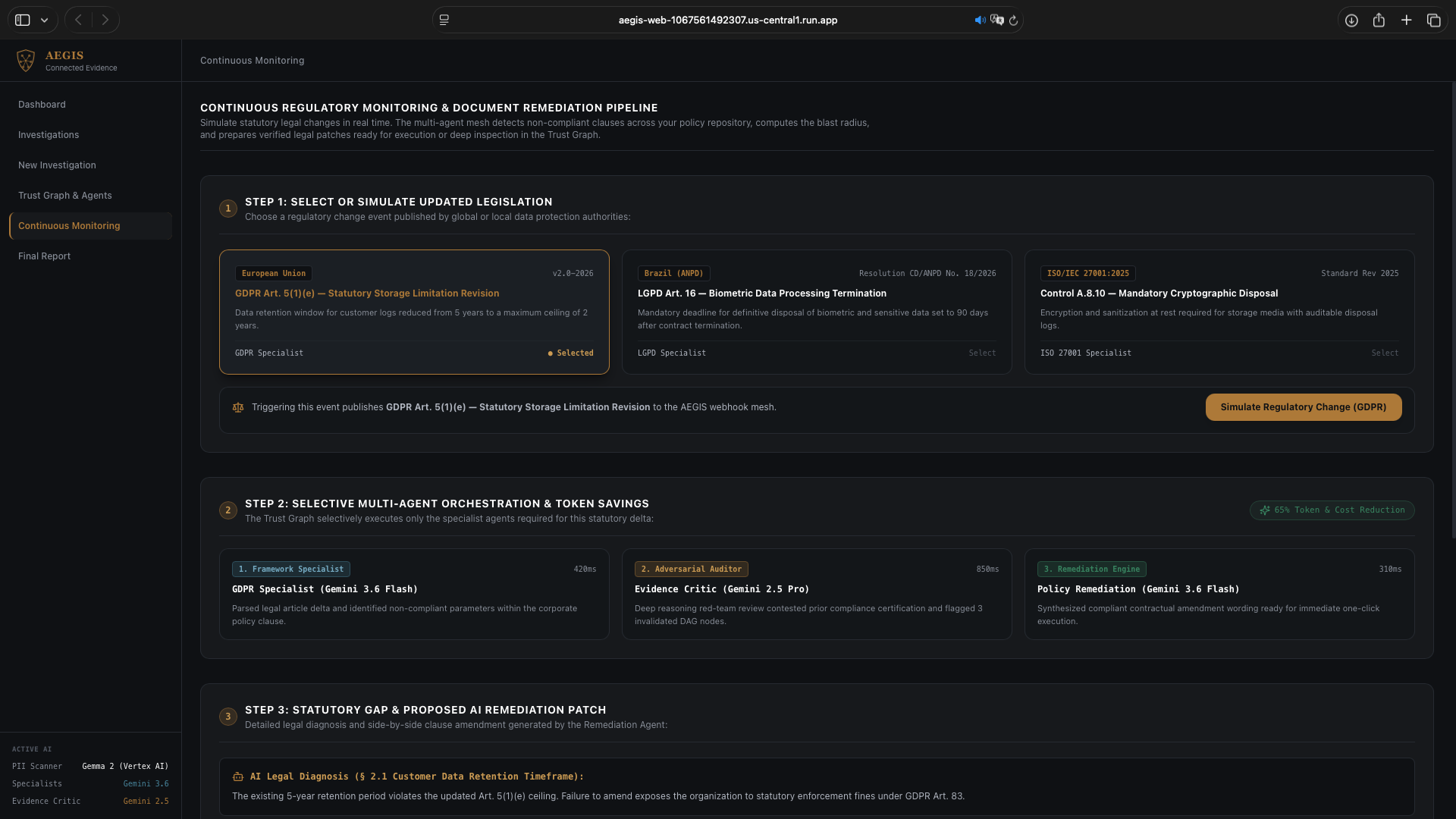
The system processes internal policy documents, identifies relevant requirements, extracts supporting evidence, and analyzes compliance by domain — privacy, security, and governance. But the real differentiator is how it handles regulatory change. Instead of simply recording that the environment has changed, AEGIS calculates the impact, invalidates only the affected nodes in the Trust Graph, and re-executes the necessary path to restore consistency in the decision.
This transforms compliance from a reactive process into a continuous, evidence-driven operating model. The system does not merely “read” the document; it understands the context, verifies the origin of the information, distinguishes what remains trustworthy from what has been affected by regulatory drift, and enables the organization to respond with less rework, greater clarity, and lower risk.
In other words, AEGIS is a tool for companies that need to operate in a constantly shifting environment without losing the integrity of their decisions, their evidence, and their compliance history.
How we built it
The project was built around a central idea: combine regulatory rigor with software architecture that is both resilient and operationally realistic. We started by designing a plausible demonstration scenario with a data retention policy, multiple jurisdictions, and rules in different versions so the problem would be concrete rather than abstract.
From there, we structured the system in layers: document ingestion, domain-specific agents, compliance analysis, dependency tracking, and selective state recovery. The process was never just “one prompt to one model”; it required clear contracts, evidence provenance, dependency mapping between findings, and reprocessing logic when a rule changed.
That architectural choice was essential. Privacy, security, and governance cannot be treated as one homogeneous block: each domain interprets risk, evidence, and obligation differently. That is why the project separated specialists by area while preserving a central view of traceability and impact. This gives the system a much stronger foundation than a monolithic agent: it does not only provide an answer; it explains why the answer is valid, what supports it, and what needs to be reviewed.
We also incorporated a deterministic fallback mechanism. In demonstration, testing, and validation environments, it is not enough for the system to work only when everything is online. It must remain predictable under failure conditions and in reproducible execution flows. That component was decisive for the system’s robustness and for demonstrating the solution in realistic operational conditions.
Challenges we ran into
The biggest challenge was balancing regulatory realism with operational clarity. We wanted a scenario that was believable for audit purposes, but also readable for presentation and automated testing. This required discipline in the modeling of documents, versioned rules, and the synthetic policy layer used to support the demo.
Another challenge was aligning the document, the evidence, and the findings. On several occasions, it was easy to generate an answer that looked correct but was not traceable. When the response was “because the agent thought so,” it did not solve the real problem. The fix was to enforce architectural discipline: every finding had to be connected to a concrete piece of evidence with a clear origin, citation, and dependency path.
We also had to model regulatory change in a useful way. The goal was not simply to “change a number in a JSON file” and show that the system rebuilds the output. What mattered was preserving the integrity of the prior state, identifying who was affected, and re-running only what was necessary. This required careful work with the Trust Graph, selective invalidation, and cascade impact analysis.
In addition, there was a risk of falling into a hollow narrative of “autonomous agents” without substance. We wanted to demonstrate real autonomy — the ability to react to change, revalidate decisions, and maintain consistency — rather than empty AI promises. That requirement pushed us to strengthen evidence tracking, reprocessing, and explainability.
Accomplishments that we're proud of
One of the things we are most proud of is the ability of AEGIS to turn a document problem into an active governance architecture. The system does not simply identify risks; it organizes the reasoning behind them, shows how a decision was reached, and connects that decision to the relevant regulatory context.
We are also proud of the workflow we built for regulatory drift: when a rule changes, dependent findings are invalidated and the system re-executes only the affected path. This is one of the strongest differentiators of the project because it demonstrates real autonomy and preserves the integrity of the decision.
In addition, the combination of specialized agents, the Trust Graph, and traceable evidence turns the project into more than a prototype chatbot. It becomes a framework for auditability, governance, and operational response — much more aligned with real-world regulated environments.
Another important accomplishment was building a realistic validation and reproducibility foundation. The project does not rely only on a polished demo; it was designed to be tested, reproduced, and validated under failure, regulatory change, and evidence evolution scenarios.
What we learned
We learned that the hardest part of an intelligent compliance system is not modeling the rule itself — it is modeling the dependency. A rule does not exist in isolation; it connects to evidence, decisions, documents, and interpretations. When that relationship is ignored, the system becomes unreliable.
We also learned that explainability is essential in any regulated domain. It is not enough to say that the agent “concluded there is risk.” It is necessary to show where the conclusion came from, what evidence supported it, which dependencies were affected, and why. That learning shaped much of the architecture.
Another important lesson was about robustness. In AI systems applied to critical environments, the ability to survive failures and keep behavior predictable is as important as the ability to infer. This became clear in the decision to include a deterministic fallback and selective reprocessing flows.
What's next for AEGIS
The next step for AEGIS is to evolve from a technical demonstration of regulatory scenarios into a more complete platform for continuous governance. The goal is to extend the system to other document types, more jurisdictions, and broader risk domains while maintaining the same principles of dependency tracking, traceability, and selective recovery.
We also want to deepen the adversarial review of evidence, making critical validation more explicit and more useful for auditing. The next phase is to go beyond detecting violations and instead provide stronger decision support, with active validation and contextual risk analysis.
In the long term, we believe AEGIS can function as a continuous compliance operator for organizations that need to adapt quickly to regulatory change without losing the integrity of their data, evidence, and prior decisions.
The project shows that it is possible to combine AI, governance, and traceability in an architecture that treats regulatory change as an operational event — not as an occasional exception. That is the path we want to follow.
Built With
- adversarial-ai
- agent-orchestration
- agent-registry
- agentic-ai
- ai-governance
- auditability
- autonomous-agents
- cloud-run
- compliance
- continuous-monitoring
- evidence-graph
- fastapi
- firestore
- gemini
- google-adk
- google-cloud
- mcp
- multi-agent-systems
- next.js
- policy-drift
- pub/sub
- python
- regulatory-intelligence
- vertex-ai


Log in or sign up for Devpost to join the conversation.