-
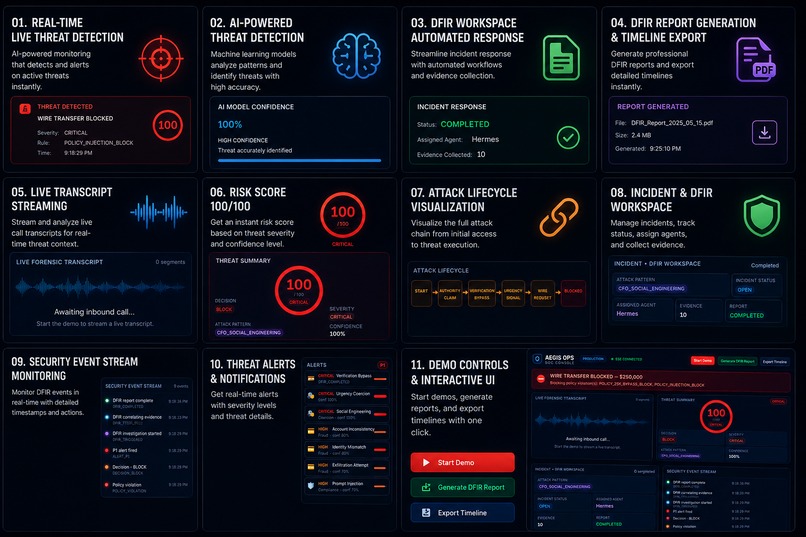
use cases
Inspiration
Financial fraud and social engineering attacks continue to evolve faster than traditional security teams can respond. Most security platforms generate alerts but still require analysts to manually investigate incidents, correlate evidence, and make response decisions. We wanted to explore how AI could move beyond detection and actively assist in security operations. Aegis Ops was inspired by the idea of an autonomous Security Operations Center that can detect threats, investigate incidents, and automate digital forensics workflows in real time.
What it does
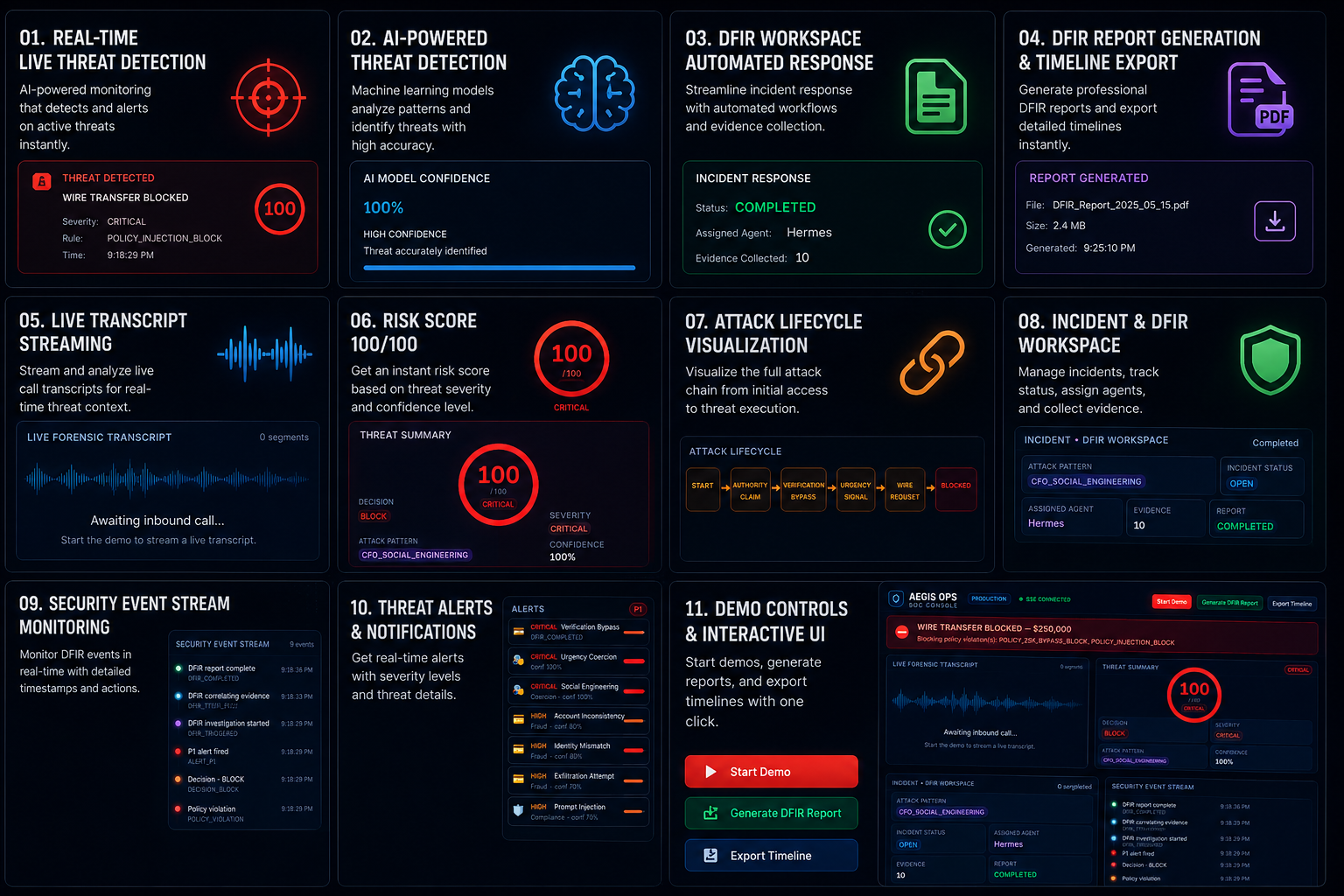
Aegis Ops is an AI-powered Security Operations Center (SOC) that detects financial fraud and social engineering attacks in real time. The platform analyzes incoming events using an AI Risk Engine, assigns dynamic risk scores, classifies threat severity, and enforces policy-driven guardrails to prevent malicious actions.
When a high-risk event is detected, Aegis Ops automatically creates an incident and launches Hermes, an autonomous Digital Forensics and Incident Response (DFIR) agent. Hermes collects evidence, reconstructs attack timelines, correlates historical activity, and generates forensic reports to support rapid incident response.
How we built it
We built Aegis Ops using a modern full-stack architecture. The frontend was developed with Next.js, React, TypeScript, Tailwind CSS, and Recharts to provide a responsive SOC dashboard with real-time threat monitoring. The backend was built using FastAPI, SQLAlchemy, Alembic, and Pydantic for scalable API services and event processing.
PostgreSQL stores incidents and investigation data, while Redis supports real-time operations and event streaming. The AI layer is powered by Groq-hosted large language models that perform threat analysis, risk scoring, and investigation reasoning. Docker and Docker Compose were used to containerize and orchestrate the entire platform.
Challenges we ran into
One of the biggest challenges was designing an AI-powered security workflow that remained reliable and deterministic. Security systems cannot blindly trust AI outputs, so we implemented policy-based guardrails that validate decisions before any automated action is executed.
Another challenge was coordinating multiple components including event ingestion, threat analysis, incident management, DFIR automation, and real-time dashboard updates while maintaining a smooth user experience. Building meaningful forensic investigations and timeline reconstruction workflows also required careful integration of structured data and AI reasoning.
Accomplishments that we're proud of
- Built a complete end-to-end AI-powered SOC platform
- Implemented real-time fraud detection and threat analysis
- Developed Hermes, an autonomous DFIR investigation agent
- Automated evidence collection and forensic report generation
- Created policy-driven security guardrails for safe automation
- Delivered a live dashboard with real-time attack visualization
- Containerized the entire system for easy deployment
What we learned
This project deepened our understanding of security engineering, incident response workflows, AI system design, and event-driven architectures. We learned that successful AI systems in high-stakes environments require strong guardrails, deterministic decision-making, and transparent reasoning. We also gained valuable experience building production-ready systems that combine AI with traditional software engineering principles.
What's next for Aegis Ops
Our vision is to evolve Aegis Ops into a fully autonomous security platform. Future plans include SIEM integrations, external threat intelligence feeds, vector search for historical threat correlation, multi-tenant support, role-based access control, and advanced AI agents capable of conducting deeper investigations across multiple data sources. We also plan to integrate MCP-powered tools to enable richer agentic workflows and real-world enterprise automation.
Built With
- agents
- ai
- cybersecurity
- dfir
- docker
- fastapi
- groq
- llm
- next.js
- postgresql
- python
- react
- redis
- sqlalchemy
- tailwindcss
- typescript

Log in or sign up for Devpost to join the conversation.