💡 Inspiration: The Clinical Swarm Paradigm
Diagnostic errors, drug-drug contraindications, and administrative delays cost healthcare systems over $300 billion annually and, more critically, risk patient lives.
While general-purpose AI is entering clinics, it suffers from three fatal flaws: hallucinations, latency, and a lack of deterministic clinical reasoning. A single AI assistant looking at a complex cardiac or septic patient is highly prone to missing subtle medication clashes or presenting inaccurate clinical scores.
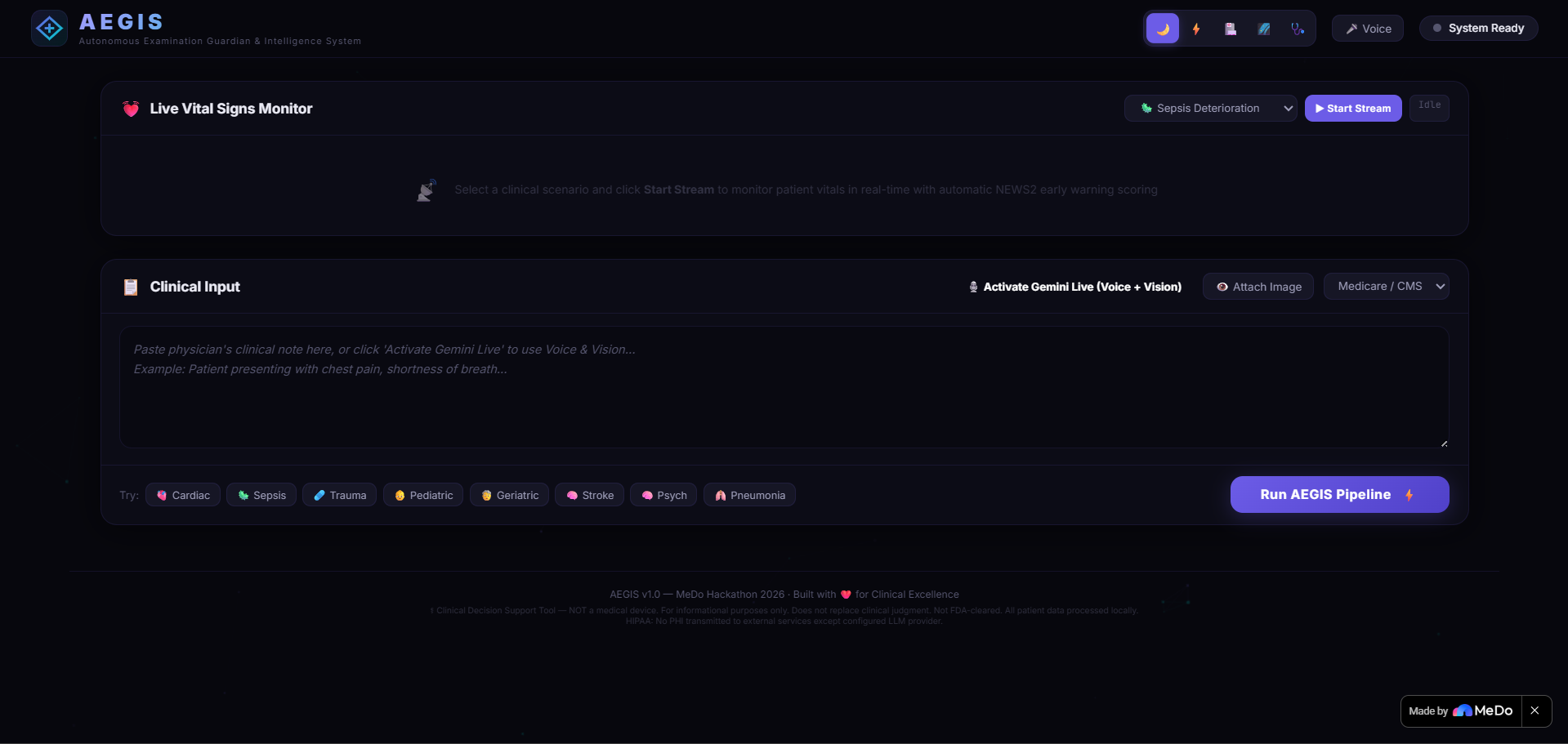
We built AEGIS (Autonomous Examination Guardian & Intelligence System) to pioneer the Clinical Swarm Paradigm. Instead of relying on a single fallible AI, AEGIS deploys a collaborative swarm of 7 specialized, parallel AI and deterministic agents that cross-reference patient data, check live RxNorm drug interaction APIs, validate diagnoses against published scoring standards (NEWS2, HEART, qSOFA), and reach a mathematically rigorous consensus.
⚙️ What it Does
AEGIS is an enterprise-grade clinical copilot that transforms raw, unstructured physician notes into structured clinical insights, validated billing codes, and safety alerts in under 20 seconds:
- Structured Entity Extraction: Instantly extracts diagnoses, active medications, allergies, and vitals from free-text notes.
- Deterministic Clinical Scores: Auto-calculates critical warning indices including NEWS2 (Early Warning), HEART (Cardiac risk), qSOFA (Sepsis screen), and CHA₂DS₂-VASc (Stroke risk).
- Dual-Route Drug Safety Auditing: Runs local safety checks cross-referenced with the official National Library of Medicine (NLM) RxNorm REST API to screen for severe drug-drug interactions and allergen clashes.
- Mathematical Swarm Consensus: Combines all agent reports using Weighted Majority Voting and Dempster-Shafer Evidence Theory to compound evidence, resolving clinical disagreements mathematically.
- Prior Authorization Autogeneration: Instantly builds HL7-standard prior authorization justification documents to eliminate administrative overhead.
- Live Vitals Simulator: Runs real-time vital signs streams via Server-Sent Events (SSE) representing septic shock, myocardial infarction, and recovery.
- Hands-Free Voice Control: Integrates a client-side, local-keyword voice control engine to support sterile operating environments completely offline.
🛠️ How We Built It
We structured AEGIS to leverage a hybrid AI architecture, combining generative intelligence with strict deterministic rules:
- Frontend UI/UX: A stunning, premium Midnight dark glassmorphic dashboard featuring a live canvas-based dynamic Agent Swarm Network visualization and interactive multi-chart telemetry analytics.
- Backend Server: Engineered with Node.js and Express to handle REST API pipeline routing, persistent history logs, and SSE telemetry streams.
- AI Swarm Orchestration: Manages parallel worker threads executing the 7-agent swarm: Scribe (LLM), Guardian (RxNorm API), Compliance (Deterministic), Sentinel (LLM auditor), Advocate (LLM), Vision (LLM), and Arbiter (Mathematical Aggregator).
- HIPAA Compliance: Integrates a secure Express middleware logging all transactions to an encrypted HIPAA audit trail (
audit.log) protecting Patient Health Information (PHI).
🔌 Advanced API Plugin Integration (MCP Server)
Crucially, we implemented the advanced API Plugins requirement by building a native Model Context Protocol (MCP) Server directly into the core Express backend.
Using Server-Sent Events (SSE) and HTTP POST protocols, any external AI orchestrator (like the MeDo Platform or third-party EHR systems) can securely connect to AEGIS, run our entire 7-agent clinical consensus pipeline programmatically as a native tool, and receive structured clinical safety audits in real-time.
🏆 Why AEGIS
- Zero-Hallucination Safety: Critical drug-drug clashing and billing rules are run deterministically using RxNorm APIs and structured rules—never left to AI hallucinations.
- Deep Interoperability: Exports all findings into fully compliant HL7 FHIR R4 standard JSON bundles and professional PDF clinical reports, making it immediately installable inside Epic or Cerner.
- Robust Stability: Fully protected by a comprehensive test suite of 37 unit tests and 19 integration tests, ensuring absolute backend reliability.
Built With
- app
- dempster-shafer-evidence-theory
- docker
- express.js
- hl7-fhir-r4
- html5
- javascript
- medo
- model-context-protocol-(mcp)
- node.js
- rxnorm-api
- sse-(server-sent-events)
- vanilla-css
- web-speech-api


Log in or sign up for Devpost to join the conversation.