-
-
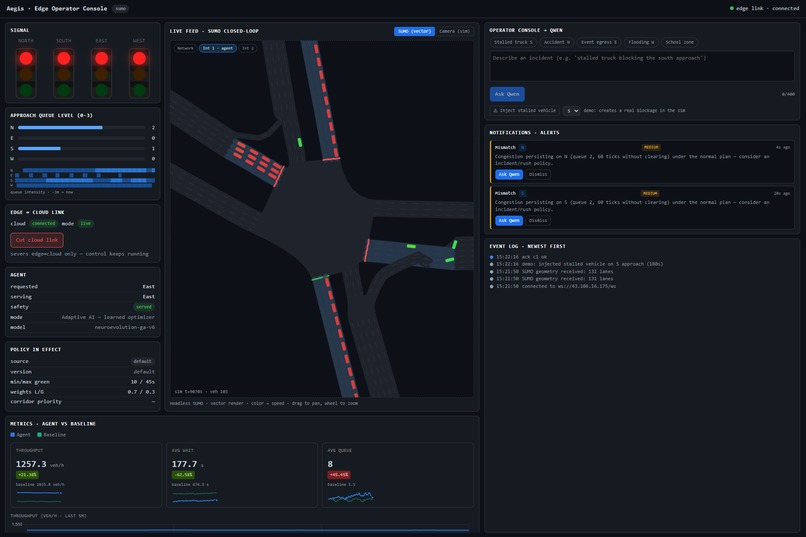
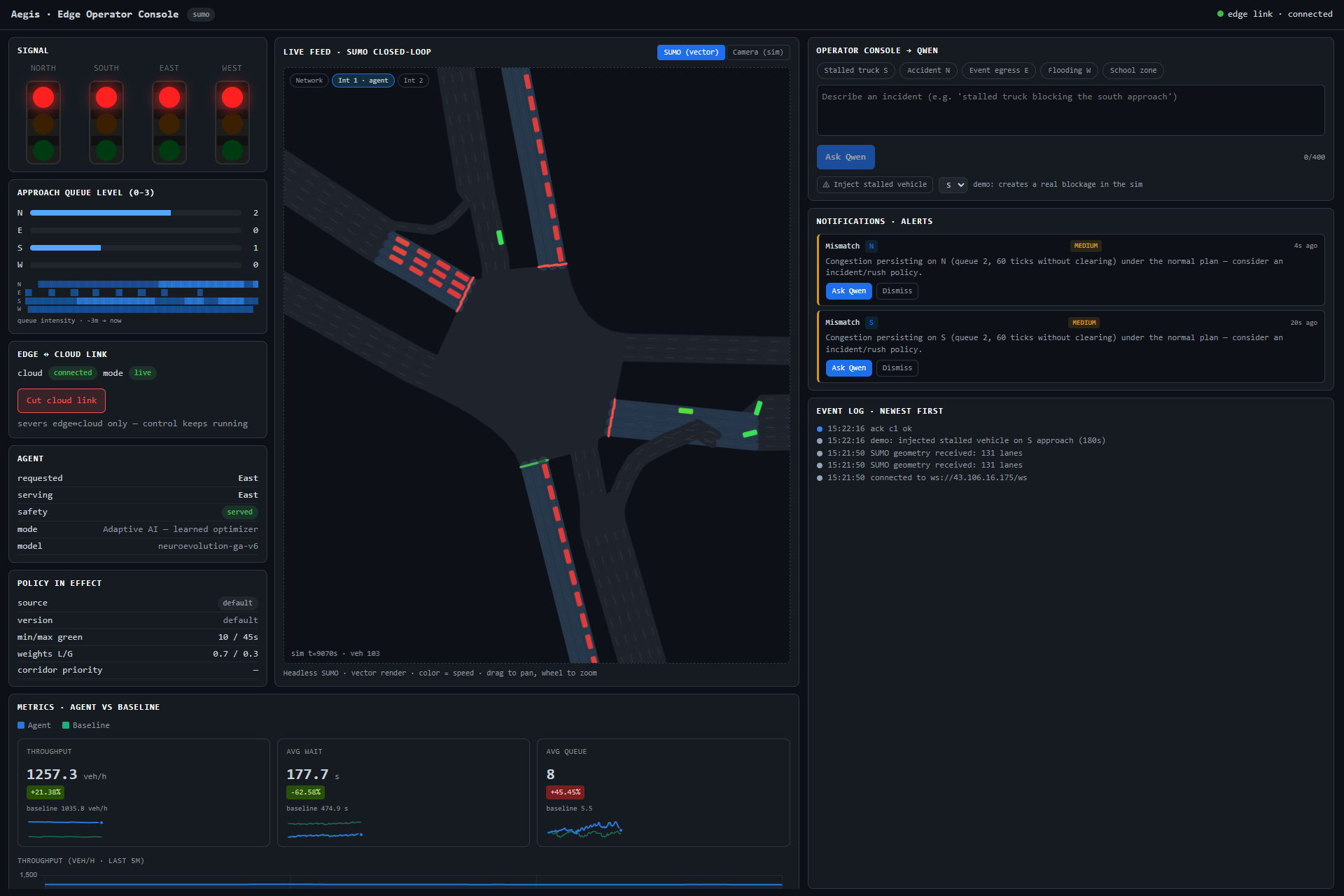
Dashboard
-
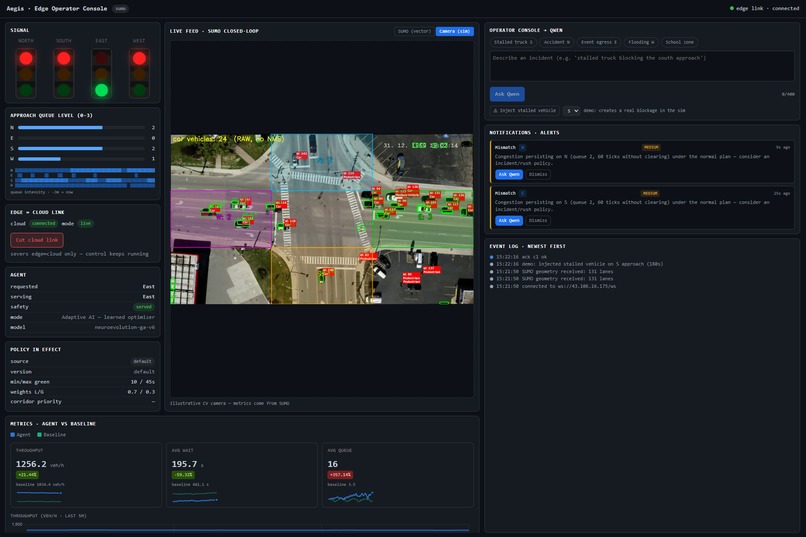
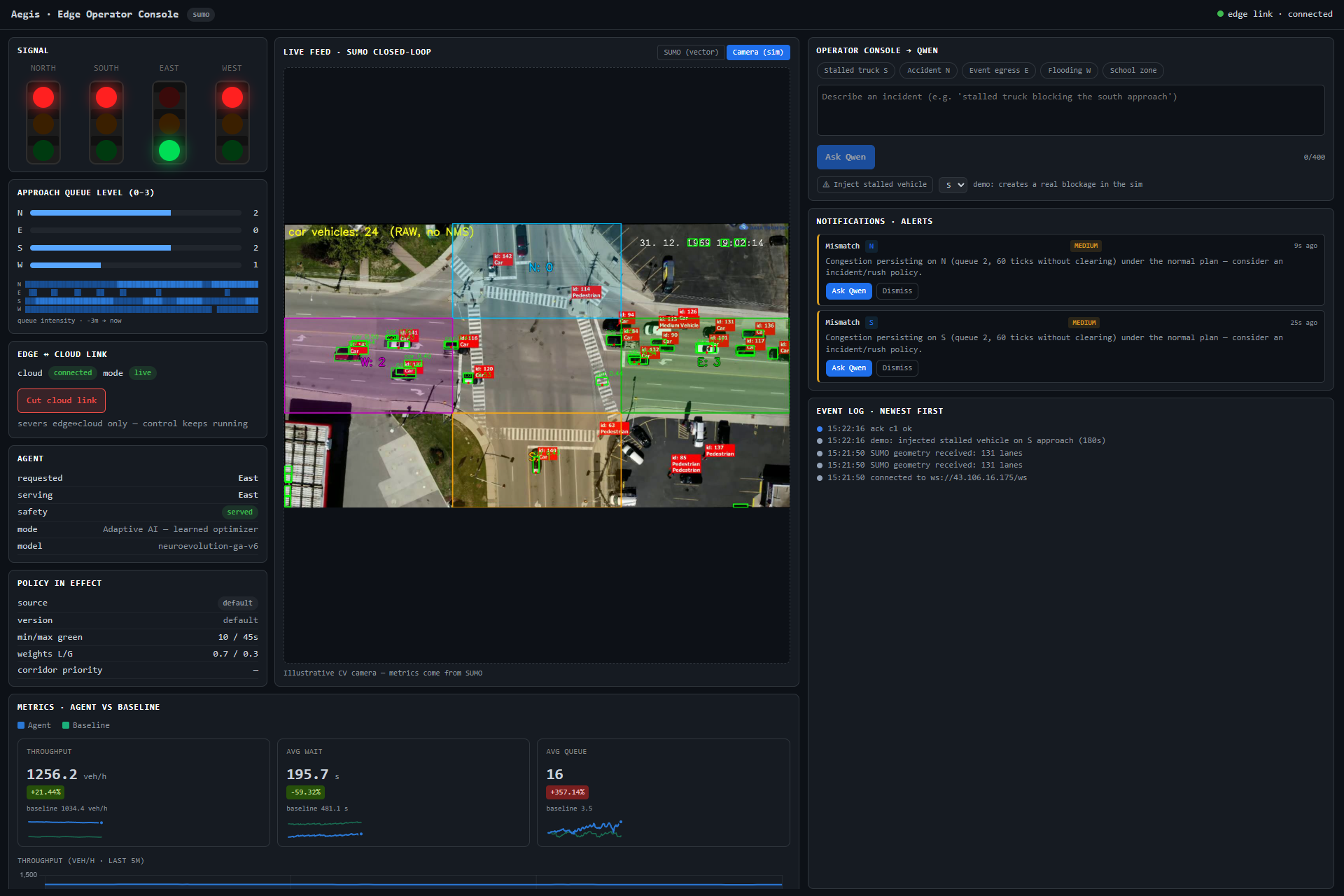
Dashboard
Inspiration
Traffic congestion is a strange problem: the low-level control is a solved, millisecond-scale engineering discipline, but the judgment layer above is not. A stalled truck, a school-zone surge, and a concert letting out all look like "long queues" to a signal controller. They need different responses, and today that judgment lives in a human control room.
Our first thought was obvious: traffic is jammed, Qwen is smart, let Qwen pick the green light. But, that should not be implemented, a cloud LLM should never be in the hot loop of a safety-critical system that must survive bad network days. That rejection became the whole design: the edge is authoritative. Qwen proposes. Humans approve. The safety validator gets the final word.
What it does
Aegis is a traffic-signal EdgeAgent. A local edge runtime runs the intersection on a perceive → decide → validate → actuate loop. Qwen, running on Qwen Cloud, wakes up at event cadence: it reasons over incidents, SOPs, weather, calendar events, and telemetry (via RAG and MCP tools), then emits a schema-valid policy proposal. A human operator approves or rejects it in a dashboard. Approved policies are still clamped by a hard safety validator before they touch the lights. Cut the cloud link mid-demo, and the intersection keeps running on the last safe policy, then a cached fallback plan. Nothing leaves the edge, a privacy filter is enforced, so only relevant telemetry are passed to the cloud.
How we built it
- Edge runtime + safety validator (Python). The validator is the only component that emits signal commands. It enforces min/max green, yellow/all-red clearance, and anti-starvation, and it clamps every policy, whether authored by Qwen or approved by a human.
- Qwen operator (QwenCloud). A two-stage reason → emit pattern: free-form reasoning with tools first, then a constrained call that emits
PolicyProposalJSON validated against a schema, with one repair attempt and a safe fallback. We measured model tiers instead of guessing:qwen3.6-flashmatchedqwen3.7-pluson proposal quality at roughly half the latency, so flash is the default and plus is the escalation model. - Escalation ladder. Deterministic triggers (zero LLM cost) → Qwen-VL confirms a cropped frame and grades severity → only high severity auto-escalates to the full proposal flow. The LLM gets called when something is worth reasoning about, not every tick.
- Perception. An HDI-finetuned YOLO11 detector (exported to ONNX) counts vehicles in calibrated approach zones: 75.9% exact-bin and 94.6% busiest-approach agreement against across five clips. In the demo, SUMO carries the closed control loop; the CV path is a measured showcase that shares the same
TrafficStatecontract and feeds Qwen-VL incident intake live. - Learned controller. We evolved a tiny NumPy MLP with a genetic algorithm instead of shipping our original DQN. Fitness is throughput-dominated, $f = \text{throughput} - 2 \cdot \text{in_network} - 0.5 \cdot \text{timeloss}$, evaluated inside the exact validated deployment loop. In a 2-hour live A/B it beat our actuated baseline: +21% throughput (1267 vs 1044 vehicles) and 71% lower mean wait (158s vs 544s).
- Hosted backend. FastAPI + WebSocket backend on Alibaba Serverless App Engine; a full operator ask (RAG retrieval + five MCP tool calls + Qwen proposal) completes in seconds hosted.
Challenges we ran into
- Every hosted Qwen call silently black-holed. After deploying to SAE, DashScope requests just hung, while in-process RAG kept working, which made it look like our code. The VPC had no internet egress. One NAT gateway, EIP, and SNAT entry later, the pipeline came alive. Lesson: check egress before debugging your client.
- Rich reasoning and strict structured output fought each other in a single call, so we split the operator into reason → emit. The workaround became the architecture.
What we learned
The most valuable thing an LLM adds to a control system is not control, it's supervision: interpreting a situation, citing the right SOP, proposing a bounded policy, and explaining why. Everything hard about this project was keeping that boundary honest: in the safety validator, in the fitness function, in the demo script, and in our own claims.
Try it
Live demo available 9am–9pm PT daily (throughout judging period) at the "Try it out" links below.


Log in or sign up for Devpost to join the conversation.