-
-
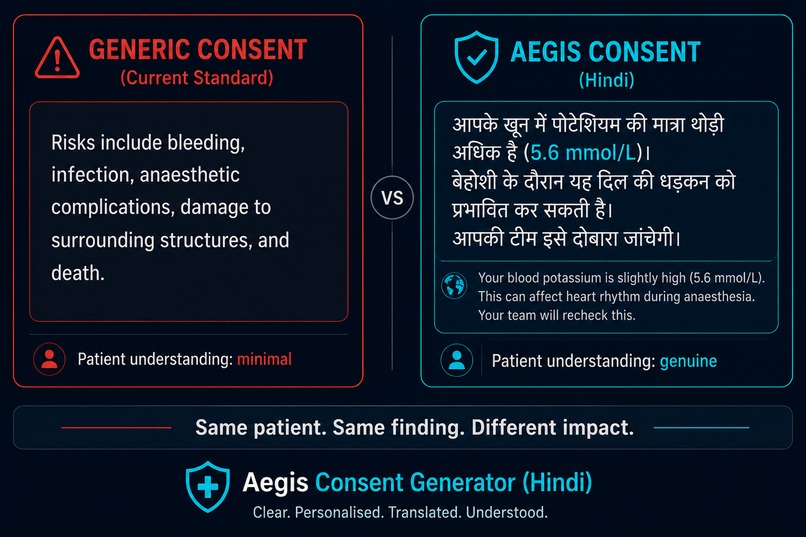
From Complex Medical Language → Clear Hindi Explanations
-
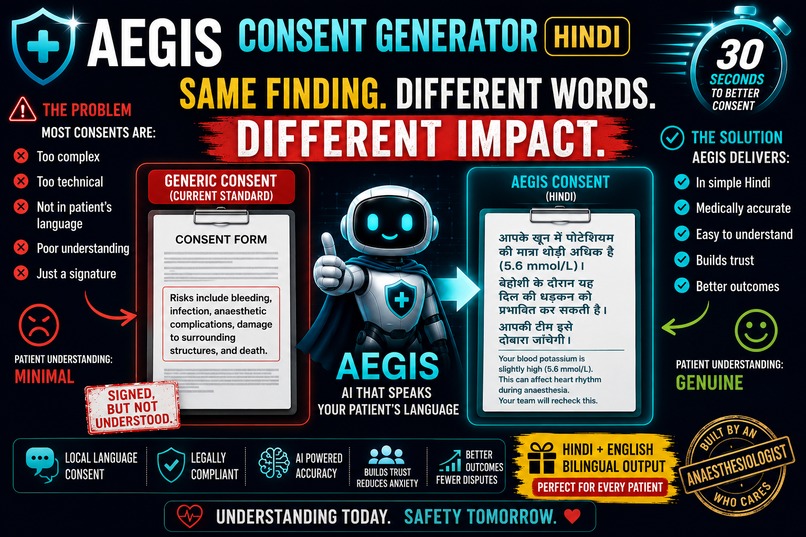
AI-generated perioperative consent in Hindi — designed for patients to truly understand.
-
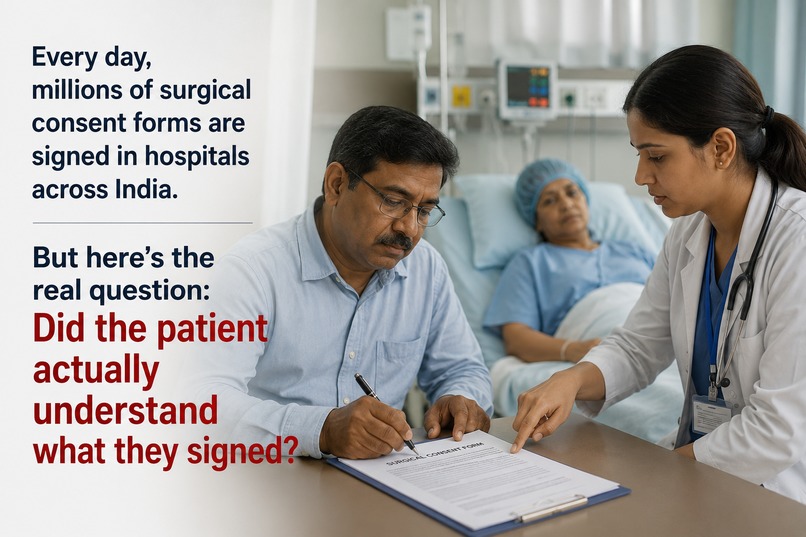
Consent Patients Can Actually Understand
-
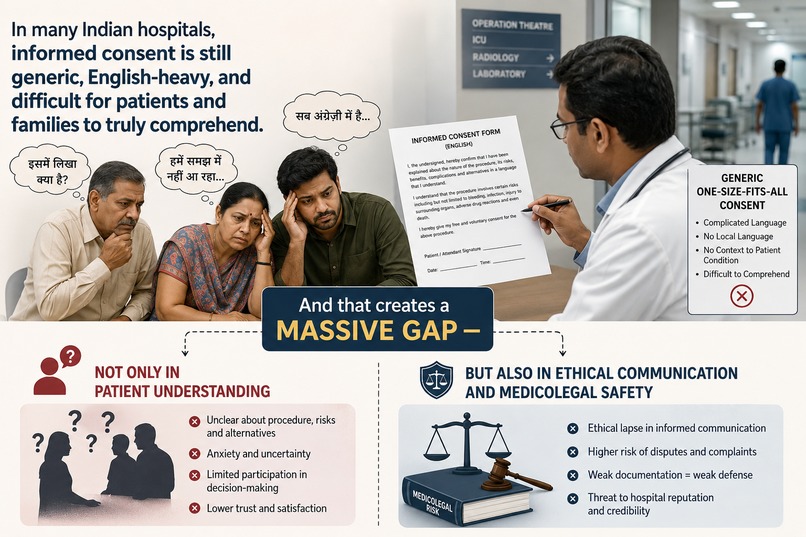
AI That Speaks the Patient’s Language Safer surgery starts with better understanding.
-
When Patients Understand Risks, Care Becomes Safer Aegis transforms perioperative data into understandable consent.
INSPIRATION
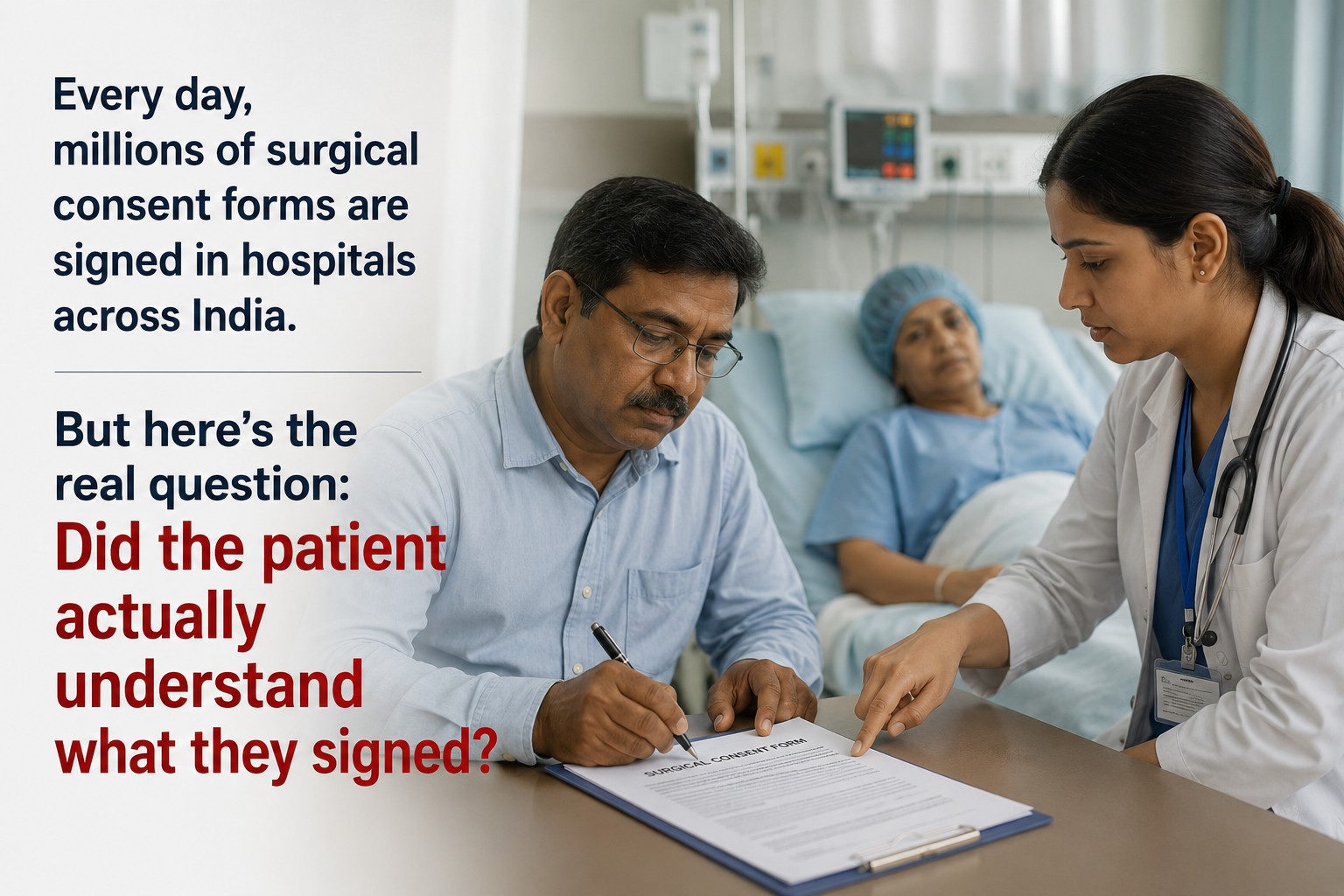
India performs over 50 million surgical procedures annually.
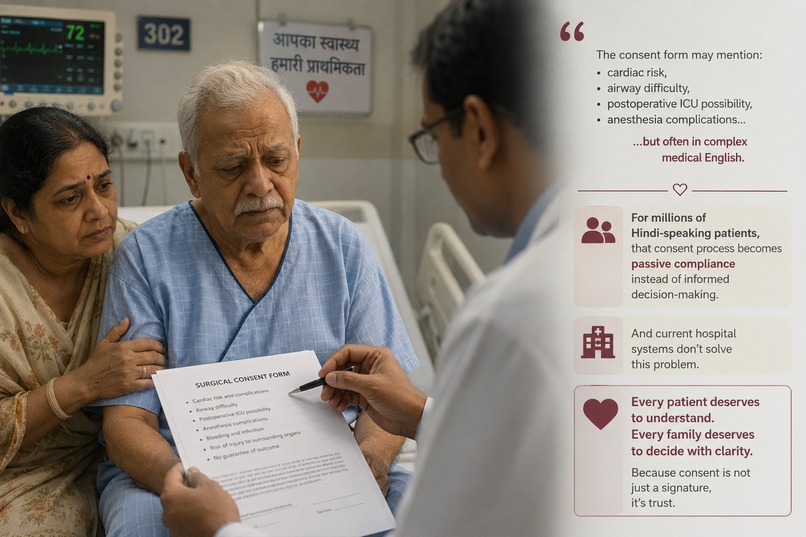
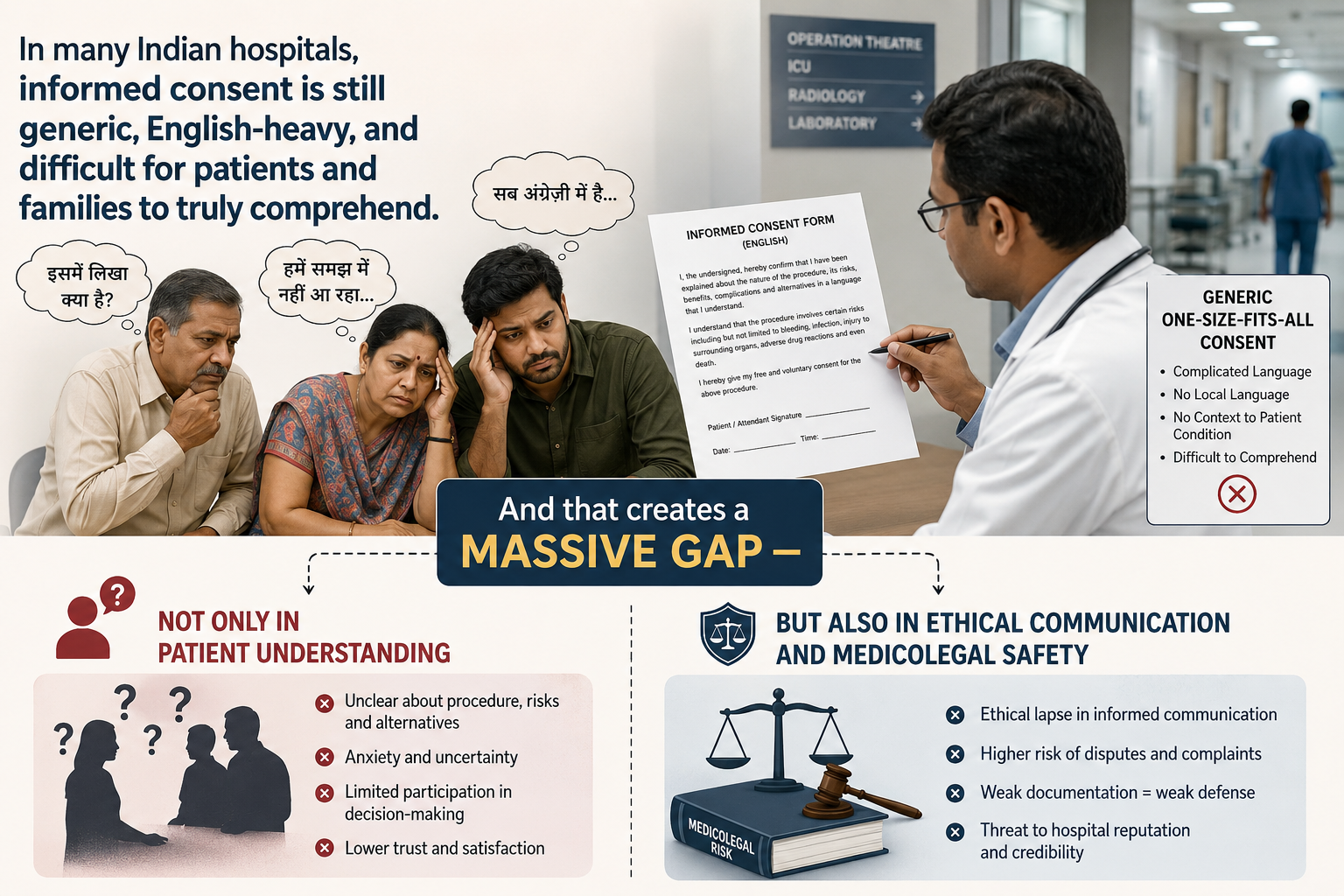
The majority of patients in government hospitals — AIIMS, PGIMER, JIPMER, district hospitals — are Hindi-speaking, with limited English literacy. Yet almost all pre-operative informed consent happens in English: the consent form, the surgeon's explanation, the anaesthesia risk discussion.
This is not informed consent. It is the performance of consent.
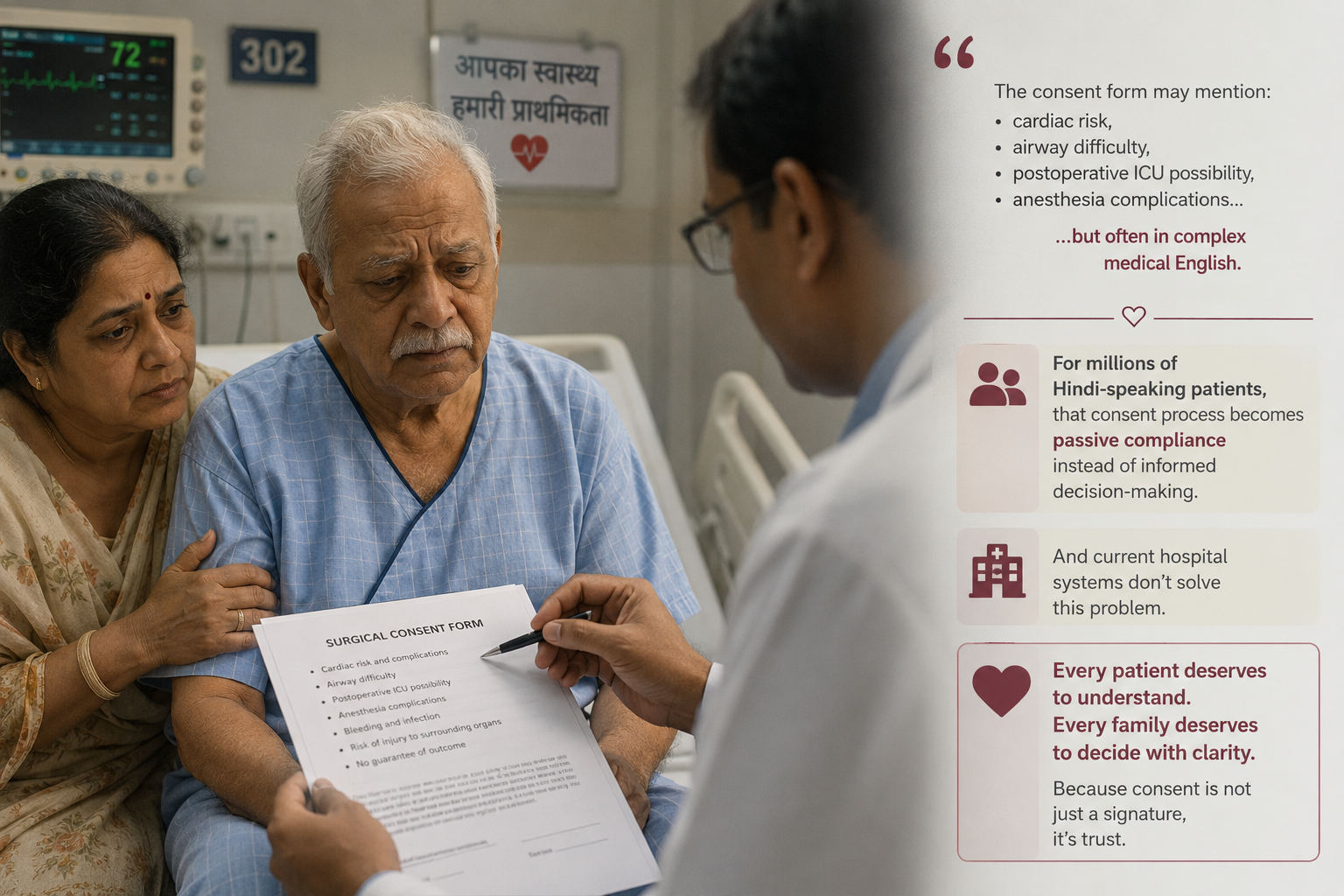
A patient who cannot read the form they are signing has not consented to their surgery. A patient who does not understand what “anaesthetic complications” means — in any language — has not been informed of the risks. Legally, the signature may hold. Ethically, it does not.
I see this every week. A patient from rural Uttarakhand, a farmer or a teacher or a homemaker, who has never heard the word “hyperkalemia” — signed a form using that word without understanding it. They trusted us. We owe them better than a signature on a form they could not read.
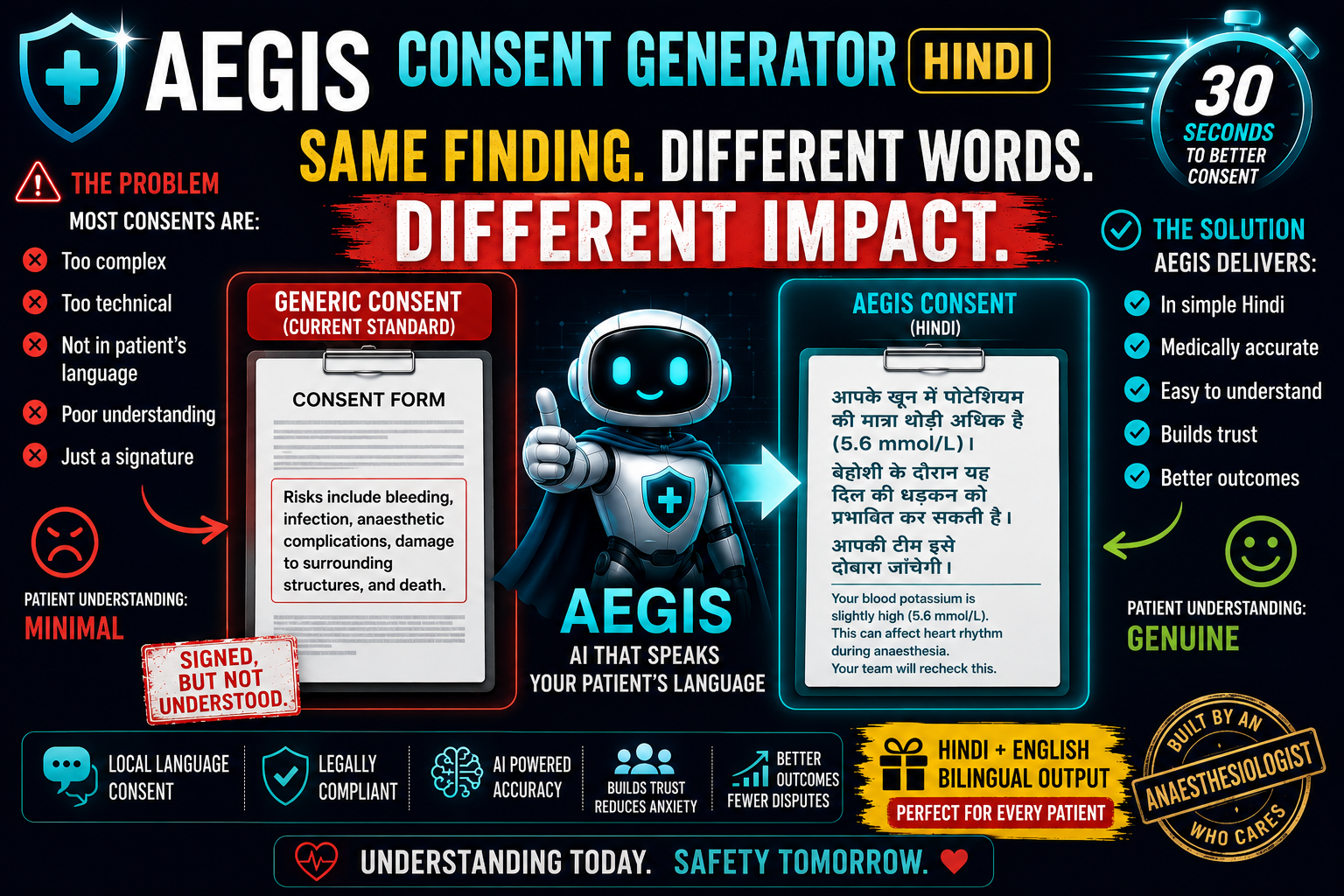
Aegis Consent Generator (Hindi) was built to close this gap.
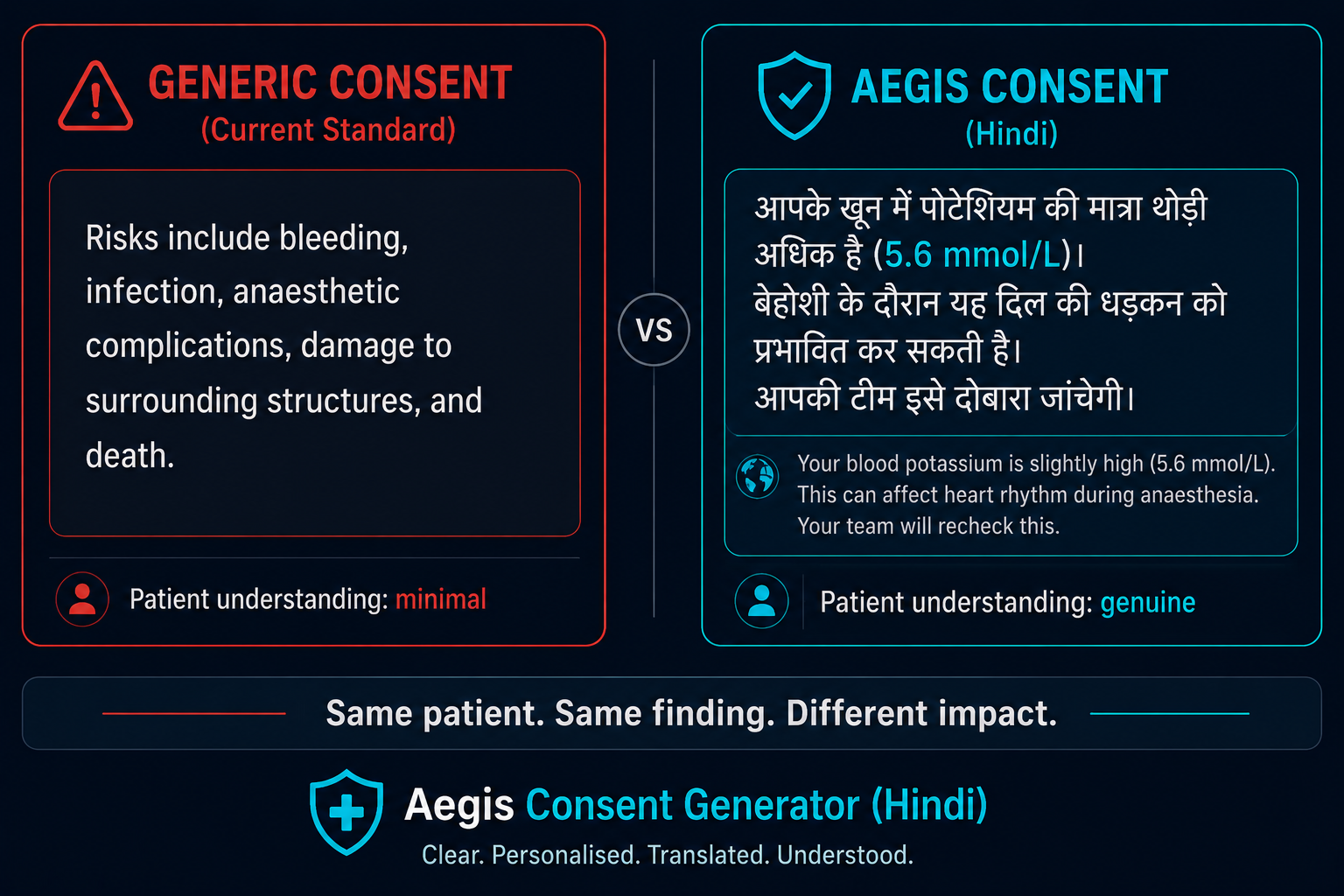
Not as a translation tool. As a clinical communication agent that understands the patient’s actual risk profile — the K+ of 5.6, the Mallampati 3, the uncontrolled HbA1c — and explains it in clear, warm, respectful Hindi that a patient can read, understand, and genuinely consent to.
WHAT IT DOES
Aegis Consent Generator (Hindi) is a PromptOpinion AI agent that receives a completed preoperative risk assessment via A2A handoff from the Aegis Perioperative Copilot and produces a structured, patient-specific informed consent brief in Hindi.
It is the same 8-section clinical structure as the English agent — but written in simple, accessible Hindi, calibrated for a typical educated Indian family. Not literary Hindi. Not bureaucratic Hindi. The Hindi you would speak to a patient’s family in a pre-op clinic.
LANGUAGE ARCHITECTURE
Patient-facing sections (1, 2, 3, 6, 7)
- Written in clear, simple Hindi (Grade 8 level)
- Medical terms introduced in Hindi, with English in parentheses
Example:
रक्त में पोटेशियम (Serum Potassium) की मात्रा थोड़ी अधिक है
(5.6 mmol/L; सामान्य 5.0 से कम होनी चाहिए)।
Clinical documentation sections (4, 5 — Surgeon Checklist + Optimisation Action Table)
- Bilingual: Hindi label + English clinical term alongside
- Medicolegal records must be interpretable by English-language review; Hindi alone is insufficient
Example:
□ रोगी को ASA III वर्गीकरण के बारे में बताया गया
/ Patient informed of ASA III classification.
WHAT MAKES THIS DISTINCTLY INDIAN
1. Indian Clinical References
AIDAA 2024 guidelines, ISA protocols, AIIMS context wherever relevant — not just western guideline citations.
2. Indian Drug Names
Glycomet instead of Metformin, Ecosprin instead of Aspirin, Warfarin as “खून पतला करने की दवा (Warfarin)” — the name the patient actually knows from their prescription.
3. Indian Cost Framing
When explaining consequences of postponement, references to ₹ costs rather than $ or £ — relevant to the patient’s financial planning around surgery.
4. Family-Inclusive Language
Indian patients typically make health decisions with family. The language is written to be readable aloud to a family member, not just to the literate patient alone.
5. Cultural Calibration
Warm, respectful tone appropriate to Indian patient-doctor relationships. Honest about risk without being alarming.
WORKED EXAMPLE (K+ 6.4 — POSTPONE CASE)
English Consent
“Serum potassium is critically elevated at 6.4 mmol/L. Surgery is contraindicated. Postponement required.”
Aegis Consent Hindi
आपके खून में पोटेशियम (Potassium) की मात्रा बहुत अधिक है
(6.4 mmol/L; यह सामान्य से काफी ज़्यादा है)। इस स्थिति में
बेहोशी के दौरान दिल की धड़कन पर खतरनाक असर हो सकता है।
इसलिए अभी ऑपरेशन करना सुरक्षित नहीं है। आपके डॉक्टर पहले
इसका इलाज करेंगे और जब यह मात्रा सामान्य हो जाए, तब
ऑपरेशन की नई तारीख़ तय होगी।
Translation
“The amount of potassium in your blood is very high (6.4 mmol/L; this is much more than normal). In this condition, there can be a dangerous effect on heart rhythm during anaesthesia. Therefore, operating now is not safe. Your doctor will treat this first, and when the level becomes normal, a new surgery date will be set.”
This is what genuine informed consent in Hindi looks like.
POSTPONEMENT NOTICE IN HINDI
When the Aegis recommendation is POSTPONE, the Hindi agent generates a full postponement letter in Hindi — explaining:
- why surgery cannot proceed,
- what must happen before rescheduling,
- and who to contact.
The patient receives this in a language they can read and share with their family.
HOW WE BUILT IT
AGENT ARCHITECTURE
Aegis Supervisor (Agent 1)
       ↓ assessment JSON via A2A
Aegis Safety Reviewer (Agent 2)
       ↓ final assessment + safety addendum via A2A
Aegis Consent Generator Hindi (Agent 4)
       ↓
8-section bilingual consent brief
SYSTEM PROMPT (IN HINDI)
Written entirely in Hindi — intentionally.
The system prompt establishes:
- the agent’s identity in Hindi,
- language rules,
- reading level (
कक्षा 8), - Indian clinical context requirements,
- recommendation-gating behaviour.
CONSULT PROMPT
Includes:
- full 8-section structure,
- worked examples for every major flag type,
- bilingual formatting rules,
- explicit postponement letter structure.
WORKED EXAMPLES IN THE PROMPT
For:
- hyperkalemia
- difficult airway
- metformin
- HbA1c
- OSA
- PONV
- anticoagulants
Each includes a calibrated Hindi paragraph to guide consistent medical output.
MCP TOOLS
The Consent Generator operates primarily from A2A assessment JSON, but remains connected to the Aegis Anesthesia MCP server.
If additional patient context is needed, the agent can directly call:
fetch_patient_from_fhirnormalize_fhir
This allows:
- re-querying live EHR data,
- verifying missing values,
- grounding consent language in verified patient data.
MCP SERVER STACK
- Python 3.11
- FastMCP 3.x
- Railway deployment
- FHIR R4
Production Tools
fetch_patient_from_fhirassess_current_patientnormalize_fhircompute_risk_scoresfetch_guidelineformat_aegis_report
Deterministic Risk Engine
Computes:
- RCRI
- STOP-BANG
- Apfel
- ASA
- cancellation probability
- 15+ safety flags
Rule-based logic only. No hallucinated scoring.
CHALLENGES WE FACED
Hindi Medical Language Has No Standard
There is no consensus on:
- “मधुमेह” vs “डायबिटीज़”
- “रक्त” vs “खून”
- “शल्य चिकित्सा” vs “ऑपरेशन”
For consent:
- understanding matters more than vocabulary purity.
Bilingual Section Calibration
Sections 4 and 5 must remain legally interpretable in English while readable in Hindi.
Cultural Tone Calibration
The correct tone is:
- warm,
- honest,
- respectful,
- family-aware,
- not excessively formal,
- not blunt.
Recommendation-Gated Hindi
Different recommendations require different communication structures:
PROCEEDOPTIMIZEESCALATEPOSTPONE
The postponement letter required especially careful language design.
WHAT WE LEARNED
1. Language Is a Clinical Intervention
Patients ask more questions and make more informed decisions when information is delivered in their own language.
2. Hindi AI Medical Output Needs Calibration
Without prompt engineering:
- outputs become overly literary,
- or literal English translations.
Worked examples solved this.
3. Bilingual Documentation Is Non-Negotiable
India requires:
- English clinical interoperability,
- patient-language communication.
Both are essential.
4. This Is the Missing Middle in Indian Healthcare AI
Most healthcare AI in India targets English-literate users.
The patients needing AI-assisted communication most are often excluded.
5. Context Matters
The Hindi agent works because it connects to real perioperative risk data:
- “आपका HbA1c 8.9% है”
instead of:
- “आपकी शुगर ज़्यादा है”
Specificity creates trust.
FUTURE SCOPE
Immediate
- Tamil
- Telugu
- Bengali
- Marathi
- Gujarati
- Odia
- voice consent output
Medium Term
- pictographic consent
- Hindi patient Q&A
- caregiver/family briefing mode
Long Term
- ABDM / ABHA integration
- rural telemedicine support
- national multilingual consent framework
BUILT WITH
- PromptOpinion
- A2A Protocol
- Claude Sonnet
- Python 3.11
- FastMCP
- FHIR R4
- Indian clinical context calibration
Companion Projects
- Aegis Perioperative Copilot
- Aegis Consent Generator English
LINKS
Demo Video
PromptOpinion Agent
https://app.promptopinion.ai/marketplace/agent/019e1012-8d75-71c8-a03a-3871af7cf396
Companion Projects
Aegis Perioperative Copilot
https://devpost.com/software/ai-assisted-perioperative-optimizationAegis Consent Generator English
https://devpost.com/software/aegis-intelligent-consent-generator


Log in or sign up for Devpost to join the conversation.