-
-
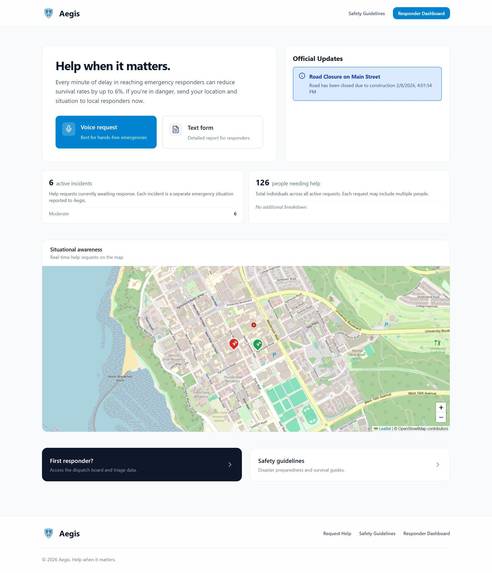
Landing Page
-
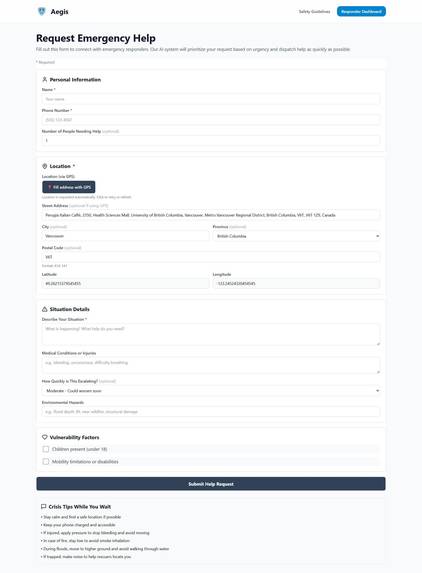
Request Help - Text
-
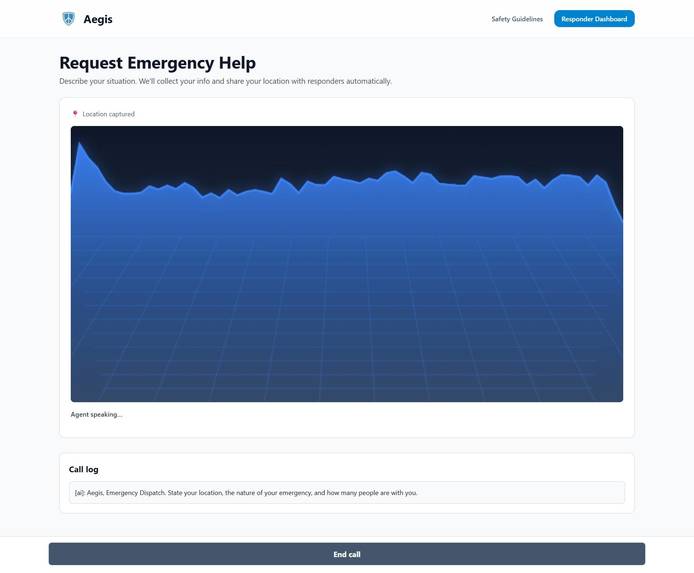
Request Help - Voice
-
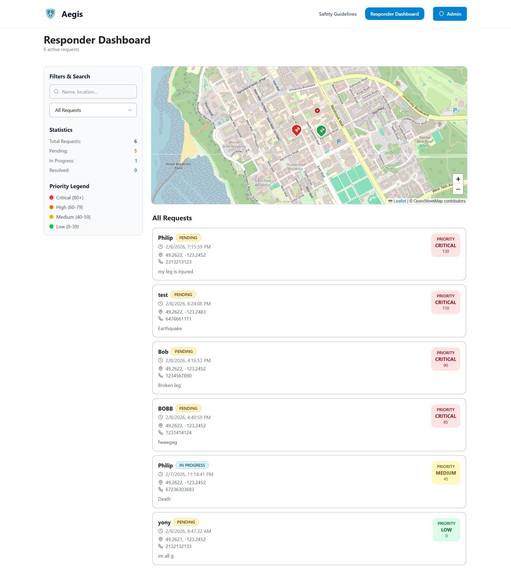
Responder Dashboard
-
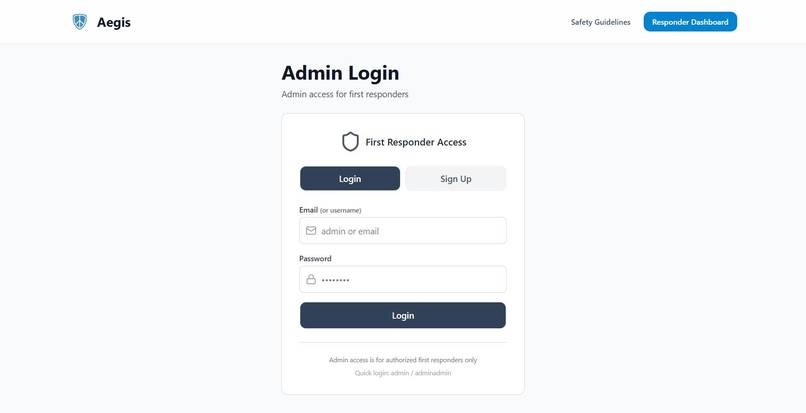
Admin Login
-
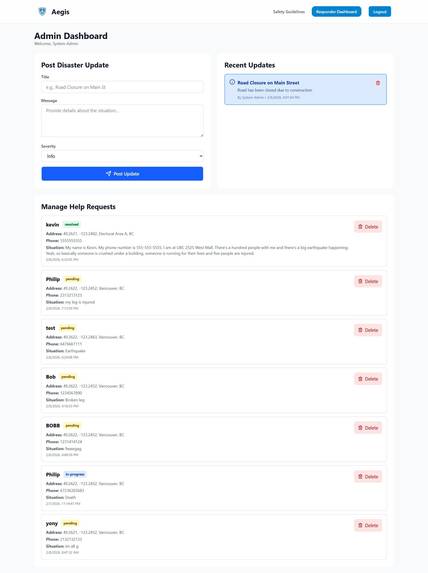
Admin Dashboard
-
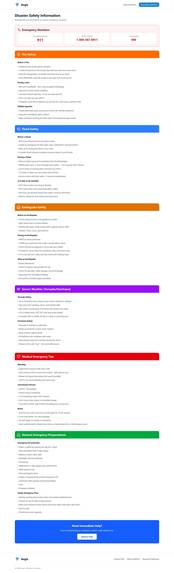
General Safety Page


Inspiration/Problem
Oftentimes, 911 and other emergency hotlines are clogged due to a sudden increase of calls following a disaster. With different callers reporting incidents of varying severity, the individuals that need help the most may not be able to reach emergency responders
What it does
Aegis is a website that all emergency traffic will be redirected to following a natural disaster. Taking inspiration from a police dispatch system, users can request for help and upon describing their issue, will be assigned a severity rating. Ratings above a score of 60 are deemed high priority and will be prioritized by trained emergency responders. Lower scores will not be as prioritized. However, if there are any other individuals that were minimally impacted by the disaster, there is an option for them to assist lower rated scores.
Admins (dispatchers/government organizations) can log in and manage requests. System wide notifications regarding the status of the disaster can also be broadcasted from this menu.
It was decided that a website would be better than a mobile app as in a disaster, data rates may be slow--reducing download speeds.
How we built it
Frontend
The frontend is built using React with TypeScript. We used Tailwind CSS and Lucide React in order to maintain a clean, modern design. We used the fetch API to make asynchronous network requests and seamlessly connect our frontend to our backend.
Backend
The backend is powered by a FastAPI + MongoDB triage service that receives emergency reports, assigns urgency, and powers responder/admin dashboards. When a report is submitted it maps form fields into structured incident data. It then scores incident severity using Gemini AI, with a built-in rule-based fallback if AI fails. The system then stores incident data using MongoDB Atlas. When the web application runs, the backend serves incident feeds, map-friendly data, and dashboard metrics to users. The server also handles incident CRUD actions for incident lifecycle management and disaster update management. Finally, our backend supports an AI chat endpoint for real-time emergency guidance using user form context and conversation history.
Challenges we ran into
For the three of us, this was our first hackathon. Starting off, everyone was quiet and kept to themselves. However, after a few hours, we warmed up and were able to function as proficient team.
On the technical side, a challenge we faced was that we were working with technology we had never worked with before. Another challenge was that we migrated to a new database service provider during the hackathon, which led to significant code refactoring.
Accomplishments that we're proud of
We are proud of the fact that we managed to realize our goal to create a complete fullstack web application leveraging modern AI and cloud solutions that can strengthen communities in the aftermath of a disaster.
What we learned
We learned how to strip the request form information in JSON format and store the data in MongoDB Atlas. We also learned how to access and manipulate that data via API calls in our frontend. In addition, we learned how to refactor code to handle a different database service provider. We learned how to integrate AI into our project, including an ElevenLabs chatbot and Gemini API to help collect incident data and provide guidance in a crisis.
What's next for Aegis - Help When It Matters Most
To implement Aegis into the real world, collaborations with local governments are required. Public service announcements and outreach would be required to inform the general public of the system.
As well, permanent servers that can handle thousands of requests are needed.
Data security wasn't prioritized during this project as it is assumed that in a life or death situation, individuals are less likely to be worried about parts of their personal data (such as name or current location) being released to the public if it brings them help.


Log in or sign up for Devpost to join the conversation.