-
-
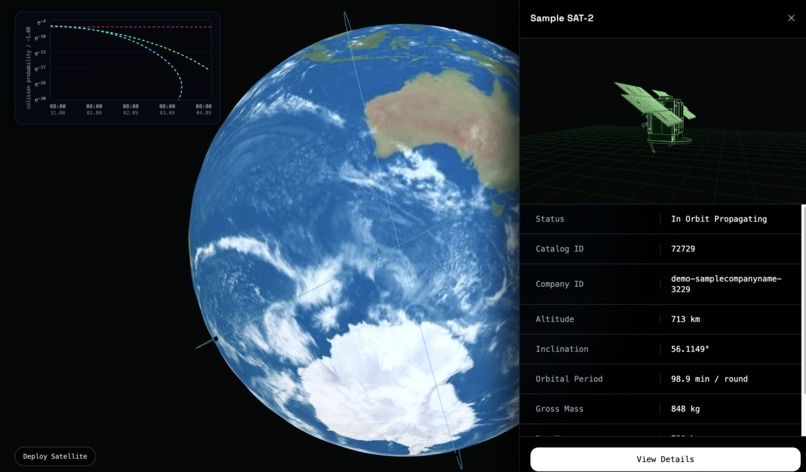
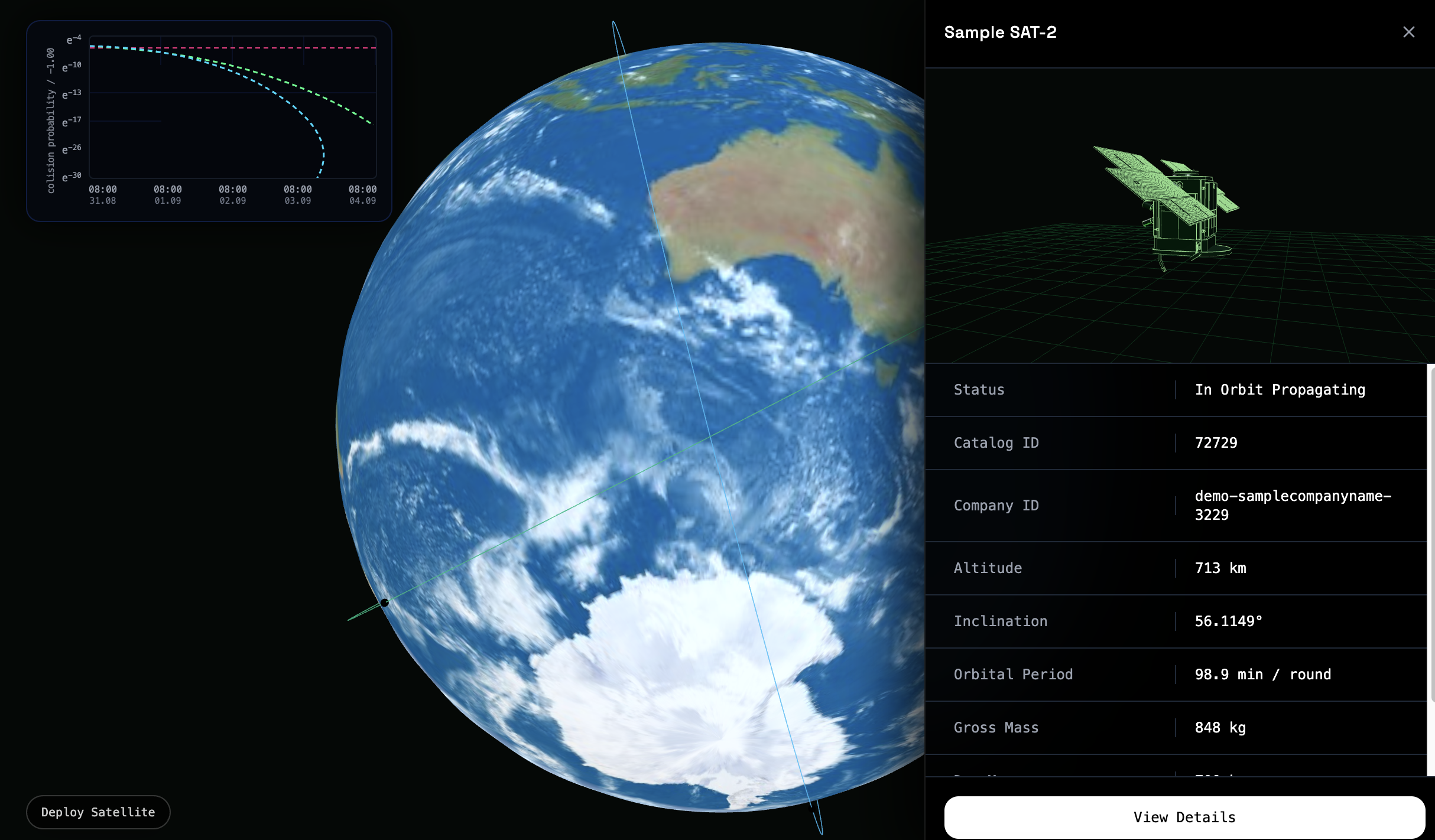
Webapp for testing
-
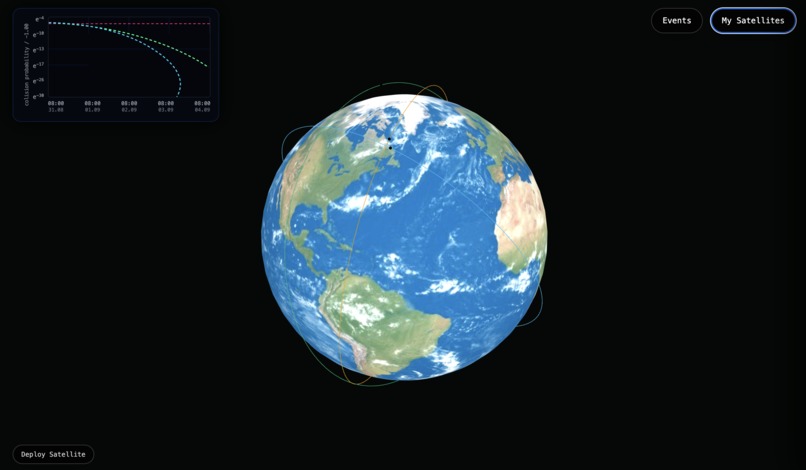
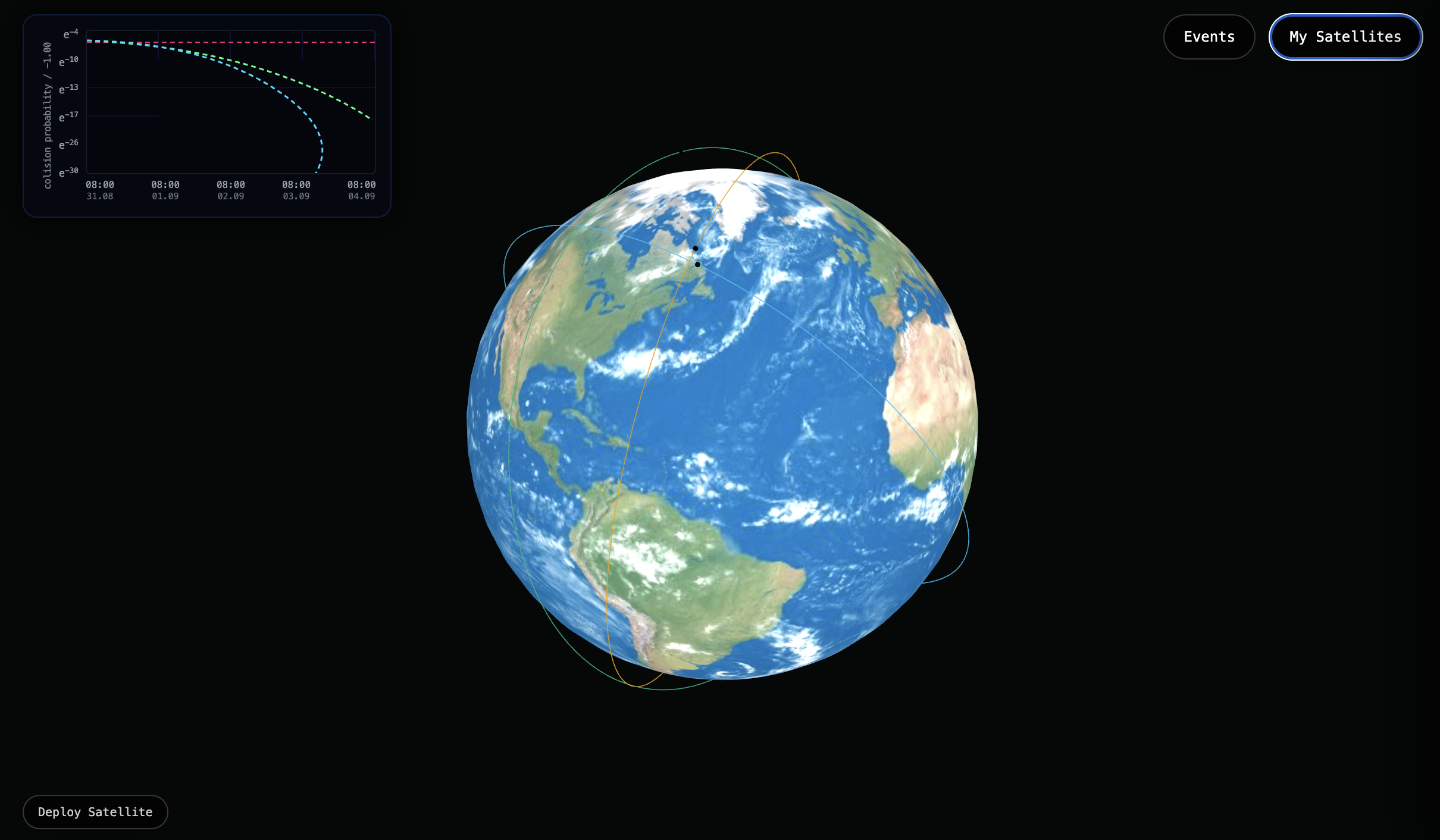
Testing with multi paths
-
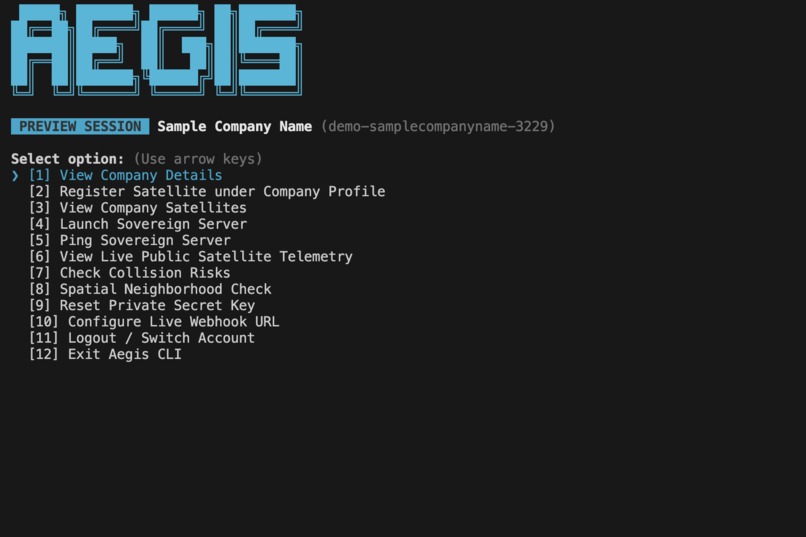
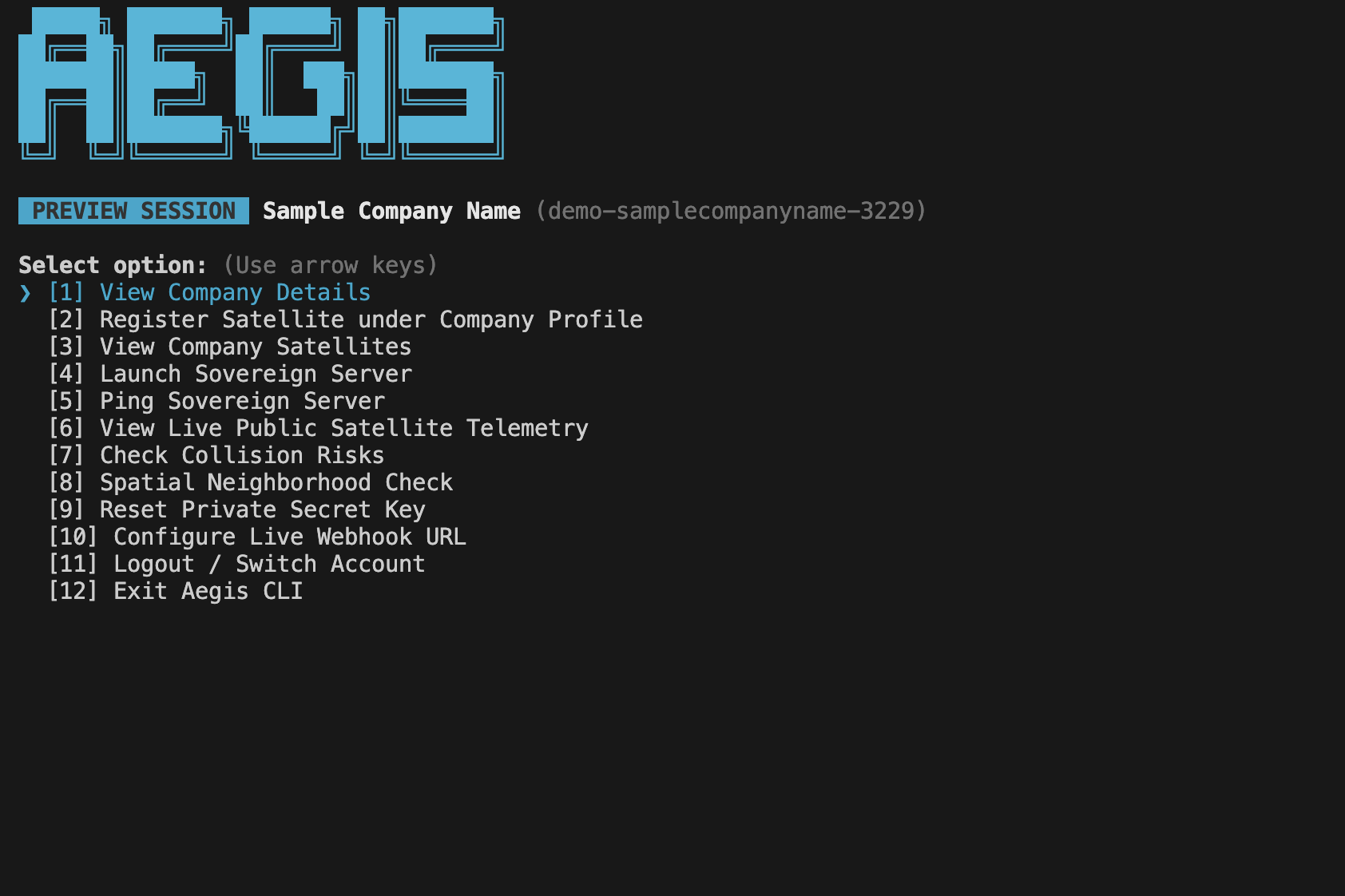
CLI
-
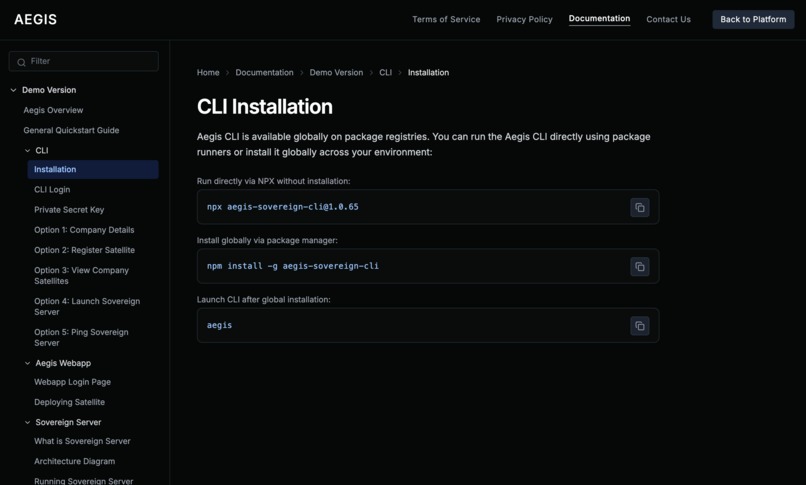
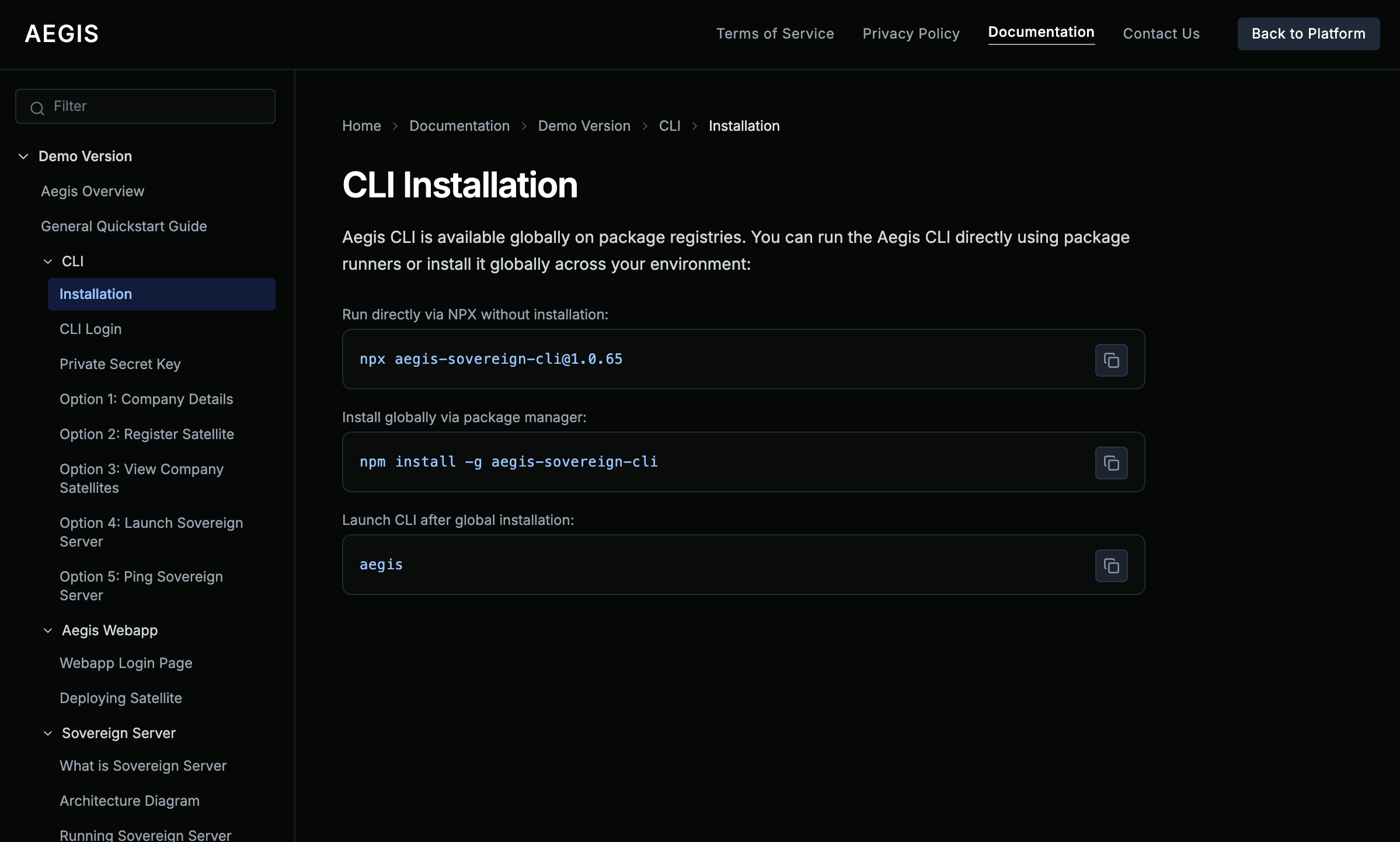
Docs Detailed Explanation.
Inspiration
Earth Orbit is rapidly filling up with thousands of satellites launched by commercial companies and sovereign entities. Moving at orbital velocities exceeding \( 7.5\text{ km/s} \), even a minor close call between two satellites can cause a catastrophic space collision.
When two rival satellites find themselves on a collision course, a high stakes standoff occurs. Executing an evasive maneuver consumes non renewable onboard fuel, shortening satellite operational lifespan and causing multi million dollar mission downtime. Neither company wants to be the one forced to yield and burn fuel first. While software solutions exist today to manage space traffic, they force companies to upload their secret operational data into third party databases, which satellite operators strongly refuse to do.
We created Aegis to break this orbital deadlock. We envisioned a system where competing satellite operators do not need middleman agencies or central databases to resolve orbit emergencies. By enabling their servers to connect directly with each other, both sides can privately negotiate right of way, determine who should safely execute the evasive maneuver, and instantly settle the economic impact in seconds before a collision occurs.
How It Works
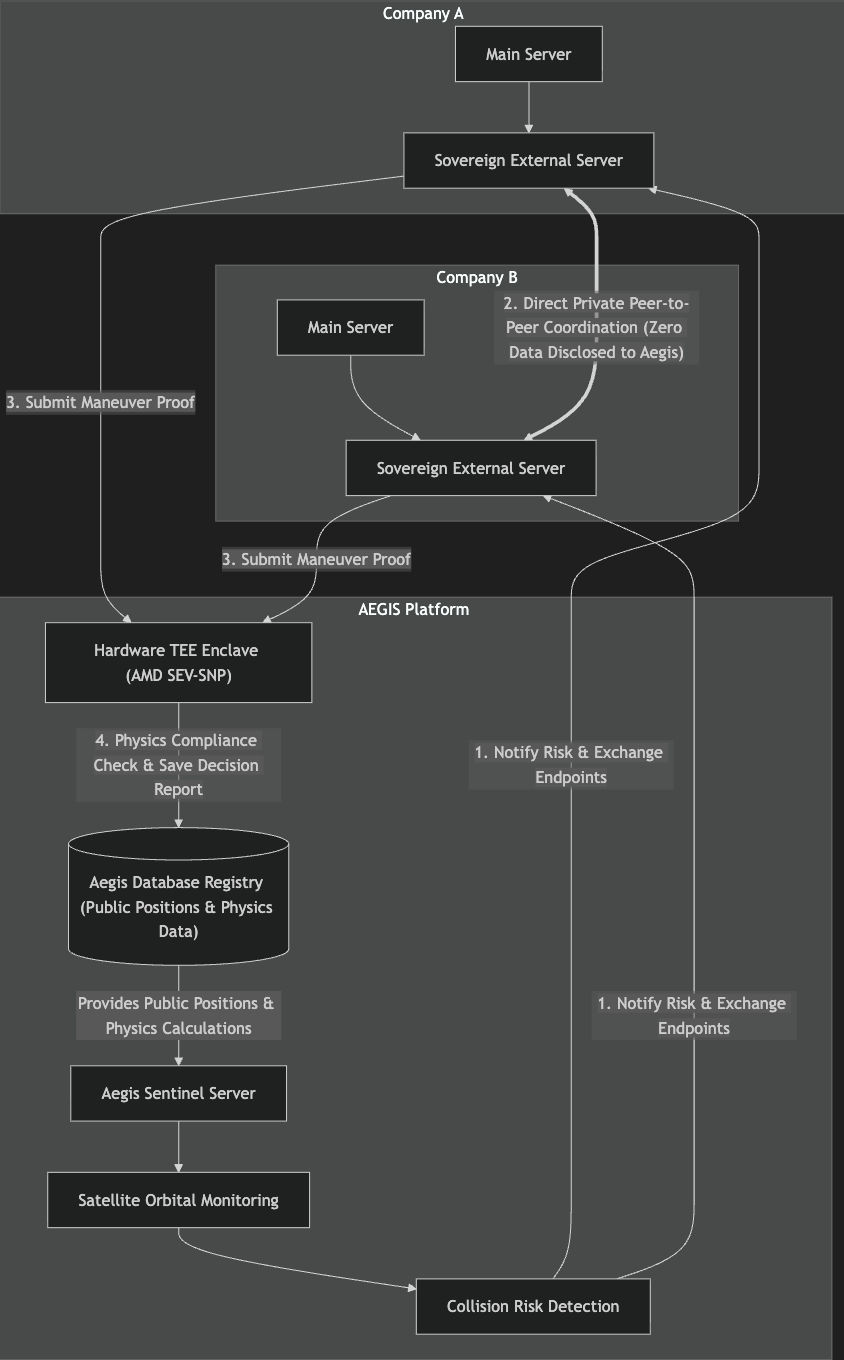
End-to-End Operational Story
Company Main Server & Local Sovereign Server Setup
Company A operates an internal Main Server (Flight Operations Center). Company A launches a Sovereign External Server locally on their device with a live public internet URL to communicate across the network.The 60 Telemetry Parameter Fields
Company A's Main Server feeds a total of 60 satellite telemetry parameter fields to their local Sovereign External Server:
id,noradId,satName,companyId,email,satelliteCategoryId,satelliteCategoryTitle,satelliteModelKey,endpointUrl,publicKeyPem,isDeployed,status,deployedAt,registeredAt,dryMassKg,grossMassKg,solarArraySpanMeters,thrustOutputNewtons,maxThrustDurationSeconds,thrustUncertainty,raanUncertainty,argOfPericenterUncertainty,eccentricityUncertainty,inclinationUncertainty,altitudeKm,inclinationDegrees,raOfAscendingNodeDegrees,meanAnomalyDegrees,argOfPericenterDegrees,eccentricity,meanMotion,epoch,bstar,classificationType,elementSetNo,ephemerisType,meanMotionDot,meanMotionDdot,objectId,revAtEpoch,positionX,positionY,positionZ,velocityX,velocityY,velocityZ,semiMajorAxisKm,periodMinutes,perigeeAltitudeKm,apogeeAltitudeKm,dragCoefficient,crossSectionalAreaSqM,ballisticCoefficient,fuelMassKg,propellantType,ispSeconds,activeThrusterStatus,lastManeuverTimestamp,nextManeuverScheduledAt,healthTelemetryStatus.Filtering & Passing Public Positions Only
The Sovereign External Server filters all private telemetry locally and passes only publicly publishable position-related data (altitude, inclination, RAAN, mean anomaly, epoch, and TLE parameters) to the main AEGIS Sentinel Server. All private telemetry and proprietary algorithms remain safely inside Company A's local device.Background Collision Risk Detection & Alerting
The main AEGIS Sentinel Server continuously monitors satellite trajectories using publicly available position data. When a collision risk is detected between two satellites, Sentinel Server contacts both companies' Sovereign External Servers, providing each operator with the live URL address of the opposing satellite server.Direct Peer-to-Peer AI Decision Session
Equipped with each other's live endpoints, Company A's Sovereign External Server and Company B's Sovereign External Server establish a direct private peer-to-peer connection. Inside this private session, Multiple AI Agents (Sovereign Advocates, Supreme Judges, and Jurors) evaluate orbital parameters and negotiate the optimal evasive maneuver decision directly between the operators.Summary AI & Database Persistence
Once a maneuver decision is agreed upon, the Summary AI compiles a sanitized summary note containing only high-level compliance results, strictly removing any sensitive operational data or proprietary maneuver secrets. This sanitized summary note is saved safely to the AEGIS Database Registry.Inspector AI Background Monitoring
In the background, Inspector AI continuously monitors all generated summaries and decisions to ensure no evaluations are biased and no company is misusing the platform.
How We Built It
AEGIS was engineered using a modular, security-first architecture combining Google Cloud serverless compute, hardware memory-encrypted enclaves, enterprise GenAI models, and an interactive developer CLI.
Part 1: Sovereign CLI & Developer Tools
Built as a universal command-line interface (aegis-sovereign-cli) for satellite operators, enterprise companies, and hackathon testers:
- Testing Workflow: Allows testers to log in, deploy virtual satellites with simulated collision risks, launch local Sovereign External Servers on custom ports (e.g., port
4001), and configure live public tunnel URLs. - Why We Built It: Gives operators full control over their edge servers without forcing them to expose internal flight control systems or proprietary telemetry.
Part 2: Interactive Web App Dashboard
Built using React, Three.js, and HTML5 Canvas:
- Real-Time Visualization: Renders interactive 3D satellite constellations, crossing orbital trajectories, logarithmic Risk Monitoring panels, and live court session modals.
- Why We Built It: Delivers instant visual transparency for space situation awareness and live collision event tracking.
Part 3: Background Screening & Risk Detection
- Agent Runtime Screening Loop: Agent Runtime executes continuous background monitoring every 6 hours, propagating orbital state vectors across the satellite catalog registered in Agent Registry.
- Why We Built It: Enables early detection of spatial proximity and potential conjunction risks across active catalog objects.
Part 4: Direct Peer-to-Peer AI Court & Maneuver Path Calculation
When a conjunction risk is detected, AEGIS Sentinel connects Company A and Company B Sovereign External Servers into a direct peer-to-peer connection:
- Advocate Briefings: 2 Sovereign Advocates (Advocate A and Advocate B) present company fuel reserves, mass parameters, and operational budgets.
- 3 Supreme Judges & 5 Democratic Jurors: 3 Supreme Judges (Chief Justice and 2 Associate Justices) along with 5 Democratic Jurors conduct 3 structured rounds of debate to determine maneuver responsibility fairly based on orbital physics and economic downtime.
- Calculated Maneuver Path: The multi-agent court calculates an updated evasive trajectory path (delta-V radial/in-track/cross-track burn vectors, post-maneuver ECI velocity/position, and new orbital elements including semi-major axis, eccentricity, and inclination). The satellite adjusts its orbital parameters safely with zero collision risk and zero orbital interference.
Part 5: Hardware TEE Enclave, KMS, Security & Inspector AI
- Hardware TEE Enclave (AMD SEV-SNP Confidential Space): Runs multi-agent court scoring and Cryptographic KMS key attestation inside memory-encrypted hardware enclaves.
- Model Armor: Enforces inline security guardrails blocking prompt injection, tool poisoning, and proprietary data leaks.
- Agent Identity: Provides zero-trust authentication verifying every operator request and node signature.
- Summary AI & Memory Bank: Summary AI generates a sanitized summary note (containing no sensitive operational secrets), which is saved into Memory Bank inside Google Cloud Firestore.
- Inspector AI: Operates continuously in the background, querying past court verdicts in Memory Bank across extended timelines to audit historical decisions, verify impartiality, detect collusion or telemetry fraud, and log daily audit reports in Firestore.
| Google Technology / Tool / Service | Implementation Location & Role in Aegis |
|---|---|
| Google Confidential Space | Hardware TEE Enclave: Memory-encrypted environment (AMD SEV-SNP) hosting the Sentinel arbitration gateway (sentinelServer.ts) with immutable code attestation. |
| Google AI Models (Gemini 3.6 Flash) | Judicial Arbitration & Inspector AI: Gemini 3.6 Flash powers multi-agent Supreme Judges, Democratic Jurors, Advocates, and the Inspector AI audit daemon (inspectorAiService.ts). |
Google GenAI SDK (@google/genai) |
Multi-Agent Judicial Engine: Orchestrates Sovereign Advocates A & B, 3 AI Supreme Judges, 5 Democratic Jurors, and Summary AI in supremeCourtEngine.ts. |
Google Vertex AI (@google-cloud/vertexai) |
Enterprise Model Gateway: Serves Gemini 3.6 Flash / 2.5 Flash models for right-of-way trajectory reasoning and Nash bargaining calculations. |
| Agent Memory Bank & Precedent Store | Case Precedent & Agent Experience Memory: AgentMemoryService (agentMemoryService.ts) indexes historical arbitration precedents and agent identity learnings to ensure consistent stare decisis rulings. |
| Google Cloud Run | Production Sentinel Deployment: Hosts the live public container instance (https://aegis-sentinel-1086776249115.us-central1.run.app) serving 100% of production traffic. |
Google Cloud Firestore (@google-cloud/firestore) |
Database Registry: Manages persistent storage in registryStore.ts for satellite records, conjunction events, AI verdicts, and audit logs. |
| Google Cloud KMS (Key Management) | Hardware Security Module: Cloud HSM key ring producing asymmetric ECDSA-P256 hardware digital signatures for judicial verdicts (kmsSigningService.ts). |
| Google Model Armor | AI Safety & Threat Protection: Input prompt threat sanitization and output physics/neutrality auditing middleware in modelArmorService.ts. |
| Google Identity & Firebase Auth | Identity & Access Control: Authenticates operator identities via Google Accounts and enforces multi-tenant token isolation (web/src/lib/firebase.ts & apiKeyService.ts). |
Challenges we ran into
- Peer-to-Peer Edge Server Coordination: Establishing direct peer-to-peer communication between two independent Sovereign External Servers while guaranteeing zero disclosure of private maneuver data or proprietary telemetry algorithms to the central server.
- Complex Background Event Pipeline: Coordinating asynchronous background tasks across Google Cloud Run, local edge webhooks, Model Armor guardrails, and persistent Memory Bank storage.
- Testing vs. Enterprise Orbit Solvers: While Enterprise mode can simply stream live TLE feeds directly from Space-Track.org, building Demo/Testing mode required us to create an entire internal mathematical solver on our server to compute full 60-parameter state vectors and 2-hour TCA crossing orbit geometries for virtually deployed test satellites.
- Strict Hackathon Time Constraints: Managing time limits while implementing Hardware TEE (AMD SEV-SNP) attestations, KMS signatures, Gemini multi-agent court debates, and an interactive developer CLI (
aegis-sovereign-cli).
Accomplishments that we're proud of
- End-to-End Multi-Agent Space Platform: Successfully built an autonomous space traffic management system connecting edge node servers, central cloud orchestrators, and AI judicial compliance engines.
- Google Cloud & Hardware TEE Security: Seamlessly integrated Google Cloud Run, Google Cloud Firestore named databases (
demo), Google Cloud KMS, and Hardware TEE (AMD SEV-SNP Confidential Space) memory-encrypted container attestation. - Developer CLI (
aegis-sovereign-cli): Built a production-ready command line interface allowing operators and hackathon testers to deploy virtual satellites, boot local Sovereign External Servers, and configure live public tunnel URLs with one command. - Interactive 3D Web Visualization: Developed a React and Three.js 3D Globe visualizer rendering dynamic satellite orbits, crossing collision arcs, and real-time logarithmic risk monitoring charts.
What we learned
- Zero-Trust Edge Agent Architecture: How to design decentralized agent networks where proprietary operational data remains strictly local on edge devices while public state vectors drive central collision screening.
- Enterprise GenAI & Guardrails: Harnessing Gemini Enterprise GenAI models alongside Model Armor and Memory Bank to create impartial, audit-compliant multi-agent evaluation pipelines.
- Confidential Computing in Aerospace: Implementing hardware memory encryption (AMD SEV-SNP) and SHA-256 HMAC cryptographic signing for safety-critical orbital infrastructure.
What's next for Aegis
- Global Decoupled Standard: Partnering with international space agencies to establish AEGIS as the global decentralized standard for automated space collision avoidance.
Built With
- amd-sev-snp
- axios
- cli-table3
- commander
- confidential-computing
- express.js
- firebase
- gemini-api
- google-cloud
- google-cloud-firestore
- google-cloud-run
- google-genai-sdk
- inquirer
- key-management-service
- node.js
- npm
- opentelemetry
- react
- rest-api
- sgp4
- tailwindcss
- three.js
- typescript
- vite


Log in or sign up for Devpost to join the conversation.