-
-
Aegis: Stress-Testing an Enterprise EHR Decision
Inspiration
Healthcare organizations make consequential decisions through disconnected presentations, spreadsheets, vendor claims, consultant reports, and committee meetings. These processes may produce a recommendation, but they rarely preserve the assumptions carrying it, the evidence supporting it, or the conditions that should cause leadership to reverse course.
We built Aegis around one question:
What if organizations could stress-test an important decision before reality did?
That led us to Decision Engineering: treating a decision as something that can be explicitly modeled, tested, repaired, and preserved.
What it does
Aegis transforms a consequential proposal into a living, executable Decision Twin containing:
- Competing options
- Claims, assumptions, and evidence
- Weighted criteria and thresholds
- Non-negotiable hard gates
- Causal dependencies
- Fragilities and reversal conditions
- Accountable owners and approval requirements
Aegis applies a five-stage loop:
CAPTURE → COMPILE → STRESS → REPAIR → PRESERVE
The public judge experience is a self-contained, credential-free EHR Decision Twin. Judges can edit program budget, expected benefit, enterprise readiness, data-conversion risk, and implementation timeline; Aegis recalculates contract metrics, fragility, scores, disposition, and option ranking live without moving the published thresholds. Restore Original Case returns the exact governed baseline.
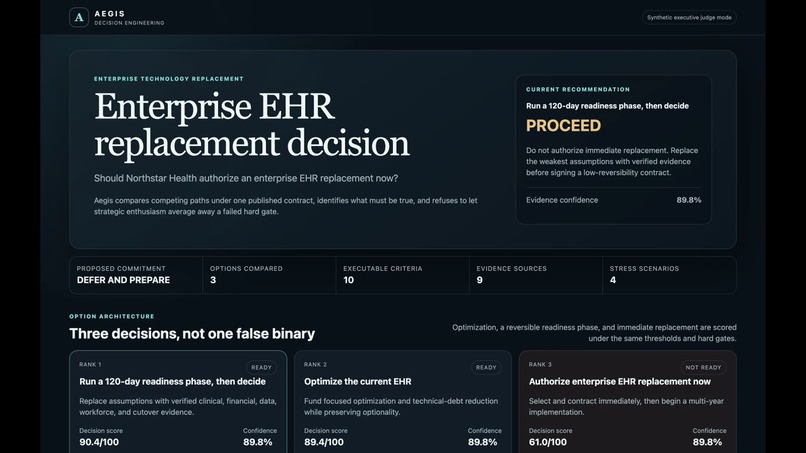
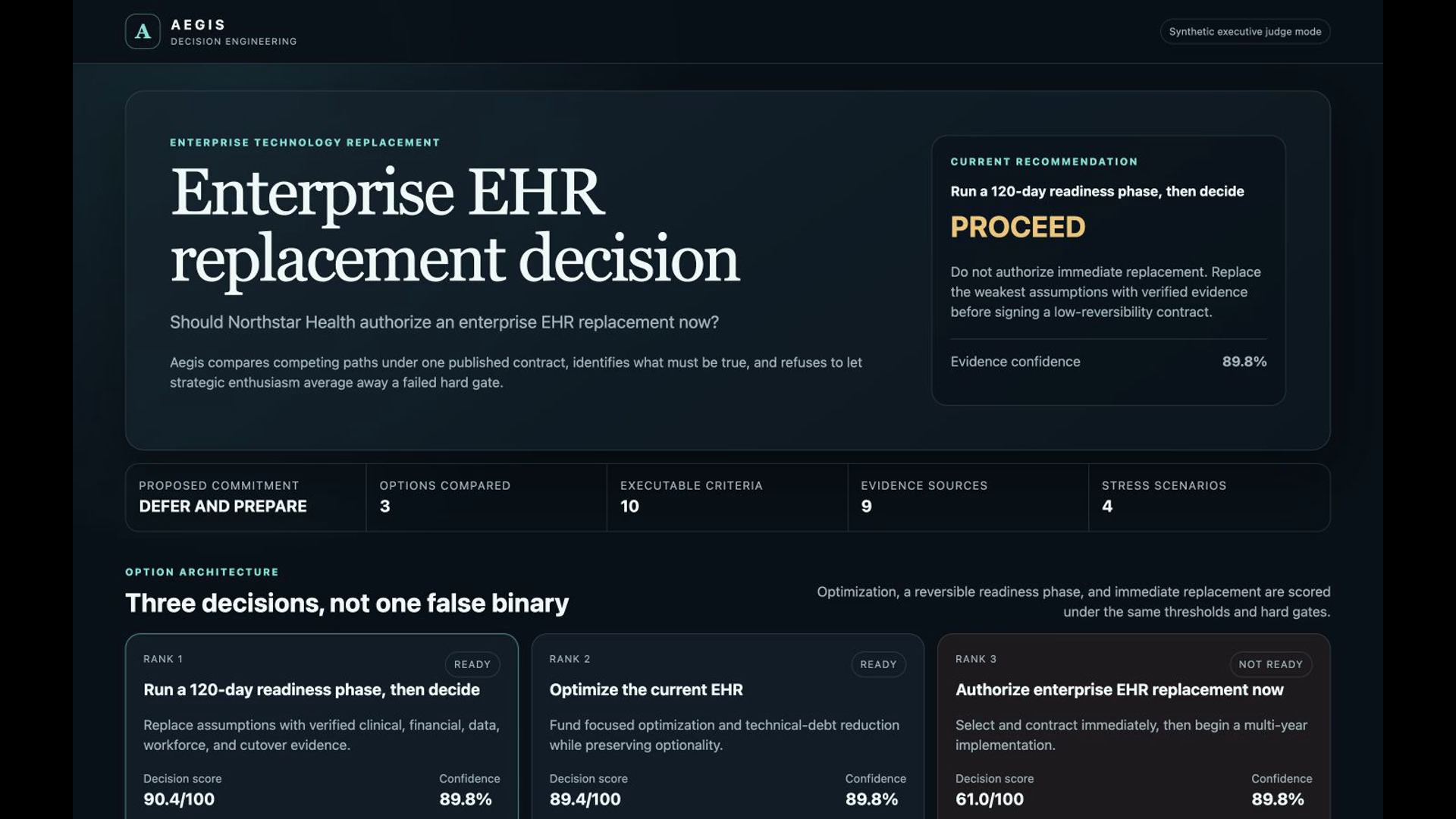
Our synthetic healthcare demonstration evaluates whether Northstar Health should authorize an enterprise EHR replacement.
Aegis compares three choices under the same published contract:
- Optimize the current EHR.
- Run a 120-day readiness phase and then decide.
- Authorize immediate enterprise replacement.
Immediate replacement has attractive strategic potential, but it does not clear the liquidity, revenue-cycle, or data-conversion gates. Aegis recommends the reversible readiness phase.
When a failed revenue-cycle assessment is introduced, Aegis propagates the evidence and reruns the same contract. The recommendation changes to optimizing the current EHR.
When the vendor improves its pricing, the economics improve—but Aegis still refuses immediate replacement because better pricing cannot purchase operational readiness.
The Repair Engine converts the most important fragilities into an owned readiness program with evidence requirements, thresholds, timing, and failure consequences. A Decision Passport preserves why the decision was made and when it must be reopened.
How we built it
Aegis combines two deliberately separated reasoning layers.
The deterministic layer owns the verdict. It evaluates options against published thresholds and ensures that hard clinical, financial, operational, and governance gates cannot be averaged away.
Seven bounded GPT-5.6 specialists examine the proposal from clinical, privacy, workflow, financial, technology, adoption, and red-team perspectives. They challenge assumptions, identify missing evidence, preserve dissent, and enrich the final decision record. OpenAI Code Interpreter independently verifies the financial model.
Codex was the primary engineering collaborator used to:
- Design the Decision Twin architecture
- Build the FastAPI application and executive interface
- Implement the evidence, shock, repair, and preservation engines
- Develop the reusable decision contract
- Create the enterprise EHR decision pack
- Diagnose failures and harden the judge experience
- Build automated tests and behavioral evaluations
- Prepare the public demonstration and submission materials
During Build Week, we expanded Aegis from a specialized healthcare decision demonstration into a reusable Decision Engineering core with multiple-option evaluation, hard gates, evidence-confidence scoring, scenario shocks, repair programs, and an enterprise EHR Decision Twin.
Challenges we ran into
The hardest challenge was preventing Aegis from becoming an articulate report generator.
For consequential decisions, persuasive model output cannot be allowed to quietly change the rules. We created a strict boundary: GPT-5.6 can investigate, challenge, and explain, but the deterministic contract controls the verdict.
A second challenge was making recommendation changes genuine rather than theatrical. Every shock modifies the underlying decision state and reruns the same contract. Tests verify that model prose cannot override decision semantics and that favorable economics cannot bypass a failed hard gate.
The third challenge was scope. Decision Engineering could apply to many domains, but Build Week required a focused and memorable demonstration. We chose enterprise EHR replacement because it combines clinical, operational, financial, technical, and governance consequences in one decision.
Accomplishments that we're proud of
We are proud that Aegis is not another chat interface wrapped around a recommendation.
The final prototype includes:
- A reusable Decision Engineering contract
- A living Decision Twin
- An editable Decision Twin Studio with governed live recalculation
- Multiple-option comparison
- Evidence-confidence scoring
- Hard gates that cannot be averaged away
- Evidence-driven recommendation changes
- A Shock Engine with consequence cascades
- A Repair Engine with owners and thresholds
- An auditable Decision Passport
- Seven bounded GPT-5.6 specialist perspectives
- Independent Code Interpreter financial verification
The final build passed 46 automated tests and 11 of 11 behavioral evaluations. It also passed adversarial tests covering hard-gate precedence, prompt-like evidence, recommendation integrity, and attempts to use repair logic to bypass a safety stop.
What we learned
We learned that the most valuable AI system may not be the one that produces the most confident answer. It may be the one that makes uncertainty, disagreement, and reversal conditions impossible to ignore.
We also learned that deterministic and generative reasoning are complements. GPT-5.6 is effective at investigating evidence and challenging assumptions, while an explicit contract provides consistency, auditability, and protection against persuasive but unsafe conclusions.
Most importantly, leaders do not only need decision support. They need a durable system of record for why a decision was made, what must remain true, and when the organization should change course.
What's next for Aegis Decision Engineering
The next step is applying Aegis to real, governed decisions with healthcare design partners.
Near-term priorities include:
- Compiling uploaded proposals, contracts, research, and financial models
- Enterprise authentication and data isolation
- Persistent, versioned Decision Passports
- Approval history for thresholds and hard gates
- Role-based governance workflows
- Additional healthcare decision packs
- Longitudinal monitoring after a decision is approved
- Measuring decision-cycle time, avoided losses, and realized ROI
Healthcare is the initial focus because its decisions are expensive, regulated, operationally complex, and sometimes life-affecting. The longer-term vision is a reusable Decision Engineering platform for any consequential decision that can be expressed through options, evidence, thresholds, risks, and accountable owners.
Aegis stress-tests consequential decisions before reality does.

Log in or sign up for Devpost to join the conversation.