-
-
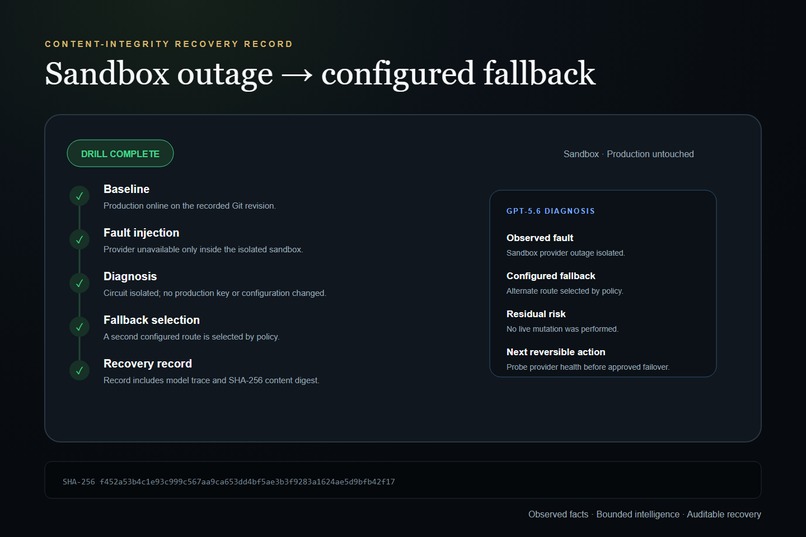
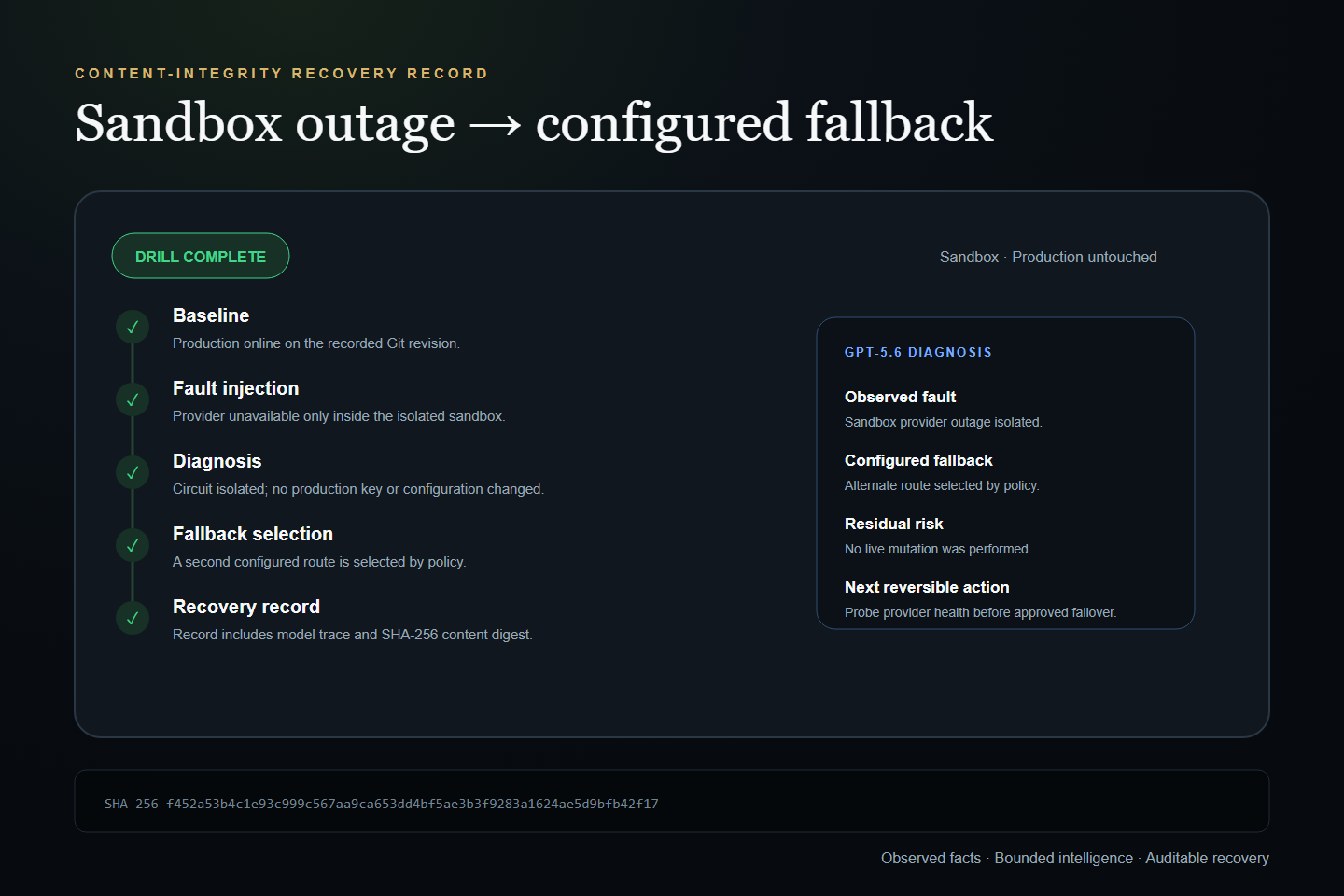
Recovery proof — Simulated provider outage, configured fallback selection, no production mutation.
-
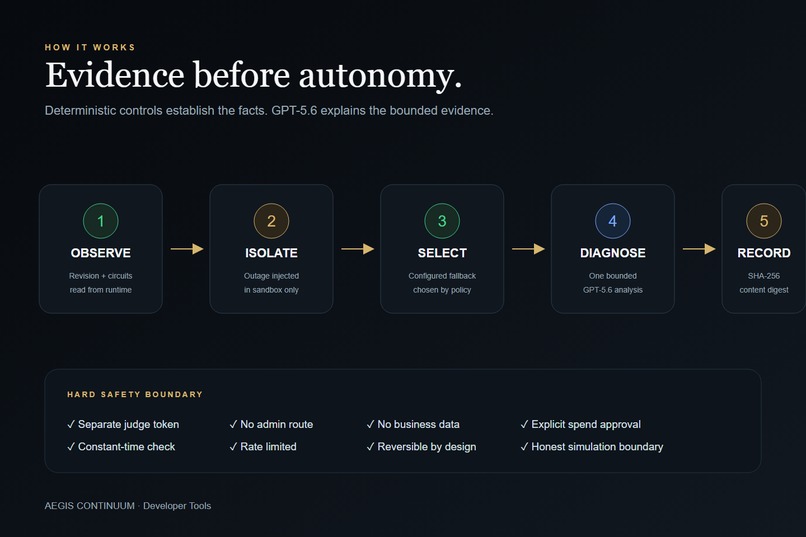
Architecture — Isolated judge sandbox, deterministic recovery engine, bounded GPT-5.6 analysis.
-
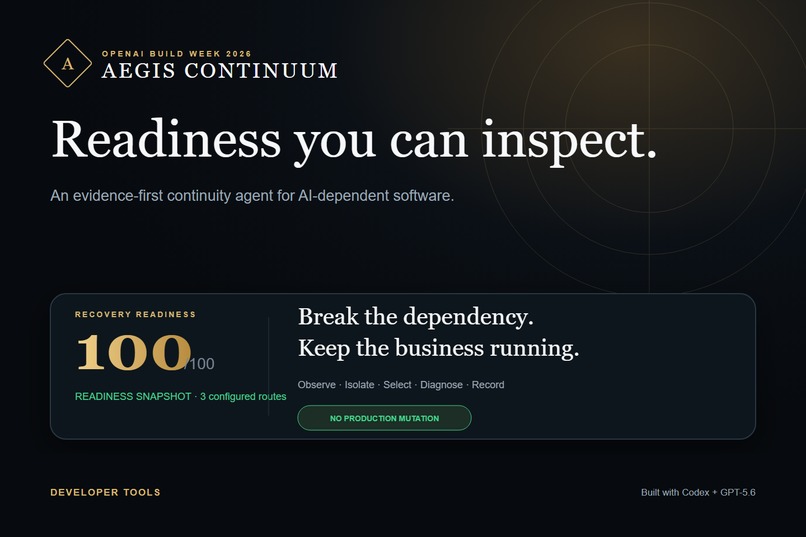
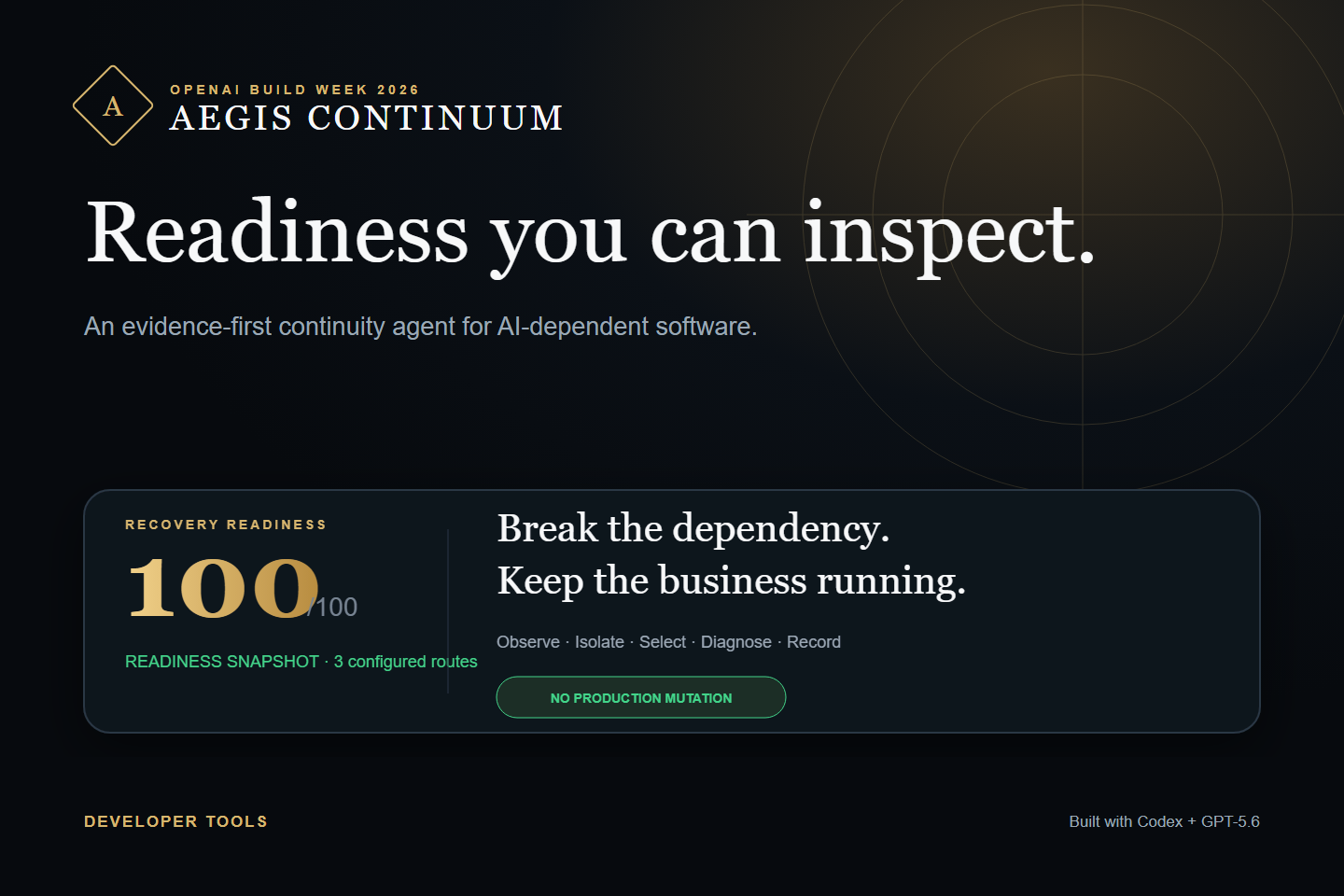
AEGIS CONTINUUM — Evidence-first AI continuity for developer operations.
Inspiration
AI products are increasingly built on a fragile assumption: one provider will always remain available. A provider outage, account suspension or broken route can stop an otherwise healthy business. Monitoring can tell us that something failed, but it rarely distinguishes a configured alternate route from a genuinely tested live recovery.
AEGIS CONTINUUM was inspired by a real operational question: how can a company demonstrate continuity without deliberately breaking production?
What it does
AEGIS is an evidence-first continuity agent for platform engineers, SREs and teams operating AI-dependent software. It:
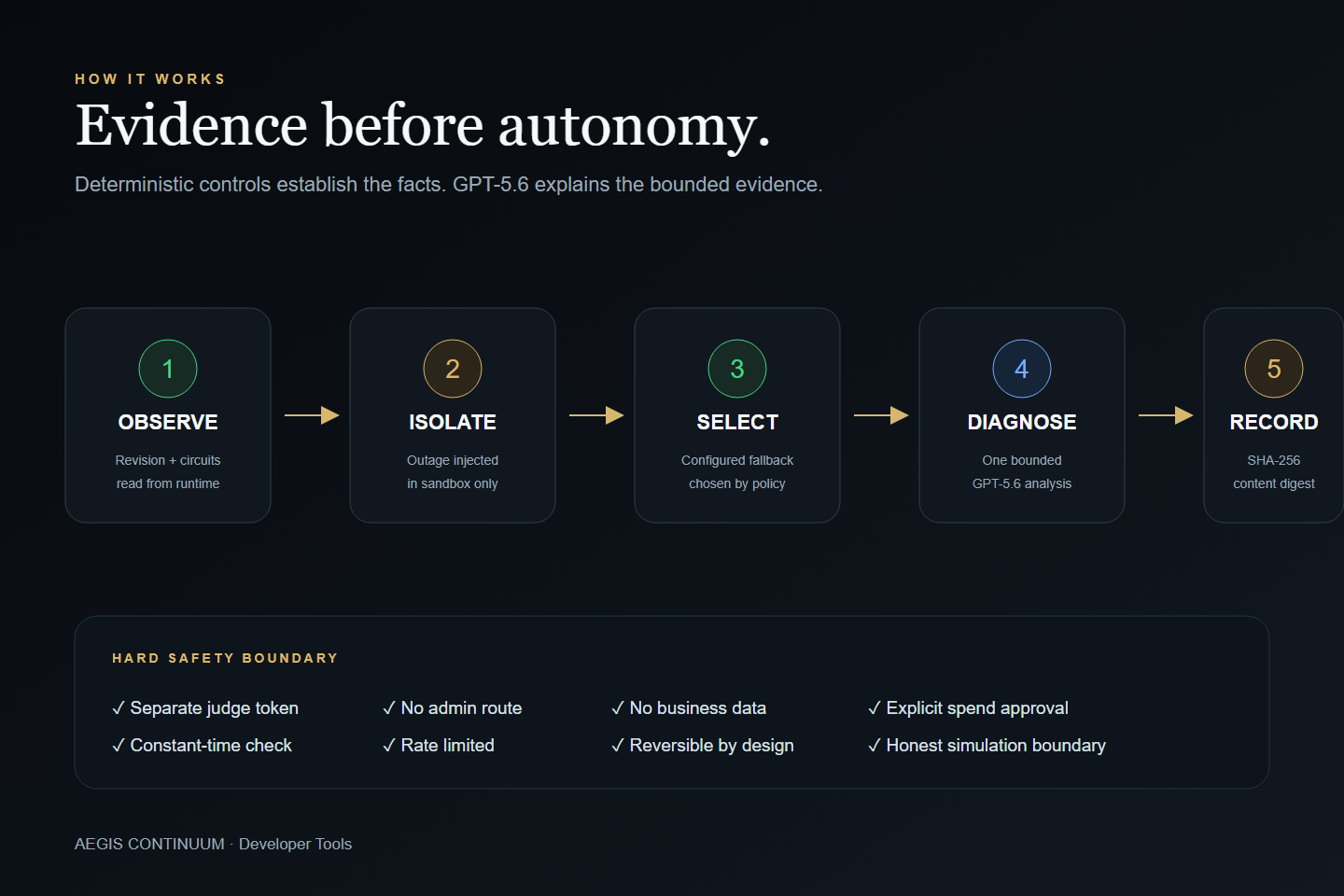
- reads the deployed revision and locally observed provider-circuit configuration;
- computes an explainable configuration-readiness score;
- injects a selected provider outage only inside an isolated sandbox;
- proves that the simulated fault is isolated without changing production keys or configuration;
- selects a configured fallback route whose local circuit is closed;
- gives deterministic evidence to GPT-5.6 for a bounded four-part diagnosis;
- records model, provider, duration, residual risk and the production-mutation boundary;
- records a SHA-256 content-integrity digest over the final recovery record.
Judges receive a dedicated token for a public test sandbox. That token cannot reach our Control Center, projects, documents, Supabase data or administrative APIs.
How we built it
The product combines a deterministic Node.js continuity engine, a multi-provider AI router, an Express API, an isolated judge interface, automated tests, Docker and Railway deployment.
The recovery engine makes the safety decision before any model is called. GPT-5.6 never invents the system state and never controls a live failover. It receives only the bounded drill evidence and returns four concise elements: observed fault, configured fallback selected, residual risk and next reversible action. A successful diagnostic call confirms limited OpenAI API reachability for that request only; it does not prove production-route readiness or a live failover.
Codex was our principal engineering collaborator during Build Week. We used it to audit the pre-existing system, design AEGIS's autonomy and approval boundaries, implement the isolated continuity engine and judge surface, create regression and isolation tests, review diffs, diagnose deployment issues and verify that the deployed demo matched the intended Git revision.
Challenges we ran into
The hardest challenge was resisting a visually impressive but unsafe “chaos demo.” A genuine production outage would create unnecessary business risk. We therefore separated three facts that are often conflated:
- provider configuration and circuit state observed from the running application;
- failure injection performed only in the sandbox;
- future live failover, which remains approval-gated and reversible.
We also had to prevent a judge credential from becoming an indirect path into the existing business platform. The final judge route imports no Supabase client, exposes no admin route, uses a separate constant-time token check, enforces same-origin requests and rate-limits transport independently from a daily GPT-5.6 budget.
Accomplishments that we're proud of
- A complete, coherent judge experience rather than a console-only proof of concept.
- A deterministic recovery report enhanced — not replaced — by GPT-5.6.
- Automated tests for continuity, route isolation, token checks, model budgeting, failure handling and evidence sealing.
- A SHA-256 content-integrity digest covering the final recovery record, including the bounded model trace when requested.
- A deployed demo that returns
401without the judge token and explicitly reportsproduction_access: falseanddata_access: falseafter authentication. - A documented, timestamped Build Week boundary for a pre-existing project.
What we learned
Operational autonomy is credible only when it is bounded. The strongest AI agent is not the one that takes every action; it is the one that knows what it observed, what it simulated, what it is authorized to change and what must still be approved by a human.
We also learned that GPT-5.6 is most valuable here when grounded by deterministic evidence. The model adds concise operational judgment while the continuity engine retains control of facts, permissions and the safety boundary.
What's next for AEGIS CONTINUUM
Next we will add pluggable continuity adapters for databases, queues, cloud runtimes and email infrastructure; signed evidence bundles; scheduled game days; recovery-time objectives; and approval-gated live remediations with automatic rollback. The product direction is a vendor-neutral continuity control plane for AI-dependent businesses.
Built With
- api
- codex
- css
- devops
- docker
- express.js
- github-actions
- gpt-5.6
- html
- javascript
- node.js
- openai
- railway
- security
- sha-256

Log in or sign up for Devpost to join the conversation.