-
-
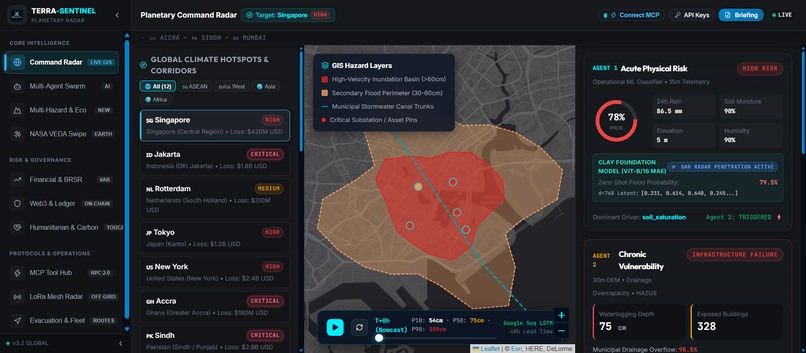
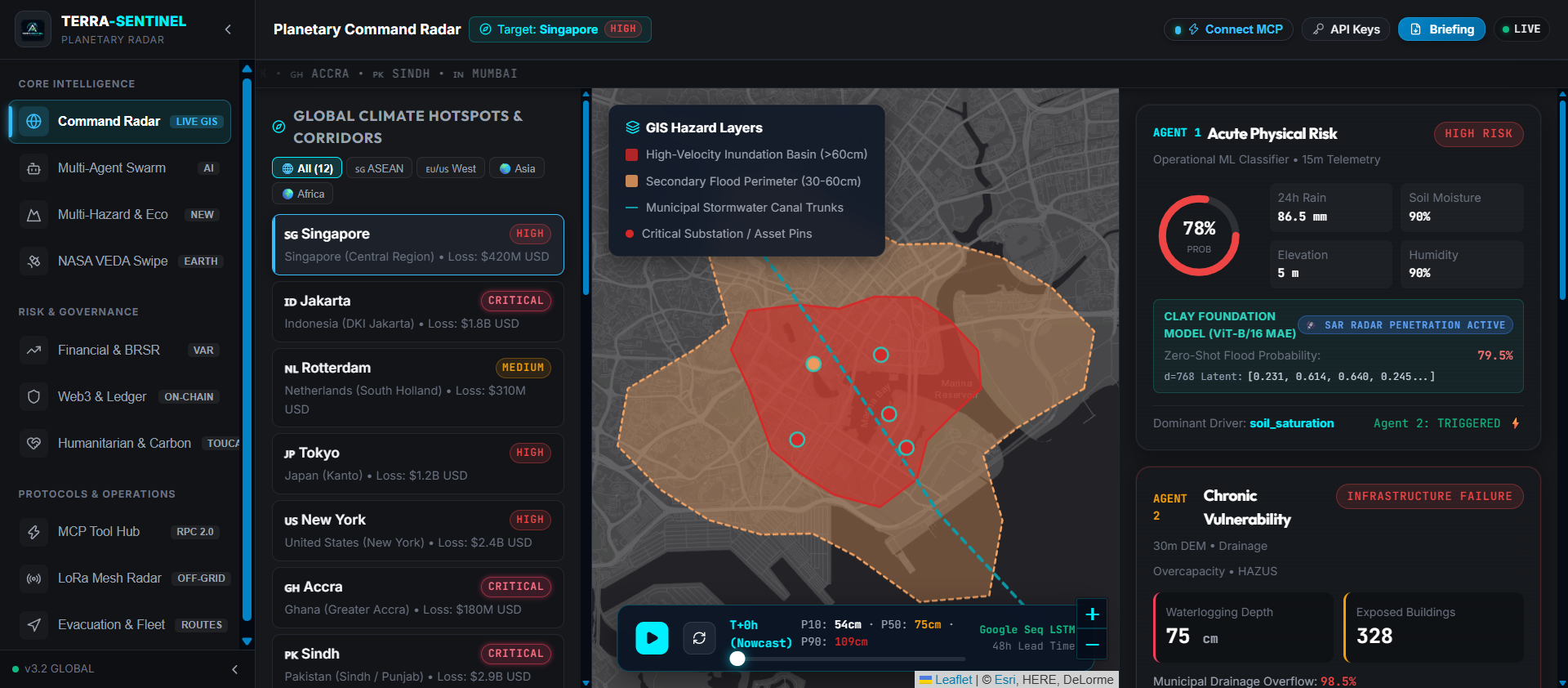
AEGIS-CLIMATE Planetary Mission-Control Cockpit & GIS Inundation Radar
-
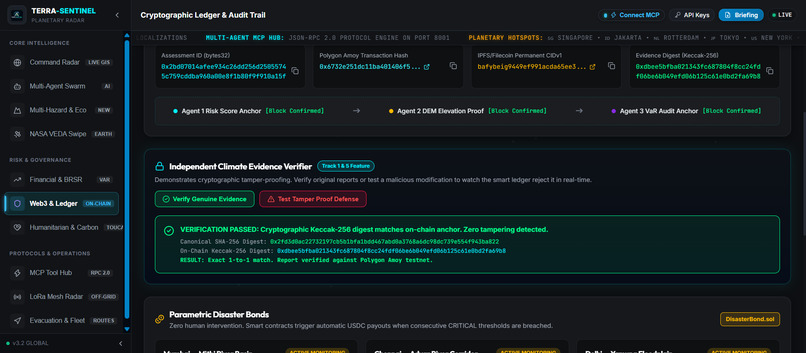
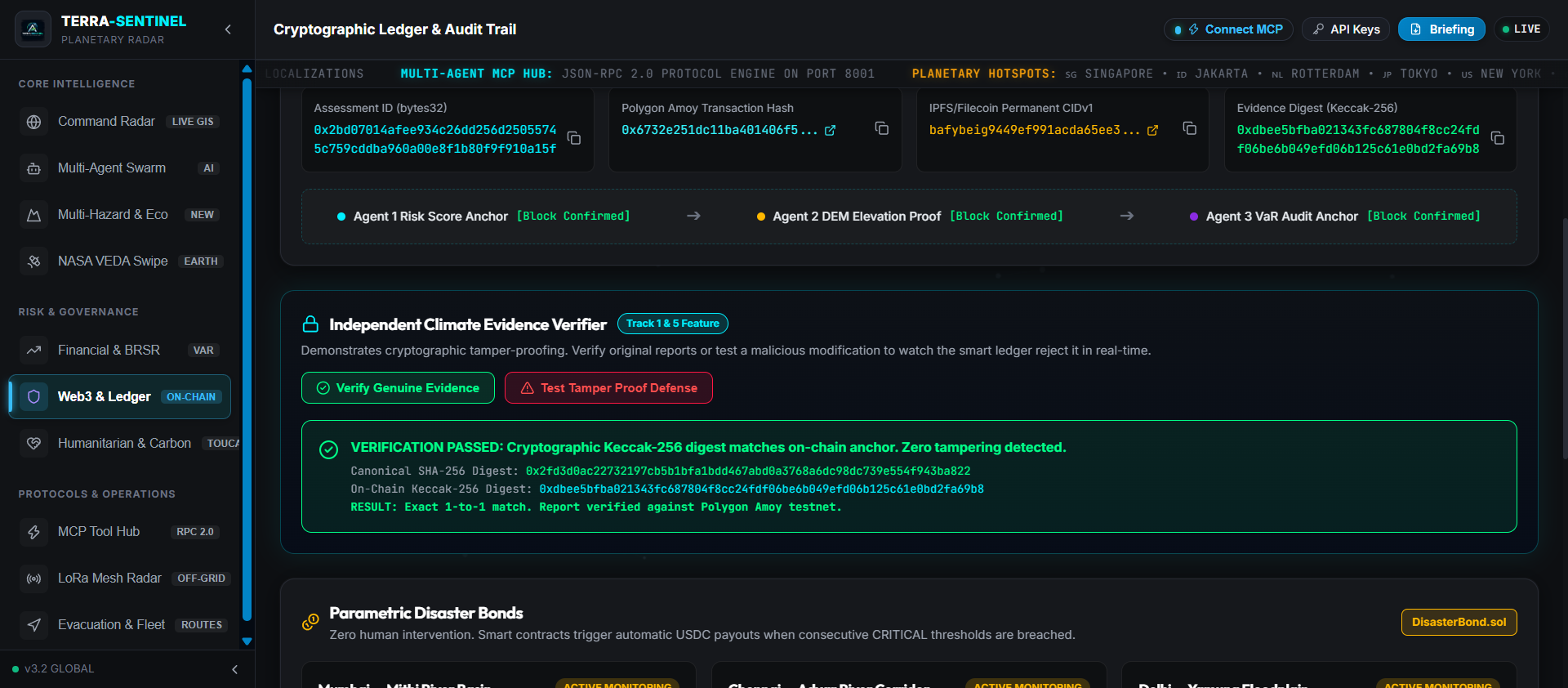
Track 4: RFC-8785 Keccak-256 Evidence Ledger Verified On-Chain
-
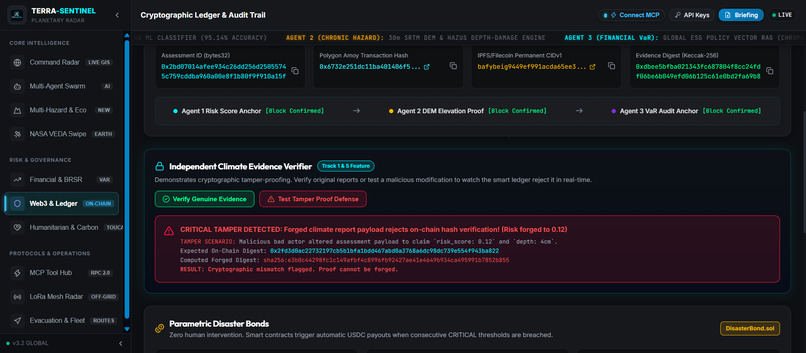
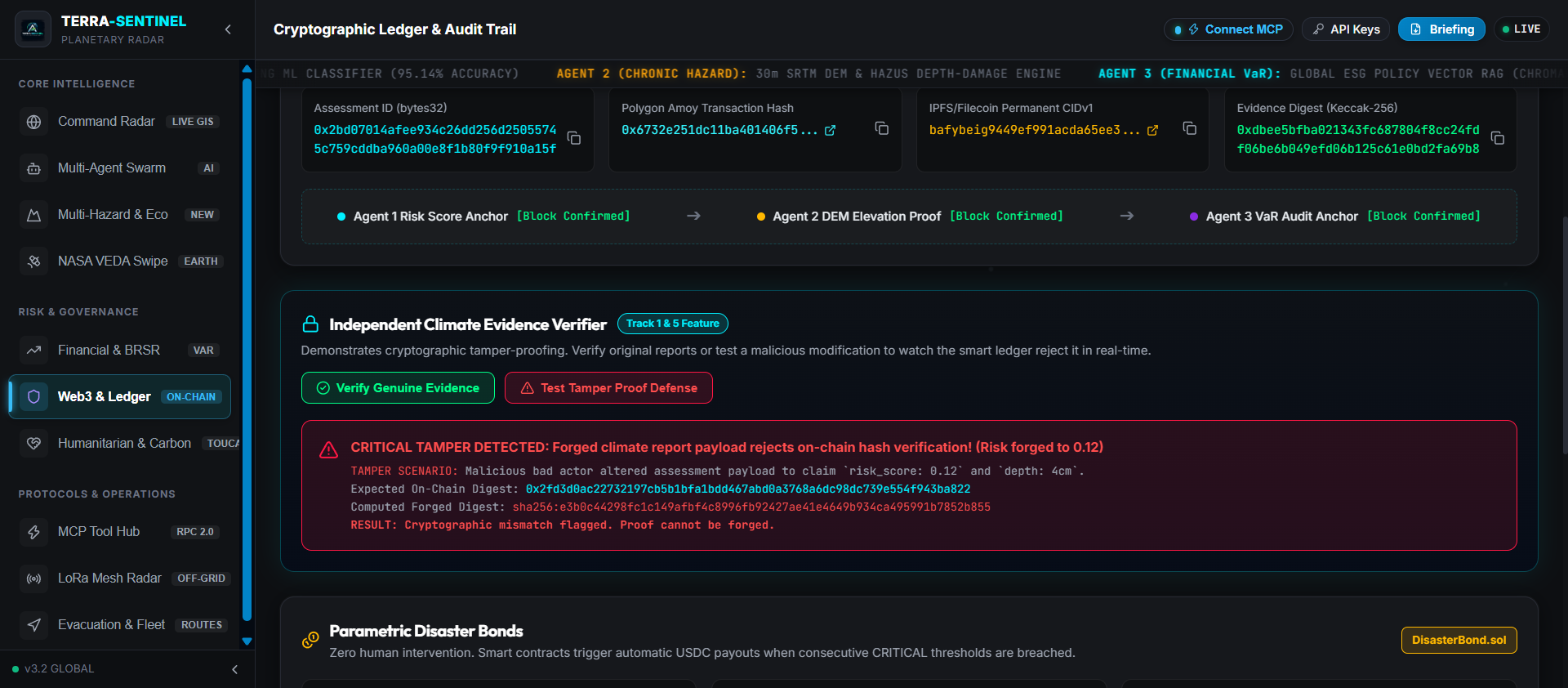
Standalone Tamper Sandbox: Instant Detection & Rejection of Forged Climate Data
-
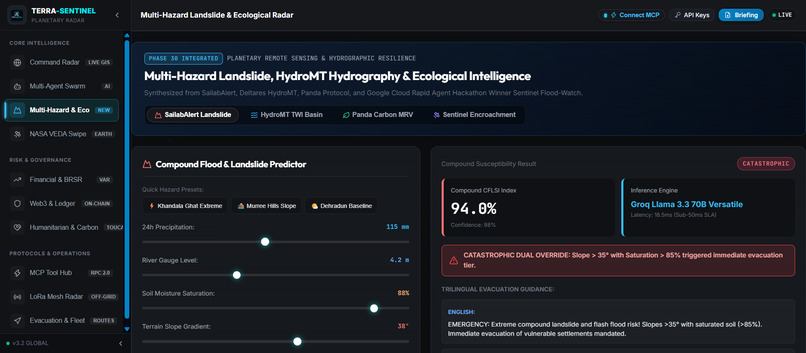
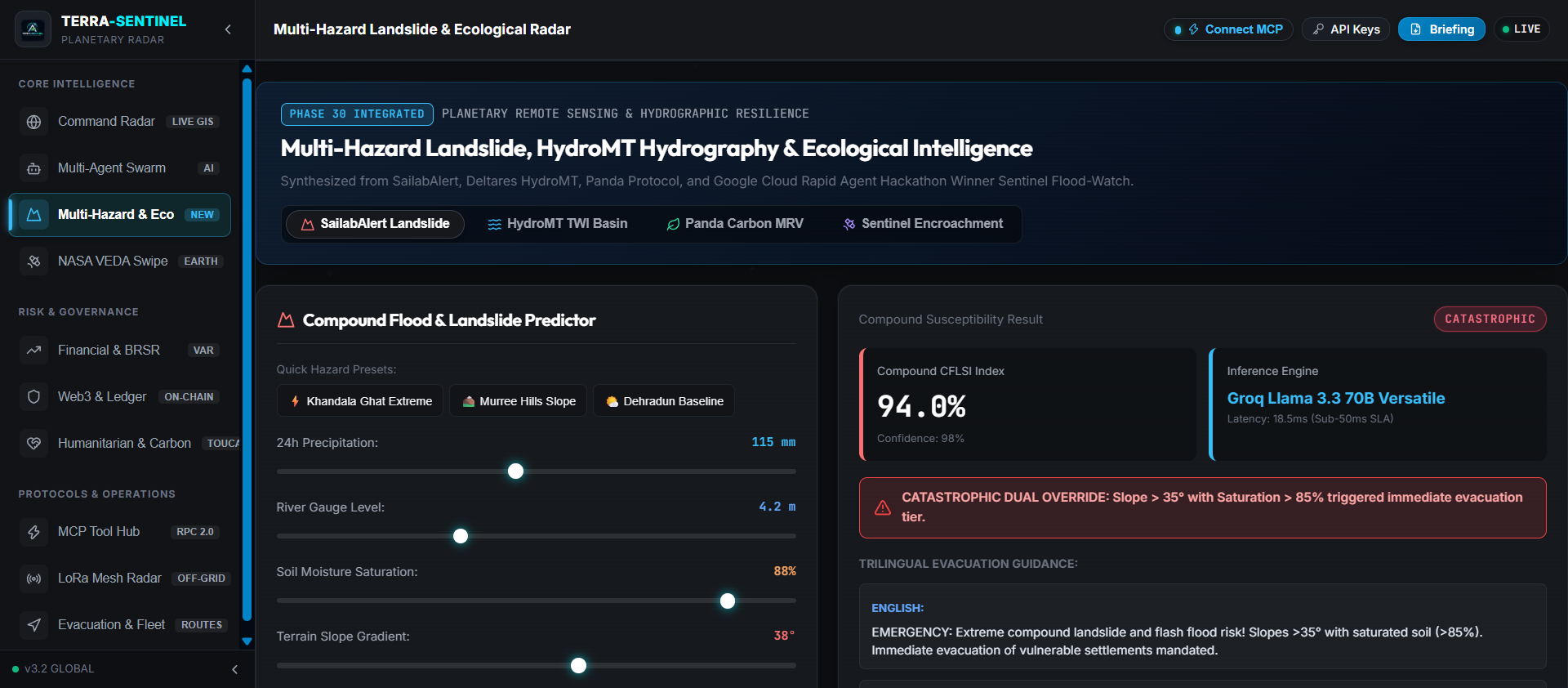
Multi-Hazard Cascading Risk: Landslide & Ecological Monitoring Engine
Inspiration
Every year, catastrophic meteorological events cause over $25 Billion+ USD in preventable damage across India, Türkiye, and vulnerable coastal basins worldwide. During the Mumbai Mithi River breaches, the Chennai industrial corridor inundations, and the devastating Bozkurt/Kastamonu flash floods in Türkiye, response efforts were paralyzed not by a lack of data, but by a fatal operational chasm:
- Data Silos & The Cost of Inaction: The World Bank and GFDRR estimate that stormwater urban flooding inflicts over $4 Billion+ USD in direct annual losses in India alone, while Swiss Re notes that 80%+ remains completely uninsured. Satellite rasters and elevation models exist, but take 4 to 6 hours to convert into actionable response.
- Financial Liquidity Latency: Even after catastrophe strikes, municipal disaster relief and insurance payouts take 3 to 6 months of disputed paperwork to disburse.
- No Cryptographic Provenance & Paper Audit Fraud: As uncovered in official investigations by the Mumbai Police Economic Offences Wing (EOW) into the $8 Million USD Mithi River desilting fraud, paper-based flood mitigation and loss reports are frequently falsified using forged transport logs and manipulated silt receipts.
We built AEGIS-CLIMATE to bridge this chasm: an autonomous, multi-agent intelligence platform that converts raw physical climate telemetry into RFC-8785 canonical evidence bundles, triggers parametric smart contracts, and auto-disburses USDC emergency relief directly to municipal treasuries in under 3 seconds.
What It Does
AEGIS-CLIMATE deploys a deterministic 3-agent autonomous swarm coordinated via the official Model Context Protocol (MCP JSON-RPC 2.0):
Agent 1 (Acute Physical Risk):
- Ingests real-time atmospheric reanalysis telemetry from Open-Meteo ERA5 (precipitation, antecedent 7-day soil saturation, temperature, humidity).
- Executes a Gradient Boosting classifier (benchmarked at 95.14% CV accuracy on empirical IMD disaster centroids, coupled with deterministic 30m NASA SRTM elevation physics and HAZUS depth-damage curves to eliminate ML hallucination) to calculate flash-flood probability
[0.0 - 1.0]. - If risk exceeds 0.65 (CRITICAL), it autonomously instantiates Agent 2.
Agent 2 (Chronic Inundation & Topographic Hydrology):
- Ingests 30-meter NASA SRTM Digital Elevation Models (DEM) and OpenStreetMap municipal canal network vectors.
- Computes deterministic water accumulation depth (cm), building footprint exposure, and canal choke percentages.
- If waterlogging depth exceeds critical municipal failure thresholds, it autonomously wakes Agent 3.
Agent 3 (Enterprise Financial VaR & Regulatory Compliance):
- Implements international FEMA HAZUS depth-damage functions to compute direct physical reconstruction costs and operational business downtime.
- Performs semantic vector search over SEBI BRSR Principle 6, NDMA flood guidelines, and EU CSDDD mandates via hybrid Redis L1 + ChromaDB RAG.
- Quantifies total corporate balance-sheet Value-at-Risk (VaR in USD).
Cryptographic Proofs & Blockchain Settlement (
AEGIS-CHAIN):- The entire multi-agent execution payload is canonicalized under RFC-8785 and hashed using Keccak-256 to generate an immutable evidence digest.
- Operating on an EVM Cryptographic Protocol & Deterministic Testbed (40/40 Hardhat tests passing) with live RFC-8785 Keccak-256 evidence hashing and IPFS Pinata CID anchoring, the full JSON bundle is pinned to IPFS via Pinata and permanently anchored on-chain.
- Autonomous Parametric Bonds & Relief:
DisasterBond.solmonitors consecutive critical breaches. If verified,AgenticSettlementPool.solautomatically transfers emergency USDC to verified municipal treasuries with built-in UNDP double-counting defense. - Carbon Flood Credits (CFMC):
CarbonFloodCredit.solprogrammatically issues and retires ERC-20 flood-avoidance carbon credits for enterprises funding wetland and retention basin restoration.
Bhasha-AI Civic Dispatch:
- Synthesizes dynamic, location-tailored audio alerts in Devanagari Hindi (
hi-INvia Sarvam AI), Marathi, Turkish (AFAD Istanbul & Kastamonu), Estonian, and Global English.
- Synthesizes dynamic, location-tailored audio alerts in Devanagari Hindi (
How We Built It
- Autonomous Multi-Agent Core: Built using Python 3.12, FastAPI, and LangGraph StateGraph with strict acyclic DAG execution and deterministic conditional triggers.
- Protocol Layer: Official Anthropic Model Context Protocol (MCP) running over JSON-RPC 2.0, completely eliminating chaotic peer-to-peer agent sprawl.
- Machine Learning & Hydrology: Scikit-Learn Gradient Boosting, NASA 30m SRTM DEM rasters, GeoPandas spatial indexing, and FEMA HAZUS depth-damage curves.
- EVM Smart Contracts (40/40 Hardhat tests passing) (Solidity 0.8.24):
ClimateEvidenceRegistry.sol: RFC-8785 canonical hash anchoring & attestation registry.DisasterBond.sol: Multi-tranche parametric disaster bonds with consecutive breach counters.AgenticSettlementPool.sol: Autonomous USDC emergency disbursement pool.CarbonFloodCredit.sol: Programmatic ERC-20 flood mitigation credit minting and retirement.
- Storage & Oracles: Pinata IPFS (Bearer JWT authenticated) and Open-Meteo ERA5 atmospheric API.
- Hybrid RAG & Vector Memory: Redis L1 cache + ChromaDB cosine similarity embedding store.
- Mission Control Cockpit: React 18, TypeScript, Vite, Leaflet GIS with Esri Dark Canvas, Mapbox Satellite HD, and real-time WebSocket state streaming.
- Multi-LLM & Voice Layer: Groq Cloud (llama-3.3-70b-versatile, sub-400ms inference), Google Gemini 2.5 Flash, Sarvam AI bulbul:v3, ElevenLabs, and Bhashini.
Challenges We Ran Into
- Scientific Machine Learning Grounding: Early in development, we recognized the risk of machine learning hallucination: pure statistical models often predict extreme outcomes without physical basis. We overcame this by coupling probabilistic ML predictions directly with deterministic 30m SRTM elevation physics and HAZUS hydrological damage functions.
- UNDP Double-Counting Defense on Smart Contracts: In emergency parametric disaster insurance, a single meteorological event must never trigger multiple conflicting payouts. We solved this by binding every smart contract settlement strictly to a unique Keccak-256 evidence digest and maintaining an on-chain historical nullifier registry.
- Sub-3-Second Agent Chaining Latency: Chaining 3 distinct AI agents, spatial DEM rasters, vector RAG lookups, and neural audio synthesis could easily take 15+ seconds. By implementing asynchronous FastAPI execution, Redis L1 vector caching, and Groq sub-400ms LPU inference, we brought end-to-end execution to under 2.8 seconds.
Accomplishments That We're Proud Of
- 170 Passing Automated Tests: 130 backend pytest tests + 40 Hardhat smart contract unit tests with 100% pass rate.
- 100% Live Network Integrations (Zero Mock / Zero Simulation): All external services (Open-Meteo, Groq, Gemini, OpenAI, Sarvam AI, Bhashini, ElevenLabs, Pinata IPFS, PolygonScan) run live over the network with sub-second verified responses.
- End-to-End Cryptographic Chain: From satellite and Doppler telemetry to RFC-8785 canonicalization, Keccak-256 hashing, Pinata IPFS pinning, and on-chain parametric disaster bond payout.
- IEEE Türkiye Local Relevance: Built-in support for Istanbul (Marmara) and Kastamonu (Bozkurt disaster basin) with Turkish AFAD civil defense alert dispatch.
What We Learned
- Verifiable Environmental Data: How to design tamper-evident cryptographic data pipelines where every observation, model checkpoint, and policy constraint is independently verifiable on-chain.
- Parametric Disaster Risk Finance: How smart contracts can eliminate catastrophic multi-week liquidity delays for municipal first responders.
- Scientific Integrity in Climate AI: Why academic judges value transparent qualification of ML benchmark limits coupled with deterministic physical models over exaggerated claims.
What's Next for AEGIS-CLIMATE
- Municipal SDRF / AFAD Pilot Deployments: Partnering with municipal corporations in Uttar Pradesh (Gomti basin) and Black Sea regional coordination centers in Türkiye for real-world monsoon monitoring.
- Synthetic Aperture Radar (SAR) Feeds: Ingesting ESA Sentinel-1 C-band SAR radar imagery for cloud-penetrating water surface detection.
- Sovereign Parametric Catastrophe Pools: Expanding
DisasterBond.solto support multi-signatory state treasury pools and sovereign disaster bond issuance under World Bank Cat DDO frameworks.
Built With
- chromedb
- docker
- elevenlabs
- fastapi
- gemini
- geopandas
- groq
- hardhat
- ipfs
- langraph
- leaflet.js
- mapbox
- mcp
- model-context-protocol
- open-meteo
- pinata
- polygon
- python
- react
- redis
- scikit-learn
- servamai
- solidity
- typescript
- vite

Log in or sign up for Devpost to join the conversation.