Aegis: Autonomous Multi-Agent Crisis Command
Inspiration
In the first 60 minutes of a mass-casualty event—whether a flood, earthquake, or urban fire—the emergency response system faces a problem that is not simply technological: volume.
When thousands of distress signals arrive within minutes, critical information from calls, SMS, social media, images, videos, and other sources becomes unstructured noise. Human dispatchers must manually interpret, prioritize, verify, and coordinate these signals while conditions are changing by the second.
We asked a simple question:
What if an emergency response system could reason about incidents like a commander, rather than simply record them?
That question led us to build Aegis, with the goal of moving emergency operations from passive data visualization toward intelligent, explainable autonomous triage.
What it does
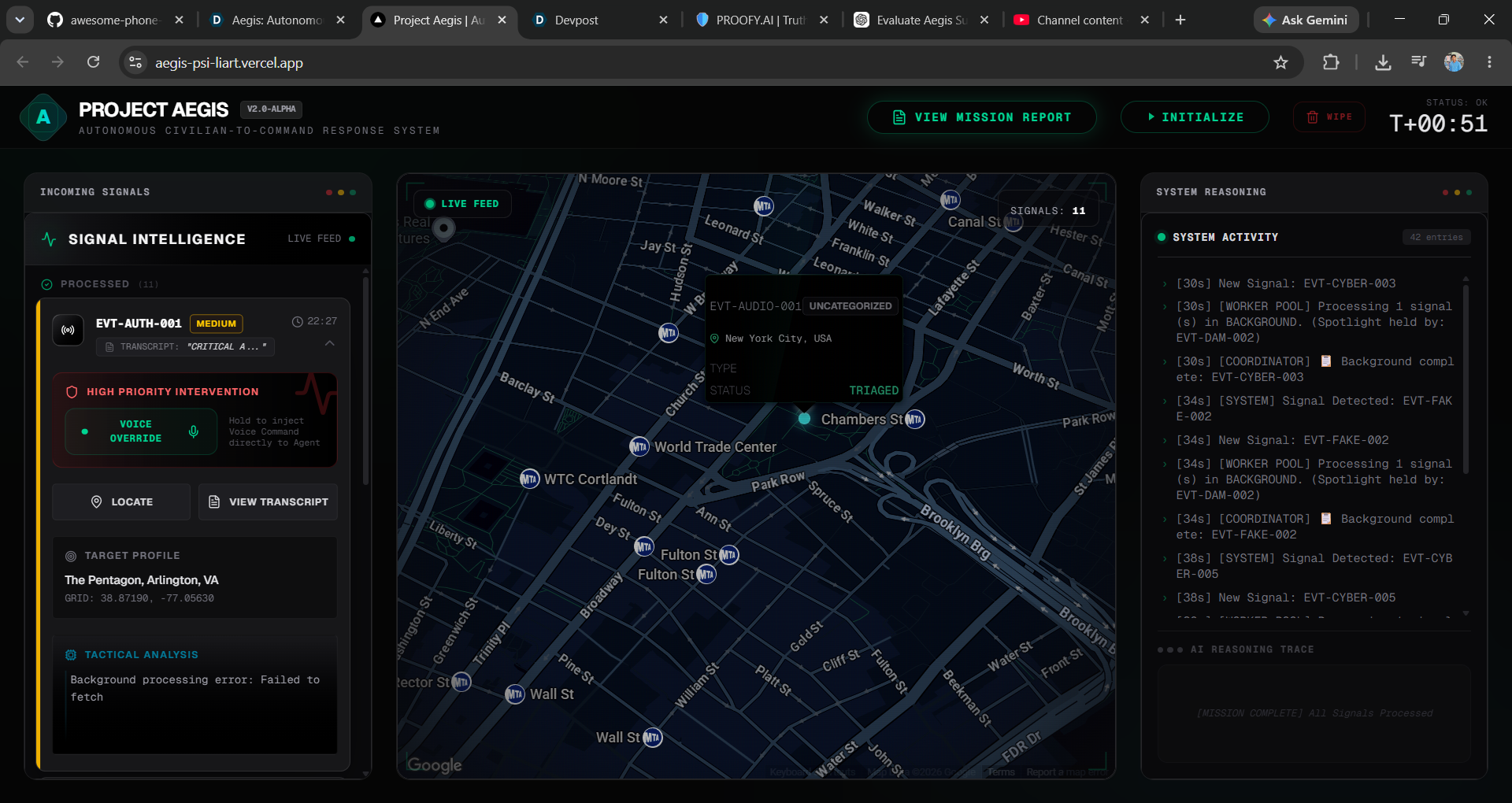
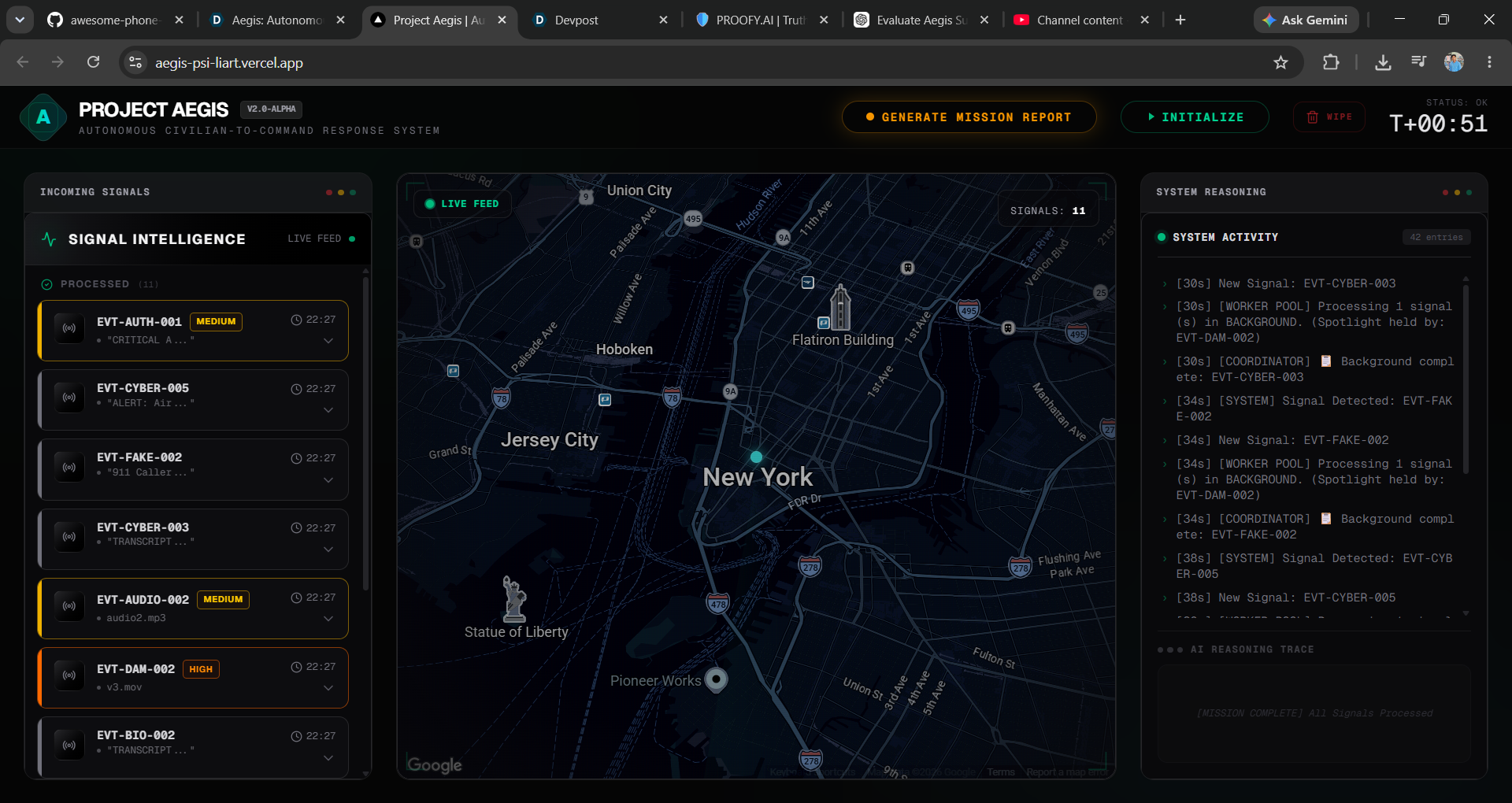
Aegis is an autonomous Civilian-to-Command response grid designed to help emergency operations teams process large volumes of incident information and identify the situations that require immediate attention.
Instead of presenting responders with another static dashboard, Aegis uses a coordinated multi-agent architecture in which specialized AI agents collaborate on different parts of the emergency-response workflow.
Coordinator Agent
The Coordinator Agent receives incoming incident signals—including audio, text, video, and images—and routes them to the appropriate specialized agents.
Triage Agent
The Triage Agent evaluates incidents using contextual reasoning rather than relying solely on keywords.
For example:
"Trapped in basement" + "rising water"
can indicate a significantly higher drowning risk than either statement considered independently. Aegis uses this contextual relationship to automatically elevate the incident's priority.
Surveillance Agent
The Surveillance Agent analyzes visual information and uses external information sources to verify incident details.
For example, it can cross-reference reported locations, weather conditions, or relevant infrastructure information before an incident is represented as a verified threat.
Logistics Agent
The Logistics Agent evaluates response requirements and calculates suitable paths for rescue assets, helping responders determine how resources can reach priority incidents efficiently.
Reporter Agent
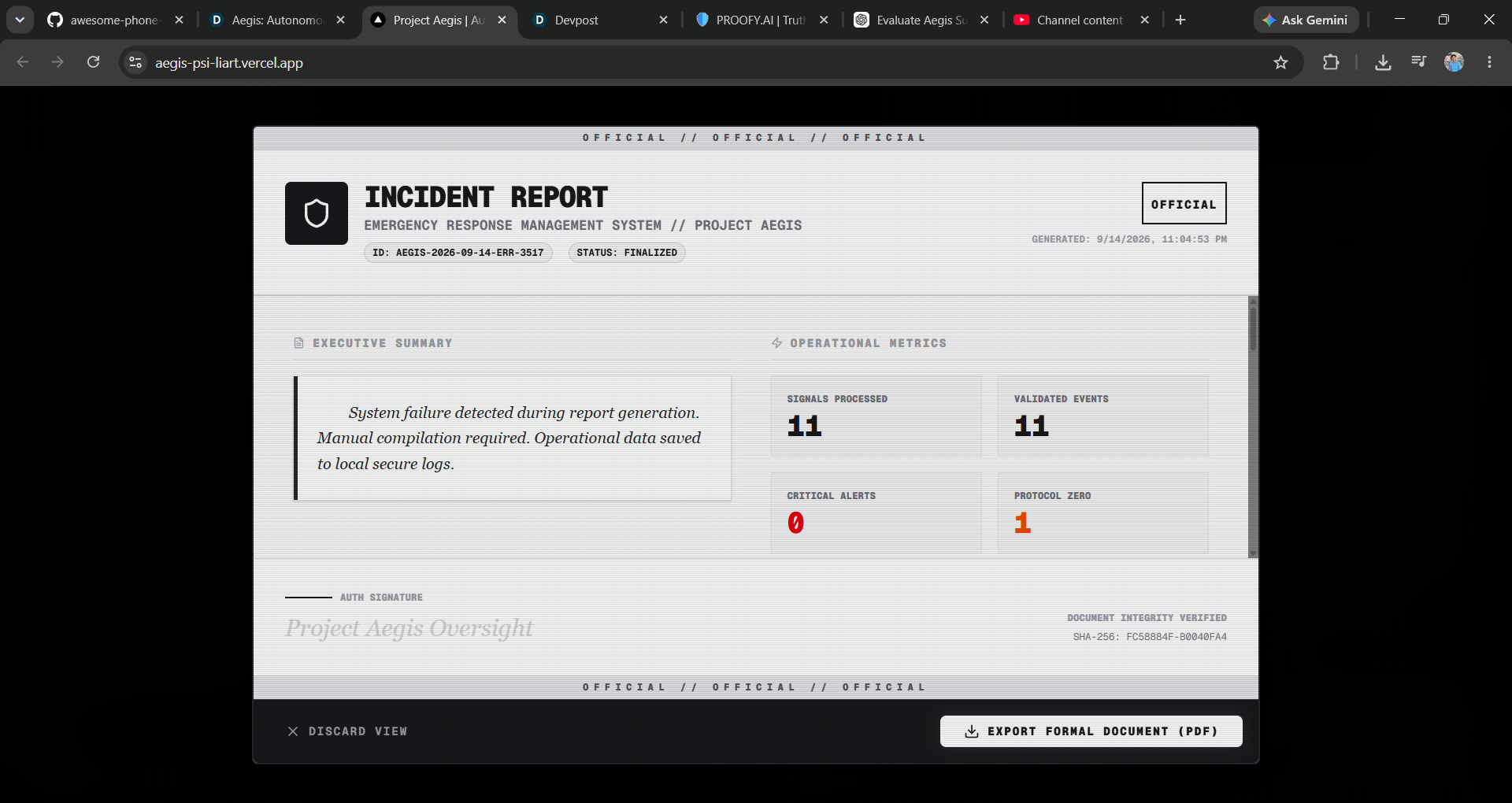
The Reporter Agent compiles incident information, timestamps, locations, decisions, and reasoning into structured situation reports that can support post-mission review and auditing.
Protocol Zero
Aegis is designed with a human-in-the-loop safety mechanism called Protocol Zero.
When a decision carries significant consequences—such as deploying heavy rescue assets—the system can identify uncertainty and request explicit approval from the human commander rather than acting autonomously.
The objective is not to replace emergency commanders.
It is to give them better information, faster.
How we built it
Aegis is built as a modular agentic system with specialized agents coordinated through a central orchestration layer.
The Brain — Gemini 3 Pro
Gemini 3 Pro provides the multimodal intelligence used to interpret incident information and reason about context.
Rather than relying purely on keyword matching, Aegis generates structured reasoning information that can be surfaced to the commander through the interface.
The Eyes — Google Maps Platform
The command interface uses the Google Maps JavaScript API with a custom dark tactical visual style.
Advanced map markers provide a high-contrast representation of incidents, priorities, and locations while keeping the command center visually focused.
The Nervous System — Next.js 14
Aegis uses Next.js 14 and the App Router, with server-side functionality designed to support parallel agent processing without blocking the user interface.
Multi-Agent Architecture
Each agent has a focused responsibility, system instructions, and tools:
Coordinator → Triage → Surveillance → Logistics → Reporter
This modular architecture allows information to move between specialized agents while maintaining a unified incident state.
Challenges we ran into
1. Cognitive Overload
Our first interface exposed too much information and too much reasoning simultaneously. During a crisis, this quickly became difficult to read.
We introduced the Spotlight Protocol.
Aegis can process incidents in the background while reserving detailed reasoning visualization for the highest-priority active threat. This keeps the command interface focused on what matters most.
2. Hallucinations vs. Reality
Early versions could generate plausible but incorrect location or incident information.
We addressed this by introducing external verification into the workflow. Reported locations, weather conditions, and relevant incident information can be checked against external sources before being treated as verified information on the operational map.
3. The Black-Box Problem
Emergency responders cannot reasonably trust a priority score if they cannot understand why it was assigned.
We therefore designed Aegis to provide concise Display Reasoning alongside its priority decisions.
Instead of overwhelming the commander with raw model output, the interface presents the key factors behind the decision so the human can quickly audit the recommendation.
Accomplishments that we're proud of
Spotlight Protocol
We developed a way to expose AI decision context without overwhelming the commander. The system can process many incidents while visually focusing attention on the most critical threat.
Multi-Agent Orchestration
Coordinating specialized agents and transferring information between them was one of the most technically challenging parts of the system. Aegis successfully connects triage, surveillance, logistics, and reporting into a unified workflow.
Real-Time Verification
Aegis does not simply accept every incoming report as fact. The system can use external information sources to validate important details before incorporating them into the operational picture.
Protocol Zero
We built a human-in-the-loop workflow for high-stakes decisions. The AI can analyze and recommend, but critical actions can remain under explicit human authority.
What we learned
Latency matters
Emergency response is inherently time-sensitive. Sequentially processing every incident can introduce unacceptable delays.
Parallel processing is therefore fundamental to an agentic crisis-response architecture.
UX is safety
In a crisis environment, interface design is not merely aesthetic.
A confusing interface can delay a decision.
We learned that clear typography, strong visual hierarchy, dark-mode presentation, and focused information density are essential when designing AI systems for high-pressure environments.
AI needs boundaries
One of our most important lessons was that a powerful AI system should not attempt to make every decision itself.
The right architecture is one that knows when to act, when to recommend, and when to ask a human.
That principle became the foundation of Protocol Zero.
What's next for Aegis: Autonomous Multi-Agent Crisis Command
IoT Integration
Connect Aegis directly to smart-city infrastructure such as flood gauges, environmental sensors, thermal cameras, and other emergency telemetry sources.
Offline-First Field Response
Develop a mobile field-responder mode capable of synchronizing information through resilient or mesh-based communication when conventional internet connectivity is unavailable.
Voice-to-Action
Enable commanders to issue natural-language commands such as:
"Initiate evacuation for Sector 4."
Aegis would translate the command into the appropriate operational workflow while maintaining human authorization for high-impact actions.
GovTech Pilot
Our long-term goal is to work with municipal disaster-management and emergency-response teams to evaluate Aegis as a force-multiplier for existing emergency operations rather than a replacement for trained personnel.
Aegis represents our vision for emergency response where AI handles the volume, surfaces the signal, explains its recommendations, and keeps humans in control of the decisions that matter most.
Built With
- aiagent
- google-maps
- next.js
- tailwind-css
- typescript

Log in or sign up for Devpost to join the conversation.