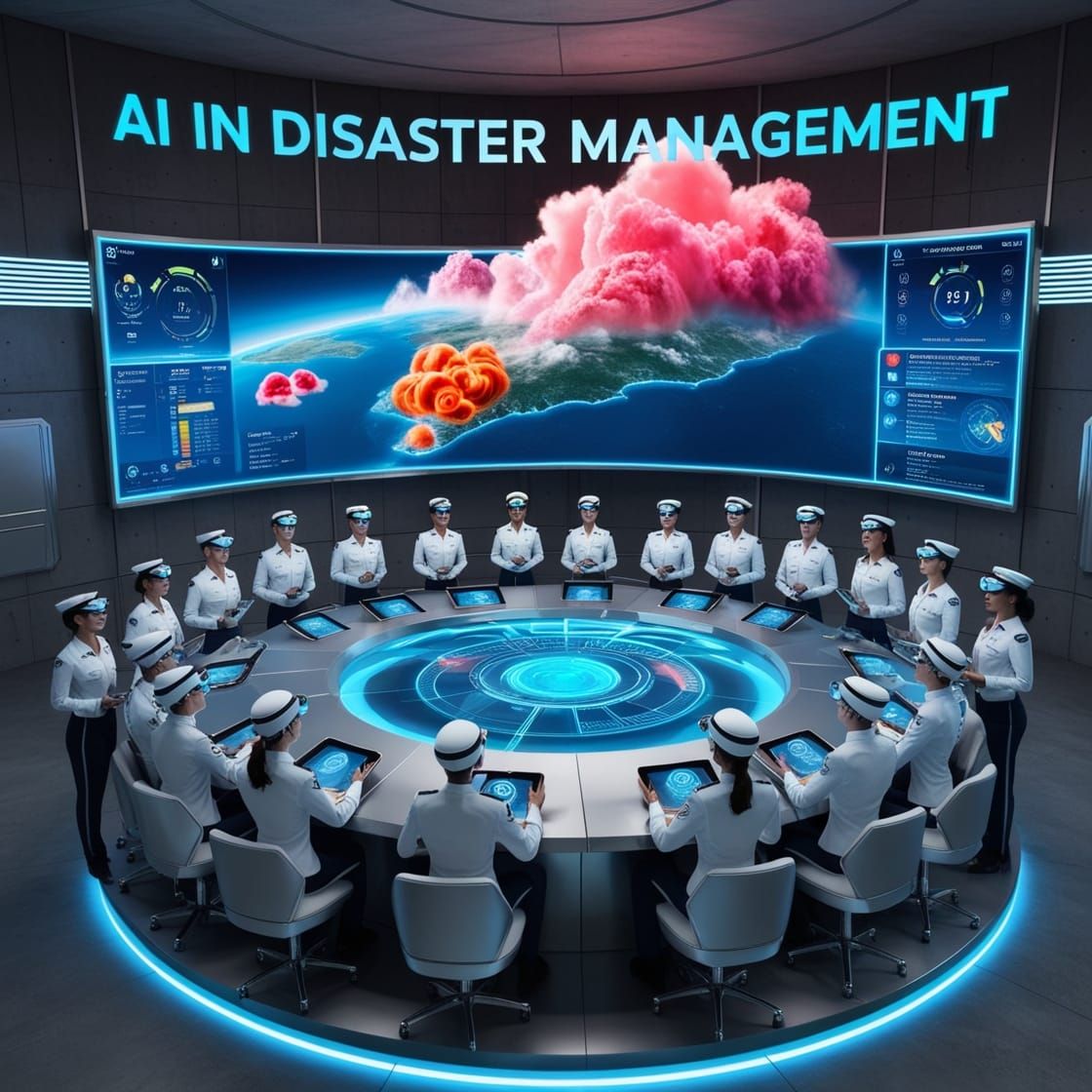
Aegis: AI Disaster Response Coordinator
Strategic Human–AI Collaboration for High-Performance Innovation
Abstract
Aegis is a decentralized, high-performance disaster response platform designed to bridge the gap between hardware-level mesh data and intelligent clinical decision-making. By integrating real-time mesh network monitoring with Gemini-powered multimodal triage, Aegis optimizes the "Last Mile" of emergency response, ensuring that critical resources are deployed with mathematical precision in environments where traditional communication infrastructure has failed.
1. Inspiration: The Genesis of Aegis
The inspiration for Aegis stems from the recurring tragedy of "information blackouts" during natural disasters. In events like the 2023 earthquakes in Turkey and Syria, or major hurricanes in the US, the primary cause of preventable death is often not the event itself, but the collapse of communication.
We were inspired by the potential of Mesh Networking—a decentralized communication topology—and the reasoning capabilities of Large Language Models (LLMs). We asked: What if the network itself was intelligent? What if every node in a disaster zone wasn't just a relay, but a triage officer capable of analyzing injuries and optimizing rescue paths? Aegis was born from this vision of a "Living Network."
2. Problem Statement: The "Last Mile" Crisis
In disaster response, the "Last Mile" refers to the final, most difficult stage of reaching a survivor. Current systems face three critical failures:
- Infrastructure Fragility: Centralized cellular and internet networks are the first to fail.
- Triage Bottlenecks: Human first responders are overwhelmed, leading to "Triage Fatigue" and errors in prioritization.
- Data Fragmentation: Vital signs and injury data are often recorded on paper or isolated devices, making it impossible for central command to see the "Big Picture."
Mathematically, the complexity of resource allocation in a disaster zone can be modeled as a variation of the Vehicle Routing Problem (VRP) with stochastic demands. If $N$ is the number of survivors and $R$ is the number of rescue teams, the search space for optimal allocation grows factorially, making human-only coordination inefficient under pressure.
3. The Solution: Aegis Intelligence Layer
Aegis provides a three-tier solution to the "Last Mile" crisis:
A. Decentralized Mesh Monitoring
Aegis simulates a robust mesh network where each node monitors its own health and local survivor signals. This ensures that even if 50% of the network is destroyed, the remaining nodes continue to route data to the Aegis Dashboard.
B. Gemini Multimodal Triage (GMT)
The core innovation is the GMT Engine. Using Google Gemini, Aegis can process:
- Visual Data: Photos of injuries to detect severity.
- Quantitative Data: Heart rate, blood pressure, and $SpO_2$ levels.
- Qualitative Data: Natural language descriptions from field volunteers.
C. Tactical Command Interface
A high-density dashboard that provides "God-view" situational awareness, allowing commanders to see the triage status of an entire sector at a glance.
4. Technical Architecture & Implementation
Aegis is built on a modern, full-stack TypeScript architecture designed for low-latency and high reliability.
The Operational Loop
- Data Ingestion: Mesh nodes detect a survivor signal (simulated or hardware-triggered).
- AI Analysis: The field medic scans the survivor. The data is sent to the Gemini API.
- Triage Scoring: Gemini returns a structured JSON assessment.
- Global Sync: The dashboard updates in real-time, re-calculating the priority queue.
5. Mathematical Framework
Aegis uses a weighted priority algorithm to determine rescue order.
Triage Priority Score ($P$)
The priority of a survivor is calculated based on their Triage Level ($L$) and their Vital Stability ($V$):
$$P = \omega_1 L + \omega_2 (1 - \frac{HR_{norm} + BP_{norm} + O2_{norm}}{3})$$
Where:
- $L \in {4, 3, 2, 1}$ (Critical to Minor)
- $\omega$ are weighting constants determined by clinical protocols.
- $O2_{norm}$ is the normalized oxygen level, where values below 90% exponentially increase the priority.
Mesh Signal Decay
To ensure data reliability, we model signal strength ($S$) over distance ($d$) using the inverse-square law, adjusted for disaster-zone interference ($\beta$):
$$S(d) = \frac{P_{tx} \cdot G_{tx} \cdot G_{rx}}{d^2 \cdot \beta}$$
Aegis monitors these values to predict node failure before it happens.
6. Tech Stack: The Aegis Engine
- Frontend: React 19 with Vite for ultra-fast HMR and build times.
- Intelligence: Google Gemini API (
gemini-3-flash-preview) for multimodal reasoning. - Styling: Tailwind CSS 4.0 for a high-performance, utility-first design system.
- Components: shadcn/ui for accessible, professional-grade UI primitives.
- Animations: Motion (formerly Framer Motion) for smooth, non-distracting state transitions.
- Icons: Lucide React for a consistent technical iconography.
7. Challenges Faced & Overcoming Obstacles
Challenge 1: Multimodal Data Consistency
Problem: Getting an AI to return consistent triage levels from varying photo qualities.
Solution: We implemented a strict JSON Schema in the Gemini configuration. By forcing the model to adhere to a Type.OBJECT structure with specific enums, we eliminated "hallucinations" and ensured the dashboard could always parse the result.
Challenge 2: Real-time Simulation Logic
Problem: Simulating a mesh network without actual hardware during development. Solution: We built a custom React Hook that manages a stochastic simulation of battery drain and signal degradation, allowing us to test the "Critical Alert" UI logic without needing physical sensors.
8. Lessons Learned
- AI as a Reasoning Layer, Not Just a Chatbot: We learned that the true power of Gemini lies in its ability to act as a structured data processor. By using it to "score" survivors, we turned a creative tool into a clinical one.
- Design is a Functional Requirement: In high-stress environments, UI clarity saves lives. We learned to prioritize high-contrast elements and "glanceable" data over aesthetic flourishes.
- The Importance of "Fail-Safe" Defaults: We implemented error handling that defaults to "Stable" triage if the AI fails, ensuring the system never causes panic through technical errors.
9. Future Scalability: The Roadmap
Aegis is designed to scale from a hackathon prototype to a global standard:
Phase 1: Hardware Integration (The "Edge" Layer)
Integrating ESP32 LoRa modules to replace the simulation with real-world mesh data.
Phase 2: Predictive Disaster Modeling
Using Gemini to analyze historical disaster patterns and predict where the next "Communication Blackout" is likely to occur, allowing for pre-deployment of mesh nodes.
Phase 3: A2A (Agent-to-Agent) Coordination
Implementing the Model Context Protocol (MCP) to allow Aegis to talk directly to autonomous delivery drones. Example: Aegis identifies a "Critical" survivor needing blood. It automatically sends an MCP request to a nearby drone swarm to deliver the specific blood type.
10. Conclusion
Aegis is more than a dashboard; it is a strategic framework for human-AI collaboration. By offloading the cognitive load of triage to Gemini and the physical load of communication to a mesh network, we empower human responders to do what they do best: save lives.
Developed for the 2026 MakeNJIT Hardware Hackathon.
Built With
- css
- geminiapi
- html
- python
- react
- typescript

Log in or sign up for Devpost to join the conversation.