-
-
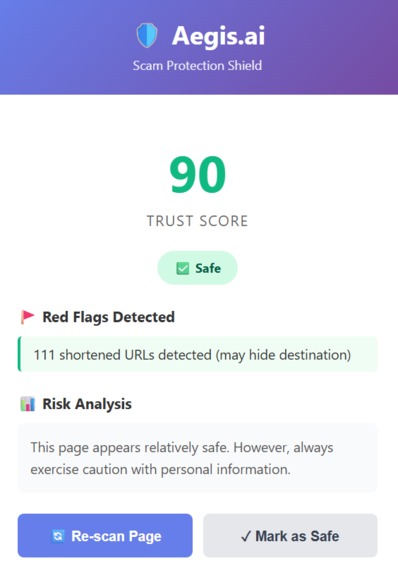
The extension
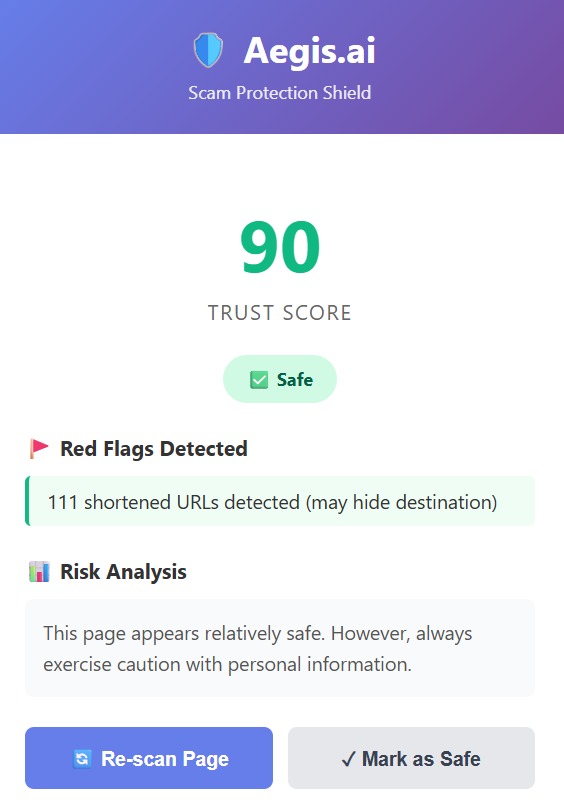
Inspiration
The internet has become increasingly unsafe, especially for students, job seekers, freelancers, and everyday users who face fake internships, phishing emails, investment scams, and fraudulent financial pages. These threats often look legitimate on the surface, making them easy to fall for. We wanted to create a simple, instant, and trustworthy layer of protection that helps people understand whether a link, post, or webpage is safe before they interact with it. That idea became Aegis.ai.
What it does
Aegis.ai is a browser extension that scans webpages, emails, job postings, and financial links to detect warning signs of scams or fraud. It analyzes:
- Suspicious keywords, red-flag language, and impersonation patterns
- Phishing indicators
- Fake job/internship templates
- Financial risks such as unrealistic investment claims or unsafe payment pages
- Metadata and structural anomalies often found in scam sites
The result is shown as a simple rating: Safe ✔ | Suspicious ⚠ | Dangerous ✖
A Premium concept version adds deeper scanning, scam history tracking, and early alerts for new fraud patterns.
How we built it
The extension combines:
- JavaScript, HTML/CSS
- Browser extension APIs
- AI/NLP models for language analysis
- Custom heuristics for financial and phishing detection
- A modular structure that allows rapid updates as scam patterns evolve
All processing is lightweight, fast, and privacy-focused, running directly in the browser.
Tracks: ✔ Artificial Intelligence & Machine Learning ✔ FinTech & Digital Economy
Challenges we ran into
- Designing a detection system that works reliably across different types of webpages.
- Keeping the extension lightweight without compromising risk analysis.
- Ensuring clear communication of risk without overwhelming users.
- Navigating constraints around publishing and distributing browser extensions.
Accomplishments that we're proud of
- Built a functional, user-friendly safety tool within a very short timeframe.
- Achieved consistent detection of phishing cues and suspicious financial content.
- Designed an interface suitable for both tech and non-tech users.
- Created a solution that blends AI, safety, and digital trust in a practical way.
What we learned
- How AI can be applied to real-world scam and fraud detection.
- How online threats evolve, especially in job markets and digital finance.
- How important UI clarity is for trust and adoption.
- How browser extension architecture can be adapted quickly for security use cases.
What's next for Aegis.ai
- Publishing on the Chrome Web Store after meeting all required policies.
- Expanding the Premium feature set with deeper analysis and dashboards.
- Adding OCR-based scanning for email attachments and images.
- Introducing mobile support and integration with messaging apps.
- Building a community-driven database of newly reported scams.
Built With
- css3
- extension
- html5
- natural-language-processing

Log in or sign up for Devpost to join the conversation.