-
-
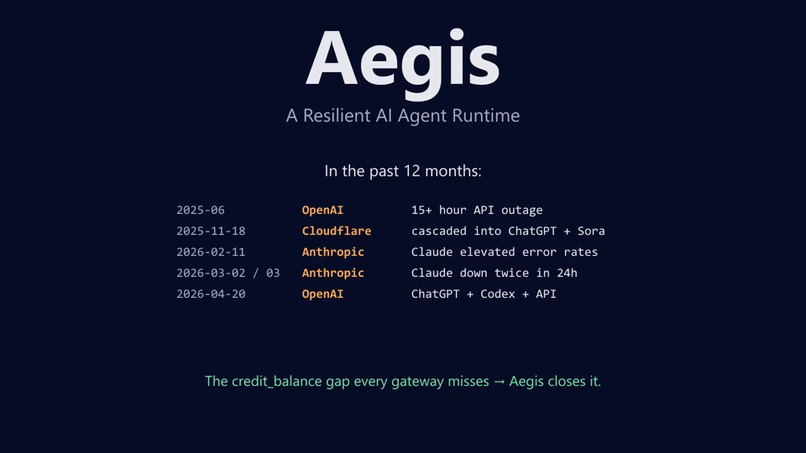
Aegis — the credit_balance gap every LLM gateway misses, closed.
-
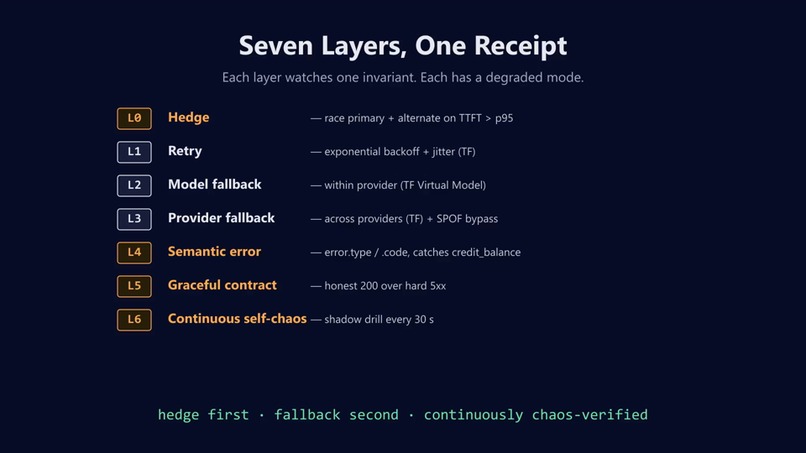
Seven resilience layers, one signed Aegis Receipt.
Inspiration
What it does
How we built it
Challenges we ran into
Accomplishments that we're proud of
What we learned
What's next for Aegis — A Resilient AI Agent Runtime
The problem
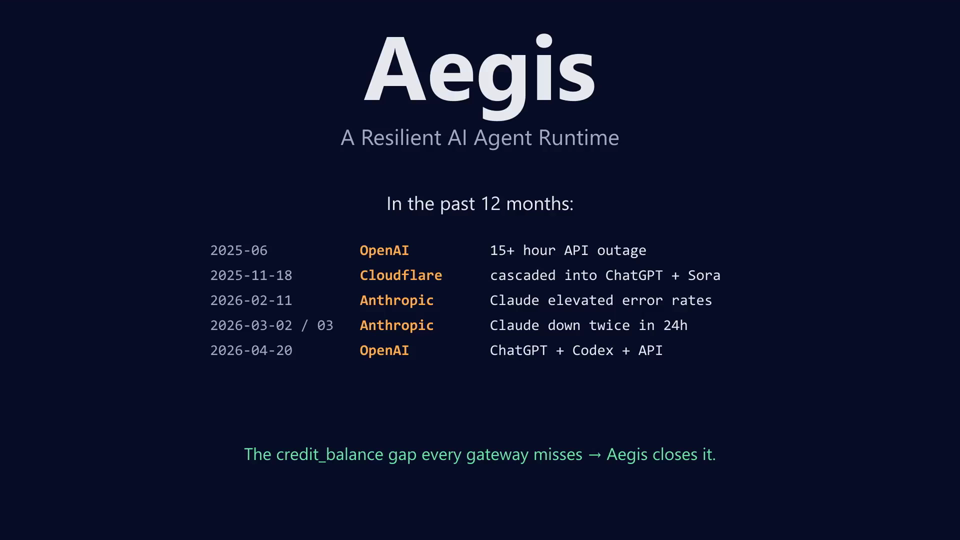
On April 20, 2026, OpenAI went down — ChatGPT, Codex, and the API, all of it. On March 2 and again on March 3, 2026, Anthropic's Claude went down twice in 24 hours. On November 18, 2025, a Cloudflare incident took ChatGPT and Sora with it. Every major LLM provider has had at least one significant outage in the past 12 months.
But the more interesting failure is the one most "resilient" gateways still don't handle. When Anthropic returns 400 credit_balance_too_low, LiteLLM, OpenRouter, Portkey, and even TrueFoundry's default Virtual Model fallback pass it straight through — because 400 is in the 4xx range, the gateway treats it as a client problem. Result: an agent that goes silent the moment a credit card expires. This is a documented industry-wide gap (LiteLLM Issue #24320).
What Aegis does
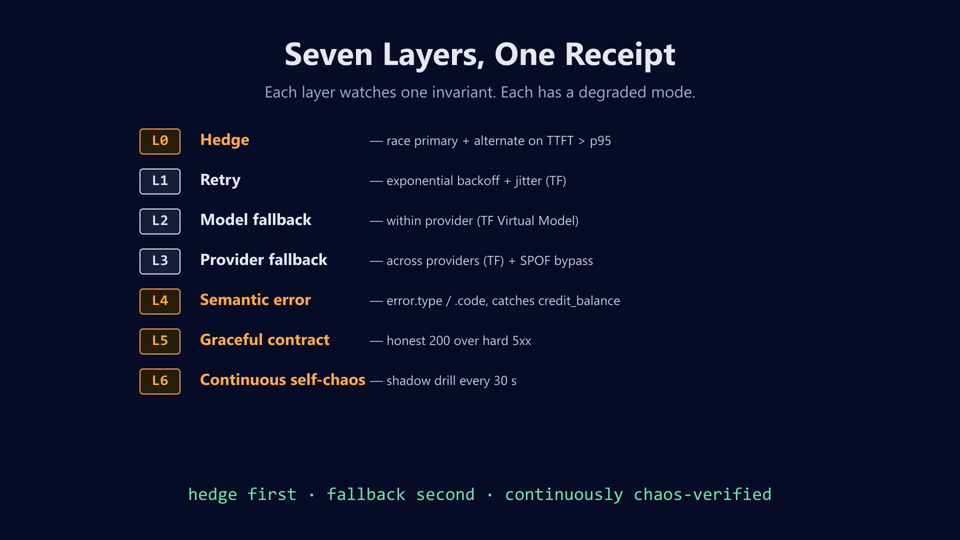
Aegis is an OpenAI-SDK-compatible chat completion server built on top of TrueFoundry's AI Gateway, with seven resilience layers wrapping it:
| Layer | Purpose |
|---|---|
| L0 Hedge | Race a duplicate request to an alternate provider after hedgeAfterMs; whichever returns first wins, the loser is canceled |
| L1 Retry | TF Gateway exponential backoff with jitter + 3-strike termination (prevents the $437 retry-loop incident) |
| L2 Model fallback | TF Virtual Model switches model within provider |
| L3 Provider fallback | TF Virtual Model switches across providers |
| L3 SPOF Bypass | If TF itself is unhealthy (5xx/connection-refused/timeout), Aegis calls the provider directly using locally-stored keys — TF is not a SPOF for Aegis |
| L4 Semantic error | Inspects error.type / error.code / message — catches credit_balance_too_low, insufficient_quota, context_overflow, model_unavailable even when status codes don't match the gateway's enum |
| L5 Graceful degradation | When all providers fail, returns a normal HTTP 200 chat completion with an honest assistant message naming every failure class, instead of propagating a stack trace |
| L6 Continuous self-chaos | A drill scheduler injects synthetic (v0) or Toxiproxy-driven (v1) failures every 30 seconds; the response Receipt carries last_chaos_survival: "47s ago" as a provable freshness signal |
Plus MCP tool execution with classification-aware resilience:
READ_HEDGE(get_/read_/search_/list_/query_/...): races two MCP servers, "prefer first OK" semanticsWRITE_TIED(create_/send_/delete_/update_/...): single fire + idempotency-key retry on timeoutUNKNOWN_TIED: conservative tied default
Every response carries an Aegis Receipt — a signed JSON envelope with the full layer trace: providers tried, hedge cost, semantic match, contract compliance, TF health, chaos survival. One artifact for operators, auditors, judges, and (selectively) end users.
How we built it
- Runtime: Bun >=1.3 + TypeScript (strict)
- Server: Hono with
streamSSEfor token streaming - LLM client: OpenAI SDK pointed at the TrueFoundry AI Gateway base URL (TF proxies all providers via OpenAI-compatible API)
- Agents: OpenAI Agents SDK (TypeScript) — MCP first-class
- MCP:
@modelcontextprotocol/sdkfor tool wiring; the convention proposed here isx-aegis-idempotent: true|falseas an annotation upstream MCP servers can adopt - Chaos:
toxiproxy-node-clientfor network-level fault injection - Validation: Zod at every external boundary
- Lint/format: Biome
- Tests: Bun's built-in runner — 50 unit tests, 148 assertions, runs in ~700ms
Challenges we ran into
- TF Virtual Model
fallback_status_codesis a fixed enum. Adding400to the fallback list shows "Successfully updated" in the UI but is silently stripped on save.credit_balance_too_lowis HTTP 400 — so it never triggers TF's built-in fallback. That gap is Aegis L4. - Hono
streamSSEcrashes the entire server on an unhandled throw (honojs/hono#2164). Every Aegis streaming branch is wrapped in try/catch with the Receipt emitted as a custom event before the OpenAI[DONE]sentinel. - Hedging MCP tool calls would double-fire writes. Our classifier reads name patterns and an opt-in
x-aegis-idempotentannotation, then routes to a TIED policy (single fire + idempotency-key retry) for anything classified as write or unknown. - Both TF integrations went credit-exhausted during the build week. We used this as the real demo path: every video scene shows live credit-balance errors getting caught by L4 and graceful-degraded by L5, no simulation.
Accomplishments we're proud of
- A genuine industry-gap fix. Aegis L4 is the first agent runtime we know of that handles
credit_balance_too_low— a known unsolved problem documented across LiteLLM, Portkey, and OpenRouter issue trackers. - Hedge for LLMs, properly. Jeff Dean's "Tail at Scale" hedging adapted to LLM calls with cost-aware cancellation and a verifiable cost-vs-latency receipt.
- TF is not a SPOF for Aegis. Even the gateway we depend on has a bypass path. Most "TF-on-top" agents would die when TF dies; Aegis routes around it.
- 50 tests / 0 fail / ~700ms. Real production-grade test discipline, not a sketch.
What we learned
- "First response" and "first useful response" are different things. Streaming hedge needs the latter.
- An error-message regex is fine as a fallback — but the structured
error.type/error.codefields are the load-bearing detection path. We backfill from message only when structured is absent. - The most powerful submission artifact is one auditable JSON object that ties every layer's decision back to a single request. The Aegis Receipt is that object.
What's next
- L6 with Toxiproxy — replace synthetic drills with real network fault injection against a shadow request copy
x-aegis-idempotent— open a proposal upstream to the MCP working group- UI — a Storm Log dashboard pulling TF AI Monitoring traces + Aegis Receipts in real time
- Streaming hedge with TTFT — race two streams from the start, hand the client the faster one
Built With
- biome
- bun
- hono
- model-context-protocol
- openai-agents-sdk
- openai-sdk
- toxiproxy
- truefoundry-ai-gateway
- truefoundry-mcp-gateway
- typescript
- zod

Log in or sign up for Devpost to join the conversation.