-
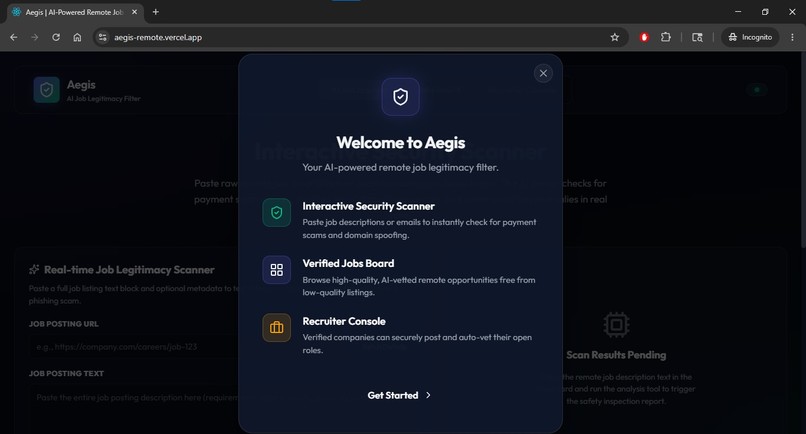
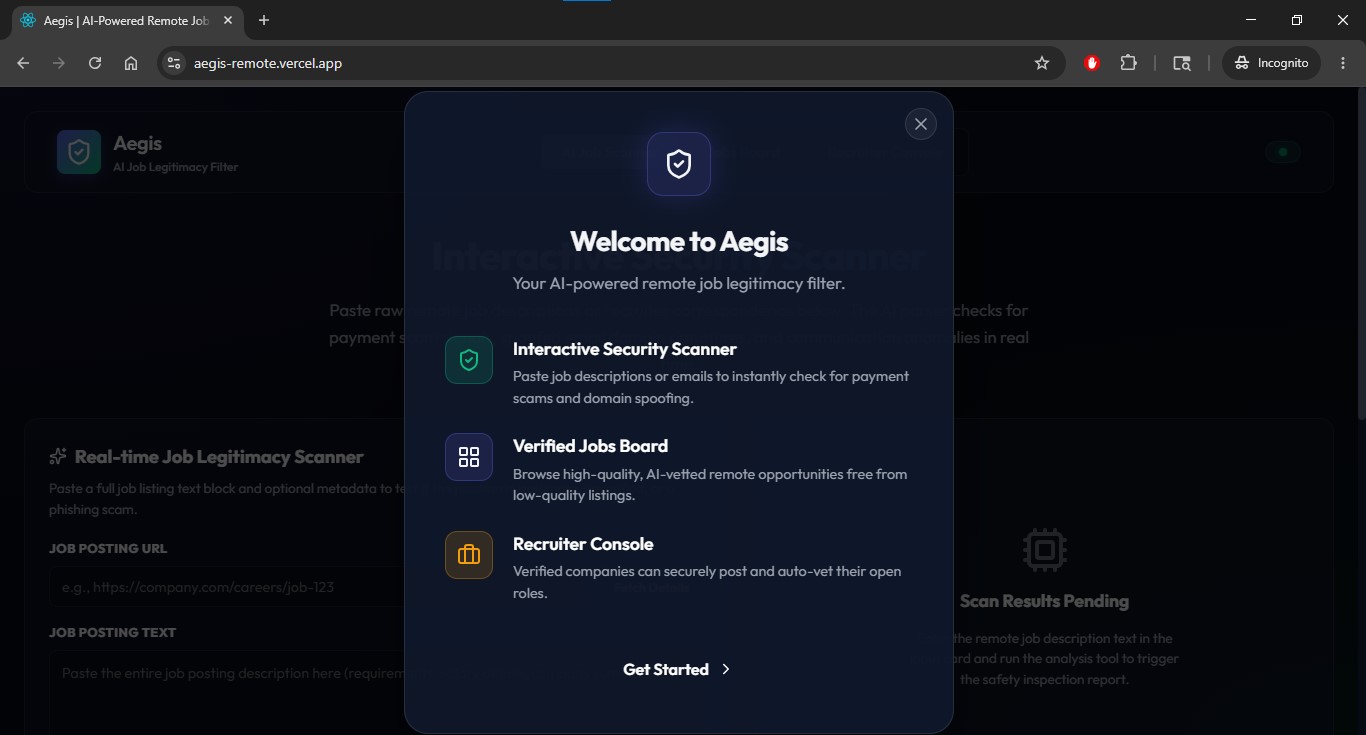
FTUE
-
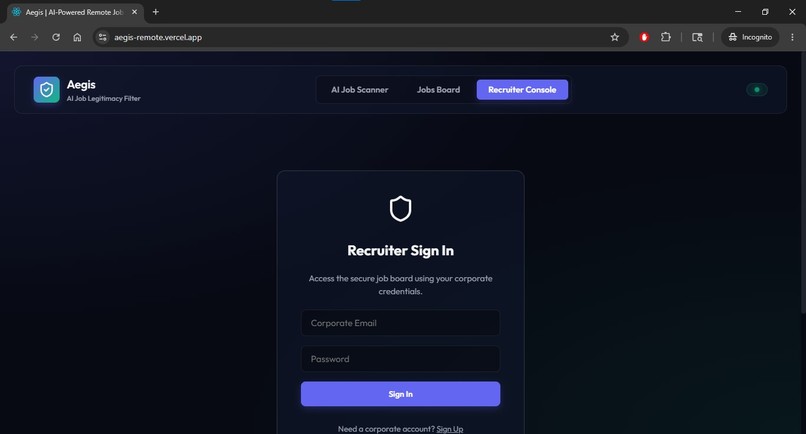
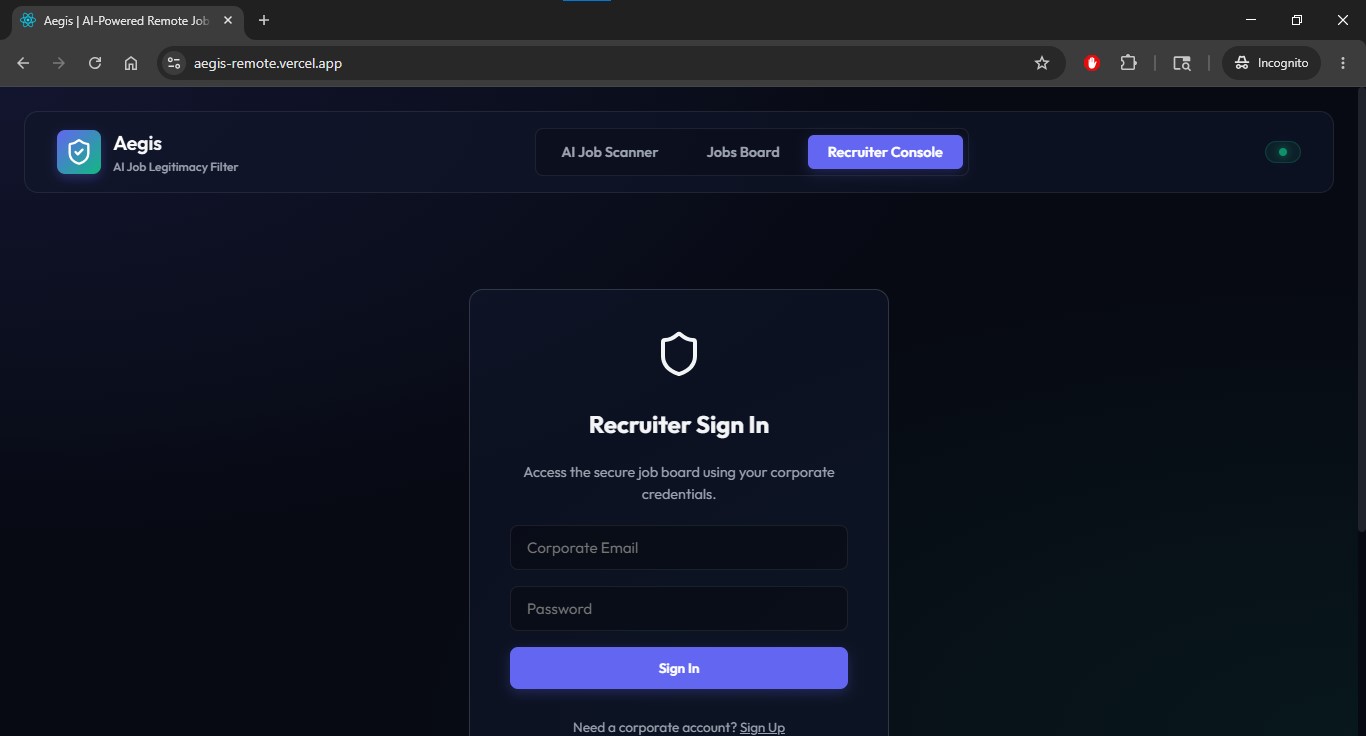
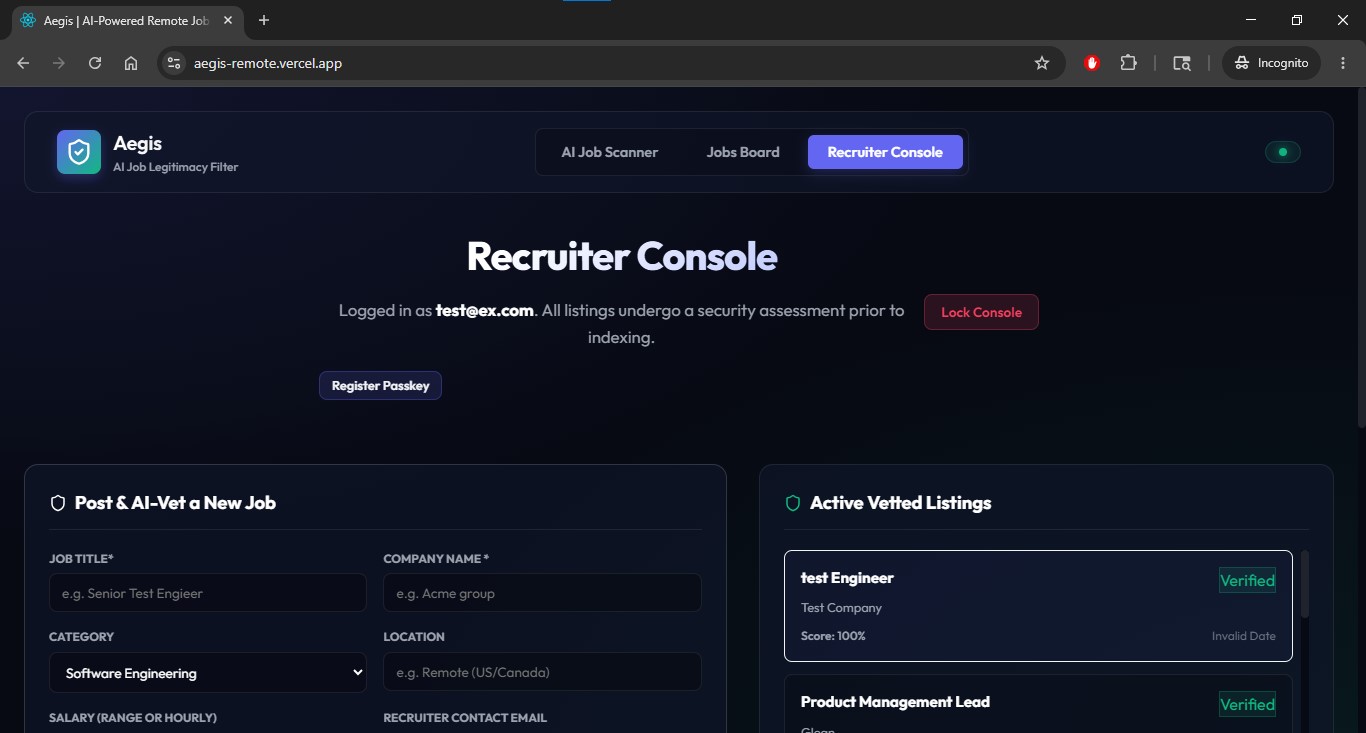
Recruiter's console
-
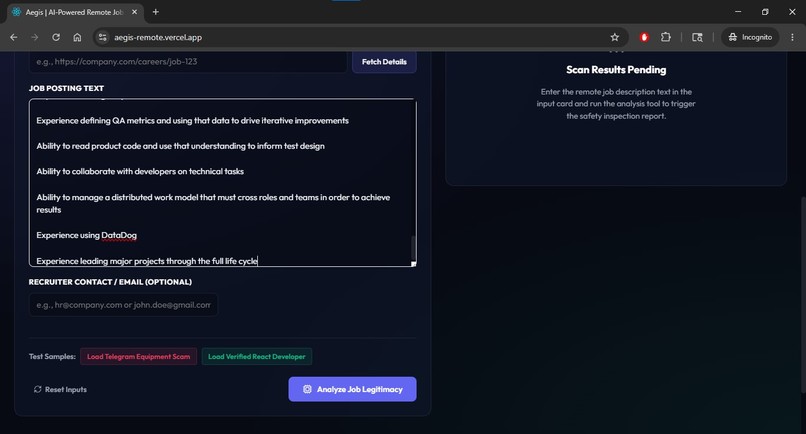
Home Screen
-
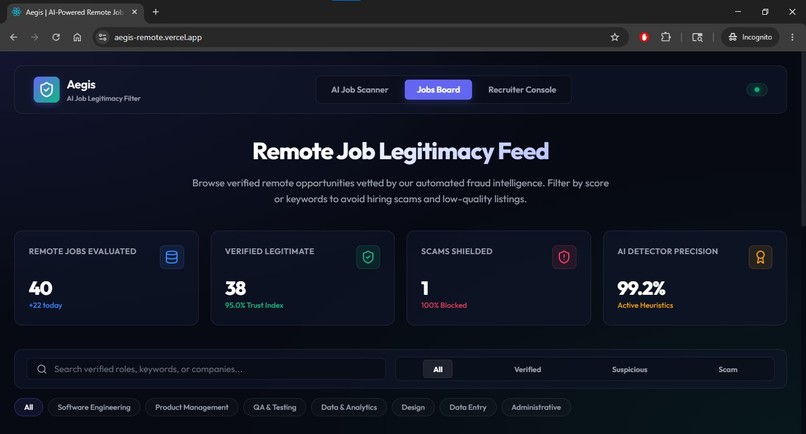
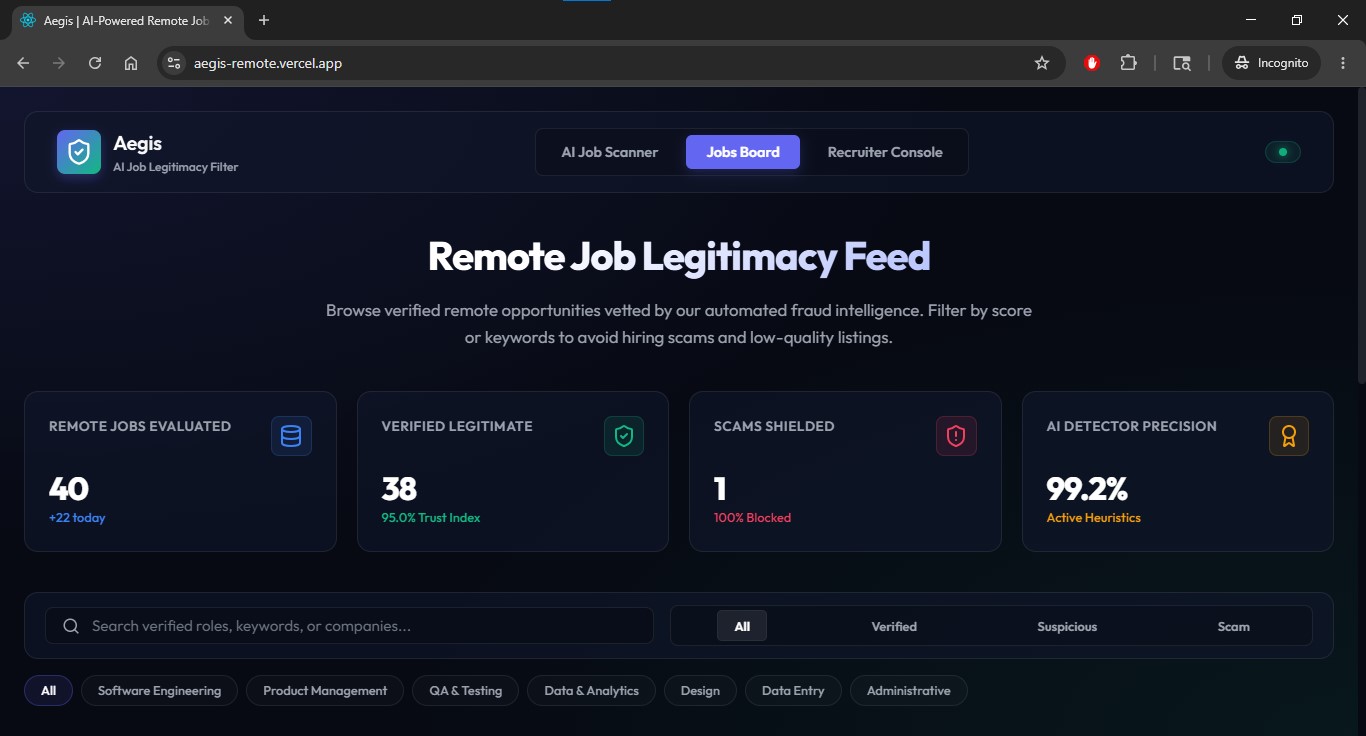
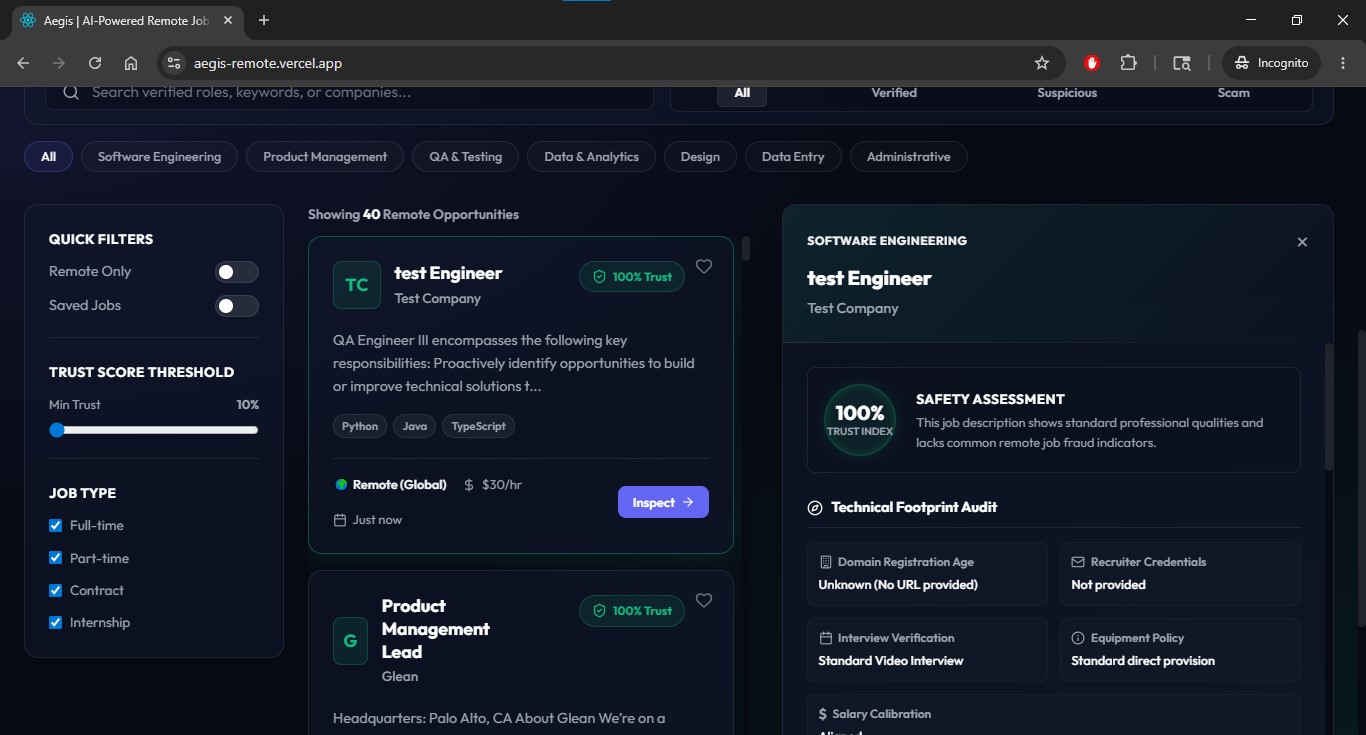
Jobs Board
-
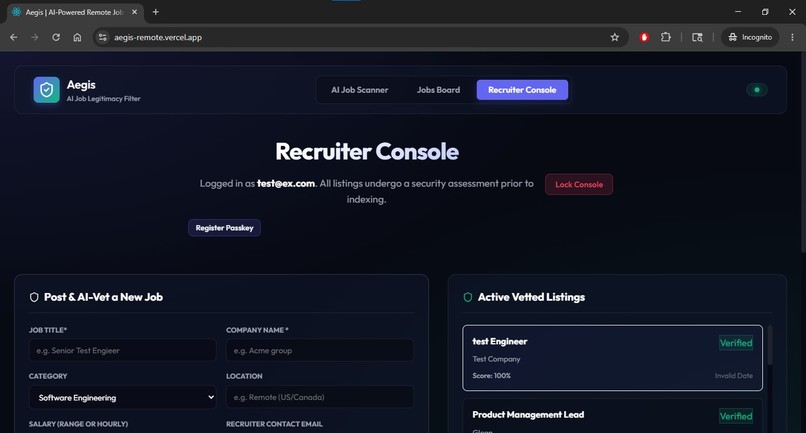
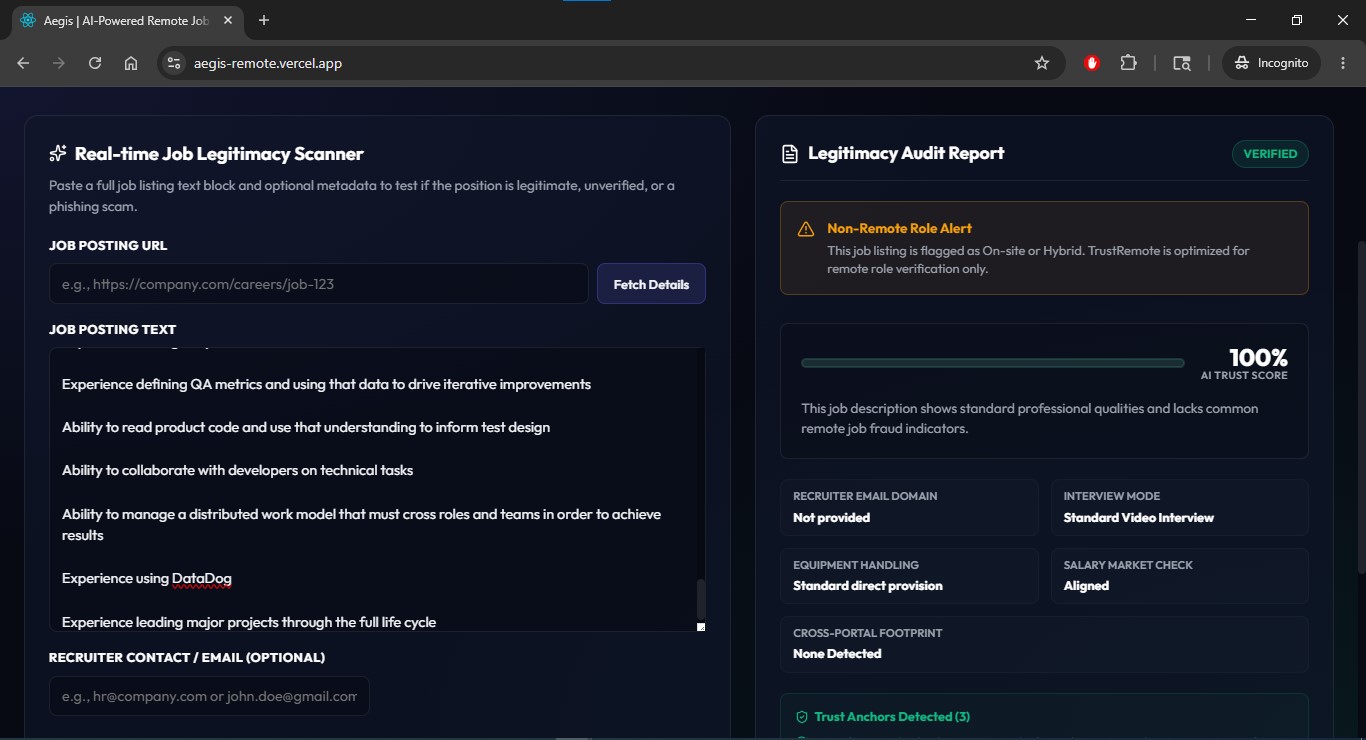
post sample job role - test Engineer
-
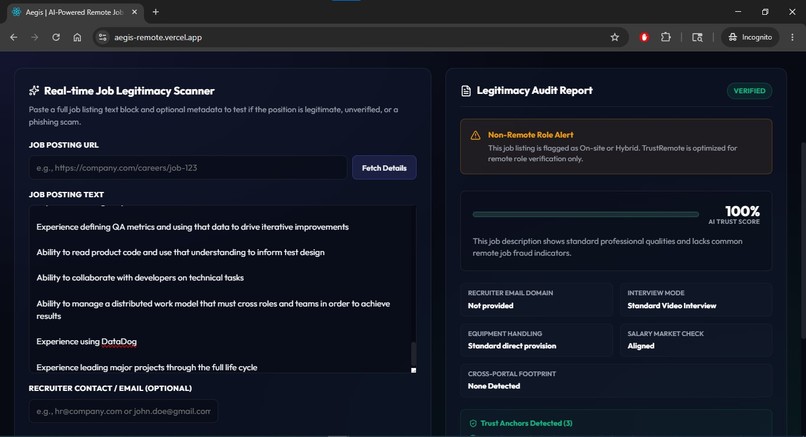
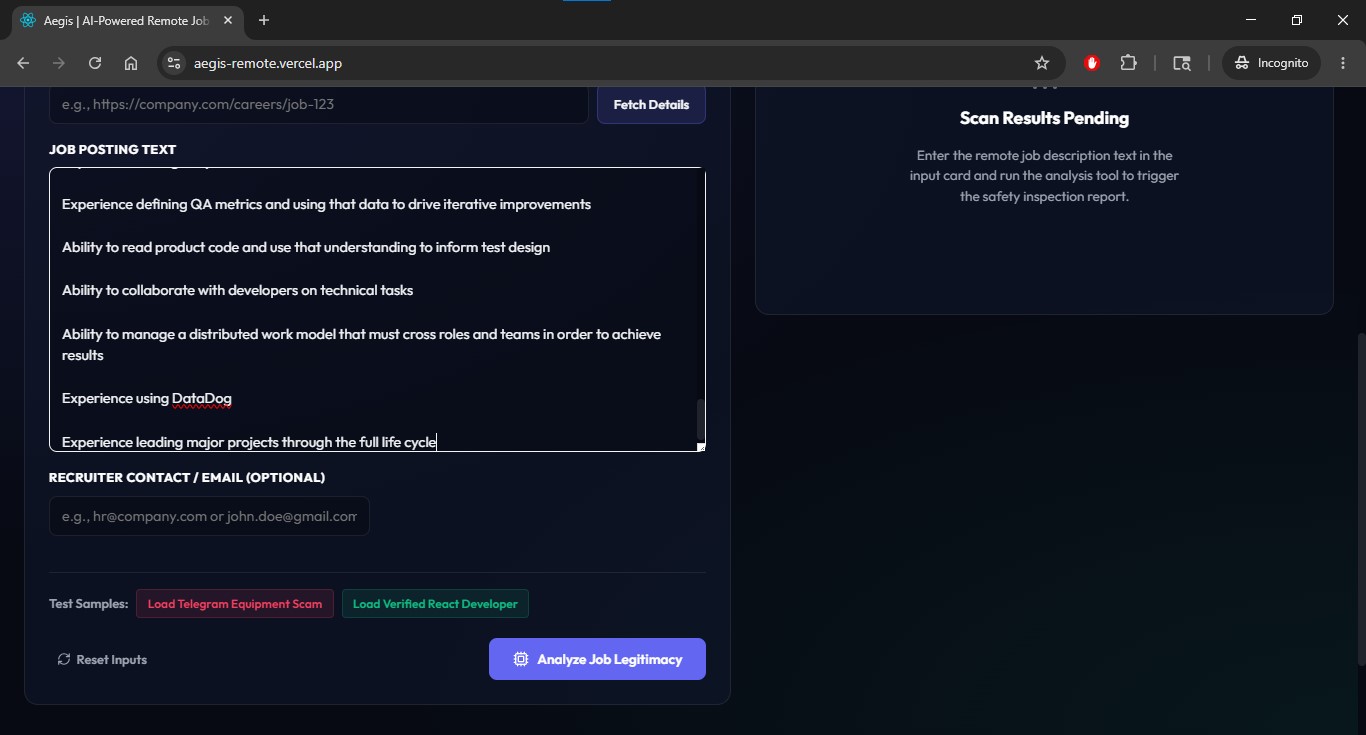
After obtaining description
-
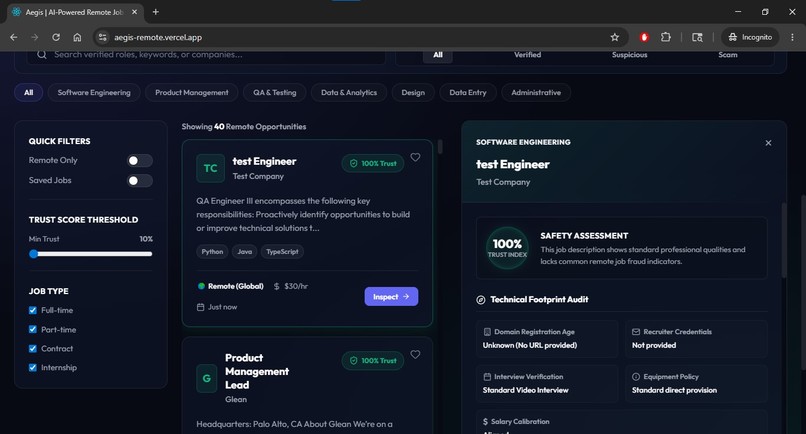
List of remote jobs
💡 Inspiration
The remote job market is facing an unprecedented trust crisis. Job boards are heavily targeted by malicious text scams, check-cashing fraud, and identity harvesting traps that exploit remote workers. As a solo developer, I wanted to build a platform that could act as an unbreachable protective barrier. I engineered Aegis (originally conceptualized as TrustRemote) to serve as an intelligent security shield—restoring absolute legitimacy and data transparency to remote employment by vetting listings before an applicant ever clicks "Apply."
⚙️ What it does
Aegis is a multi-layered, full-stack defensive gateway. It aggregates job feeds and evaluates posts in real time through a dual-engine architecture:
- Automated Heuristics: Instantly flags conflicting workspace indicators (such as hidden onsite parameters or tracking suspicious request structures).
- Generative AI Guardrails: Passes raw description text payloads into the Google Gemini API to analyze operational risk, scoring the post's legitimacy and generating human-readable trust insights.
The platform provides users with a clean, searchable dashboard featuring strict trust metrics, visual risk highlights, and deep heuristic breakdown data.
🛠️ How I built it
I engineered, tested, and deployed this entire architecture independently as a decoupled full-stack ecosystem:
- Frontend: Built with React, Vite, and Tailwind CSS to deliver an ultra-responsive, highly scannable grid dashboard.
- Backend: Powered by a Node.js and Express REST API that handles secure query routing, validation gates, and dynamic feed synchronization.
- AI Integration: Implemented the Google Gemini API to establish advanced contextual analysis on text data payloads.
- Testing & CI/CD: Developed comprehensive browser integration suites using Playwright, orchestrated via a custom GitHub Actions pipeline to catch port conflicts and ensure runtime stability, with deployments globally managed by Vercel.
🤝 Human-AI Collaboration Patterns
A key differentiator of my solo development lifecycle was a highly disciplined approach to AI governance. I strictly avoided chaotic, unvetted code dumps by implementing two specific boundaries:
- Human-in-the-Loop (HITL): Critical architectural milestones—such as designing server-side security gates and passcode validation schemas—were blocked until I explicitly audited, modified, and signed off on the execution strategy document.
- Human-on-the-Loop (HOTL): While the AI executed high-velocity asset generation, I assumed an overseer capacity—monitoring background automated test loops, diagnosing runtime exceptions, and manually managing version control. Fully autonomous actions (HOOTL) were strictly forbidden outside of sandboxed testing.
🧗 Challenges I faced
One of my primary technical hurdles was process management and network isolation inside my automated CI/CD environment. The background Vite development server continuously blocked the cloud virtual runner, leading to pipeline hangs. I resolved this by optimizing process detachment patterns and configuring automated testing to safely manage its web server lifecycle. I also handled tricky asynchronous proxy errors (ECONNREFUSED) by explicitly synchronizing background API daemons right before executing headless browser runs.
🏆 Accomplishments that I'm proud of
I successfully moved past generic, shallow AI integrations to build a functional, multi-tier security gate completely by myself. I am incredibly proud of constructing a stable, production-grade automated pipeline that runs complete browser regression tests on every single push, ensuring that my security rules scale safely without breaking core application features.
📚 What I learned
This hackathon completely redefined my approach to engineering velocity. Working solo, I mastered modern process management, containerized automation loops, and discovered how to treat Generative AI not as a black-box code-generator, but as a structured, governed asset that can be safely steered to build secure, robust web applications.
Built With
- express.js
- github-actions
- google-gemini-api
- javascript
- node.js
- playwright
- react
- tailwind-css
- vercel
- vite


Log in or sign up for Devpost to join the conversation.