-
-
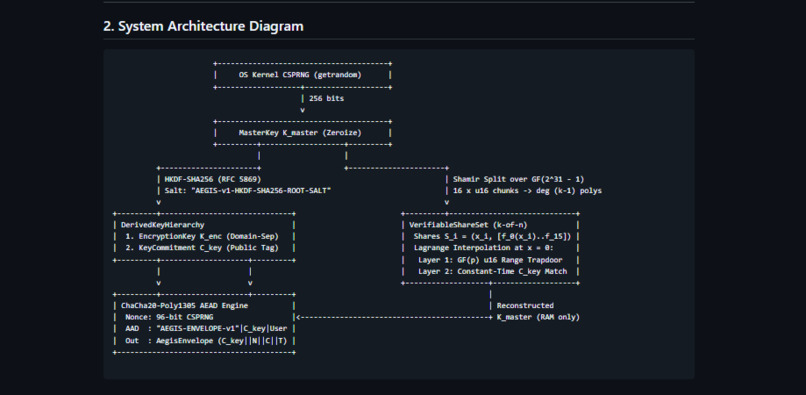
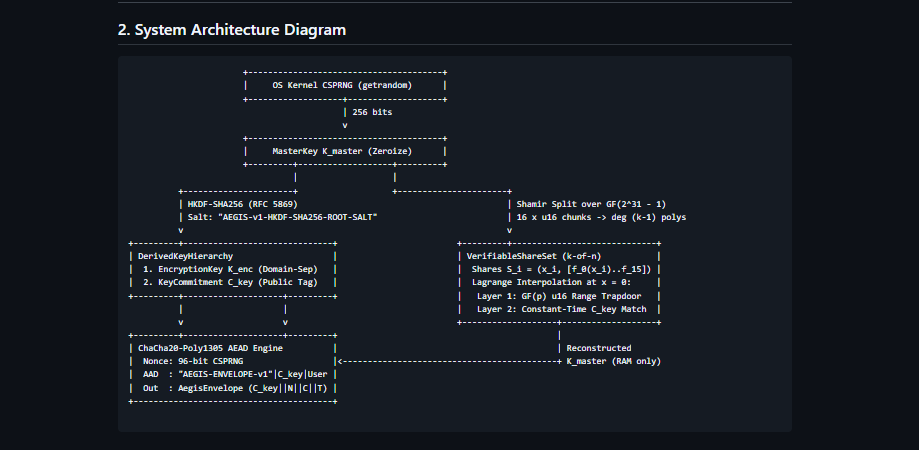
AEGIS Key-Committed Threshold Architecture: Combining HKDF-SHA256 Domain Separation, GF(2^31-1) Secret Sharing, and Canonical AAD Binding.
-
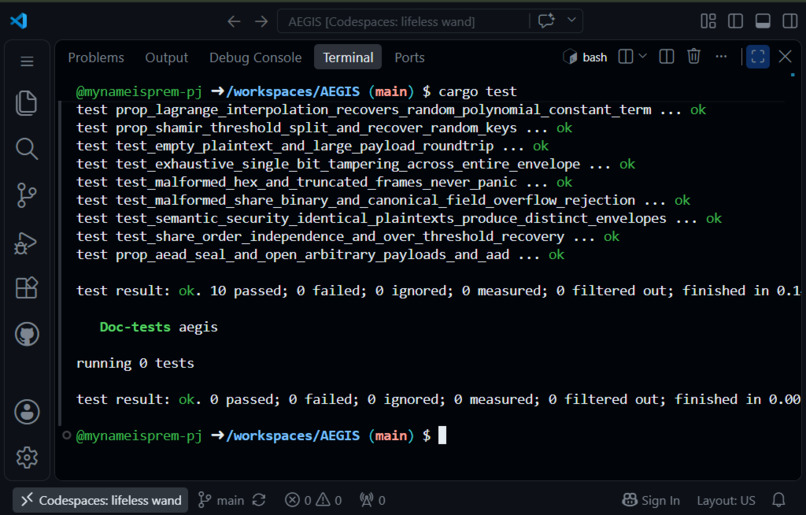
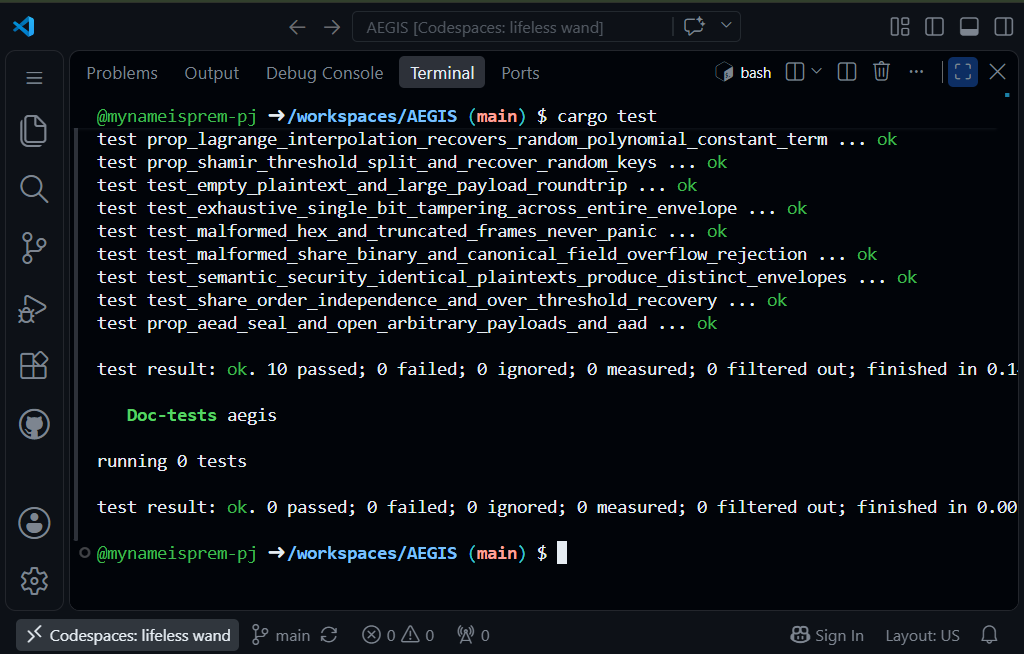
46 Automated Unit, RFC 8439/5869 KAT, Adversarial Bit-Flip, and Proptest Property-Based Security Tests Passing with Zero Warnings.
Inspiration & Problem Statement
Cryptographic key management faces a fundamental dilemma: storing a single symmetric key creates a catastrophic single point of failure, while replicating keys across multiple backups multiplies the attack surface. Worse still, naive implementations of Shamir's Secret Sharing (SSS) suffer from unauthenticated secret reconstruction—because any $k$ points define a degree-$(k-1)$ polynomial over a finite field, a single corrupted or maliciously injected share causes Lagrange interpolation to silently output a wrong key without warning.
What It Does
AEGIS solves both problems through a unified, verifiable cryptographic architecture:
- CSPRNG Master Key Generation (
src/keygen.rs): Samples 256-bitMasterKeybuffers directly from the OS kernel CSPRNG (getrandom) with volatile memory scrubbing (ZeroizeOnDrop) and constant-time equality (subtle::ConstantTimeEq). - HKDF-SHA256 Domain-Separated Key Hierarchy (
src/kdf.rs): Derives an orthogonal 256-bitEncryptionKey($K_{\text{enc}}$) and a 256-bit publicKeyCommitment($C_{\text{key}}$) using distinct domain labels. - Custom Prime Finite Field $\mathbb{F}_{2^{31}-1}$ (
src/field.rs): Implements exact modular arithmetic over the eighth Mersenne prime $p = 2^{31}-1$ usingu64intermediates (mathematically proving zero overflow since $(p-1)^2 < 2^{62} < 2^{64}-1$), Fermat's Little Theorem multiplicative inverses ($a^{p-2} \bmod p$), Horner's polynomial evaluation, and unbiased 31-bit rejection sampling. - Two-Layer Verifiable Shamir Secret Sharing (
src/sss.rs): Splits a 256-bit key into 16u16chunks embedded in $\mathbb{F}_{2^{31}-1}$. During Lagrange interpolation at $x=0$, corrupted shares are caught first by an Algebraic Range Trapdoor ($1 - 2^{-240}$ detection probability across 16 chunks) and second by Constant-Time HKDF Commitment Verification ($1 - 2^{-256}$ detection probability). - Key-Committed ChaCha20-Poly1305 AEAD (
src/cipher.rs&src/engine.rs): Binds the protocol version,KeyCommitment, and user Associated Data (AAD) into a canonical transcript authenticated by Poly1305, enabling Zero-Exposure Threshold Decryption directly from shares in RAM.
How We Built It (Alignment with Judging Criteria)
- Cryptanalysis (3 pts): Verified by 46 automated unit, adversarial bit-flip, RFC 8439/5869 Known-Answer Tests (KAT), and
proptestproperty-based tests, backed by a 10-vector formal Threat Model (docs/SECURITY_ANALYSIS.md). - Uniqueness (2 pts): Clearly separates battle-tested symmetric primitives (ChaCha20-Poly1305, HKDF-SHA256) from our custom $\mathbb{F}_{2^{31}-1}$ threshold algebra, dual-layer verification trapdoor, and canonical AAD commitment binding.
- Attack Surface (3 pts): Enforces
#![forbid(unsafe_code)], minimal audited dependencies,ZeroizeOnDropon all secret structs, noCopytrait on keys,subtle::ConstantTimeEq, and oracle-free error reporting. - Mathematical Presentation (2 pts): Accompanied by a 14-section academic LaTeX paper (
docs/AEGIS_MATHEMATICAL_PAPER.tex) provingu64overflow freedom, Fermat's Little Theorem inverses, and Vandermonde matrix invertibility.

