AEGIS — Your Digital Safety Companion
Inspiration
Online harassment is a serious issue, particularly for women and underrepresented genders in technology. Whether it happens through social media, emails, online communities, or private messages, harassment can leave individuals feeling overwhelmed and uncertain about what to do next.
One of the biggest challenges isn't just experiencing harassment. It's documenting it.
Evidence is often scattered across multiple platforms, messages become difficult to organize, and recognizing meaningful patterns can require hours of manual work. Existing digital forensics tools are frequently designed for cybersecurity professionals rather than the people who actually need support.
I wanted to create something different.
AEGIS (Adaptive Evidence Graph & Incident System) was inspired by the idea that powerful technology should be accessible to everyone, especially individuals navigating difficult experiences.
My goal was to combine artificial intelligence, digital forensics, and conversational voice technology into a platform that helps people document their experiences, understand potential patterns, and take control of their information.
Rather than making accusations or replacing human judgment, AEGIS focuses on helping users make informed decisions using the evidence available to them.
What It Does
AEGIS is an AI-powered digital safety companion that helps users document, organize, analyze, and report online harassment.
The platform combines several capabilities into a single, accessible workspace.
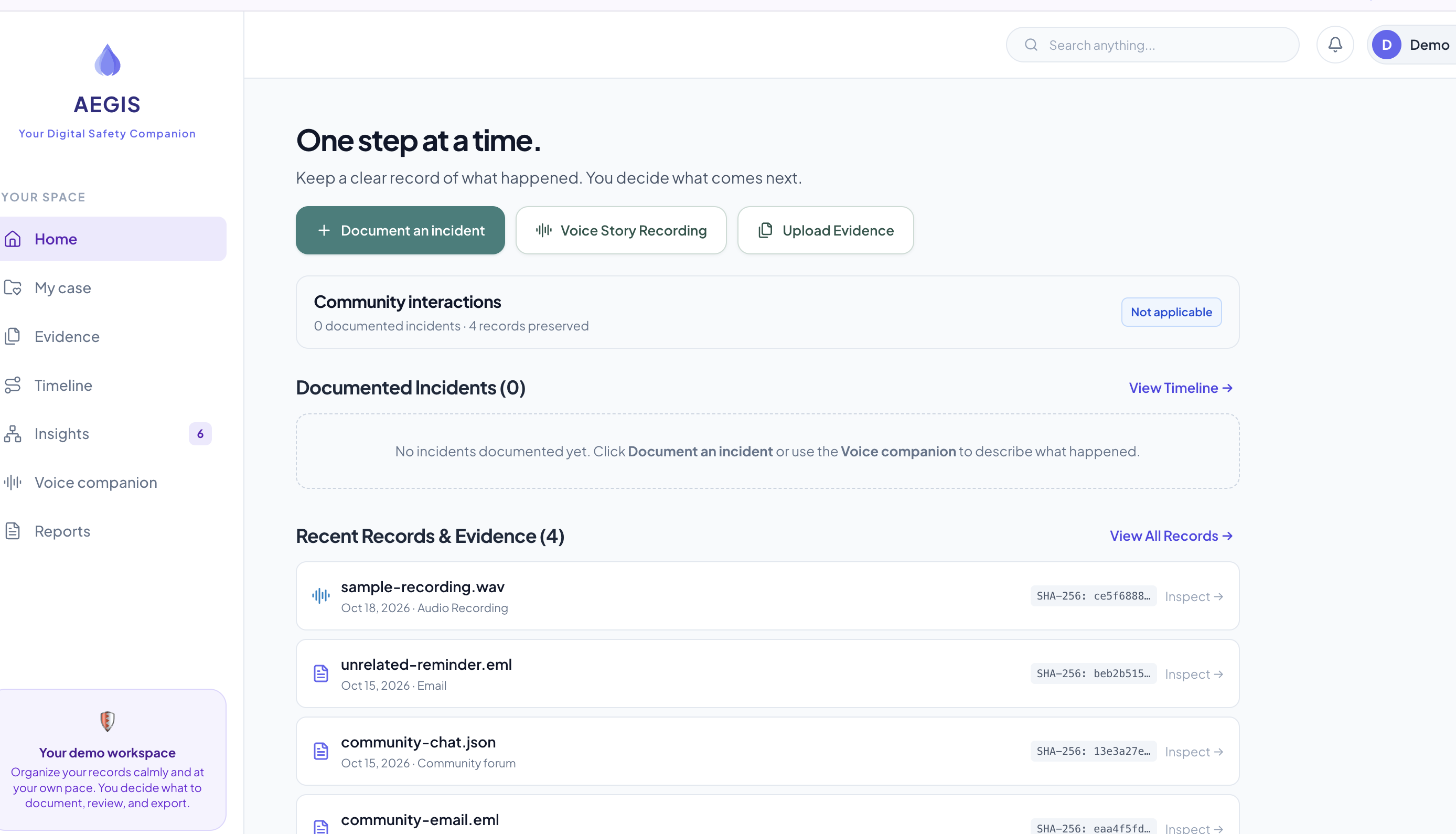
Evidence Preservation and Organization
Users can upload screenshots, emails, text files, chat records, and supported audio recordings.
AEGIS preserves original uploaded files and generates SHA-256 fingerprints to help detect changes to their contents. It also extracts supported metadata and organizes records within an investigation.
Intelligent Timeline Reconstruction
AEGIS automatically extracts timestamps from supported evidence formats and organizes documented incidents into a chronological timeline.
This helps users understand how events unfolded without manually piecing together information from different sources.
AI-Powered Pattern Discovery
AEGIS uses deterministic forensic techniques to identify possible connections between evidence records, including repeated phrases, shared URLs, and messages occurring within similar timeframes.
Google Gemini helps translate these technical observations into clear, understandable explanations that reference supporting evidence.
Importantly, AEGIS distinguishes between observations and interpretations. A suggested connection does not prove that two messages came from the same person or that harassment was coordinated.
Users can review suggested findings and decide whether they are relevant to their experience.
ElevenLabs Voice Companion
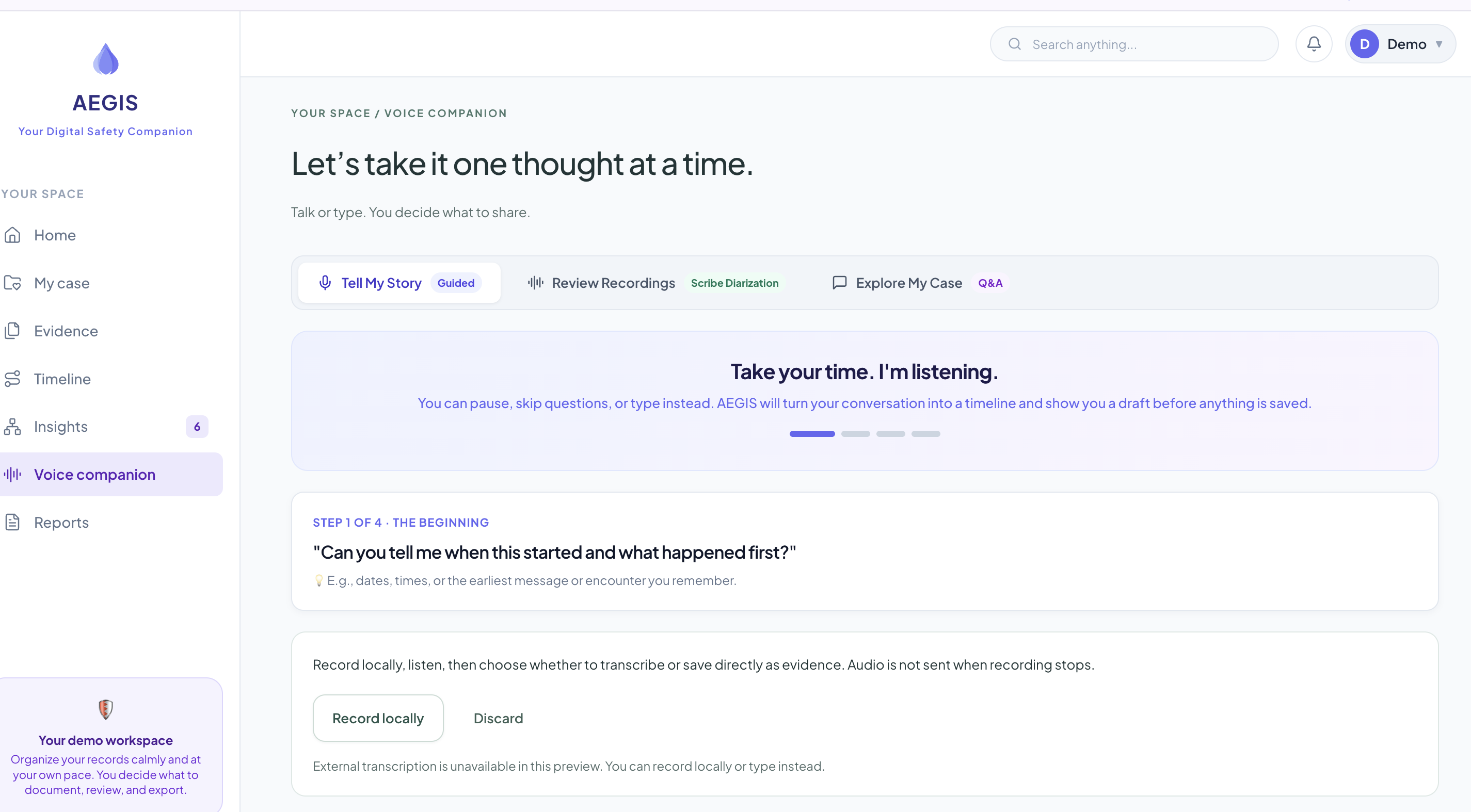
One of AEGIS's most important features is its voice-powered documentation experience.
Using ElevenLabs speech technology, AEGIS provides three interaction modes:
- Tell My Story: Users can describe an incident verbally, review the transcription, and generate a structured incident draft.
- Review Recordings: Users can analyze supported audio recordings through transcription, speaker-turn labeling, and timestamped excerpts.
- Explore My Case: Users can ask natural-language questions about their evidence and optionally listen to spoken responses.
The goal is to make documentation more accessible for individuals who may find lengthy written forms difficult or overwhelming.
Customizable Incident Reports
Users can select relevant evidence, review suggested findings, redact sensitive information, and generate organized PDF reports.
AEGIS gives users control over what information they include and export.
How I Built It
AEGIS combines a React-based frontend with a Python-powered backend and integrations with Google Gemini and ElevenLabs.
For the frontend, I used React, TypeScript, and Vite to build a responsive application. I incorporated Radix UI, Lucide icons, and GSAP animations to create a polished and accessible user experience.
For the backend, I used Python and FastAPI to manage evidence uploads, case information, forensic processing, AI integrations, and report generation. SQLAlchemy and SQLite handle database operations, while Python's built-in hashing and email-processing libraries support evidence preservation and metadata extraction.
The forensic analysis engine compares records using shared URLs, overlapping phrases, and timestamp proximity. These connections are presented alongside supporting evidence so users can understand why a particular relationship was suggested.
I integrated the Google Gemini API to generate structured explanations and answer questions about selected evidence. I also incorporated ElevenLabs Scribe for speech-to-text functionality and ElevenLabs text-to-speech for spoken responses.
For report generation, I used ReportLab to create downloadable PDFs. The application is containerized using Docker and deployed through Render.
Throughout development, I focused on making the interface feel approachable rather than intimidating. Instead of building a traditional cybersecurity dashboard filled with complex graphs and technical terminology, I designed AEGIS around simplicity, readable information, and guided interactions.
I also used AI-assisted development tools to accelerate implementation, debugging, and iteration while learning how the different parts of the application work together.
Challenges I Faced
Making Digital Forensics Understandable
One of the most challenging aspects of building AEGIS was translating technical forensic information into explanations that everyday users could understand.
Identifying repeated phrases or shared URLs is relatively straightforward compared to explaining what those similarities actually mean.
I worked on separating direct observations from possible interpretations and making supporting evidence accessible without overwhelming users with unnecessary technical details.
Preventing Misleading AI Conclusions
Another major challenge was ensuring that AI-generated explanations remained grounded in the available evidence.
Language models can produce convincing conclusions even when information is incomplete. For a platform dealing with sensitive experiences, this could cause serious misunderstandings.
To address this, I implemented evidence-reference validation and human-review controls. I also designed the system to communicate uncertainty rather than presenting every suggested relationship as a confirmed fact.
Integrating Voice Technology
Building the voice companion required more than simply connecting a microphone to an AI model.
I had to work through recording permissions, audio capture, transcription, speech playback, user consent, and transforming spoken experiences into structured incident drafts.
I also needed to distinguish original recordings from generated transcripts and AI interpretations, ensuring that users could review information before saving it.
Connecting the Full Stack
Coordinating evidence uploads, timeline reconstruction, forensic analysis, Gemini, ElevenLabs, and PDF reporting introduced several technical challenges.
Each feature depended on accurate communication between the frontend and backend, careful error handling, and consistent data structures.
Deploying the application also required accounting for API configuration, temporary storage, and limitations associated with running a hackathon prototype.
What I Learned
Building AEGIS helped me develop a deeper understanding of full-stack software engineering and the challenges of integrating AI into real applications.
I gained practical experience with REST APIs, backend architecture, database management, digital evidence processing, structured AI outputs, voice technology, and document generation.
More importantly, I learned how important user experience is when developing software for sensitive situations.
An application can have powerful technology behind it, but that technology means very little if users cannot understand or trust its results.
One of my biggest takeaways was that responsible AI development requires more than generating useful responses. It requires transparency, clear limitations, evidence grounding, and meaningful human oversight.
What's Next
AEGIS is currently a hackathon prototype designed around synthetic demonstrations, but I would like to continue developing it.
Future improvements could include stronger authentication and secure persistent storage, support for additional evidence formats, more advanced evidence relationship visualizations, expanded multilingual voice accessibility, and comprehensive privacy and security testing.
I would also like to explore ways to make the voice companion more interactive while keeping users in complete control of their recordings and personal information.
Ultimately, my vision is to make AEGIS a practical digital documentation companion that empowers individuals to understand their experiences, organize their evidence, and take informed next steps.
AEGIS is built around one simple belief: everyone deserves tools that help them feel informed, supported, and in control of their own story.
Built for the Technica 2026 Hackathon by Saumit Guduguntla.
Built With
- css3
- docker
- elevenlabs
- elevenlabs-scribe
- fastapi
- google-gemini
- google-gen-ai-sdk
- gsap
- html5
- httpx
- javascript
- lucide-react
- pytest
- python
- radix-ui
- react
- render
- reportlab
- sha-256
- sqlalchemy
- sqlite
- typescript
- uvicorn
- vite
- vitest


Log in or sign up for Devpost to join the conversation.