-
-
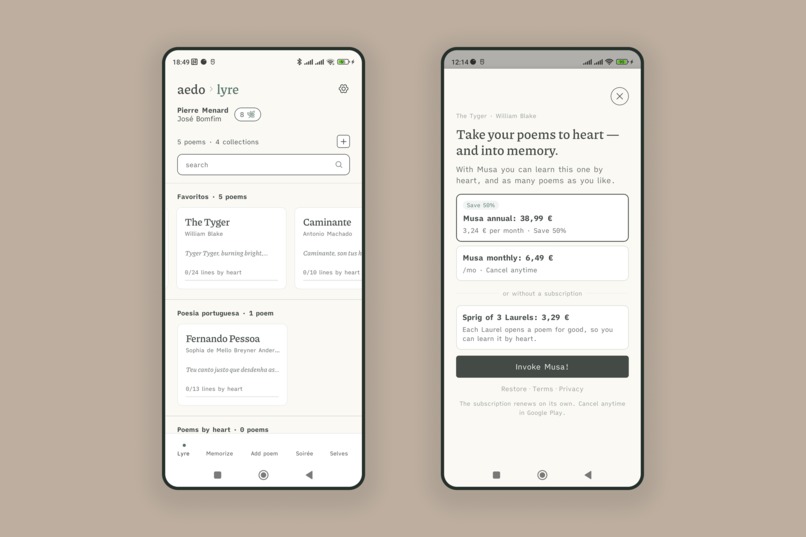
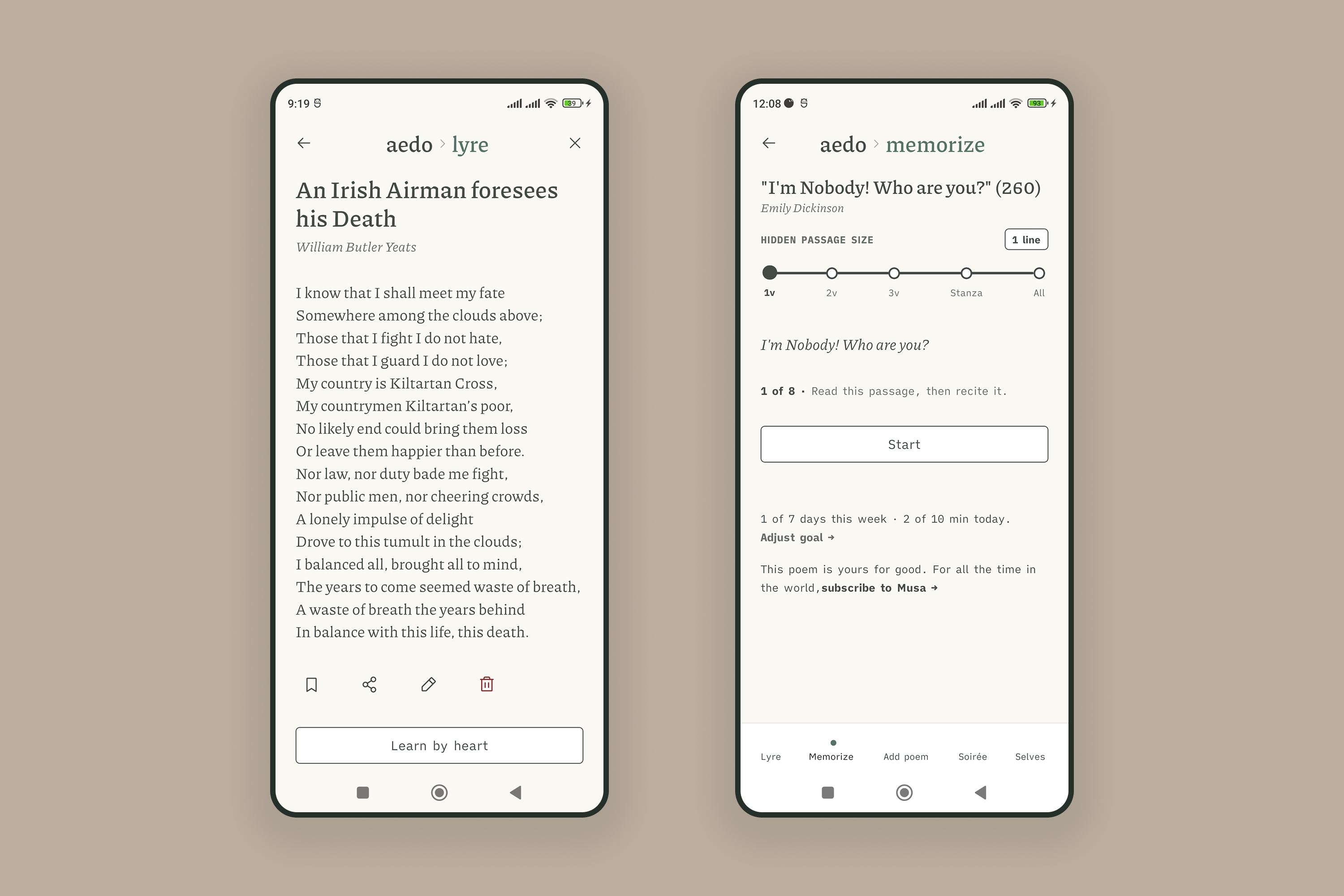
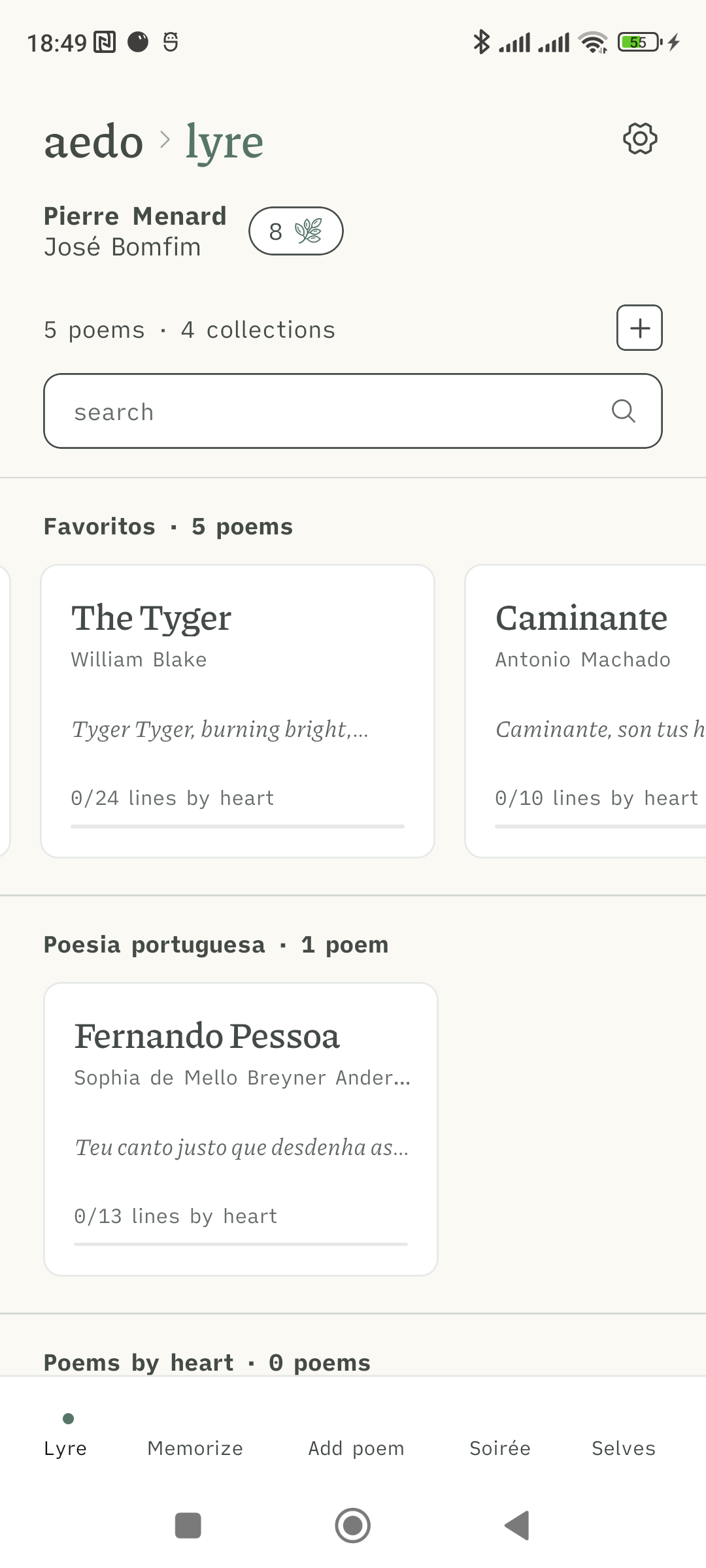
Initial screen (lyre) and the paywall
-
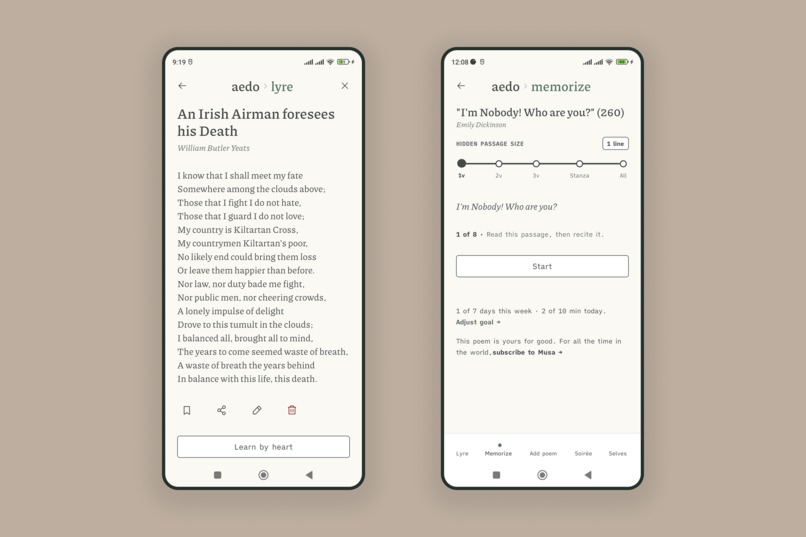
A poem and the memorize feature
-

App icon
-
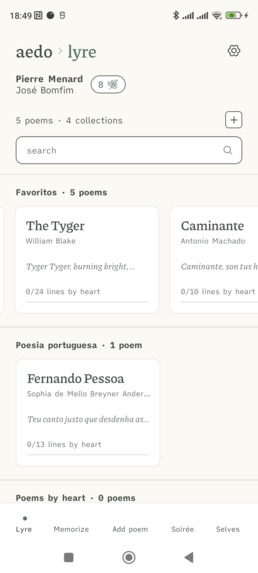
Screen capture without frame
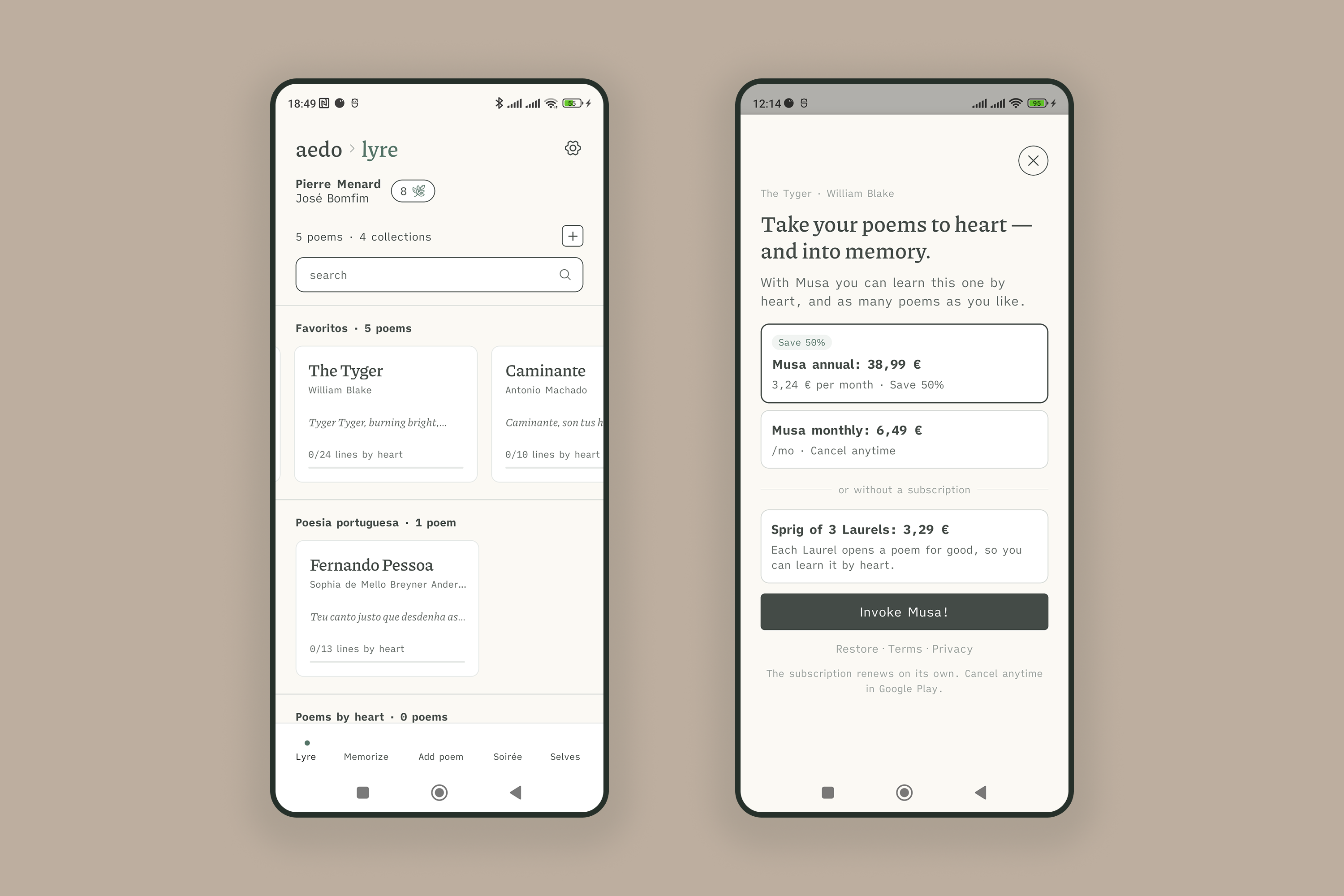

Inspiration
Scrolling through social media, every now and then I'd come across a photographed poem that stopped me in my tracks. Aedo was first born to be a living repository for the beauty that finds us in the poems we stumble upon: easy to use, clean and clear. An Are.na for poetry.
Then I realized that poetry — "Sing, O Muse" — is above all voice: a voice that sings and tells. (The name comes from the aoidos, the Homeric singer.) I remembered that classical education was built on learning poems by heart, because poetry concentrates the best of a language with content that is existentially real and stays with us forever. As Ezra Pound put it, poetry is "simply language charged with meaning to the utmost possible degree."
That's why I wanted to use AI to listen to your recitation practice, the way a teacher or a friend once did. I believe that in personal, lifelong, informal education, what makes the difference today is using artificial intelligence to make us more intelligent, not the other way around. Or, if you prefer, to make us wiser: more open to reality, and to the truth embedded in it.
What it does
Aedo lets you live poetry in three movements:
- Collect. Keep the poems you love in your Lira, a personal shelf, not a feed. Your own poems are welcome too.
- Learn by heart. In Decor, you choose a passage (a few lines, a stanza or the whole poem), it hides, and you say it aloud. Aedo listens and answers Passed or Try again. No percentages, no red underlines: the poem stays clean.
- Share the poems you love, as text and, above all, in your own voice.
Laurels. Poets were once crowned with laurels. I used that image to design an internal economy that keeps Aedo sustainable, so I can keep dedicating myself to it. Today, laurels unlock special features and let you train more than one poem. Monthly and yearly subscribers receive a quota of laurels every month, and anyone can buy a sprig of laurels without committing to a subscription. In the future, laurels will also reward the creators who publish inside Aedo.
How we built it
- App: React Native with Expo (Expo Router, TypeScript), built with EAS and published on Google Play.
- Backend: Supabase for authentication and data, with Edge Functions that call Groq for speech-to-text and a language model that evaluates the recitation against the original text.
- Payments: Google Play Billing through RevenueCat (monthly and yearly subscriptions plus a consumable laurel pack).
- Languages: Portuguese, Spanish and English from day one.
- Process: I'm a product designer and maker, not a full-time engineer. I designed the flows, the design system and the tone, and built the app pairing with AI coding agents.
Challenges we ran into
- Judging a recitation fairly. Speech-to-text isn't built for poetry: line breaks, archaic words, rhythm. The feedback had to be honest but gentle, respectful of the poem and of the person saying it.
- Showing the whole poem while training in pieces. Behind the scenes a poem is split into passages, but on screen it should always feel like one poem. This is still a design problem I'm refining.
- Audio on real devices. Recording and transcription behaved differently on the emulator and on a real Android phone, and debugging that took longer than any feature.
- Getting to production on Google Play. A closed test with real testers before production access, then two rejections because the launcher icon inside the build didn't match the store icon. Lesson learned: submit the listing and the build together.
- In-app purchases end to end. Test purchases went through but didn't reach RevenueCat until the Play service account was wired up correctly.
Accomplishments that we're proud of
- Aedo is live on Google Play, available in Spain, Brazil and the United States.
- Real subscriptions and a laurel pack working end to end through Google Play and RevenueCat.
- A trilingual app (Portuguese, Spanish, English) built solo in about six weeks.
- A feedback design that stays out of the poem's way: no scores, no red marks, just Passed or Try again.
- A product with a clear point of view: a shelf instead of a feed, your voice instead of a synthetic one.
What we learned
- How to take an app from idea to a live store listing: store policies, testing tracks, data safety, legal pages, and versioning that only ever goes up.
- How to design a business model that fits the product's values instead of fighting them: scarce, meaningful laurels instead of likes and endless engagement.
- How to work with AI agents as a designer: writing clear specs and decisions, and knowing when to cut scope so I could ship first and polish after.
- That restraint is a feature. A calm, sober interface respects poetry more than any animation.
What's next for Aedo – poetry by heart
- Saraus: a space to record asynchronous recitations and share them on your social networks.
- Eus (poetic selves): inspired by Fernando Pessoa's brilliant creation of heteronyms, a system that lets poets publish without necessarily exposing themselves, with imaginary biographies and a universe of their own.
- iOS, and more ways to bring poems into your Lira.
Built With
- android
- astro
- cursor
- deno
- eas
- expo-router
- expo.io
- figma
- google-play
- google-play-billing
- gpt-oss
- grokbot
- groq
- paper
- postgresql
- react
- react-native
- revenuecat
- supabase
- typescript

Log in or sign up for Devpost to join the conversation.