Inspiration
Academic advising is hard at scale. Students get stuck behind hidden prerequisite chains and limited seats; advisors guess which policy change will help most. We wanted a sandbox where universities can simulate changes before students feel the pain.
What it does
AdvisorGPT is an AI dashboard that:
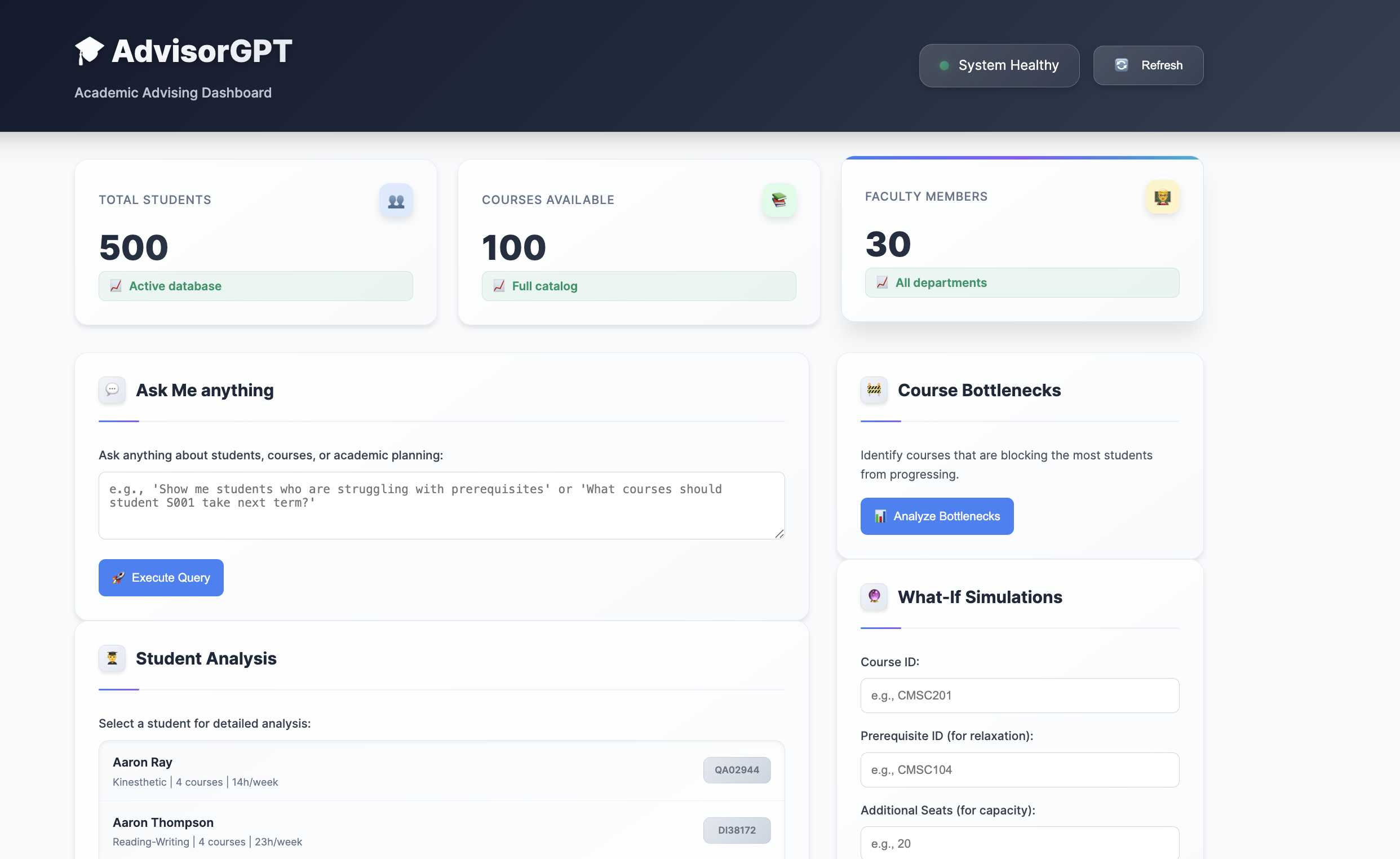
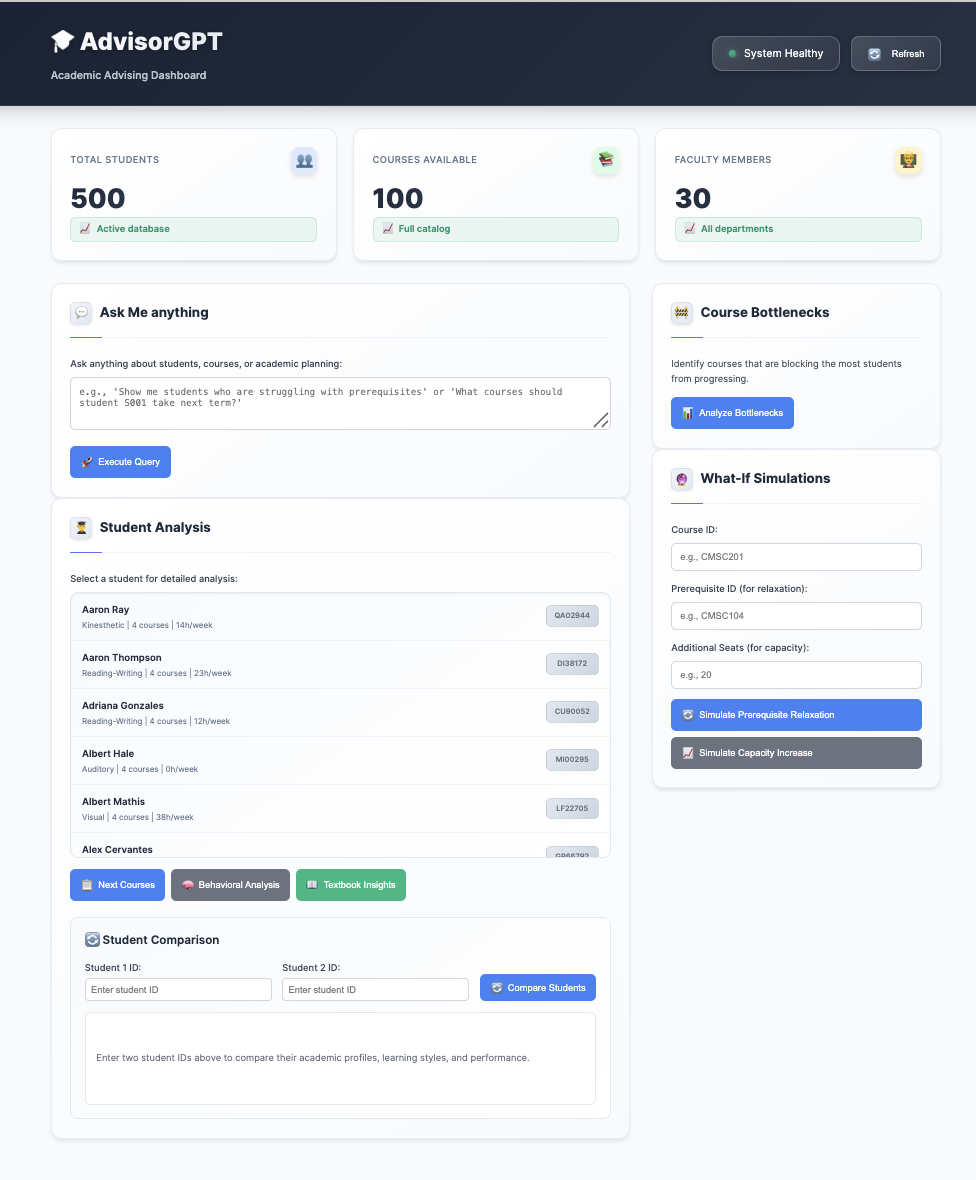
Detects bottlenecks: finds courses blocking the most students.
Explains why: shows prerequisite chains and historical D/F/W patterns.
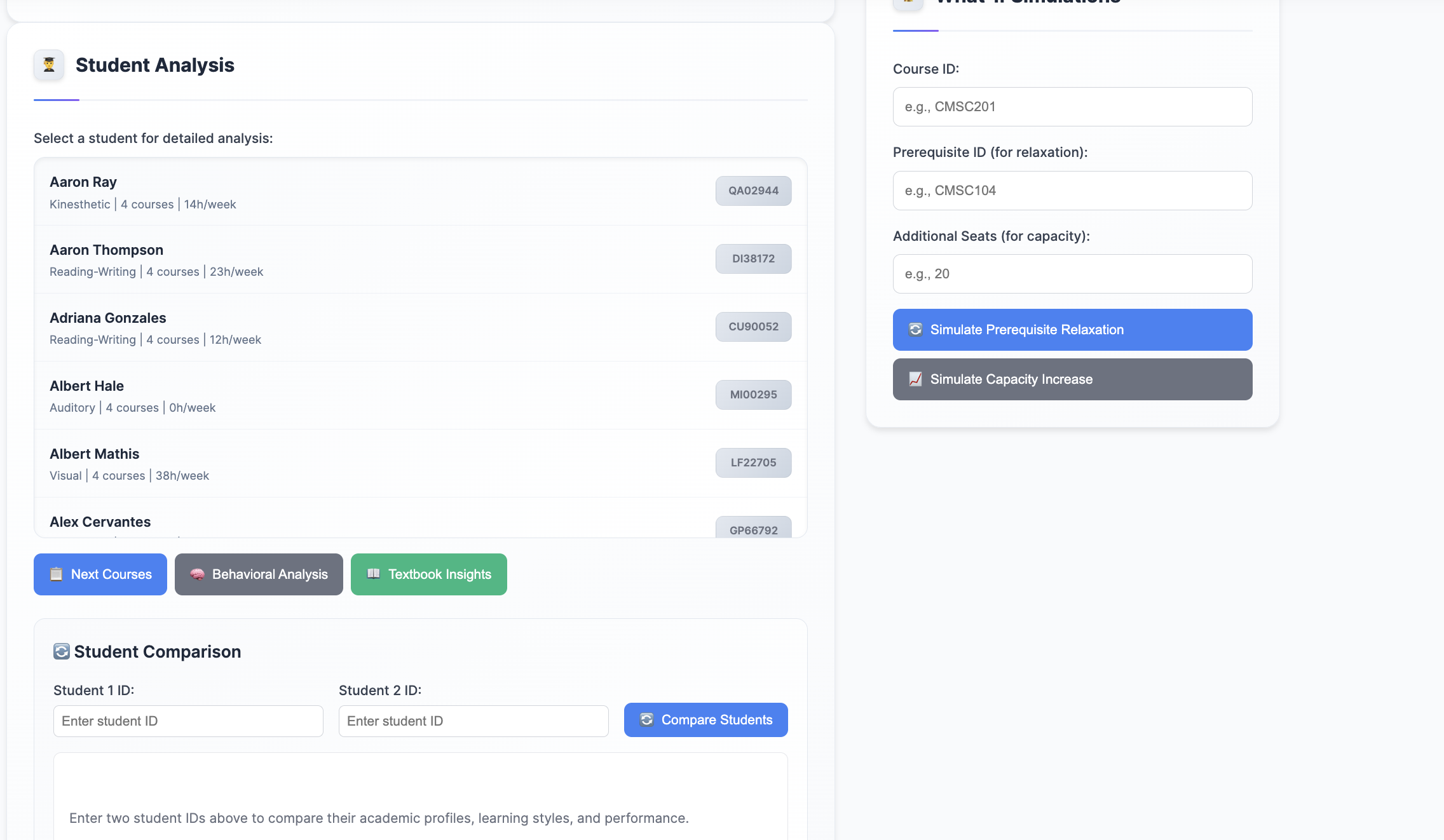
Runs “what-if” simulations: add seats, relax a specific prerequisite, or prioritize near-grads—then see throughput gains, risk deltas, and who benefits (by major/term).
Personalizes plans: generates 3 schedule options per student (fastest, balanced, light load) with plain-English rationales.
How we built it
Graph model: Students, Courses, and PREREQ edges in Neo4j (Cypher for eligibility & deficits).
API: FastAPI endpoints (/bottlenecks, /whatif/capacity, /whatif/relax, /student/:id/plan).
NL → Cypher: a small LLM router (Gemini/GPT) that turns natural language into read-only Cypher with a schema whitelist.
Frontend: React + Vite + Tailwind with Recharts/D3 visuals and framer-motion micro-animations.
Design: “Scenario Compare” drawer to pin simulations; every chart shows hover explanations and the exact Cypher we ran.
The modeling bits
We compute a transparent risk score to keep decisions responsible:
$$ \text{risk} \;=\; w_1\,\mathbf{1}[\text{missing core}] \;+\; w_2\,\mathbf{1}[\text{GPA}<2.5] \;+\; w_3\,\mathrm{DFW\_rate}(\text{course}) \;+\; w_4\,\mathbf{1}[\text{credit load}>15]. $$
Where ( \mathbf{1}[\cdot] ) is an indicator (1 if the condition is true, else 0).
For each what-if, we report (\Delta) throughput, (\Delta) average risk, and benefit distribution across majors/years.
Challenges we ran into
Visualizations: Time constraints meant we couldn’t fully integrate Sankey, waterfall, and scatter plots. These remain clear next steps.
Gemini limits: We hit token request limits during the hackathon, so real-time comparisons were constrained. With more time/credits, we’d enable smoother live demos.
Data realism: Tuning synthetic datasets to feel authentic (prereq chains, GPA, D/F/W rates) took longer than expected.
Accomplishments we’re proud of
A production-feel demo with reproducible simulations and clear explanations.
Transparent risk metrics that frame policy in terms of both throughput and fairness.
A system design that could plug directly into advising workflows.
What we learned
Graphs beat tables for curriculum logic.
“Transparent by default” (show queries + rationale) builds trust fast.
Small fairness checks shift the convo from “Can we?” to “Should we, and for whom?”
What’s next
Visualizations: integrate bottleneck leaderboards, Sankey flows, and fairness heatmaps.
Report generation: auto-generate advisor-ready reports per course or student cohort.
Waitlist allocator: use optimization (knapsack/ILP) to maximize cleared students under a seat budget.
Auto-scheduler: OR-Tools to suggest valid schedules respecting conflicts and instructor load.
Real SIS integration: role-based access + audit logs to connect with live student systems.
How to run (quick start)
backend
cd api && uvicorn app:app --reload
neo4j
docker run -p7474:7474 -p7687:7687 -e NEO4J_AUTH=neo4j/test neo4j
frontend
cd web && npm i && npm run dev
Environment vars: NEO4J_URI, NEO4J_USER, NEO4J_PASS, LLM_PROVIDER (gemini or openai), API_BASE_URL.
Built With
- ai:
- d3-(sankey)
- docker
- fastapi
- framer-motion-backend:-python
- frontend:-react
- gemini/gpt
- pydantic-data/db:-neo4j-(cypher)
- python
- recharts
- tailwind-css
- typescript
- vite


Log in or sign up for Devpost to join the conversation.