-
-
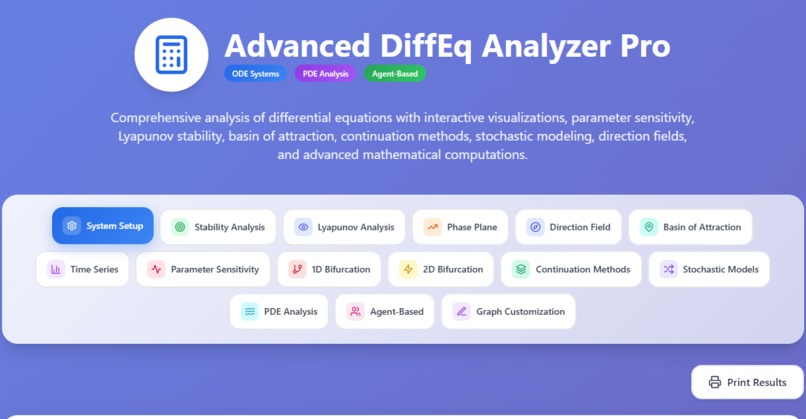
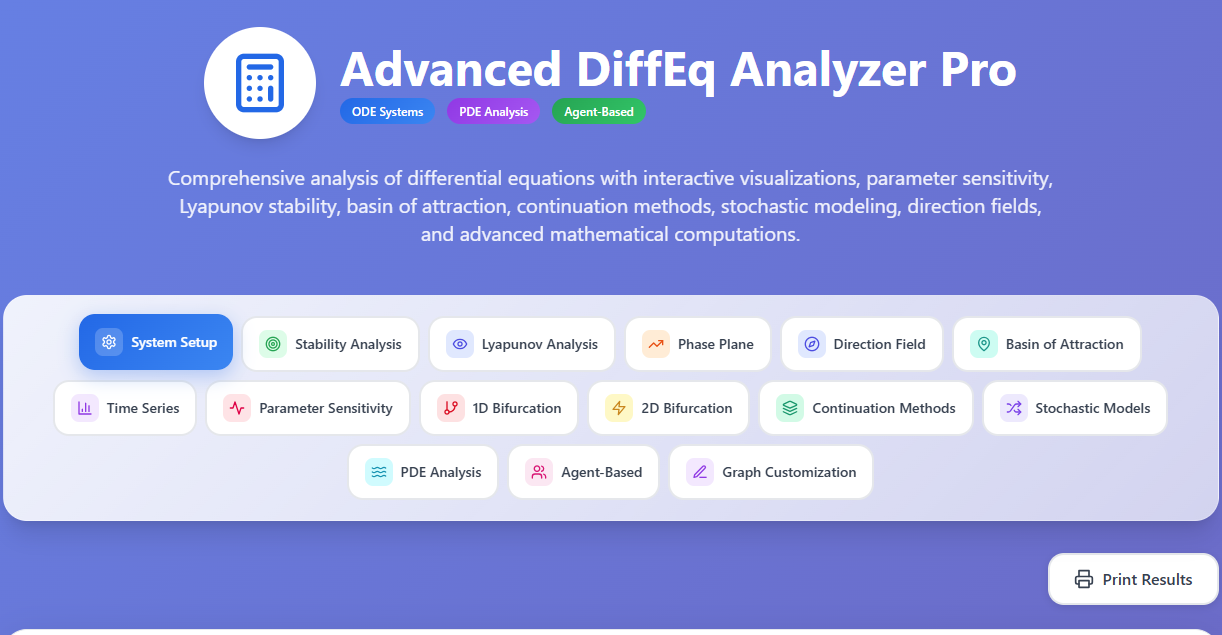
Advance DiffEq Analyzer Pro interface
Inspiration
As a mathematics educator and researcher in mathematical biology, I wanted to create an intuitive yet powerful software tool that empowers students, teachers, and scientists to explore the dynamic behavior of complex biological systems. Many existing platforms focus either on numerical computation or theory, but few bridge both with clarity. The need for a platform that integrates ODE, PDE, and stochastic models with interactive learning tools and rigorous analysis inspired the development of this project.
What it does
Advanced DiffEq Analyzer Pro is a unified platform for modeling, simulating, and analyzing systems of differential equations — deterministic and stochastic. It allows users to:
Define ODE, PDE, and SDE models from biological, physical, or ecological systems
Perform stability, bifurcation, and phase plane analysis
Visualize time series, nullclines, phase portraits, and spatial patterns
Run reaction-diffusion simulations, stochastic simulations (e.g., Gillespie, SDE solvers), and pattern formation models
Export clean mathematical LaTeX reports and simulation data
The platform is tailored for education, computational experimentation, and research prototyping.
How we built it
The core engine was built using:
Python (SciPy, NumPy, SymPy) for numerical computation and symbolic math
Matplotlib + Plotly for dynamic visualizations
Jupyter integration for interactive notebook functionality
Tkinter / PyQt (GUI) or optionally Streamlit for a web-based interface
Modular architecture for easily plugging in new solvers (e.g., Runge-Kutta, Euler-Maruyama, FEM-based PDE solvers)
Challenges we ran into.
Designing a unified framework that can handle deterministic and stochastic systems while remaining intuitive was a non-trivial task.
Implementing automatic Jacobian and eigenvalue analysis required symbolic differentiation that remained efficient even for large systems.
Making PDE solvers user-friendly and interactive (with real-time plots) involved balancing performance with visualization quality.
Ensuring biological interpretability — especially in multiscale or hybrid models — required thoughtful modeling templates and example libraries.
Accomplishments that we're proud of
A fully functional prototype that can analyze, simulate, and visualize a wide range of models from SIR dynamics to reaction-diffusion Turing patterns.
Successfully integrated bifurcation diagrams and eigenvalue computations into the GUI in a way that users can explore system stability interactively.
Built a library of preset models (e.g., Lotka–Volterra, FitzHugh–Nagumo, stochastic SIR, chemotaxis) for instant experimentation.
Provided step-by-step derivations and visual learning modes to support mathematical education.
What we learned
Designing educational software requires not just technical precision but also pedagogical clarity.
Visualization plays a crucial role in helping students and researchers understand abstract dynamics like bifurcations and limit cycles.
Biological systems often demand hybrid models — combining deterministic cores with stochastic or spatial components — highlighting the need for modular model construction.
There's a huge value in making advanced mathematical concepts accessible and interactive, especially for students in applied mathematics and biology.
What's next for Advanced DiffEq Analyzer Pro
🔄 Support for data-model fitting and parameter estimation (MLE, Bayesian)
🔢 Integration with machine learning to classify dynamical behaviors (e.g., pattern types, bifurcation structures)
🧬 Domain-specific modules: actin filament modeling, cancer invasion models, gene regulatory networks
📘 Launching an interactive tutorial series and workshop guide for use in classrooms and research labs
Built With
- bolt

Log in or sign up for Devpost to join the conversation.