Inspiration
My dad grew up in India. He learned all of this math there — long division, subtraction with borrowing, all of it. He is good at it. He speaks Telugu. English is hard for him. And I never learned enough Telugu for him to just explain it to me in Telugu instead. So when I was in elementary school and middle school and got stuck on a math worksheet, this is what it looked like: I’d be sitting there with the paper, and my dad would be right there, and he knew the answer — and there was no way for it to get from him to me. He couldn’t read the sheet. I couldn’t follow his explanation. We were one language apart, at the same table. I asked him about it while I was building this. He told me something like this would have really helped him back then — he wanted to teach me the way he had learned it, and he couldn’t. I want to be clear about who is locked out here. It was me. I was the kid who didn’t get help. But the person you have to actually build for is him, because he was the one holding the thing I needed.
What it does
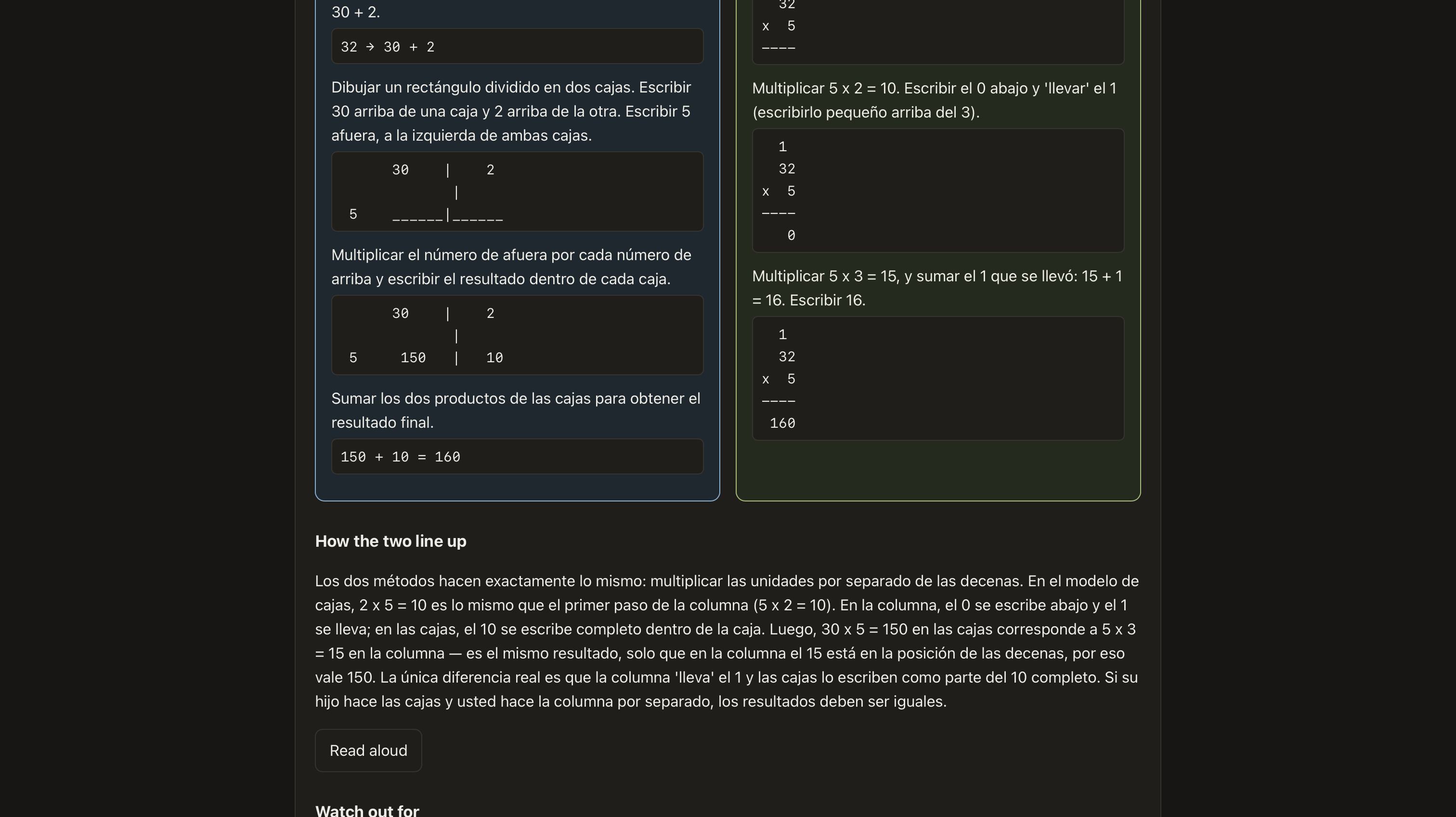
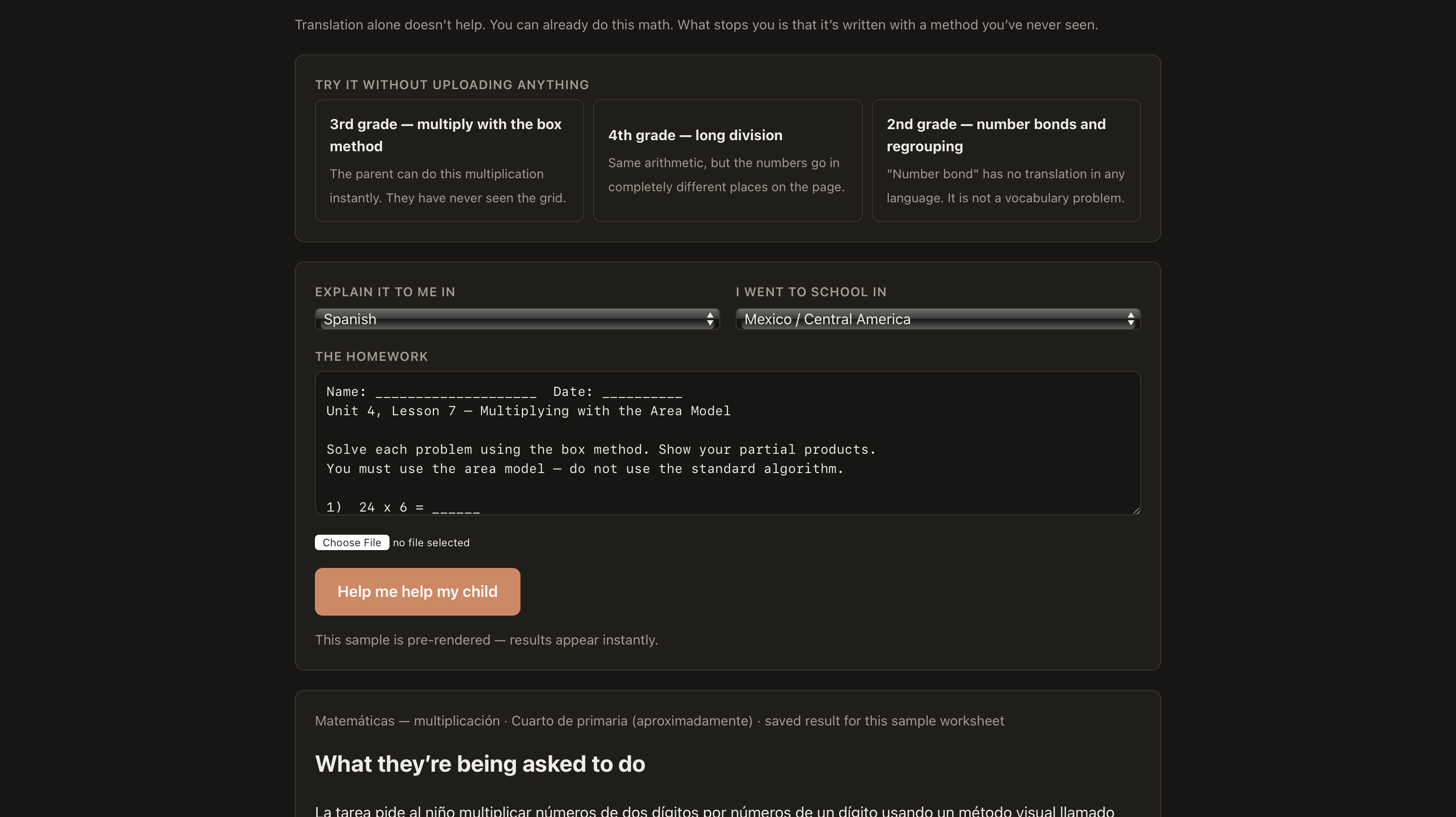
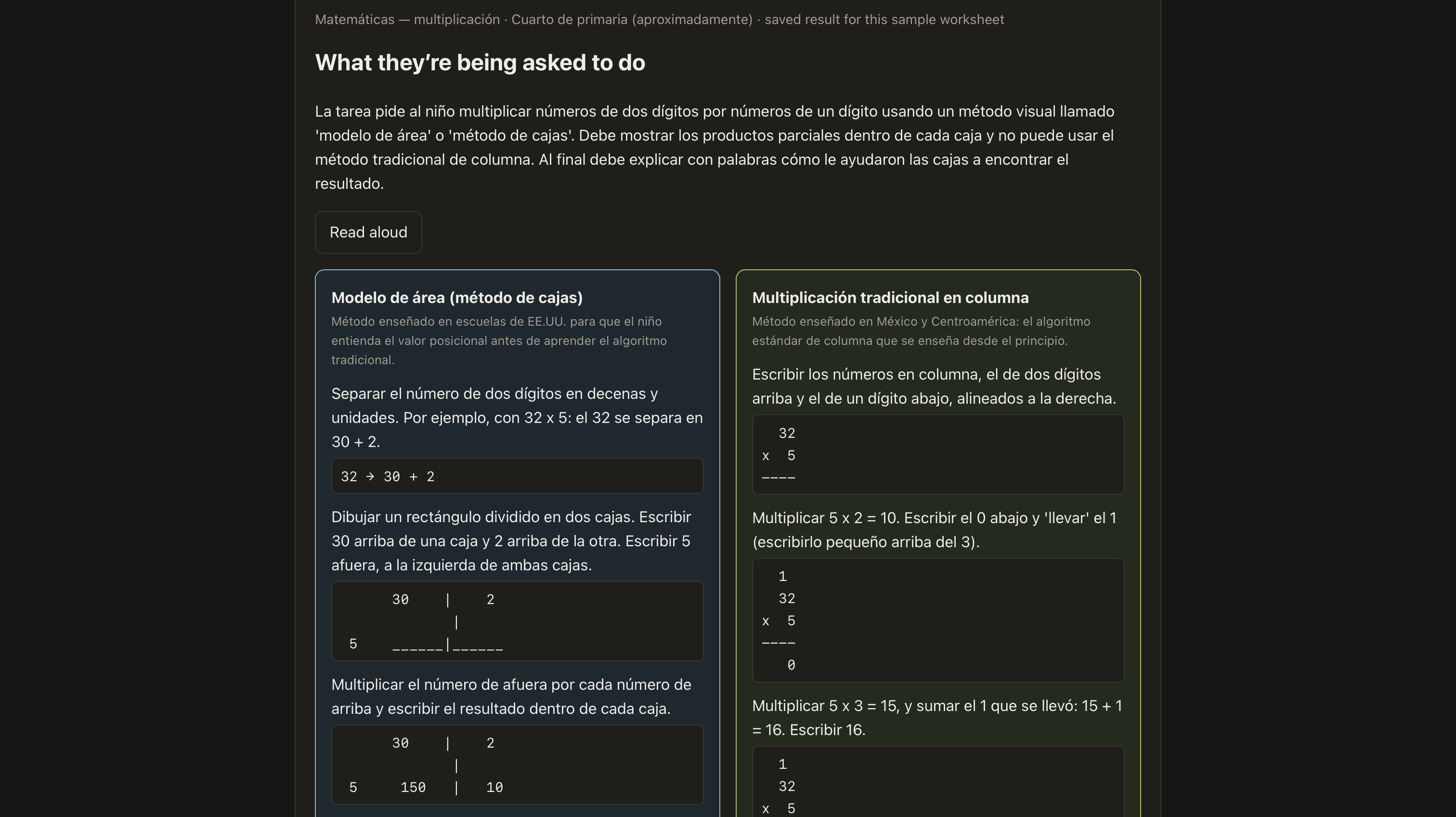
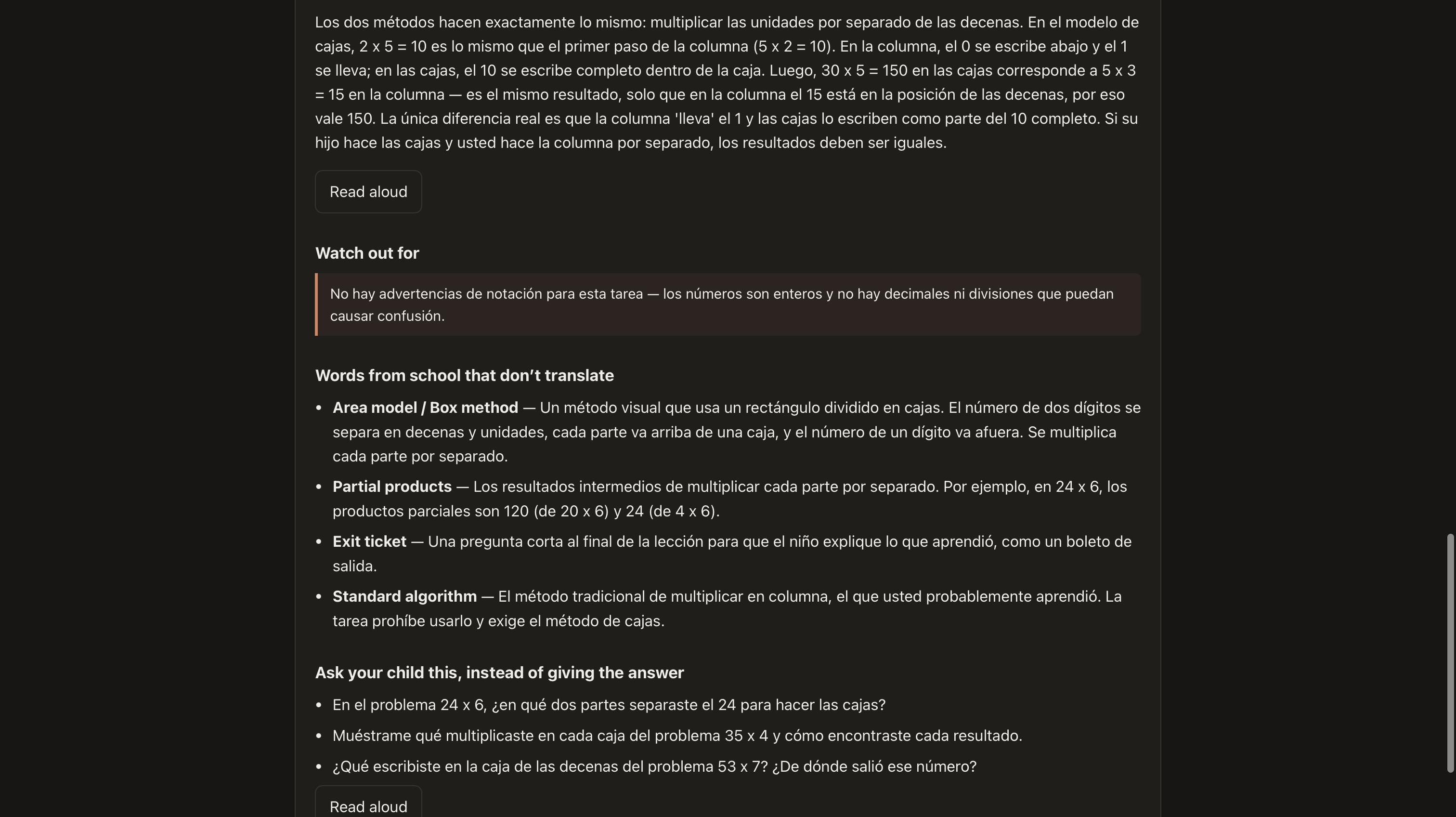
Helps parents explain homework to their child
How we built it
Next.js and React on Vercel, with two models doing separate jobs through Featherless AI. GLM-5.2 does all the reasoning and writes the explanation in the parent's language. A Qwen3-VL vision model transcribes photos and is never allowed to solve anything.
The most important piece isn't a model at all — it's lib/methods.ts, a file where we wrote down how six countries actually teach arithmetic. Asked directly, the model gave vague and inconsistent answers, so that knowledge had to be researched and encoded by hand.
Challenges we ran into
The vision model got the math wrong. Our first working version told a Telugu-speaking parent that 62 - 27 = 55 — confidently, in the exact panel a parent is supposed to trust. A homework helper that states wrong numbers is worse than no tool at all, because now the parent looks wrong in front of their kid.
That forced a redesign: the vision model was demoted to copying text down, and a stronger model does every bit of reasoning. We also wrote eval/run.py, which re-computes every equation the model writes and fails the run if anything is off.
Speed was the other problem. Worksheets took four to seven minutes at first. That's now 8–20 seconds, and the three demo worksheets are pre-rendered so they load instantly.
Accomplishments that we're proud of
It works, and the part that makes it different works: a parent sees the school's method and their own method side by side, in their language, with the arithmetic verified rather than assumed. The three demo worksheets pass with 8, 16, and 8 equations checked and zero errors.
It's also deployed and fast — a sample worksheet returns in under half a second in production.
What we learned
Don't trust a model with arithmetic. It will be wrong confidently, in a language you can't read, in the place it matters most — so check it in code instead of hoping.
And keep going when something breaks. Nearly everything about this project failed at least once — models timing out, API keys dying mid-build, uploads crashing on Safari. Fixing them one at a time is what turned it into something real.
What's next for Homework Bridge
Higher-level math, up through algebra and calculus, where the gap between how it's taught here and abroad gets wider rather than narrower.
More countries — six are covered now. Better handwriting support. And testing with real families instead of just my own: one interview shaped this, ten would shape it better.
Built With
- claude
- css
- featherless
- javascript
- python
- typescript
- vercel

Log in or sign up for Devpost to join the conversation.