-
-
Builder Signal
Inspiration
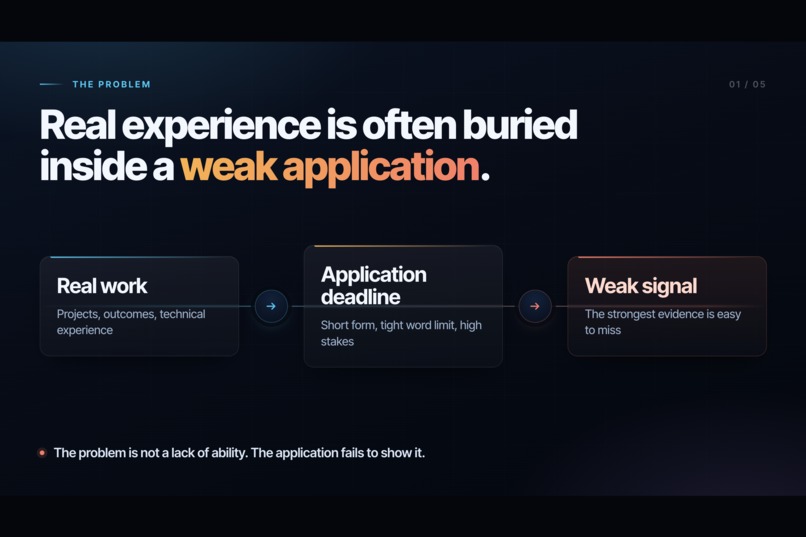
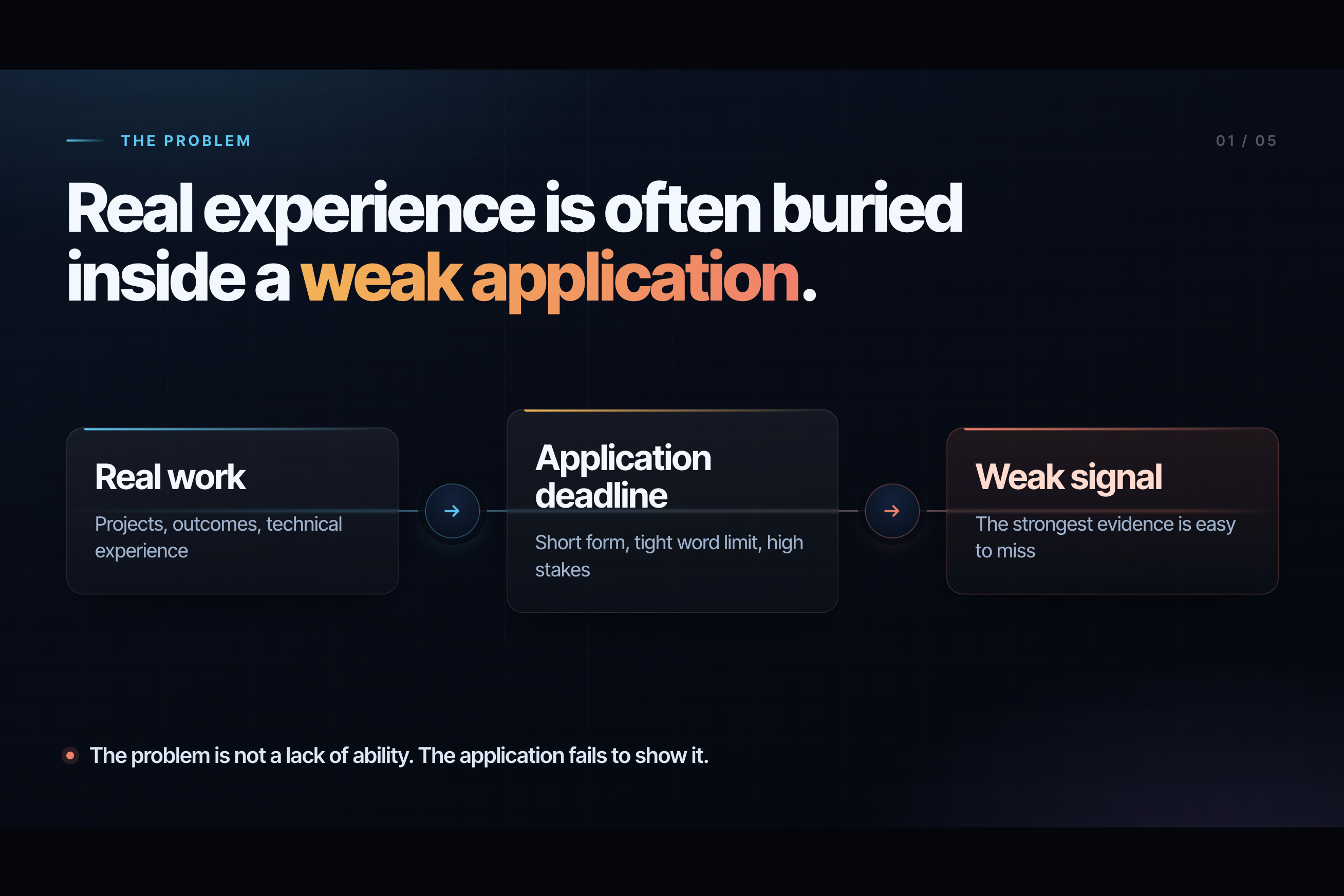
Technical builders often have strong projects, useful experience, and real results, but that information is scattered across resumes, portfolios, project notes, and previous applications.
When a selective opportunity has a tight deadline and a strict word limit, the problem is not always a lack of experience. The application may simply fail to show the strongest evidence clearly.
General-purpose AI tools can produce polished writing, but they often begin with a blank chat and make it difficult to see which claims are actually supported. I built Builder Signal to make the process more structured, grounded, and reusable.
What it does
Builder Signal helps technical builders prepare applications for hackathons, fellowships, accelerators, and other selective programs.
The user provides their real background and the target opportunity, then chooses an output such as an application answer, professional profile, outreach message, or application package.
Builder Signal uses Gemini to:
- identify the strongest positioning for that opportunity;
- create a concise, editable draft;
- explain why the positioning is credible;
- connect proof points to exact excerpts from the user’s background;
- identify missing details that could strengthen the answer;
- refine or rebuild the draft without inventing experience.
The applicant remains responsible for reviewing and approving the final response. Builder Signal organizes the evidence, but the applicant owns every claim.
Builder Signal is designed around an immediate need: a builder facing a real deadline. A reusable background profile can then make future applications faster and create repeat use.
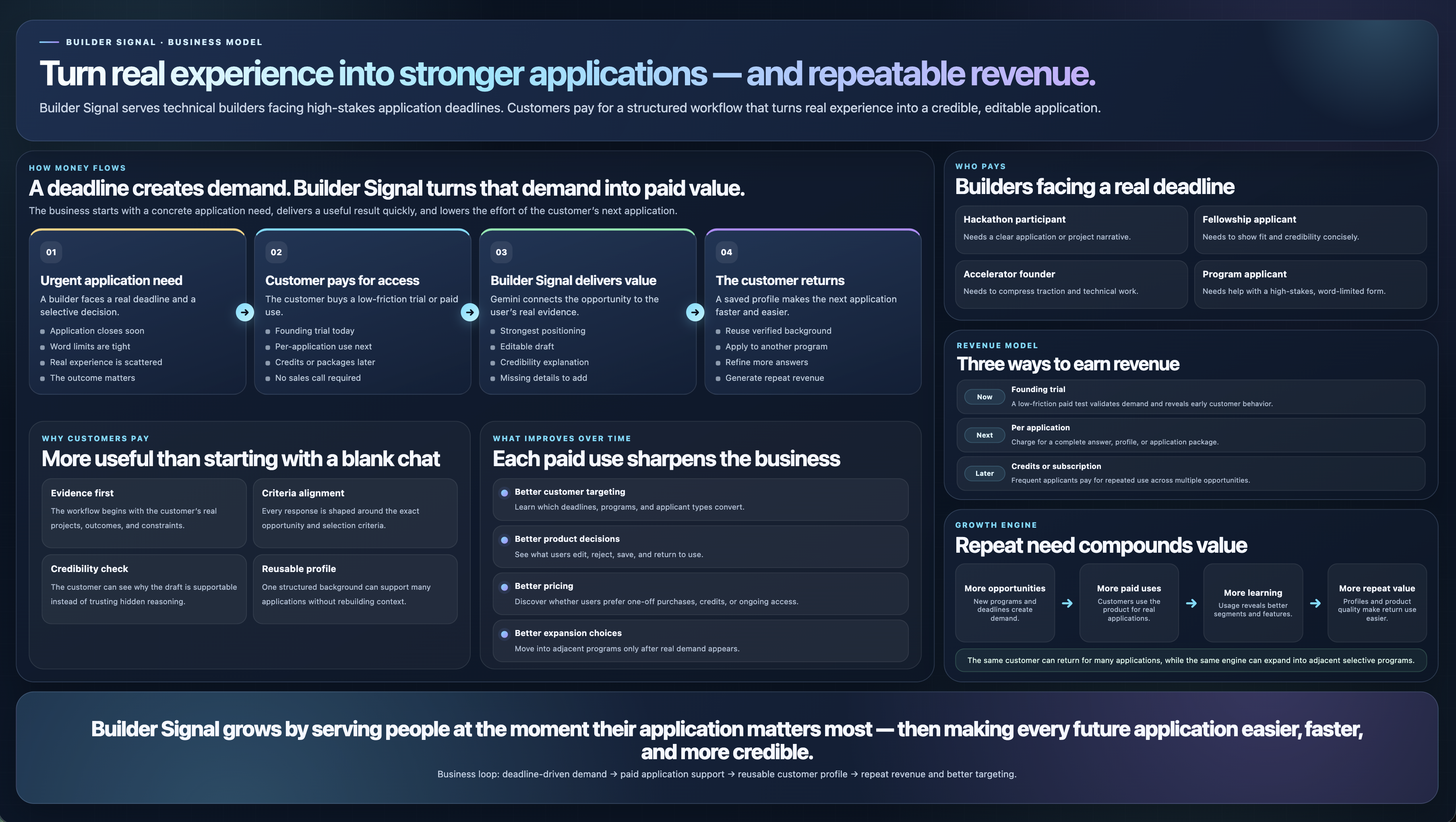
View the full-size Builder Signal business model
How we built it
Builder Signal uses a Node.js and Express backend with a vanilla JavaScript frontend.
Gemini is called through the @google/genai SDK and returns structured JSON. The result is separated into the strongest signal, editable draft, proof points, missing details, and additional analysis so the user can inspect more than a single block of generated text.
To reduce unsupported claims, proof-point excerpts are checked server-side against the background supplied by the user. Quotes that cannot be matched exactly are flagged instead of being silently presented as evidence.
Firebase Authentication handles Google sign-in. Firestore stores user-scoped sessions, saved background profiles, edits, feedback, and activity events. The application is deployed on Google Cloud Run.
Users can save a profile, reuse it for another opportunity, apply quick refinements, add missing information, and rebuild the application while preserving the original context.
Challenges we ran into
The main challenge was making the output useful without making it sound more impressive than the evidence supports.
A fluent draft is easy to generate. A credible draft is harder. I had to separate source facts from AI interpretation, verify proof-point excerpts, preserve exact names and results, and prevent unsupported titles, metrics, or achievements from entering the response.
Another challenge was preserving user control. Refinements needed to make a response shorter, more specific, or more natural without replacing the original facts. Rebuilding with added details also needed to update the saved session only after the new analysis succeeded.
The interface also needed to support several output types and word limits without becoming a complicated application-management system.
Finally, I added authentication, per-user data isolation, access controls, and rate limits so the deployed Gemini endpoint would not operate as an open proxy.
Accomplishments that we're proud of
I am proud that Builder Signal is a complete, deployed workflow rather than a prompt demonstration.
It can:
- turn a real background and opportunity into an editable application response;
- surface the applicant’s strongest signal before presenting the draft;
- show why the response is credible;
- verify supporting excerpts against the original material;
- identify important information that is still missing;
- refine or rebuild the answer without inventing facts;
- save reusable background profiles and previous sessions;
- expose the model, prompt, and raw response for inspection.
I am also proud that the product does not hide uncertainty. It shows both the strongest available evidence and the details that would make the application stronger.
What we learned
I learned that the most valuable part of an AI application assistant is not simply writing better sentences.
Users also need to understand:
- which experience is most relevant;
- why a claim is credible;
- what evidence supports it;
- what information is missing;
- what they should verify before submitting.
I also learned that reusable context can be more valuable than a one-time draft. A saved profile reduces repeated work and gives the user a reason to return for another opportunity.
Most importantly, transparency improves the product. Showing evidence, gaps, model details, and editable outputs makes AI assistance easier to trust and correct.
What's next for Builder Signal
The next step is to test Builder Signal with more technical builders facing real application deadlines and learn which opportunities, outputs, and pricing models create the most value.
Future directions include:
- paid use per application;
- credits or ongoing access for frequent applicants;
- better support for complete application packages;
- careful import of resumes and portfolio materials;
- stronger learning from edits, copied drafts, rebuilds, and repeat use;
- clearer guidance about which missing details would most improve an application.
The long-term goal is not to automate applications. It is to help builders present what they have actually done, clearly and credibly, when the opportunity matters most.
Built With
- cloudfirestore
- css
- express.js
- firebaseauth
- geminiapi
- googlecloudrun
- googlegenai
- html
- javascript
- node.js

Log in or sign up for Devpost to join the conversation.