## Inspiration
Running Meta ads for a small team is a grind: you need a steady stream of fresh creatives, someone to watch spend every day, and someone to decide what to kill and what to scale. Agencies charge thousands a month for exactly that. We built AdRiseLab after doing this manually for our own products and realizing that most of the work is pattern matching over a competitor's ad library, a product page, and yesterday's performance numbers — which is precisely what a model is good at.
## What it does
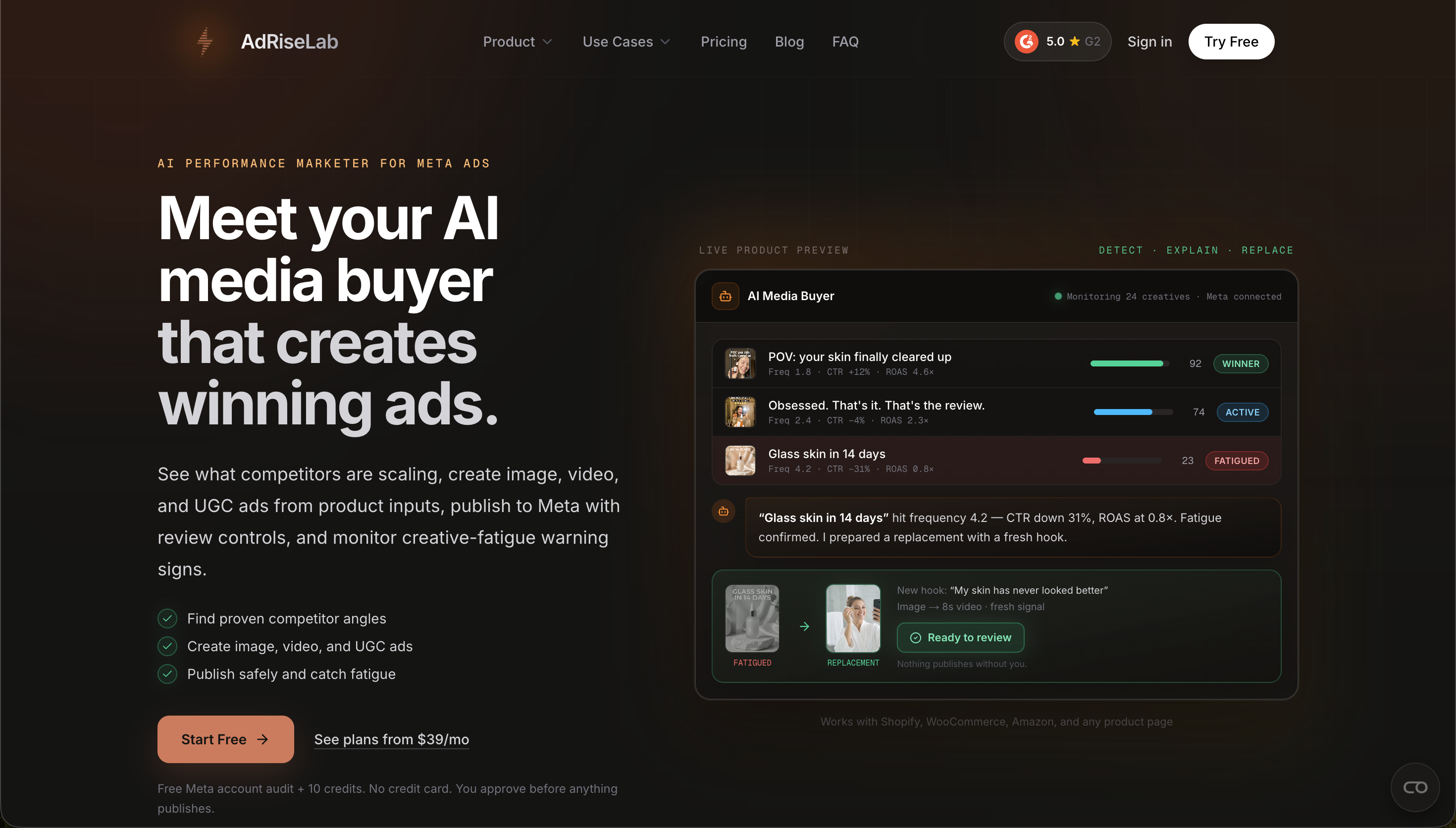
AdRiseLab is an AI creative and media buying layer on top of Meta Ads.
- Creative generation: you connect a product (URL or brief) and it produces ad images, UGC-style videos, and matching ad copy in the formats Meta actually serves.
- Competitor research: it pulls what competitors are running from the public ad library and turns the recurring angles into briefs instead of vague "inspiration".
- Campaign builder: creatives, copy, audiences, and budget get assembled into a launch-ready campaign structure instead of a folder of assets you still have to upload by hand.
- AI Media Buyer: once campaigns are live, it reads performance daily and recommends what to pause, duplicate, or scale, with the reasoning attached so you can disagree with it.
The goal is a solo founder shipping the volume of creative that used to need an agency.
## How I built it
- Frontend/app: Next.js (App Router) + TypeScript + Tailwind, deployed on Cloudflare.
- Generation: a model-agnostic pipeline over image and video generation APIs, so each step of a creative (product shot, hook frame, motion, voiceover) can use whichever model is best for it rather than forcing one provider.
- Ads integration: Meta Marketing API for campaign structure and insights, Meta Conversions API server-side for reliable event data.
- Measurement: GA4 + GTM with server-side event forwarding, so the product's own funnel is instrumented with the same rigor we ask users to apply to their ads.
- Media buying logic: performance data is pulled on a schedule, normalized, and handed to an LLM with an explicit decision framework — thresholds, spend guardrails, and a required justification for every recommendation.
## Challenges I ran into
- Consent and event ordering. Our own analytics quietly dropped events because tracking fired before the consent state resolved. Fixing the race exposed a second bug: the same event was being pushed from two code paths, double-counting conversions. Nothing about the model layer was hard compared to trusting the numbers underneath it.
- Server-side conversions on edge runtime. Sending Conversions API events from a webhook on Cloudflare hit a self-fetch limitation that failed silently. It took reproducing the full payment flow end to end to prove it was actually working.
- Making video generation reliable, not just impressive. A single good demo clip is easy. Getting consistent characters, aspect ratios, and safe margins across a batch — every time, without a human reviewing each frame — is where most of the engineering went.
- Keeping the media buyer honest. Early versions confidently recommended scaling ad sets with too little data. We had to force minimum-volume gates and make the model state its evidence before its recommendation.
## Accomplishments that I'm proud of
- An end-to-end path that actually closes: connect a Meta account, generate creatives, build a campaign, and get daily optimization recommendations — in one product, not four tabs.
- The AI Media Buyer shipped and is running on real accounts with real spend, not on mock data.
- Fully instrumented funnel from first visit to payment, verified event by event, which means every product decision is made on measured behavior instead of guesses.
- Built and shipped as a very small team.
## What I learned
- Instrumentation is a feature, not plumbing. Half our early "growth insights" were artifacts of broken tracking, and every hour spent proving the data was correct paid for itself immediately.
- Models are best used as constrained decision-makers. The media buyer got dramatically more useful when we narrowed what it was allowed to decide and required it to show its reasoning.
- In ads, volume of creative beats polish of any single creative. The product's job is throughput with a quality floor, not one perfect asset.
- Ship the boring reliability work before the demo-friendly work. Users forgive a plain UI; they do not forgive a campaign that failed to launch.
## What's next for AdRiseLab
- Expanding beyond Meta to TikTok and Google, using the same creative-to-campaign pipeline.
- Closing the loop from performance back into generation: creatives that win should directly shape the next batch of briefs.
- Deeper autonomy for the AI Media Buyer, with user-set guardrails so it can act rather than only recommend.
- A creative benchmark layer so teams can compare their CTR and CPA against what's actually working in their category.
You can try and see it https://adriselab.com/
Built With
- ai
- cloudflare
- ga4/gtm
- growth-marketing
- meta-marketing-api
- next.js
- python
- stripe
- typescript
