-
-

Learn in-home caregiving skills
-
Care with confidence
-
Caregiving can happen overnight
-
Caregiving doesn't come with a manual
-
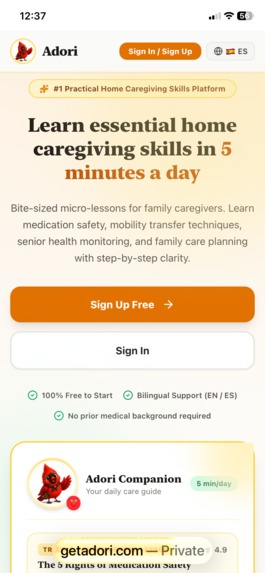
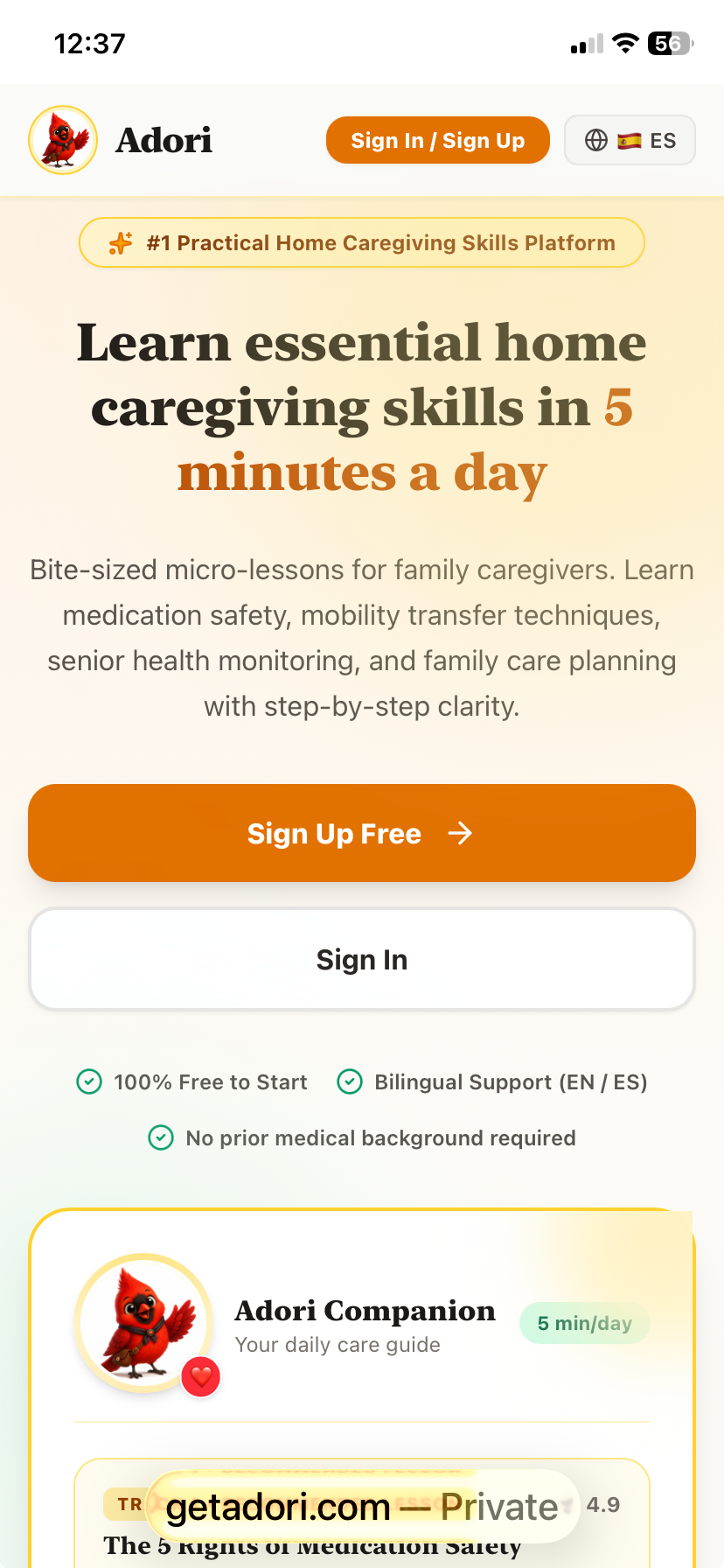
Adori - getadori.com home page

What Inspired Me to Create Adori
My parents are 76 and 78 and insist on aging in their own home, despite my mom's recent surgery and my dad's neuropathy as a cancer survivor now on a scooter instead of his Harley. My sister is 10 minutes away, my brother 45, and I'm 12 hours away. My siblings admitted they didn't feel they had the skills to care for our parents when the time comes. I built Adori for them, and for the millions who'll become family caregivers almost overnight over the next two decades.
According to the National Alliance for Caregiving, 59 million people cared for an adult with a complex medical condition or disability at home in 2025 in the U.S. The population will continue to age with 1 in 5 people aged 65+ by 2030. Almost no one teaches this home caregiving job. A hospital discharge, diagnosis, fall, or sudden decline can turn an adult child into a caregiver overnight, expected to manage medications, prevent falls, and navigate hard conversations with no preparation.
Hospitals send families home with paperwork. Agencies train their paid staff. The family member doing day-to-day care learns by trial and error. I built Adori for that person.
I created Adori so no one has to become a caregiver feeling alone, unprepared, and afraid of getting it wrong - caregiving competence made understandable, accessible, and achievable, five minutes at a time. For the love of family.
Why a Learning App, and Why Bilingual
In-home caregivers are busy and tired - they need to know what to do next, not read a textbook. That led to a five-minute daily lesson model: short lessons, quizzes, streaks, levels, and badges that turn an intimidating responsibility into a skill built one step at a time. Caregiving also crosses language and income lines, so Adori was built bilingual, English and Spanish, from the start - not translated later.
What It Does
Adori is a mobile-first, bilingual app teaching the practical, medical, and emotional skills of caring for an aging loved one, in lessons of two to five minutes. The curriculum has 25 clinically reviewed lessons across five tracks: Caregiving 101 (free), Medication Basics, Mobility and Fall Prevention, Recognizing Decline, and Hard Conversations and Caregiver Burnout. Each lesson pairs instruction with a quiz; users track streaks, levels, and shareable badges.
New users complete a short onboarding flow, and AI tailors their lesson path from the answers. Caregiving 101 is free; finishing it prompts a subscription to Pro (via Stripe) for the rest of the library. Also free is Voice Conversation with Adori - spoken Q&A, advice and encouragement on caregiving essentials, powered by Gemini AI, with a warm friendly voice. Adori doesn't diagnose or replace professional care - it helps in-home family caregivers know what to do next.
How I Built It
I built Adori as a lean, mobile-first MVP using Google AI Studio and AI-assisted tools, hosted on Google Cloud, moving fast without the cost of a traditional consumer-health build. I organized caregiving situations into five tracks of five lessons each; every lesson had to address a specific situation, be understandable without medical training, and be useful in about five minutes. AI assisted the interface, lesson structuring, bilingual build, and gamification. As mentioned above, Gemini AI powers the tailoring of lesson plans for the user and the Voice Conversation component.
Challenges
- Serious but approachable - falls, decline, burnout, end-of-life needed a supportive, not clinical tone
- Simple without oversimplifying - content needed clarity without losing context or overstepping into diagnosis
- True bilingual design - tone had to hold equally in both languages, not English-first with translation added on
- Designing for overwhelmed users - every screen had to minimize cognitive load for someone in crisis
- Building trust in a lean MVP - AI accelerated development but never made medical calls; reviewed content stayed the foundation
- Integrating the Voice Conversation component
Accomplishments
- Working, mobile-first caregiving education app
- 25 clinically reviewed lessons across 5 tracks, English and Spanish
- Caregiving 101 free as an entry point
- Quizzes, streaks, levels, shareable badges
- Integrated Voice Conversation with Adori
- Purchased getadori.com for launch
- Facebook ad: 11.5K views, 416 engagement, 318 link clicks in 7 days on $57 spend
Proudest of the core transformation for users: from "I don't know what to do" to "I know my next step."
What I Learned
- Direction matters more than information - caregiving content online is fragmented; Adori organizes it into a guided path
- Five minutes can be meaningful - 25 lessons at five minutes is a real foundation without an intimidating course
- Emotional design matters as much as function - tone must feel supportive, not tested
- AI works best with human judgment - it expands what a small team can build, but accuracy needs expert oversight
- Distribution has to be built in - caregivers don't search until crisis hits, so Adori needs hospitals, agencies, employers as channels
What's Next
- Validate the core loop: activation, completion, retention, paid conversion
- Launch institutional pilots through hospitals, agencies, elder-law firms, employers
- Expand curriculum: dementia care, hospital-to-home transitions, finances, long-distance caregiving, end-of-life prep
- Introduce personalization from situation and quiz performance, not diagnosis
- Add family learning plans, shared sibling progress, care-team invitations
- Launch on the App Store and Google Play
- Scale toward $3M ARR (~30,000 subscribers, ~$8.30/month) via subscriptions plus institutions
Category Choice: Education and Human Potential
Caregiving is one of the starkest places the barrier between people and the skills they need still exists. Adori treats caregiving competence as learnable, not innate - 53 million Americans are expected to manage medications or recognize a medical emergency with zero training, a gap by neglect, not choice. Adori closes it the way education closes any gap: accessible knowledge, built into a daily habit instead of learned alone in a crisis.
The human-potential angle cuts two ways: it frees the caregiver's own potential - a confident caregiver has more of themselves left for career and family, why the burnout track exists - and it protects the parent's dignity, since competent care means staying home longer, with more autonomy, instead of a facility out of fear.
The bilingual, mass-market pricing is part of that same altruistic case, not just growth strategy: income or language shouldn't decide access to this knowledge. Adori's bet is that the format that made language-learning genuinely democratic - free to start, five minutes a day - can do the same for one of the most universal, least-taught skills there is.
Built With
- browserlocalstorage
- canvasconfetti
- css3
- esbuild
- express.js
- framermotion
- gemini2.5flash
- geminiapi
- googlecloudplatform
- googlecloudrun
- html2canvas
- html5
- in-memoryexpressdatabase
- lucidereact
- node.js
- react18
- stripeapi
- tailwindcss
- tsx
- typescript
- vite
- webspeechapi

Log in or sign up for Devpost to join the conversation.