Inspiration
Most social-media platforms support product endorsement by displaying advertisements on behalf of certified sellers. These advertisements lack target-audience knowledge and have limited area of creativity for the sellers. Such generic ads have a low probability of reaching the right audience.
TLDR; there are two main areas in tailored discovery to improve ad success:
• Recommend specifc products to users based on user data
• Allowing seller to choose an influencer for advertisement.
What it does
Our tailored discovery system is a two part AI service, where
1. Knowledge Graphs helps sellers by endorsing their product in the form of a personalized advertizement, specifically to a users who are more likely to buy their products based on their activity/interactions on Tiktok.
2. GenAI helps sellers to choose an influencer whose digital footprints are utilized to generate a personalized ad video, in a controlled manner.
How we built it
The system can be distributed in to 4 major parts:
1. DataStore : We utilized Appwrite as our central datastore for app data and media storge.
2. UI : We built our UI using Reactjs, Nextjs & tailwind.css.
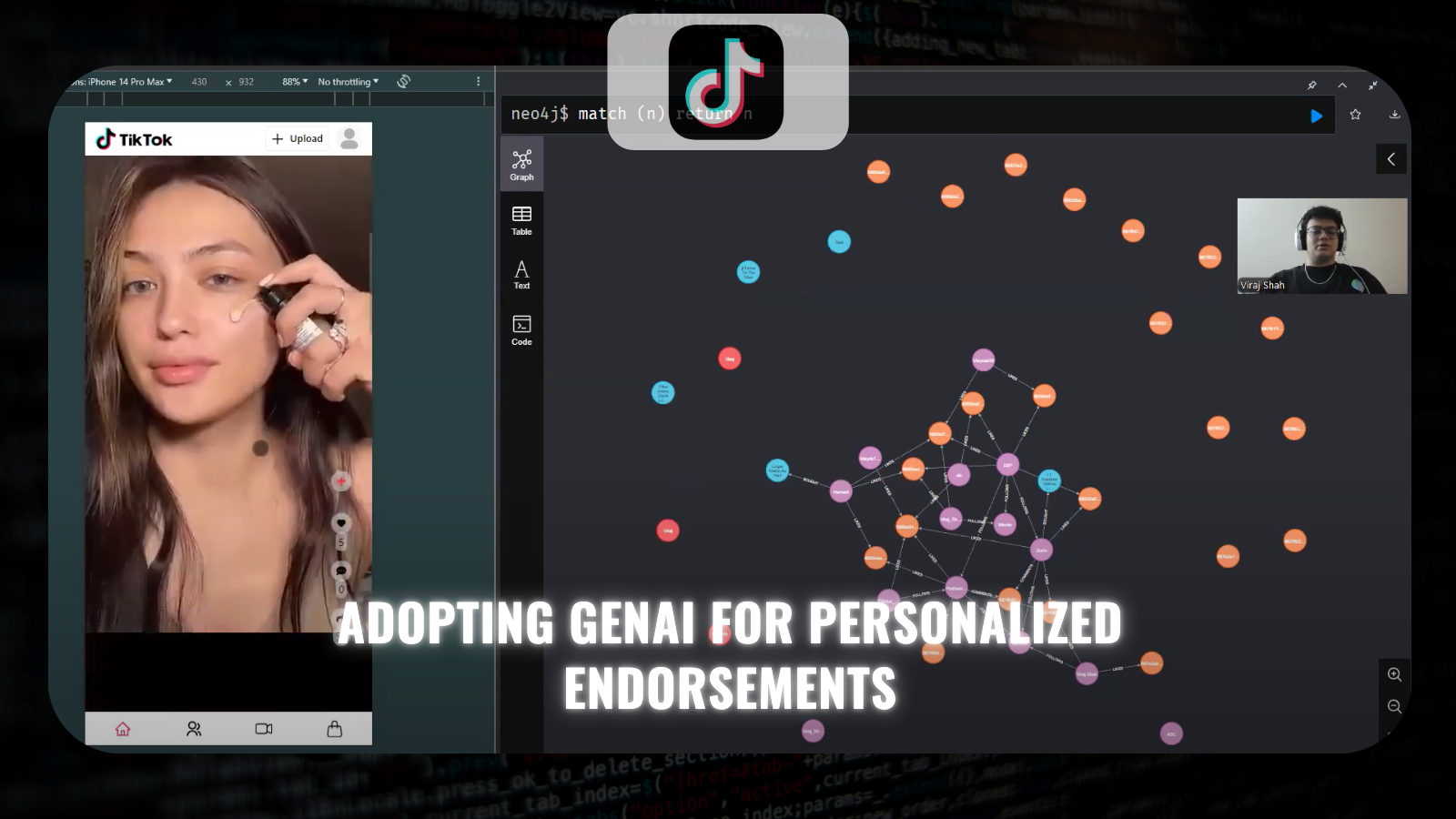
3. Product Recommendation : We created knowledge graphs in Neo4J based on likes, follows, posts, etc.. Then the LLM is given this graph as input to generate product reccomendations.
4. Ad generator : After product is recommended, a deep fake video for the product is generated and sent to the frontend.
Challenges we ran into
There are several challenges we needed to address to make a stable prototype
1. Too many 'tiktoks' would cause homepage to load late. We had to implement pagination to solve this issue.
2. To demonstrate the effectiveness of knowledge graphs, we had to study user interaction patterns and evolve our graph using simulated data.
3. To save time, we had to plan effectively and decide what aspects of 'Tiktok' are necessary to replicate.
4. During ad-generation POC, we had to switch from diffusion models to GANs, and then lighter versions of GANs because of limited resources and data. This tolled us more to generate quality output.
Accomplishments that we're proud of
- We successfully deployed a minimal and stable standalone UI that replicates Tiktok behavior modified with ads to products.
2. After populating our knowledge graph with enough data we observed user-data driven product recommendation that changes with latest-recorded user activity.
3. Using light-weight GANs, we successfully generated personalized advertizements which contains the AI generated video of a certified Tiktok influencer speaking a script at run-time tweaked with user-data
What we learned
1. We learned UI technologies like Reactjs, NextJs and Tailwind CSS.
2. We learned how to utilize Neo4J for creating knowledge graphs.
3. Grasped the concepts of merging LLMs with knowledge graphs to generate reccomendation.
4. While brainstorming ideas for innovation in ads, we learned many aspects of UX design-science that is applied to regulate as well as enhance ad experience
What's next for Adopting GenAI for personalized endorsements
1. Broader research is necessary for understanding revenue-model involved in making this live, and analyzing the performance of our model.
2. Better ML-models can be used to generate better quality videos. User data can be used to enhance these videos with different elements like background theme, weather effects, color palette, etc.


Log in or sign up for Devpost to join the conversation.