-
-
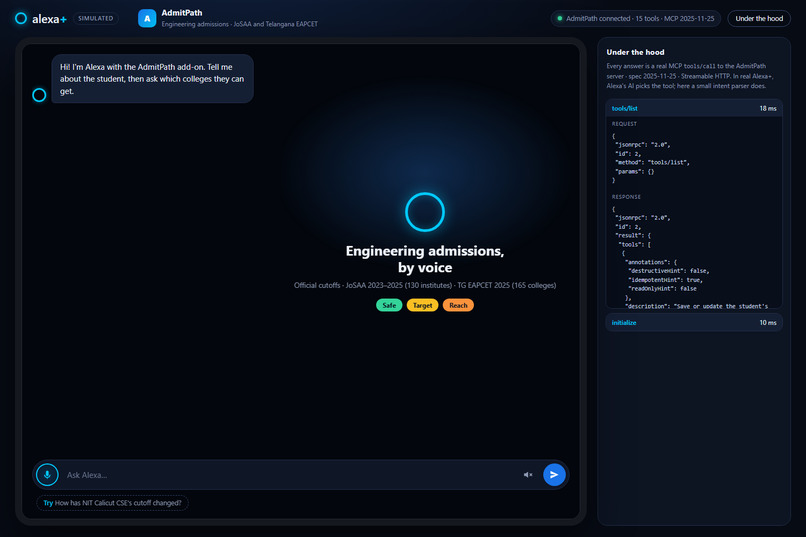
Welcome
-
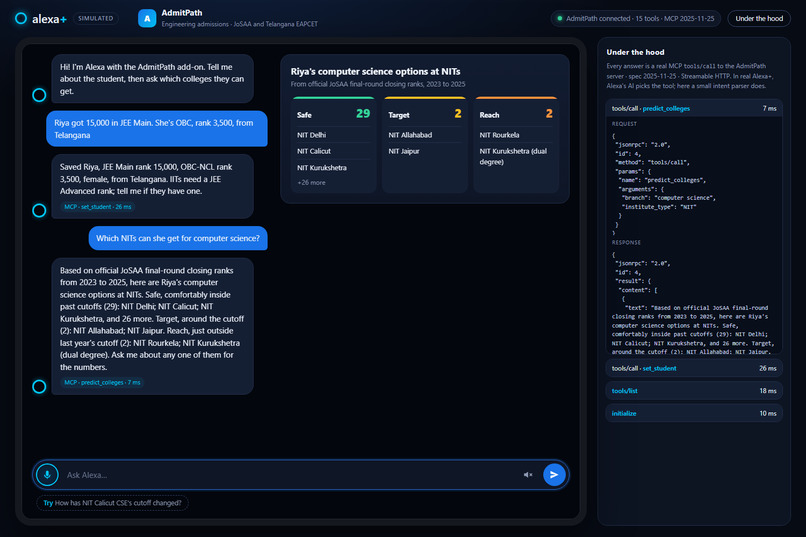
Which Nits
-
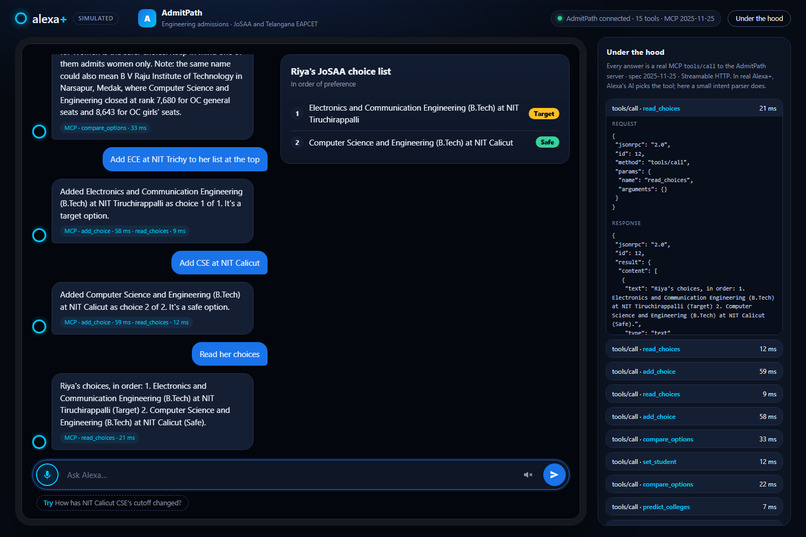
choice list
-
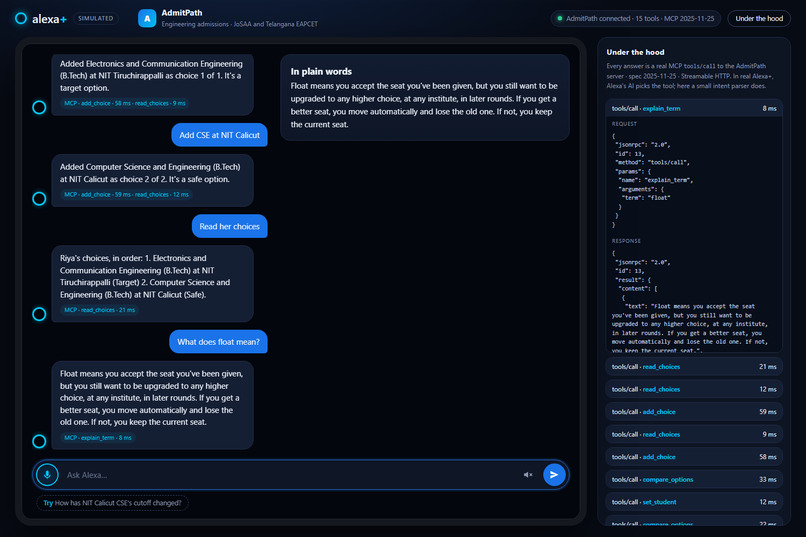
explain float
-
comparision of clg
-
compare
Inspiration
Every year, well over a million students in India write JEE and state engineering entrance exams. Then their families face a second, harder exam: counselling. Over a hundred JoSAA institutes, hundreds of branches, home-state and other-state quotas, category ranks, female-only seats, several rounds, and words like float, slide and freeze. On top of that, many colleges, like CBIT or VNR in Hyderabad, aren't in JoSAA at all and use a completely different exam and rank.
Most families make this life-changing decision from scattered web tables, PDFs and coaching-centre advice. We wanted a calm, patient advisor the whole family could simply talk to at home, so Alexa+ felt like the right place for it.
What it does
AdmitPath is an Alexa+ add-on: a self-hosted MCP server (spec 2025-11-25, Streamable HTTP) with 15 tools. A family can say:
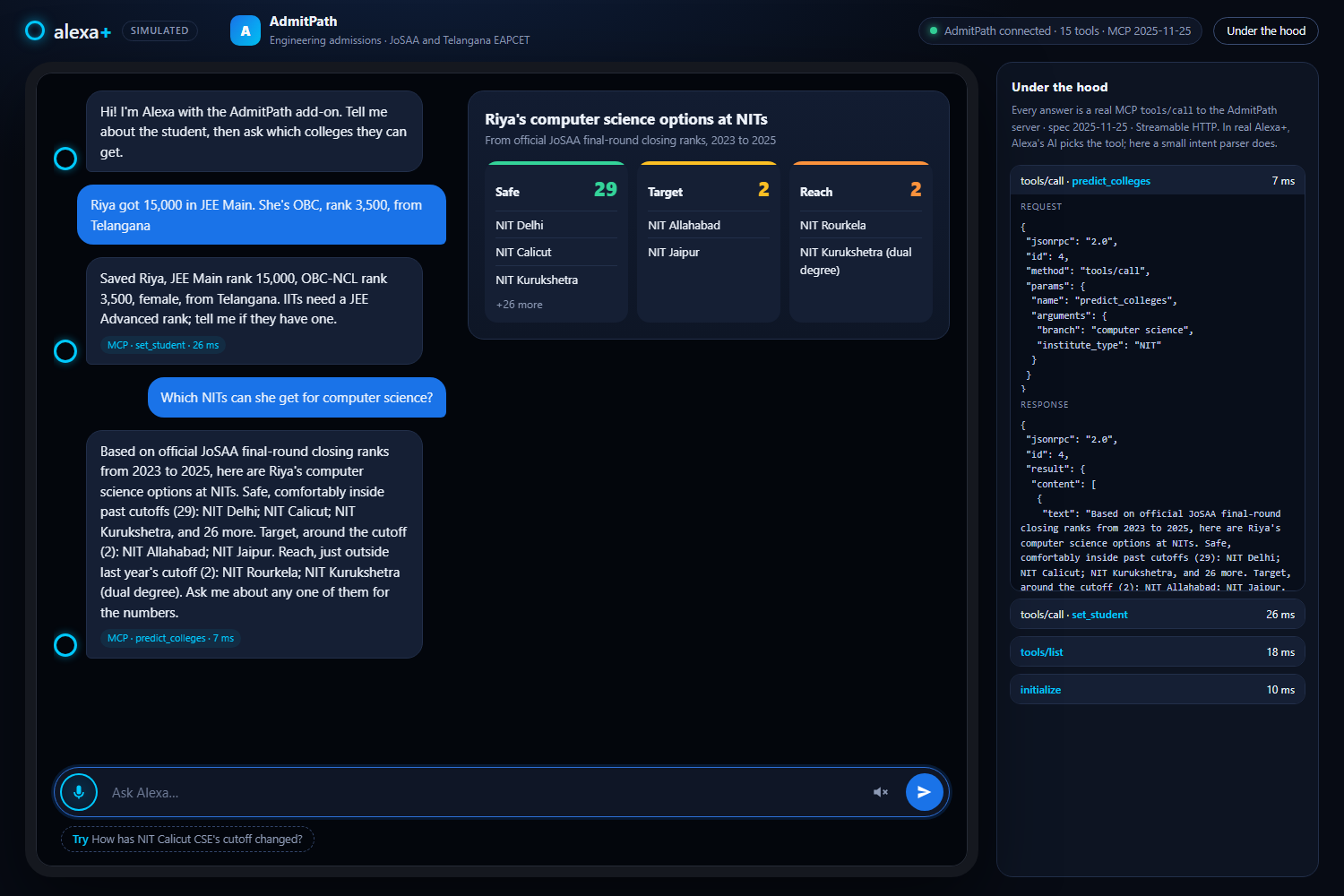
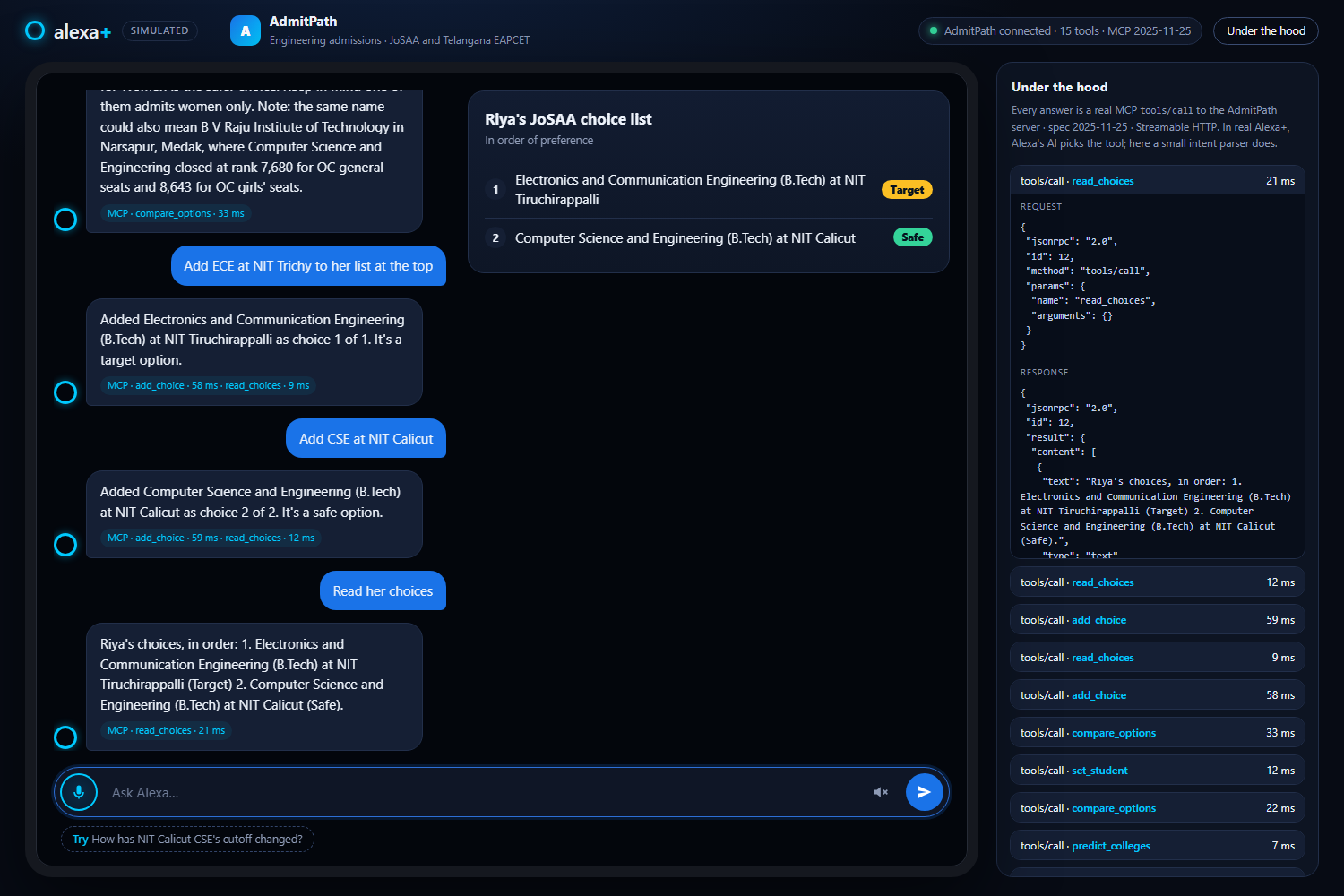
- "Riya got 15,000 in JEE Main. She's OBC, rank 3,500, from Telangana." → it remembers the student.
- "Which NITs can she get for computer science?" → Safe / Target / Reach lists from official cutoffs.
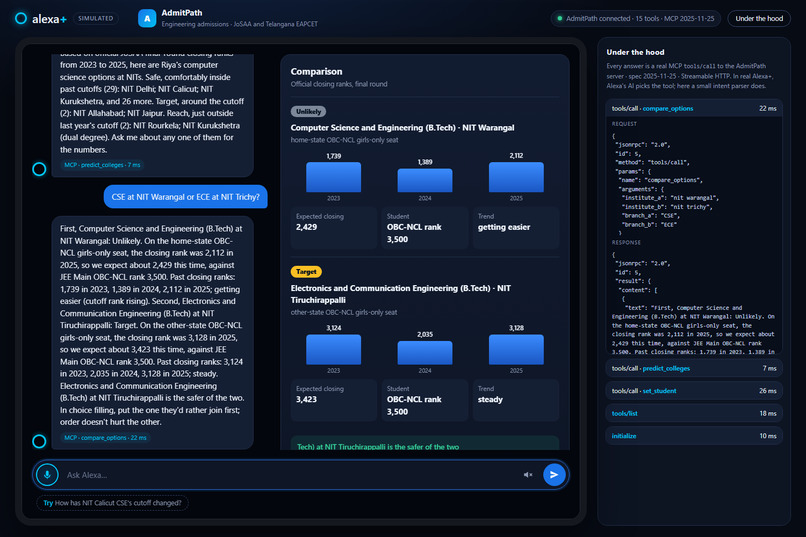
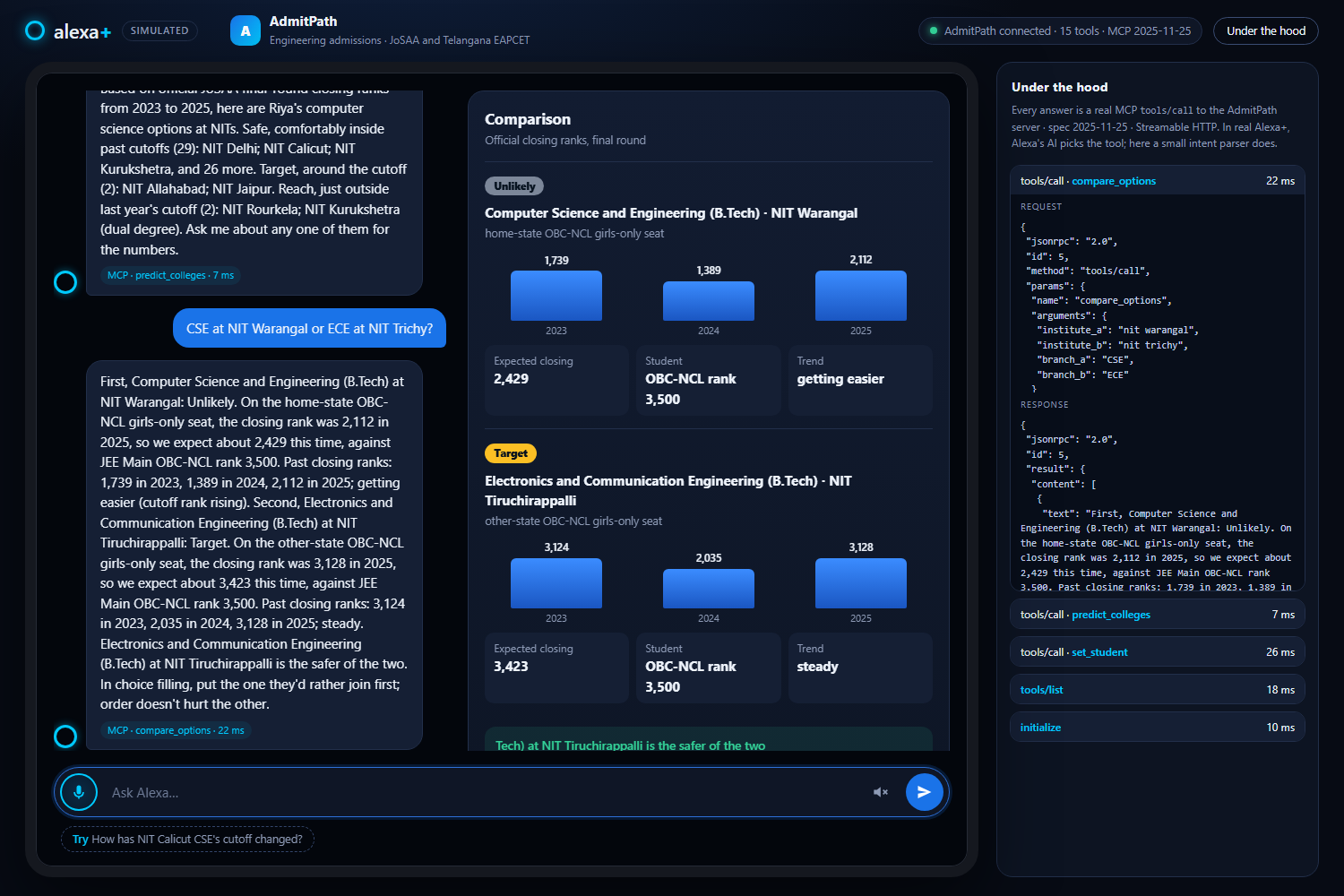
- "CSE at NIT Warangal or ECE at NIT Trichy?" → closing ranks year by year, the trend, and which is safer.
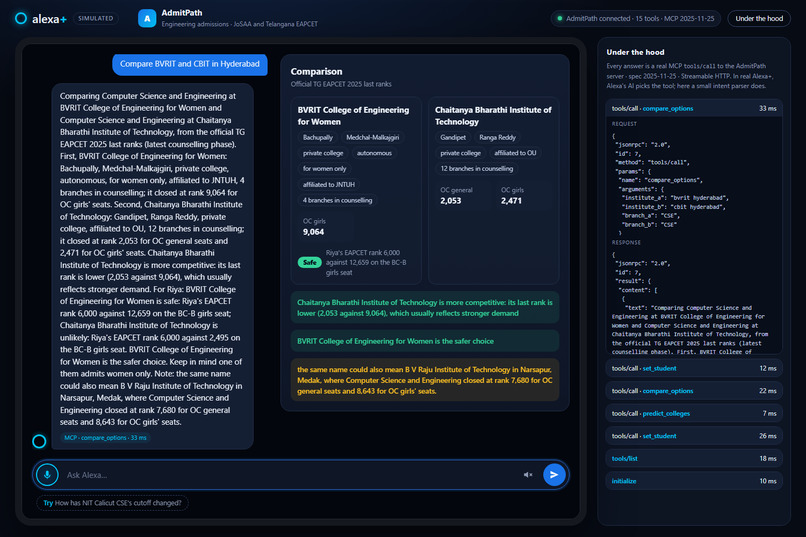
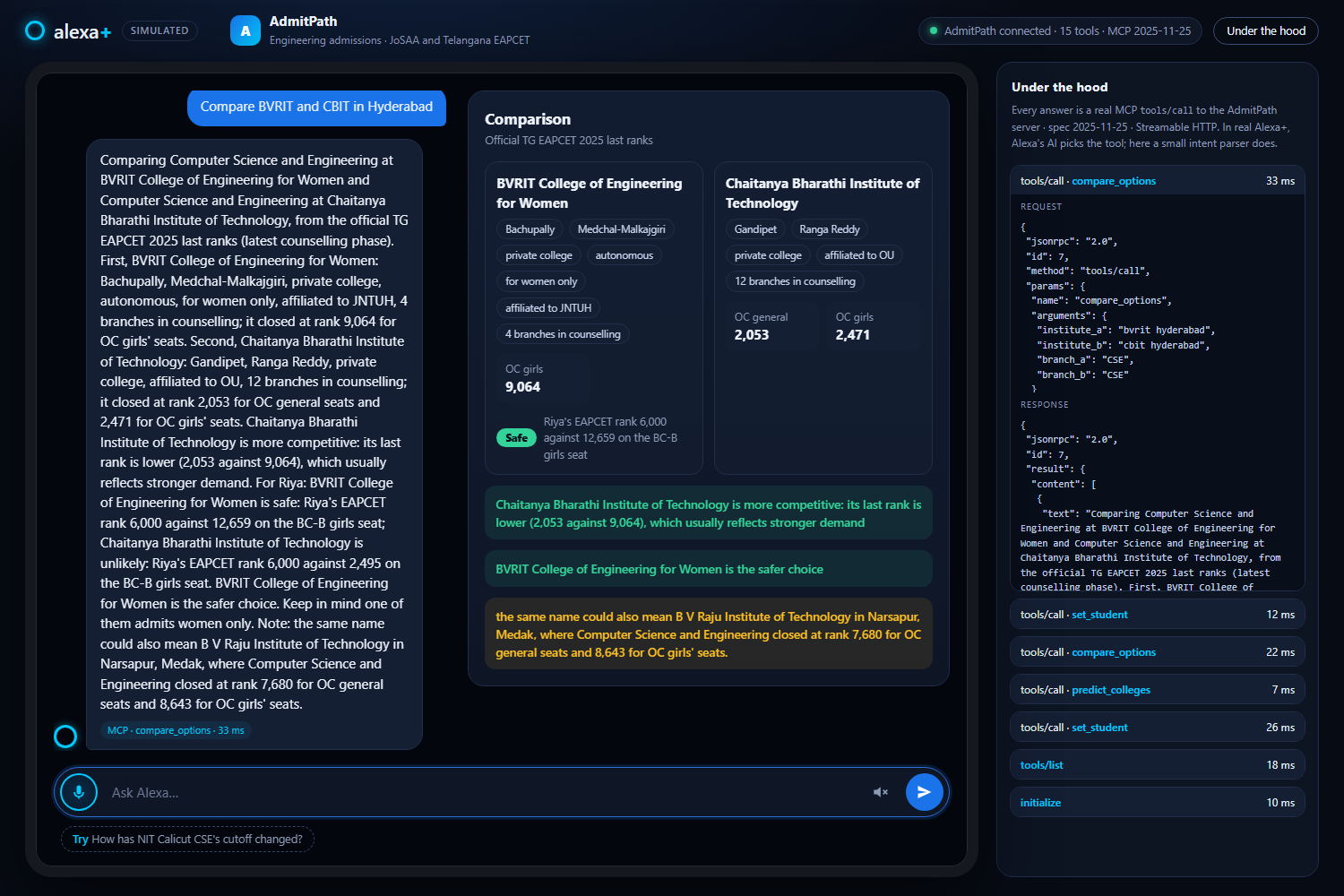
- "Compare BVRIT and CBIT in Hyderabad." → Telangana state colleges too, by EAPCET rank and Telangana category. It notices when one name means two campuses.
- "Add ECE at NIT Trichy to her list at the top." → builds the choice list by voice.
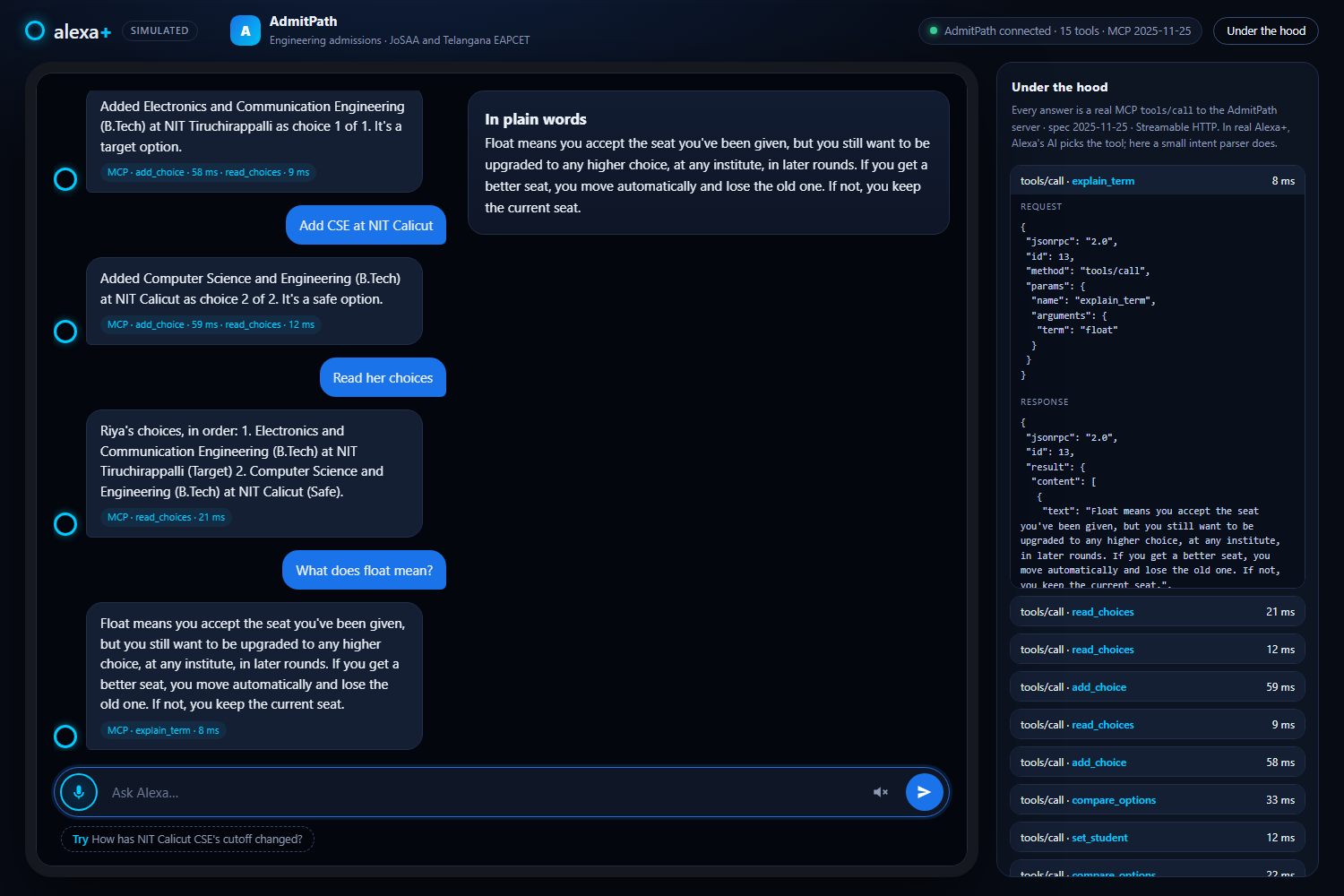
- "What does float mean?" → plain-language explanations of the counselling process.
It also says clearly when a college isn't in JoSAA (IIIT Hyderabad, DTU, BITS), and when two colleges use different exams, so their cutoffs can't be compared.
How we built it
Data first. We used only official numbers:
- 33,560 JoSAA final-round opening and closing ranks for 2023–2025 (130 institutes). The JoSAA archive is an ASP.NET form, so we wrote a script that walks it like a browser: year → round → institute type → all programs.
- TG EAPCET 2025 last ranks for 165 Telangana colleges, parsed from the government's PDF statements with
pdfplumber, merging the first, second and final phases.
Prediction. For each program, AdmitPath picks the seats the student is actually eligible for (quota, category, gender) and compares their rank with an expected closing rank that follows the recent trend:
$$ \hat{c} = c_{2025} \cdot \operatorname{clip}!\left(\operatorname{median}{y}\frac{c{y}}{c_{y-1}},\ 0.85,\ 1.15\right), \qquad r = \frac{\text{student rank}}{\hat{c}} $$
The clipping keeps one unusual year from dominating. Then:
$$ \text{Safe if } r \le 0.85,\quad \text{Target if } 0.85 < r \le 1.05,\quad \text{Reach if } 1.05 < r \le 1.25 $$
The best seat for the student counts. Every answer shows the seat used and the numbers behind it, because these are estimates, not guarantees.
The server. Python with the official MCP Python SDK: 15 typed tools with descriptions written for a voice assistant, stateless Streamable HTTP, and answers from local data in about 10–40 ms, well under Alexa+'s 500 ms target. Spoken names ("NITW", "IIT kgp", "triple IT Allahabad", "CBIT", "VNR") are matched to official names.
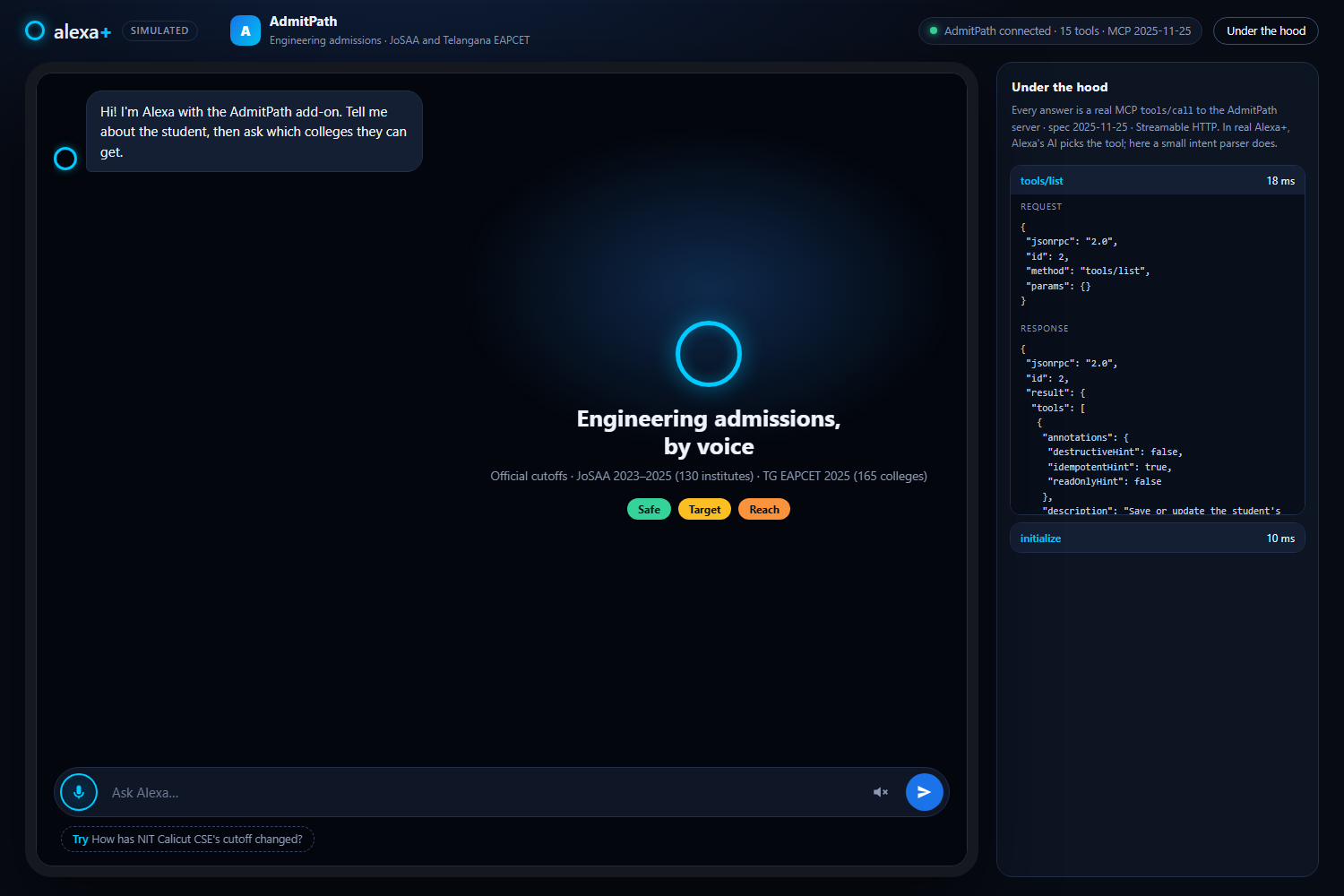
The demo. We didn't get Alexa+ Preview access, so we built a simulated Alexa+ web page: an Echo Show-style screen with voice in and out. It is a real MCP client, and every answer is a real tools/call to the server, with the JSON-RPC request and response shown on screen. In real Alexa+, Alexa's AI picks the tool; in the simulation, a small intent parser does.
Quality. 48 pytest tests cover name matching, quota rules (home state, Goa, J&K), category and female seats, the trend calculation, Telangana categories, comparisons and real MCP calls.
Challenges we ran into
- No downloadable data. JoSAA only offers an ASP.NET form, and TG EAPCET publishes PDFs only for the latest year. Older Telangana years have been taken down, so state-college answers have no trend yet.
- Rules that differ by system. NIT home-state quota depends on the state where the student passed class 12; Goa, Jammu and Kashmir, and Ladakh have special quotas; Telangana has its own categories (BC-A to BC-E, SC-I to SC-III). Each needed careful handling.
- Names people actually say. "BVRIT" means two different colleges; "ECE" was first matching Electrical and Electronics instead of Electronics and Communication; people mistype "Hyderabad". We fixed each of these and added tests.
- No Alexa+ access during the hackathon, so we designed for the documented requirements and proved the MCP side with a simulated client.
- Keeping it honest. Predictions can mislead if presented as certain, so every answer explains its numbers and labels them as estimates.
What we learned
- MCP makes a clean boundary: the same server works for Alexa+, the MCP Inspector and our own browser client.
- Writing tool descriptions and answers for voice is different from writing for a screen: short sentences, one point at a time, numbers read naturally.
- Public data is the hardest and most valuable part. Clean official numbers matter more than clever algorithms.
What's next
- Connect to Alexa+ through the MCP Toolkit as soon as Preview access is available, with account linking (OAuth 2.1 with PKCE).
- Add more state counselling systems (AP EAPCET, KCET, MHT-CET) and more years of data.
- Visual cards for Echo Show through MCP Apps.
- Reminders for counselling deadlines and round results.
Built With
- alexa-plus
- beautiful-soup
- css
- html
- javascript
- mcp
- model-context-protocol
- pdfplumber
- python
- sqlite
- starlette
- uvicorn
- web-speech-api

Log in or sign up for Devpost to join the conversation.