What it does
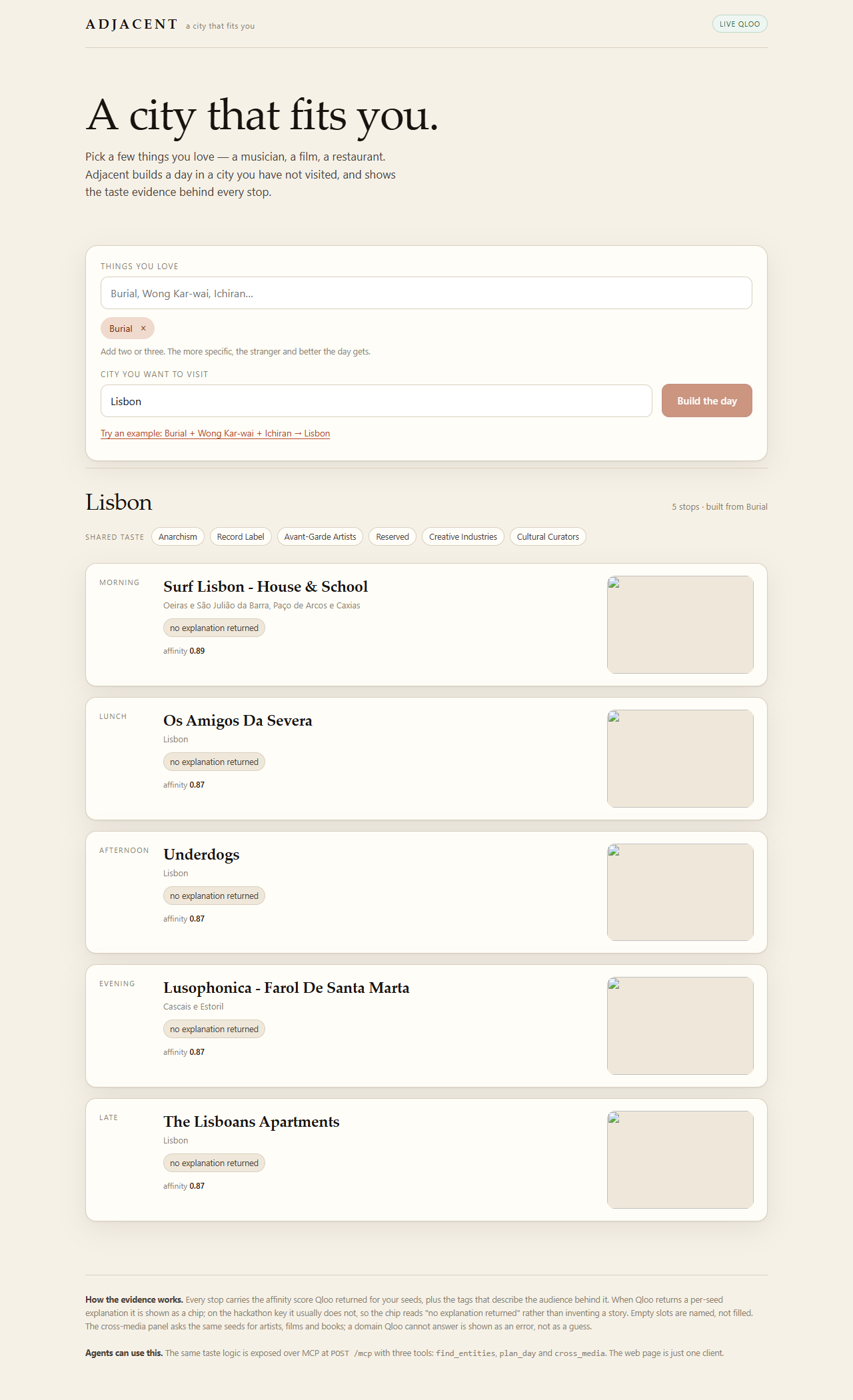
Pick three things you already love - a musician, a film, a restaurant. Adjacent builds a day in a city you have never visited, and shows the taste evidence behind every stop.
The question it answers is not "what is popular in Lisbon" but "what in Lisbon is popular with people like me". A Burial listener's next cocktail bar. A Wong Kar-wai fan's next gallery. An Ichiran regular's next lunch.
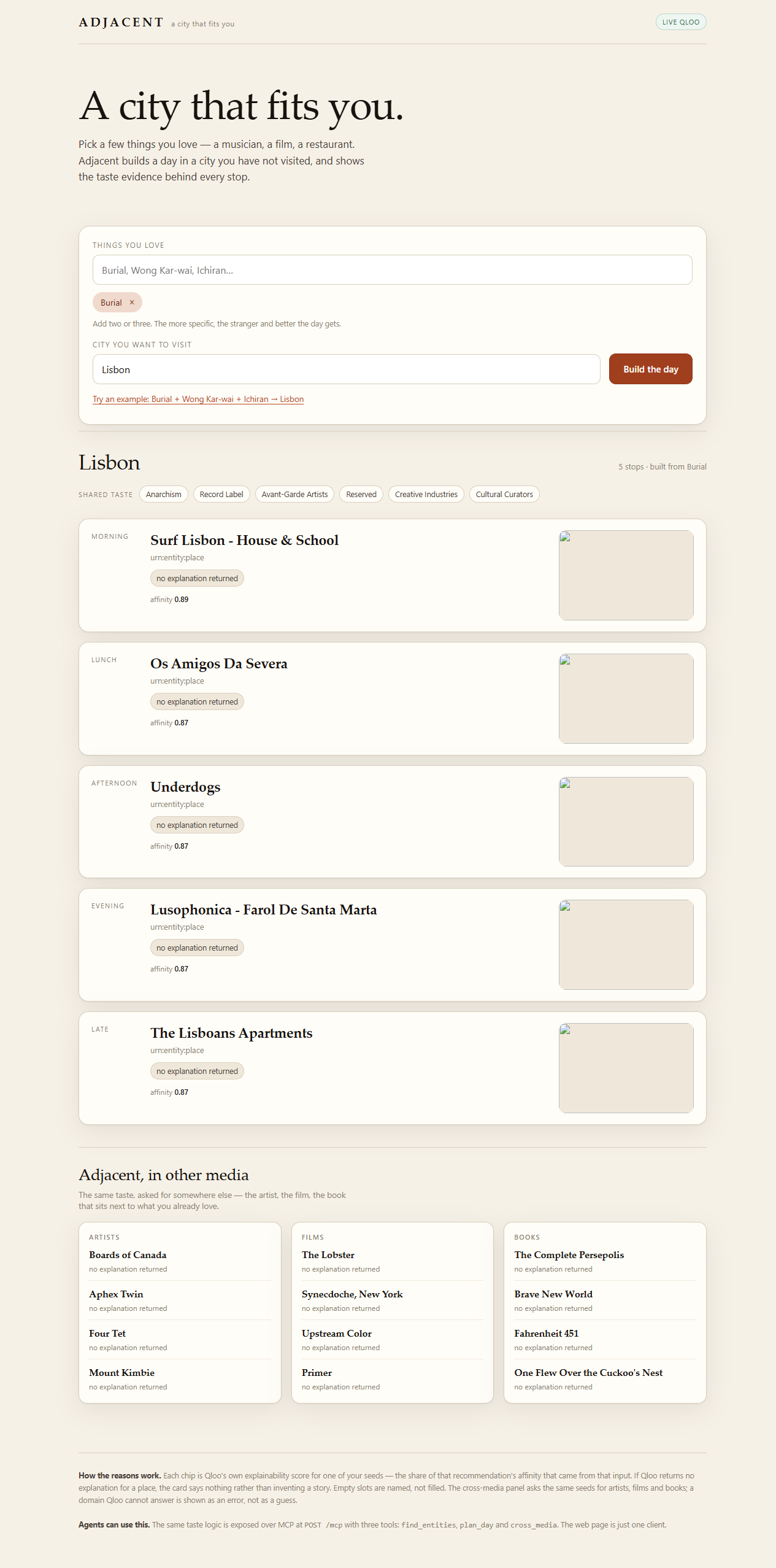
The day comes back as five slots - morning, lunch, afternoon, evening, late - each a real venue with a Qloo affinity score and the tags that describe it. With a single Burial seed in Lisbon the scores run 0.89 / 0.87 / 0.87 / 0.87 / 0.87 (checked 24 October 2026). When Qloo covers fewer venues than the day has slots, the plan is shorter and names the empty slot instead of padding it with filler.
Why it needs Qloo
Ask a language model for "a bar for someone who likes Burial and Wong Kar-wai" and you get a plausible paragraph with no source. Ask Adjacent and you get a place, a real affinity number from Qloo's taste graph, and the tags that describe the audience behind it. Remove the taste graph and the product has nothing to show but prose.
How it is built
A Cloudflare Worker serves an MCP endpoint at POST /mcp with three tools:
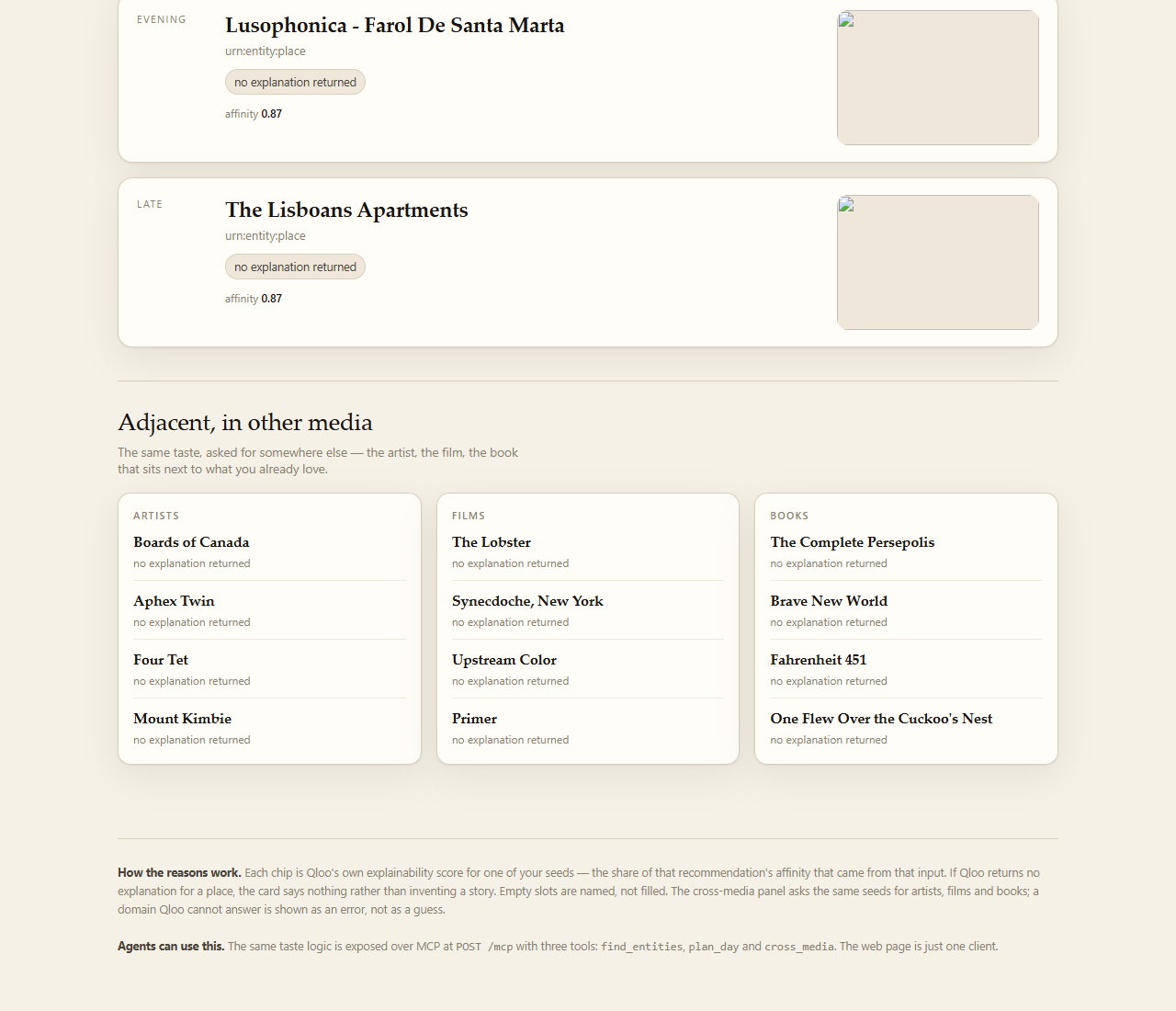
find_entities- resolve a free-text seed ("Burial", "Wong Kar-wai") to a Qloo entity id and its tagsplan_day- take seed entities and a city, and return a ranked day of real venues with affinity scores and named gapscross_media- the same seeds returned as artists, films and books, so a domain Qloo cannot answer stays empty instead of being filled with titles that sound right
The live path uses two Qloo endpoints. /search resolves a free-text name to an entity id. /v2/insights does the rest, in three shapes: filter.type=urn:entity:place with signal.interests.entities set to the seed ids produces the day - a text query would have returned popularity, not taste - filter.type=urn:tag produces the shared-taste strip, and one call per media type produces the cross-domain panel. /recommendations and /recs are never called; they are legacy and unsupported by hackathon keys.
The UI is a single static HTML file with no framework and no build step, served by the Worker next to the JSON API - the interesting part is the evidence, not the chrome.
The demo has run on a live Qloo key since 20 October 2026. Without a key the server falls back to a bundled fixture, and the badge in the header always says which source you are looking at - I did not want a demo that quietly pretends.
Challenges
- Explainability is thinner than the UI implies.
/v2/insightson a hackathon key returnsquery.affinity, tags and measurements, but no per-seed explanation payload. The reason row is therefore usually empty, and the card falls back to affinity and tags, which is the evidence Qloo actually gave. No reason is ever synthesised. - A bare city name is not a geocode filter. Asking for Lisbon with only
filter.geocode.cityreturned London venues. The client now resolves the name first when no ISO country code is supplied. - Empty is a feature. When Qloo has nothing for a domain, the right behaviour is to show nothing. Early versions filled the gap with model guesses, which is exactly the failure this project exists to avoid.
- Fixture vs live. Building without a key for two days forced a clean separation between the Qloo client and the data source, which turned out to be the best structural decision in the codebase.
What I learned
A recommendation is only as good as the sentence that justifies it. The taste graph is not a ranking API - it is an argument generator, and the product is the argument.
Live demo: https://adjacent.ojikaminari.workers.dev - Source: https://github.com/kaminariouji/adjacent (MIT)
Built With
- ai-agents
- cloudflare-workers
- mcp
- qloo
- taste-graph
- typescript
