
Inspiration
Customer support systems today are reactive, static, and require constant manual tuning. Businesses deploy chatbots and call-center automation, but these systems rarely improve on their own. We were inspired by the idea of building not just a chatbot — but a self-improving AI workforce that learns from its own conversations.
We asked: What if your customer support system had its own AI supervisor?
What it does
ADI 5 is a self-optimizing AI customer operations system.
It includes:
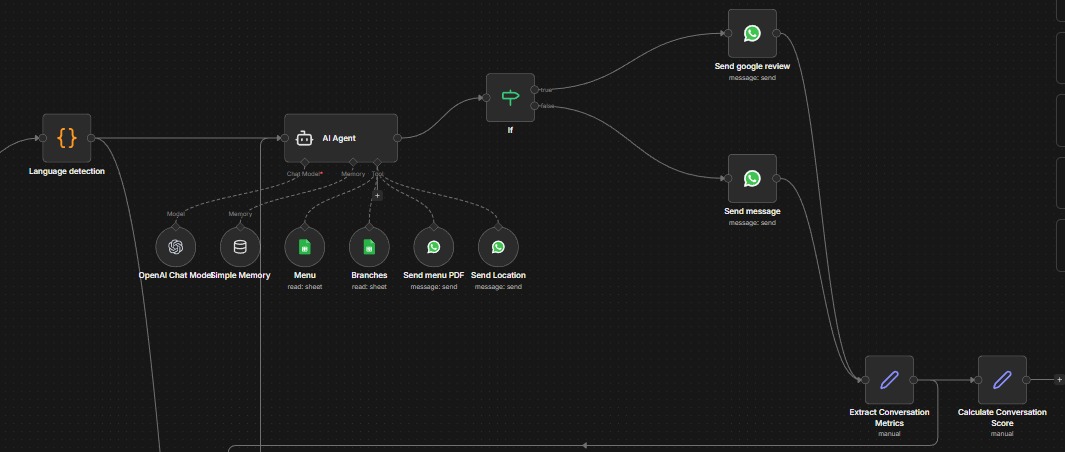
A live AI chatbot (WhatsApp-ready)
A voice-ready AI response system (via ElevenLabs)
A real-time logging and evaluation layer
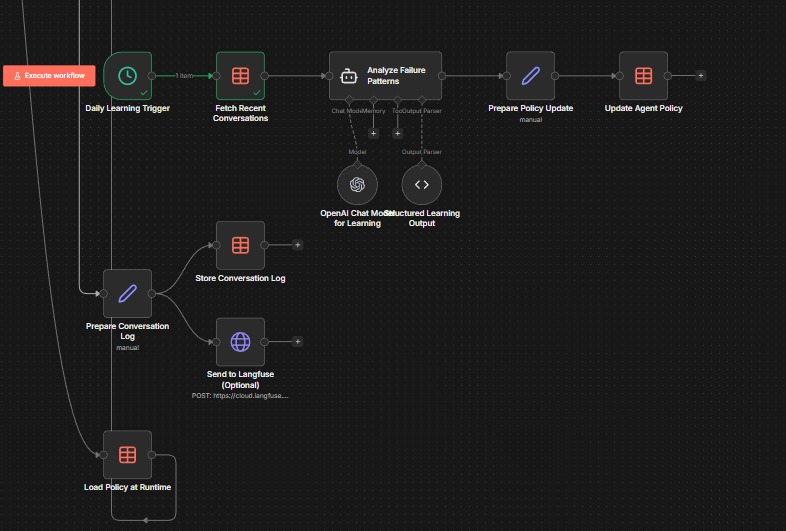
A Supervisor AI that analyzes failed conversations and improves the system over time
The runtime agent handles customer conversations. Every interaction is logged and evaluated. A separate Supervisor Agent analyzes tone, intent, emotional signals, tool usage, and escalation patterns. It then generates structured improvements to the system prompt and behavior rules.
The result: The system continuously becomes smarter, more empathetic, and more effective.
How we built it
We built ADI 5 in layers:
n8n as the runtime orchestration layer for the customer-facing agent
Langfuse for observability, evaluation, and trace logging
Kiro (AWS) to develop the Supervisor Agent responsible for behavioral diagnostics and improvement logic
ElevenLabs for natural voice synthesis
Structured JSON-based communication between all services via HTTP APIs
The architecture follows a feedback loop:
Customer → Runtime Agent → Logging → Supervisor Agent → Prompt Improvements → Runtime Agent (v2)
This creates a controlled self-learning cycle.
Challenges we ran into
Designing a safe self-improvement loop without breaking production logic
Structuring Supervisor outputs so they are actionable and system-level, not just better replies
Balancing automation with human oversight
Avoiding overengineering while under time pressure
Integrating observability in a meaningful way instead of just logging data
The biggest challenge was making the system improve behavior — not just responses.
Accomplishments that we're proud of
Building a two-layer AI system: a runtime agent and a supervising agent
Implementing tone-aware analysis and empathy diagnostics
Designing structured prompt evolution instead of ad-hoc edits
Creating a clean feedback architecture using modern AI tooling
Demonstrating measurable behavioral improvement between versions
We’re especially proud that ADI 5 doesn’t just answer — it learns.
What we learned
Observability is critical before improvement.
Tone and emotional intelligence matter more than raw accuracy.
Self-learning systems must be structured and safe.
Iteration beats complexity.
Real innovation is in architecture and feedback loops, not just model choice.
We also learned how to move fast without losing system clarity under pressure.
What's next for ADI 5
Fully automated supervisor-to-runtime updates with approval workflows
Real-time tone adaptation during conversations
Multi-agent collaboration (Supervisor + QA + Strategy agents)
Deployment at scale on AWS infrastructure
Business-facing conversational analytics for owners
Continuous A/B testing of prompt strategies
Our long-term vision is to build AI customer systems that improve themselves responsibly and autonomously.
Built With
- amazon-web-services
- business
- http
- json
- kiro
- langfuse
- meta
- n8n
- typescript

Log in or sign up for Devpost to join the conversation.