Inspiration
A career-coaching framed planner, not a clinical one: the positioning note in the listing source is explicit that ADHDFlow never claims to diagnose, treat or improve ADHD, and never uses "symptoms," "disorder," "therapy," "treatment" or "medical" in its copy — it is a work-day tool for an adult knowledge worker, written and marketed as such.
What it does
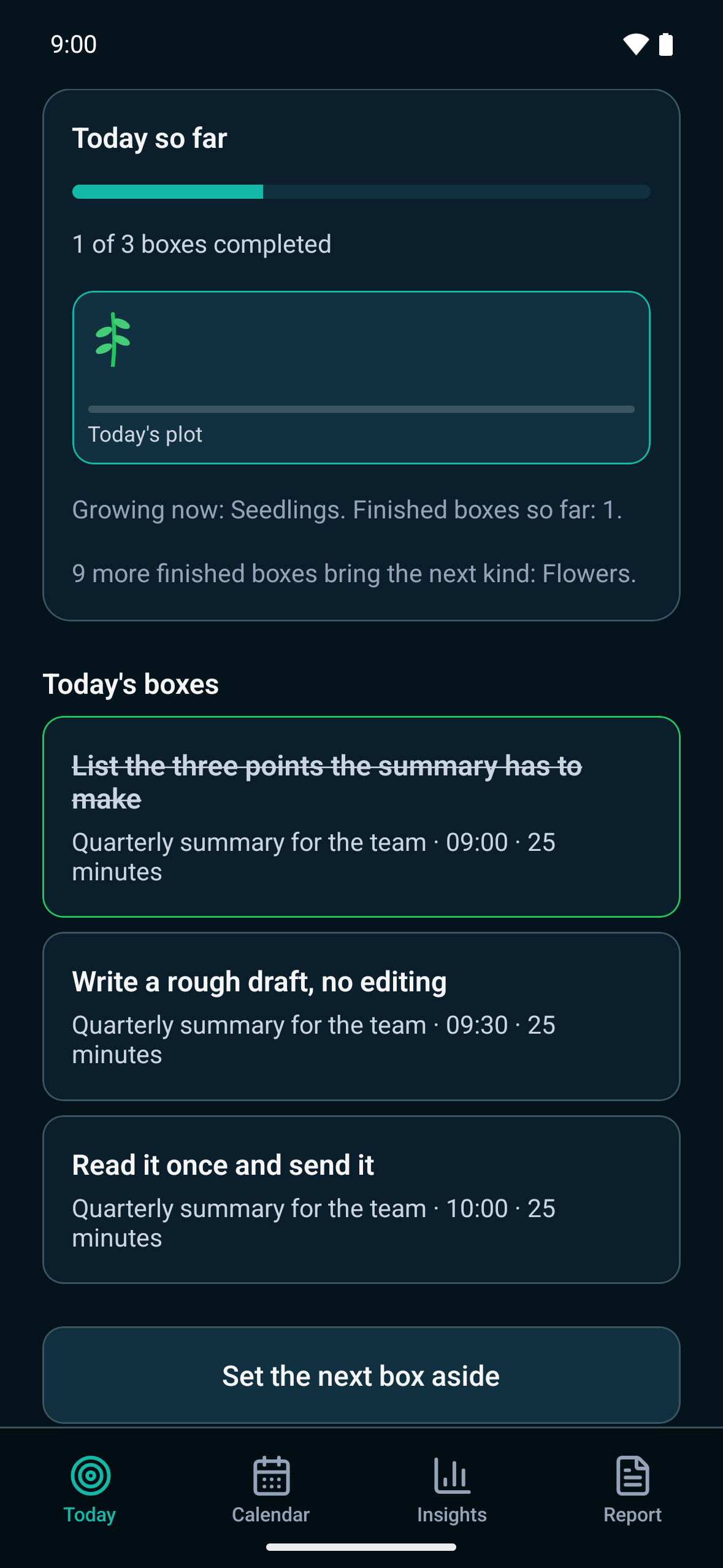
Add a task, pick a template (document, email, meeting prep, research, admin, presentation), and it becomes three to five concrete steps. Each step gets a 25- or 50-minute silent, ad-free timer box inside the user's work hours. Finishing a box asks one question — Done / Partly / Park it — and a parked thought waits on Today instead of nagging; a "Park a thought" line on the focus screen keeps interruptions out of the box. Each completed box plants something in today's plot of a focus garden: plants come in varied kinds, grow through tiers that never drop, and the next, more beautiful kind is previewed as a silhouette with an honest count of boxes to go — nothing withers, nothing is lost on a bad day. An Insights tab shows the garden, an hour-by-weekday focus map, completion rate, and a gain-framed run of good days; a Report tab writes the week in plain text to share with a manager or coach. Settings shows a Support ID (the RevenueCat app user id) the user can share when asking for help. Reminders stay off until turned on and respect quiet hours; there are no streak threats and no countdowns. Free tier: three boxes a day, three templates, forever. Premium adds every template, unlimited boxes, four weeks of pattern history, and report sharing. Nineteen languages, local-first — task, step, time-box, settings and reminder data never leave the device.
How we built it
Expo SDK ~54.0.37, React Native 0.81.5, TypeScript, Expo Router, Zustand, expo-notifications (silent channel by design — no custom sound). RevenueCat (react-native-purchases ^10.9.1): entitlement premium, offering adhdflow_default, monthly and annual plans with a 7-day trial on the annual plan. The free tier carries one AdMob banner (react-native-google-mobile-ads 15.8.3) on the Report tab; the same build-time kill switch and manifest-safety pattern used on GraceRhythm and Clocktopus carries over here — the ad SDK is always manifest-satisfied even when the flag is off, because Android autolinking compiles it into the binary regardless.
Challenges
The Play data-safety answer had to stay precise under real scrutiny: device/advertising IDs and purchase history are collected and shared with AdMob and RevenueCat, and nothing else — task, step, time-box and reminder content is local-only. Getting the tone right in the listing copy was a harder editorial problem than the code: every language block carries the same three-sentence boundary (planning tool, not a medical device; not a substitute for a doctor's advice; medication and care decisions belong to a professional) instead of softening it away in translation.
Accomplishments
A productivity tool that names its audience without pathologizing it — "ADHD" appears as who the app is for, not as a condition it manages — paired with a genuinely quiet interaction model: no sound, no vibration, no streak threat, no countdown, reminders opt-in only — and a Forest-style visible reward rebuilt without Forest's punishment: the garden only ever grows.
What we learned
The hardest constraint on this app was linguistic, not technical: keeping a consistent, non-medical boundary sentence identical in meaning across 19 languages required treating it as a fixed unit to translate, not a paragraph to paraphrase per locale.
What's next
The production release was submitted to Google Play review on 20 September 2026 with the 19-language listing; the subscription products are live on Play and mapped in RevenueCat. The App Store submission reuses the same asset set.
Built With
- expo-notifications
- expo-router
- expo.io
- github-actions
- react-native
- react-native-google-mobile-ads
- react-native-purchases
- revenuecat
- typescript
- zustand

Log in or sign up for Devpost to join the conversation.