ADHD Self-Care Assistant - Hackathon Submission
Inspiration
Millions of people with ADHD struggle daily with something that seems simple: maintaining basic self-care routines. Tasks like taking medication, eating regular meals, staying hydrated, or maintaining sleep hygiene can feel insurmountable when you're battling executive dysfunction, time blindness, and constant overwhelm.
Traditional reminder apps fail because they don't understand the ADHD brain. A generic "Take your medication" notification at 8 AM doesn't help when you're already running late, anxious, and unable to process one more demand. What people with ADHD need isn't just reminders - they need an intelligent partner that understands their unique challenges, adapts to their patterns, and provides support without judgment.
We were inspired to build an AI agent that could truly help. Imagine a companion that learns when you have the most energy, adjusts task complexity based on your current state, breaks down overwhelming routines into bite-sized steps, and provides a safety net during crisis moments - all autonomously, without requiring manual configuration.
ADHD affects 4-6% of adults globally - over 300 million people. Yet mental health technology often overlooks the specific needs of neurodivergent individuals. We saw an opportunity to use AWS's AI services to create something that could make a real difference in people's daily lives.
What it does
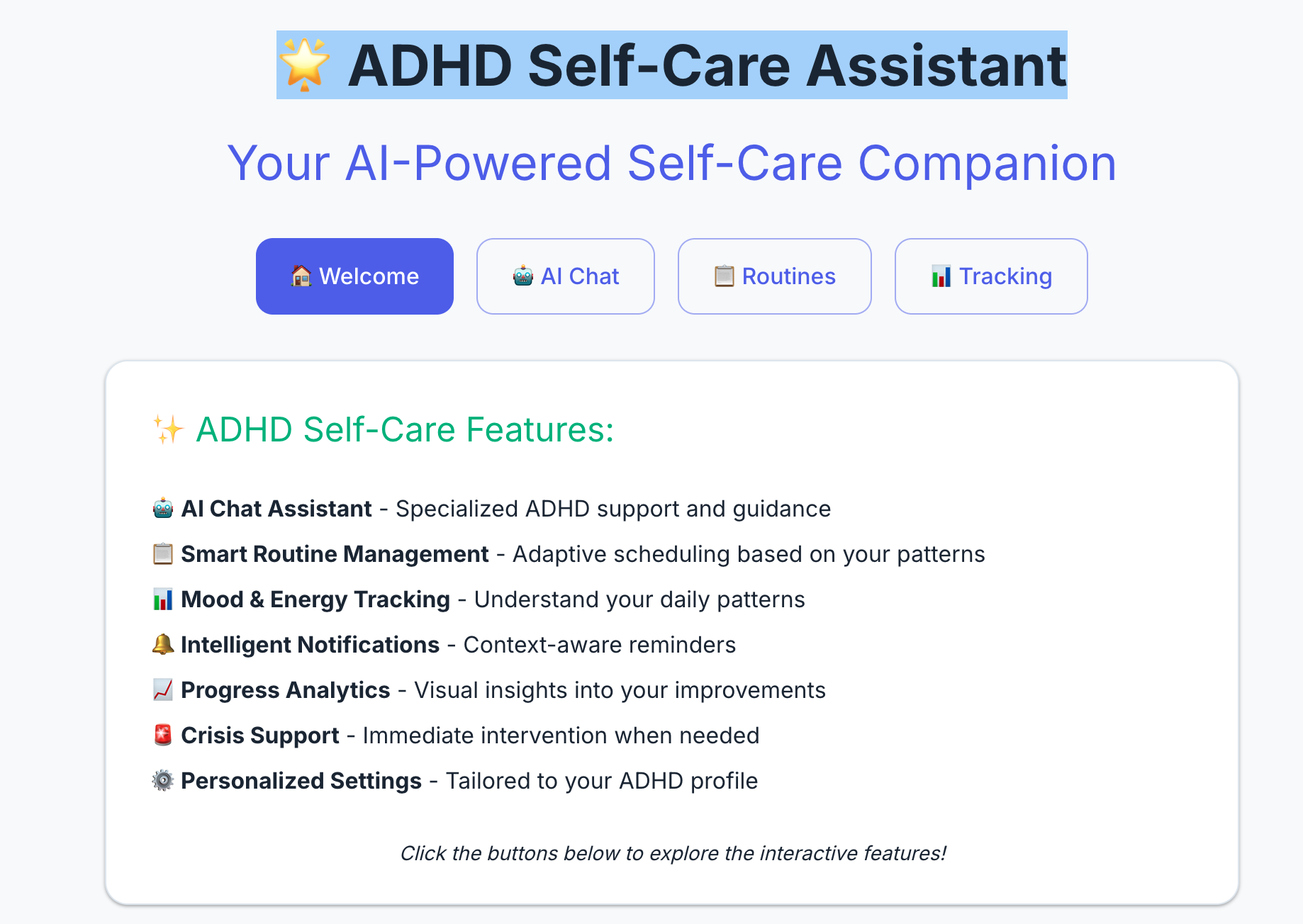
The ADHD Self-Care Assistant is an autonomous AI agent built on Amazon Bedrock that provides personalized, adaptive support for managing self-care routines. Here's how it works:
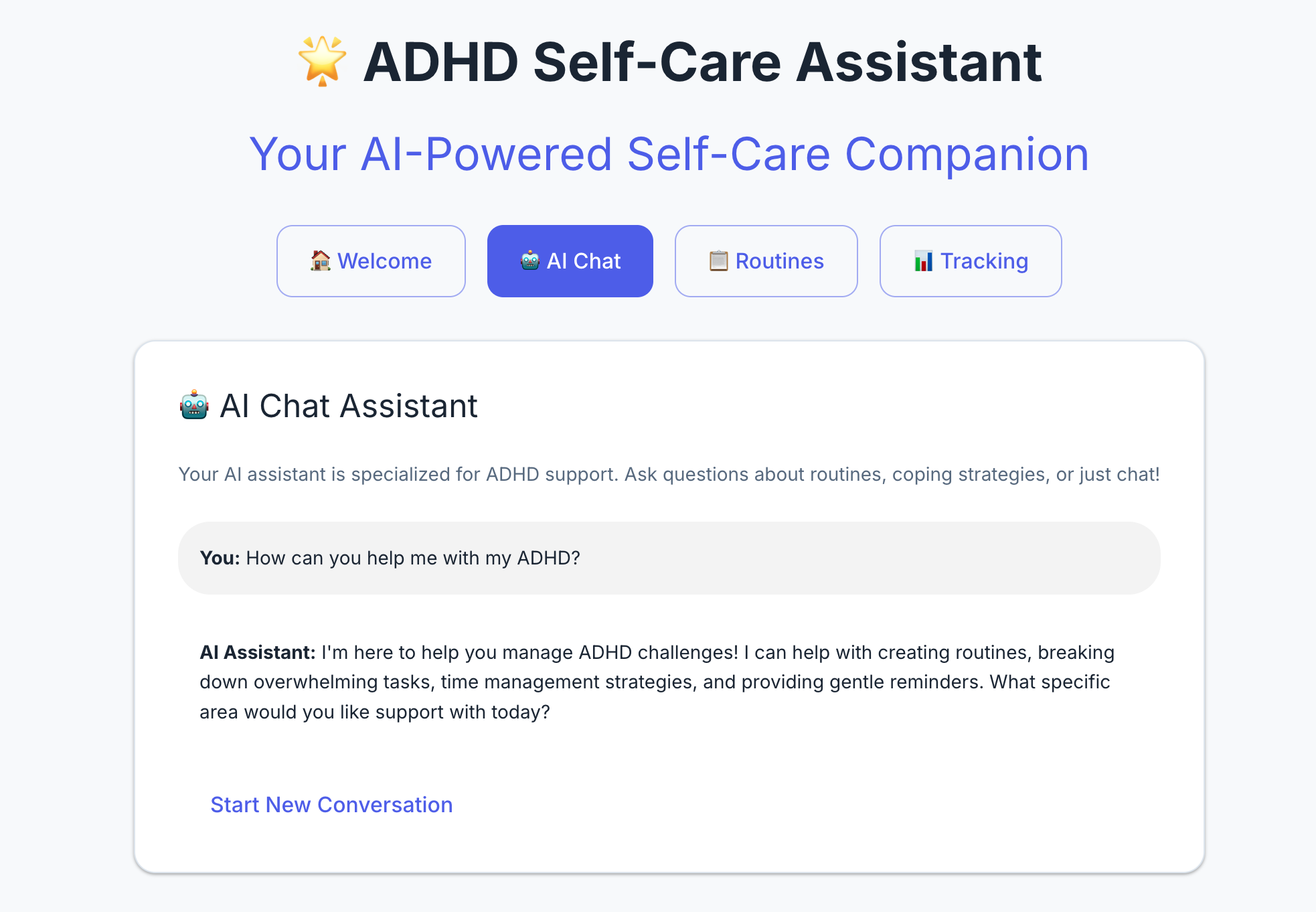
Intelligent Conversation Partner
- Engages in empathetic, ADHD-appropriate conversations using Claude 3.5 Sonnet
- Understands context beyond words - detecting mood, energy levels, and distress signals
- Provides guidance that reduces overwhelm rather than adding to it
- Remembers patterns and preferences to personalize every interaction
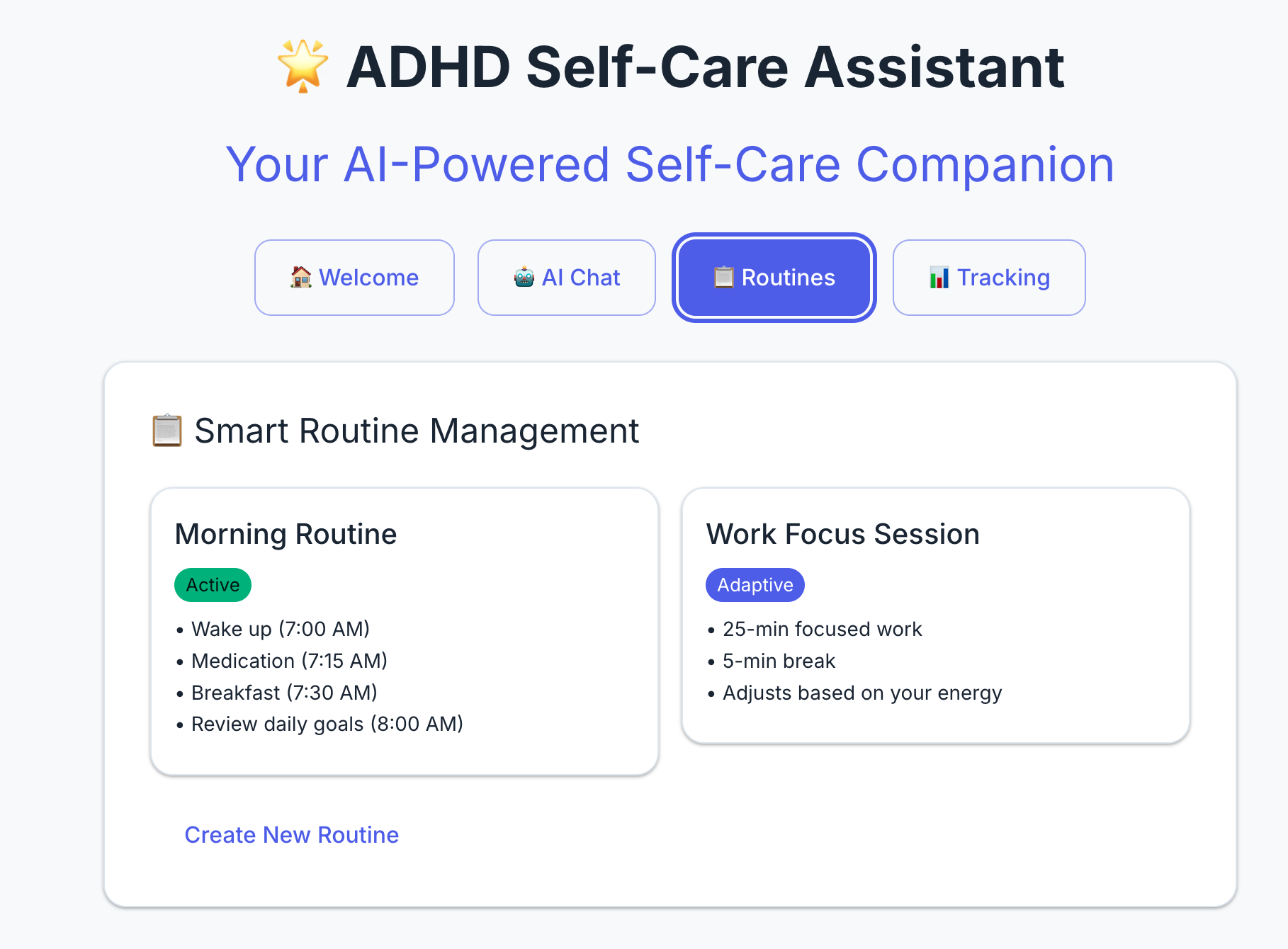
Autonomous Routine Management
- Creates flexible self-care routines (morning, evening, medication, meals, exercise, etc.)
- Breaks complex routines into manageable steps based on current user capacity
- Automatically prioritizes tasks when users feel overwhelmed
- Adjusts task complexity in real-time based on mood and energy assessments
Adaptive Scheduling
- Learns from completion patterns to identify optimal times for different activities
- Tracks success rates across different times, moods, and energy levels
- Autonomously adjusts routine timing without manual intervention
- Provides flexible time windows instead of rigid schedules
Proactive Crisis Intervention
- Continuously monitors conversations for distress indicators
- Uses multi-layered analysis (keyword detection + AI reasoning) for severity assessment
- Automatically escalates to appropriate resources based on risk level
- Provides grounding techniques and connects to crisis hotlines when needed
Smart Notifications
- Delivers context-aware reminders via multiple channels (SMS, email, push)
- Adapts notification tone and complexity to current user state
- Respects user boundaries and energy levels
- Celebrates progress genuinely without toxic positivity
Progress Tracking & Insights
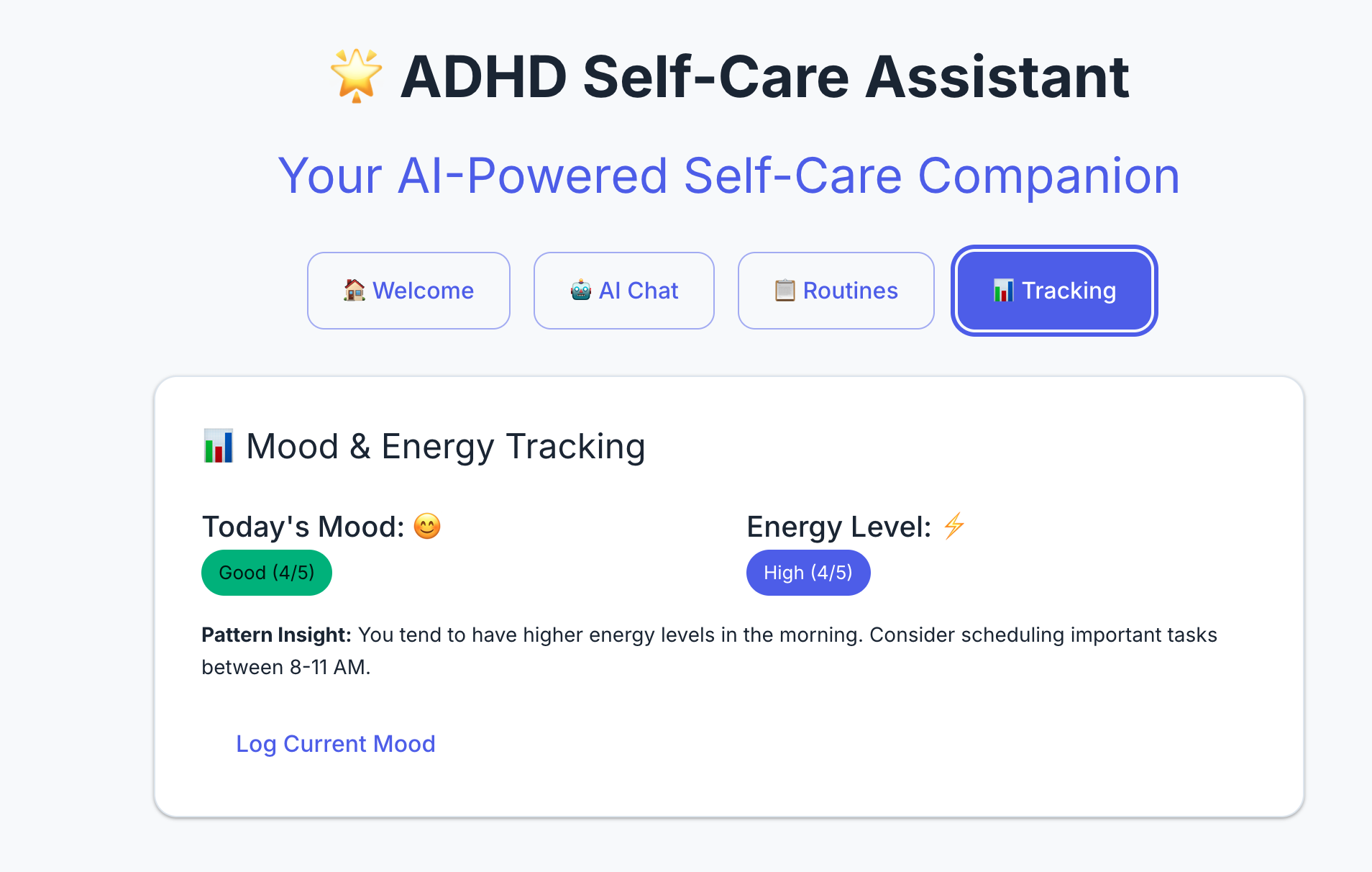
- Monitors mood and energy patterns over time
- Visualizes progress to maintain motivation
- Identifies what's working and what needs adjustment
- Provides transparency about why recommendations are made
How we built it
AWS Services Architecture
We built a fully serverless, scalable architecture leveraging multiple AWS services:
Core AI & Intelligence
- Amazon Bedrock (Claude 3.5 Sonnet): Powers natural language understanding, reasoning, and decision-making. We use the Converse API with sophisticated prompt engineering to ensure ADHD-appropriate responses
- AWS Lambda: Serverless functions handle all backend logic - agent interactions, routine management, adaptive scheduling, and crisis assessment
- Amazon DynamoDB: NoSQL database stores user profiles, routines, completion history, and conversation context with single-digit millisecond performance
User Interaction Layer
- Amazon API Gateway: RESTful API endpoints for all frontend-backend communication
- Amazon S3 + CloudFront: Hosts the React frontend with global CDN distribution for low latency
- React + TypeScript: Modern, accessible web interface with Material-UI components
Autonomous Operations
- Amazon EventBridge: Schedules automatic routine reminders and system health checks
- Amazon SNS: Multi-channel notification delivery (SMS, email, push notifications)
- AWS CDK: Infrastructure as Code for consistent, repeatable deployments
Key Technical Implementations
1. Context-Aware Bedrock Agent
const agentResponse = await bedrock.converse({
  messages: conversationHistory,
  system: adhd_optimized_system_prompt,
  inferenceConfig: {
    temperature: 0.7,
    maxTokens: 1000
  }
});
Our prompt engineering ensures responses are:
- Non-judgmental and strengths-based
- Appropriate to current user capacity
- Actionable without overwhelming
- Consistent with ADHD best practices
2. Adaptive Scheduler Algorithm
const pattern = await analyzeCompletionPatterns({
  userId,
  routine,
  timeWindow: last30Days
});

const optimizedSchedule = {
  flexibleWindow: {
    start: pattern.highestSuccessTime - bufferMinutes,
    end: pattern.highestSuccessTime + bufferMinutes
  },
  confidence: pattern.dataPoints > 10 ? 'high' : 'medium'
};
The system continuously learns from completion data and autonomously adjusts schedules within user-defined boundaries.
3. Multi-Layered Crisis Detection
const crisisAssessment = await analyzeCrisisIndicators({
  message: userInput,
  conversationContext,
  aiAnalysis: agentResponse
});

if (crisisAssessment.level >= MODERATE) {
  await escalateToCrisisProtocol(userId, crisisAssessment);
}
Combines keyword detection (5-level severity) with Claude's contextual understanding for accurate risk assessment.
Development Stack
- TypeScript for type safety across backend and frontend
- Jest for comprehensive testing
- ESLint for code quality
- GitHub for version control
- Node.js 18+ runtime
Challenges we ran into
1. Balancing AI Autonomy with User Control The biggest challenge was determining when the agent should act autonomously versus asking for permission. Too much autonomy feels invasive; too little defeats the purpose. We solved this by:
- Establishing clear boundaries users can configure
- Providing transparency about why the agent makes recommendations
- Allowing easy override of autonomous decisions
- Building trust gradually through small, helpful adjustments
2. Crisis Detection Accuracy Creating a reliable crisis intervention system was technically and ethically challenging:
- False positives could desensitize users to important warnings
- False negatives could miss critical moments when users need help
- We implemented multi-layered detection combining keyword analysis with Claude's contextual reasoning
- Added confidence scoring and escalation protocols based on severity
3. ADHD-Appropriate UX Design Designing for ADHD required rethinking standard UX patterns:
- Traditional "streak" gamification creates anxiety when missed
- Too many options cause decision paralysis
- Perfectionist metrics lead to shame
- We conducted research into ADHD-specific design principles and prioritized flexibility, reduced cognitive load, and celebration of small wins
4. Prompt Engineering for Empathy Getting Claude to consistently respond with ADHD-appropriate empathy required extensive prompt engineering:
- Needed to avoid toxic positivity ("You've got this!") that feels dismissive
- Required genuine understanding of executive dysfunction
- Had to balance supportiveness with actionable guidance
- Iteratively refined prompts through testing with ADHD community feedback
5. Adaptive Algorithm Complexity Building an algorithm that learns user patterns without overfitting was complex:
- Limited data in early usage periods
- Needed to account for day-to-day variability
- Required balancing personalization with general best practices
- Implemented confidence scoring and minimum data thresholds before auto-adjustments
6. Serverless Cold Starts Lambda cold starts could impact user experience for time-sensitive interactions:
- Implemented provisioned concurrency for critical endpoints
- Optimized bundle sizes and dependencies
- Used lightweight AWS SDK v3 for faster initialization
Accomplishments that we're proud of
Technical Achievements
Truly Autonomous AI Agent We built an agent that doesn't just respond to commands - it proactively learns, adjusts, and intervenes:
- Autonomously optimizes schedules based on completion patterns
- Detects crisis situations and escalates without waiting for explicit requests
- Adapts conversation complexity to current user state
- Makes intelligent decisions about when to act vs. when to ask
Sophisticated AWS Integration Successfully orchestrated 8 AWS services into a cohesive, scalable system:
- Bedrock for AI reasoning
- Lambda for compute
- DynamoDB for persistence
- API Gateway for communication
- EventBridge for automation
- SNS for notifications
- S3 + CloudFront for hosting
- CDK for infrastructure
Multi-Layered Crisis Detection Built a responsible crisis intervention system that:
- Combines keyword detection with AI contextual analysis
- Provides 5-level severity assessment
- Automatically escalates while preserving user autonomy
- Includes appropriate disclaimers and resource connections
Adaptive Learning Without Explicit Training The scheduler learns and improves from user behavior without requiring manual feedback or model training:
- Analyzes completion patterns automatically
- Identifies correlations between time, mood, energy, and success
- Adjusts parameters within safe boundaries
- Provides explainability for recommendations
Impact-Focused Design
ADHD Community Collaboration Designed with input from people with ADHD, ensuring features address real needs:
- Flexible scheduling instead of rigid timers
- Non-judgmental language throughout
- Progress tracking that celebrates effort, not perfection
- Crisis support when overwhelm hits
Accessibility & Inclusivity Built an interface that works for neurodivergent users:
- WCAG AAA contrast standards
- Clear, consistent typography
- Minimal cognitive load per screen
- Multiple interaction modes (chat, dashboard, quick actions)
Real-World Applicability This isn't just a demo - it's architected for production use:
- HIPAA-compliant data handling considerations
- Scalable serverless architecture
- End-to-end encryption for sensitive data
- Graceful degradation and error handling
What we learned
AI Capabilities & Limitations
Claude's Reasoning Power: We were impressed by Claude 3.5 Sonnet's ability to understand nuanced emotional context and make thoughtful recommendations. With proper prompt engineering, it can provide genuinely empathetic, ADHD-appropriate support.
Importance of Guardrails: Even powerful LLMs need structure. Our multi-layered approach (prompts + keyword detection + escalation protocols) ensures safety while leveraging AI's strengths.
Context is Everything: The same message means different things depending on mood, energy, history, and time of day. Rich context makes AI responses significantly more helpful.
AWS Ecosystem Synergy
Serverless Scales: Lambda + DynamoDB + API Gateway provide true zero-to-millions scalability without infrastructure management. Perfect for a mental health app with unpredictable usage patterns.
Bedrock Simplifies AI: Using Bedrock instead of self-hosted models eliminated infrastructure complexity and let us focus on the application logic and user experience.
EventBridge for Autonomy: Scheduled events enable autonomous agent behavior - checking in on users, adjusting schedules, and sending reminders without external triggers.
Design for Neurodiversity
Standard UX Patterns Often Fail: Features that work for neurotypical users (streaks, rigid schedules, productivity metrics) can be harmful for ADHD users.
Flexibility is Key: ADHD users need systems that adapt to variable capacity, not systems that demand consistency.
Language Matters: Tone and word choice significantly impact engagement. Gentle, non-judgmental language builds trust; demanding or shame-inducing language causes abandonment.
Celebrate Small Wins: Progress tracking needs to acknowledge that showing up is success, even when routines aren't perfectly completed.
Mental Health Technology Responsibility
Safety Must Be Proactive: Can't wait for users to explicitly ask for help - the agent needs to detect distress and offer resources.
AI Augments, Doesn't Replace: Our agent provides support between professional care visits, but always directs to human professionals for serious concerns.
Privacy is Non-Negotiable: Mental health data requires the highest security standards and user control over their information.
Development Process Insights
Start with User Stories: Beginning with Sarah's journey kept us focused on real impact rather than technical complexity for its own sake.
Iterate on Prompts: Spent significant time refining prompts - small wording changes had major impacts on response quality.
Test Edge Cases: Crisis detection, scheduling conflicts, and error handling required extensive scenario testing.
TypeScript Saves Time: Type safety caught numerous bugs before runtime, especially important for complex data structures.
What's next for ADHD Self-Care Assistant
Short-Term Enhancements (3-6 months)
Voice Interaction
- Integrate Amazon Polly for text-to-speech responses
- Add Amazon Lex for voice-to-text input
- Enable hands-free routine logging and check-ins
- Support users during overwhelm when typing feels difficult
Mobile Apps
- Native iOS and Android applications
- Push notification improvements
- Offline-first architecture with sync
- Widget support for quick check-ins
Wearable Integration
- Connect with Apple Watch, Fitbit, Garmin
- Biometric data (sleep quality, heart rate variability, activity levels)
- Automatic energy level estimation
- Better reminder timing based on activity state
Enhanced Analytics
- Weekly/monthly pattern insights
- Identify triggers for routine breakdown
- Success factor analysis
- Export reports for sharing with therapists
Gamification (ADHD-Appropriate)
- XP for effort, not perfection
- No shame for missed days
- Collectible achievements that reflect personal growth
- Social features for accountability without comparison
Medium-Term Vision (6-12 months)
Clinical Integration
- Therapist/psychiatrist dashboard for pattern review
- Secure data sharing with patient consent
- Integration with electronic health records
- Clinical decision support tools
Predictive Analytics
- Machine learning models to predict routine breakdown
- Early warning system for declining patterns
- Personalized intervention recommendations
- Seasonal and cyclical pattern detection
Community Features
- Anonymous peer support groups
- Success story sharing
- ADHD-friendly social accountability
- Moderated forums with crisis monitoring
Family/Caregiver Support
- Optional family dashboard (with user permission)
- Gentle ways to offer support
- Understanding ADHD challenges
- Communication tools that reduce conflict
API & Integrations
- Calendar integration (Google, Outlook, Apple)
- Health app connections (Apple Health, Google Fit)
- Medication tracking app partnerships
- Therapy platform integrations
Long-Term Vision (1-2 years)
Research Partnership
- Collaborate with ADHD researchers
- Contribute anonymized data to science
- Validate intervention effectiveness
- Develop evidence-based best practices
Telehealth Integration
- Video consultation scheduling
- Crisis counselor connection
- Psychiatric medication management
- Integrated care coordination
Advanced AI Capabilities
- Multi-modal interaction (text, voice, video)
- Emotion detection from voice tone
- Predictive modeling for personalized care
- Agent-to-agent collaboration for holistic support
Global Expansion
- Multi-language support
- Cultural adaptation of support strategies
- Region-specific crisis resources
- Accessibility improvements for diverse populations
Sustainability & Business Model
- Freemium model: core features free, advanced analytics premium
- Insurance partnerships for covered users
- Grant funding for underserved communities
- B2B licensing for corporate wellness programs
Technical Improvements
Performance Optimization
- Edge computing for lower latency
- Improved caching strategies
- GraphQL API for efficient data fetching
- Real-time synchronization improvements
Security Enhancements
- HIPAA compliance certification
- End-to-end encryption for all data
- Advanced audit logging
- Penetration testing and security audits
Developer Experience
- Open-source core components
- Plugin architecture for community extensions
- Comprehensive API documentation
- Developer sandbox environment
Our Commitment
This hackathon project is just the beginning. We're committed to:
- Continuing development with ADHD community input
- Maintaining high standards for safety and privacy
- Making mental health support accessible and affordable
- Proving that AI can genuinely help people thrive
We envision a future where neurodivergent individuals have technology designed for them, not adapted from neurotypical assumptions. The ADHD Self-Care Assistant demonstrates that this future is possible today with AWS's AI services.
Technologies: Amazon Bedrock (Claude 3.5 Sonnet), AWS Lambda, DynamoDB, API Gateway, EventBridge, SNS, S3, CloudFront, AWS CDK
Mission: Demonstrating how autonomous AI agents can provide meaningful, personalized support for mental health and daily living challenges.
This isn't just a hackathon project - it's a vision for how technology can genuinely help people thrive.

Log in or sign up for Devpost to join the conversation.