
The problem your project solves
Headline Supply Chain Interruptions during Black Swan Events (eg COVID-19)
COVID-19 created multiple supply chain outages, restricting the flow of critical materials related to fighting the disease (PPE, hand sanitizer, ventilators). In addition, numerous manufacturers were (to their surprise) exposed to single country primary material sourcing, leading to shortages in multiple sectors and further economic disruption. Lastly, rapidly changing and varied government responses globally created additional supply chain stresses (border closures, constraints at ports etc.). Many manufacturers typically have visibility only of their direct suppliers and not on tier below in their material supply chains. They do not have a full performance and status view of the suppliers and sub-supply chains involved (and alternative options), and additionally, those suppliers have little or no incentive to provide transparency about their operations. They do not know the status in terms of inventory and production in each leg of the supply chain. They also do not know the geographical distribution of the supply chain beyond only the suppliers they are purchasing from. Therefore, it is not possible to proactively assess overall supply risk nor react to minimize disruption associated in a crisis. Black Swan event like COVID-19 need supply chain transparency & resiliency to preempt cost & time impact associated with reallocating available materials and/or finding new sources of materials.
The solution you bring to the table
Standard Framework – Transparent Digital Smart Logistics/Supply Chain 4.0 Platform
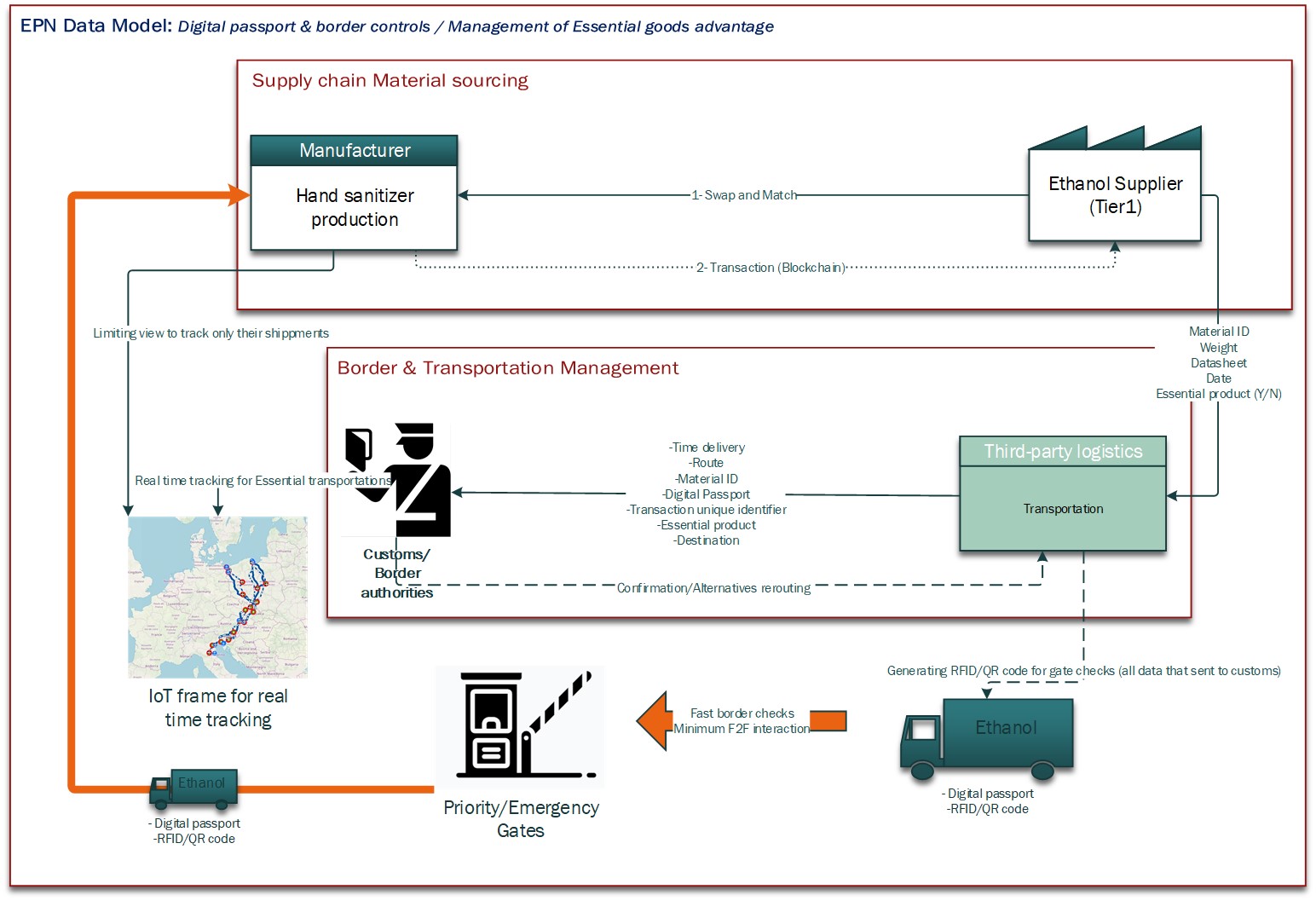
The proposed solution is to immediately create a working team to pilot, validate and rollout Smart Logistics / Supply Chain v4.0 tools, enabled by blockchain technologies. Several tools are in existence, but are not widely deployed except in specific sectors, and may not be applied in a standard way. A standard framework (set of norms) would be constructed around these, which all actors in supply chains would be required to comply with at least to ship in the EU. The framework would provide supply chain actors with tools and financial stimulus to operate with 100% transparency without causing financial or legal impacts on their customers or suppliers. The framework would require digitization of approvals and exclusion of paperwork (especially in areas such as customs clearance and shipment documentation) which would hugely increase productivity and facilitate commerce.
Initially the system could be piloted and verified on supply chains closely connected with the Covid-19 crisis (hand sanitizer raw materials for e.g Ethanol & face masks), and could be tested live in future secondary peaks of the crisis. It could then be reapplied in supply chains which have been shown to be fragile in the Covid-19 crisis (e.g. dry foods, toilet paper, kitchen paper, supply chains from the most affected geographies) as further verification.
Some data made available via the framework would be: o Live inventory tracking for materials in full E2E supply chains o Live transportation tracking for multiple shipping legs in E2E supply chains o Live production visibility for all steps in E2E supply chains (status, production rate, plans) o Digital product passport / border controls systems to allow frictionless clearance of goods when a change of origin is required in a crisis o Geospatial connection of supply data with crisis information to pre-empt supply chain issues o Capability to search for alternative passport-ready material supplies Initial focus would be on supply chains closely connected
What you have done during the weekend
Assess Need & Viability of Framework & Digital Platform
The team focused on identified supply chain issues which need to be resolved to increase resilience in a crisis. The team was broadly not expert in supply chain and logistics analysis. The first evening was therefore spent: o Researching impact of COvid19 on European supply chains and how the crisis might drive disruptive innovation o Reaching out to corporate COvid19 Supply Chain SWAT team members o Understanding concepts related to supply chain resilience o Understanding potential solutions driving supply chain transparency.
Many Banking Institutions (e.g. IMF, Standard Chartered), Consultancy (e.g. Deloitte, Accenture, McKinsey etc) & Government Institutions (e.g. FEMA) have recently written extensively on Supply Chain resilience in light of COVID-19 ( a pandemic) that has impacted supply chains across the globe, while some other events like earthquakes, epidemics etc. have had impacts on regional supply chains.
This research enabled us to sharpen our problem statement in-line with the hackathon criteria and propose the need for developing a framework that would benefit multiple parties in the supply chain while re-assuring governments in future crisis situations. We partially applied our internal company lean innovation methodologies to further refine the right problem statement, then completed a lean canvas to help us define the business opportunity and further detail the approach. We developed a graphic (non-functional) demo of our idea and spent time to refine our figures with some of the business mentors available to the hackathon teams, since our solution would require the EU to commit to develop a new platform.
The solution’s impact to the crisis
Supply Chain Resilience for Essential Products (e.g. Hand Sanitizers, Mask & Ventilator)
The Digital Supply Chain Platform for Essential Products Network would or could be part of the EU Framework Programme i.e. Horizon 2020, where-in pilot projects would cover those essential products needs to manage & flatten peaks associated with any future peaks associated with the COVID-19 pandemic within Europe. The benefits would include:
• Increased visibility on current COVID-19 critical supplies/ materials to drive out supply related losses and delays
• Identification & mitigation of constraints in the current supply chain: logistics, border controls, inaccessible supplies
• Create visibility on alternate supply options for critical materials while offering entrepreneurs opportunity to create alternate materials or supply chain proposals.
• Enabling clearer 'passpsorting' of suppliers and materials will enable more rapid reallocation of supply chains in the future
• Regulated and dangerous goods already meeting defined standards should have far lower logistical / permitting / regulatory lead time and cost to re-allocate in the future
The FrameWork & Supply Chain Digital platform could be expanded over to cover other essential products that may be impacted by other disasters. This increased Supply Chain Resilience over a 12-18month horizon would lead to
• Prevention and mitigation: as subsequent Covid19 flare-ups occur through global supply chains, immediate risk assessments will be possible in real time: rapid identification of alternate suppliers, re-directing of en-route materials (avoid hubs, ports of entry etc at risk to be in lock down)
• Rapid re-routing and correction of transport and logistics documentation
• Shorter and more agile supply chains leveraging digital platforms that (a) eliminate paper and all paper processes (b) enable electronic material passporting and (c) execute en-route re-routing of critical materials to avoid hot spots / lockdown areas
The necessities in order to continue the project
Adoption of EPN as a key Supply Chain Resilience Framework
Recognition at both the EU Commission and in multiple industries that our supply chains:
• complexity and global interdependencies have far outpaced the ability to comprehensively understand them
• When disrupted (or perceived at risk for disruption), create both real shortages (e.g facemasks) and potential self fulfilling supply chain disruptions (panic buying and bull-whip effects). These in turn can lead to broad disruption of economic activity A concerted, intentional effort at the EU level, to accelerate significantly and prioritize I4.0 work to focus on Supply Chain 4.0 concepts
• Fund and foster pilot projects with EU players ([industries, SMEs, startups] and institutions) to accelerate adoption
• Lay the framework and allocate resources to define the standards required for SC4.0
o The value of your solution(s) after the crisis
EPN expansion to evaluate and prepare for other potential Black Swan Events
o Supply chain transparency and visibility
o In crisis context; early visibility on supply chain disruption risk
o Fast identification of alternate supply options
o Visibility on ad-hoc basis, of inventories in country/ region for re-deployment to critical goods
o Optimization of supply chains at new levels
o bulk orders and greater economies of scale (single sourcing / financing of tier 2 / 3 suppliers)
o buying of common to multiple Tier 1 suppliers
o Major cost savings overall in supply chains through optimized sourcing strategies
o Supply chain auditing and regulatory / consumer transparency:
o Increased SC visibility and authentication of origin
o Reduced risk for child labour,
o more robust finished product passport (better control of recalls),
o enable stronger BIO / fair trade certification verification, carbon mapping and cradle to grave impact assessments
o Enable new supply chain financing: buyer credit cost can move to Tier 2/3 suppliers; 0.5-2.5% cost reduction
Beyond Supply Chain Resilience, a broader EPN based Supply Chain Digital Platform could create efficiency to the scale of 5-15% of the manufacturing industry which is 4 Trillion$ ie ~ 25% of EU GDP and a knock-on effect on the service industry and agriculture too.
Built With
- powerbi


Log in or sign up for Devpost to join the conversation.