-
-
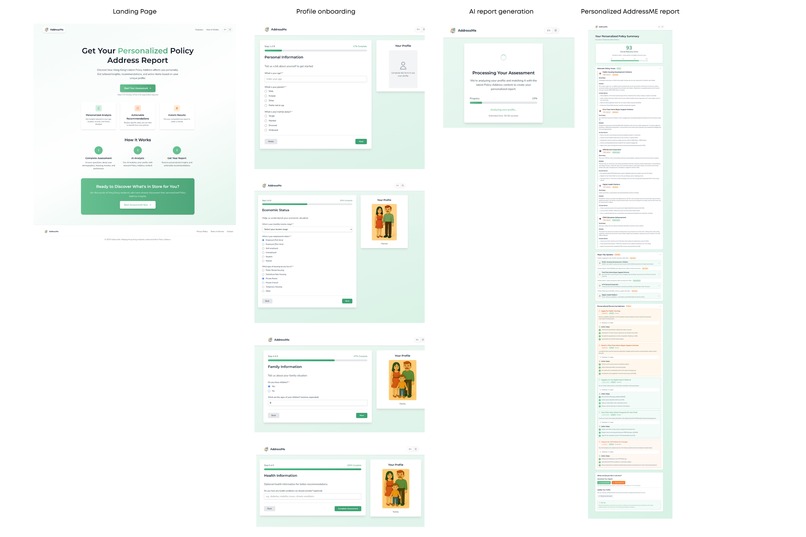
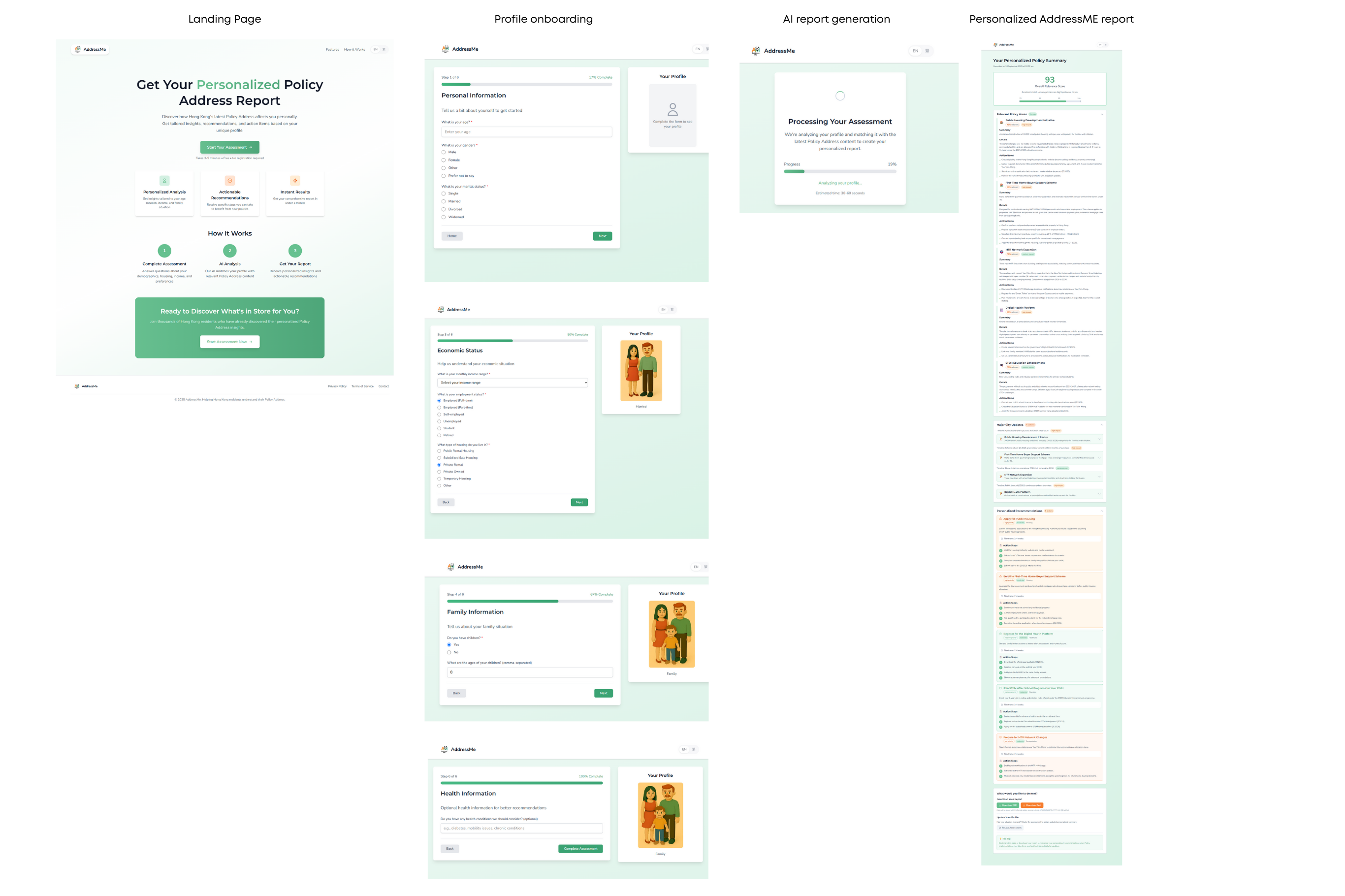
Landing Page, Onboarding Profile and AI Policy Address Report
Inspiration
Every year, our Hong Kong Chief Executive spends 2 hours plus to read deliver the policy address, which defines the development blueprint of Hong Kong. How many of us would spend the time to listen to the policy address in full? How many of us would get a hard copy and read the document? How many of us can co-relate the policy to ourselves? Most of us would watch highlights from social media but it never resonates on how the policy address would impact our lives personally.
What it does
AddressME defines the persona of a HK citizen by collecting few key information
- Personal Information
- Geographical Location of Living
- Family
- Education
- Transportation
- Medical Condition
AddressME then analyzes the profile and compile a personalized version of policy summarizing how the new Policy Address can co-relate to the us leveraging AWS Bedrock AI capability. For the items that is eligible by the user, AddressME shows a button to immediately redirect user to the relevant website for application.
How we built it
Ideation - Our team hosted multiple brainstorm sessions to bring ideas together and select the one we believed would have the most impact and benefit for Hong Kong society. We focused on identifying real problems that technology could solve effectively.
Requirement, Design, and Implementation Plan - We described our core idea in text format, then used Kiro step-by-step to generate comprehensive requirement documents, design specifications, and detailed implementation plans. This AI-assisted approach helped us structure our thoughts and create thorough documentation. This stage we have spent few iterations to fine tune the requirement to be most human-centric design.
Build (Human & AI collaboration) - We developed the application through close collaboration between human developers and AI assistance. As human, we know very well about the data source, and what pain points HK citizens are facing. We retrieved publicly available Policy Address PDF and instruct AI to perform a multi-pass data sanitization and summarization, then use Kiro build and complete the web UI and core logics. This hybrid approach allowed us to leverage AI's code generation capabilities while maintaining human oversight and decision-making.
Testing, troubleshooting, and fine-tuning - We conducted thorough testing phases, identified issues, and iteratively refined the application. This process involved both automated testing and manual quality assurance to ensure reliability.
Challenges we ran into
Limited end-to-end guidance - While Kiro provided excellent direction and suggested solutions, it could not always guide us completely to the final deliverables. We often needed to bridge gaps between AI suggestions and actual implementation requirements and troubleshoot back-and-forth with Kiro.
Enterprise readiness concerns - The AI-assisted development approach works best for quick prototyping with minimal initial setup. However, integrating with existing enterprise environments requires significantly more guidance and customization which more intelligent AI models can compensate this gap.
Waterfall-like development flow - Although Kiro excels at breaking down tasks, the overall solution could only be properly evaluated after most components were completed. This created a somewhat waterfall-like process that needs better tuning to support more iterative development cycles.
Information overload during development - AI generates comprehensive solutions, task breakdowns, and implementations, but this can sometimes be overwhelming. It becomes challenging for humans to maintain a clear overview of the entire system, particularly during troubleshooting when tracing through AI-generated code and logic.
Accomplishments that we're proud of
Only HK citizen can resonate with the local HK pain points. AddressME can tailor make a Policy Address that is easy to understand based on your age and education, 100% personalized. The AddressME idea is also 100% originally ideated by local Hong Kong citizens, and applicable to all HK citizens. By leveraging AI, we have leveraged the latest technology that reduces project delivery lead-time from months to days with Kiro and AWS AI capabilities.
What we learned
Working with Kiro and embracing a spec-driven development lifecycle has been a game-changer for our team. We have learned how to collaborate with AI not just as a tool, but as a development partner that helps us move faster and stay focused.
By feeding clear specs into Kiro, we’ve seen how it can accelerate the build process, reduce repetitive work, and even surface edge cases we might’ve missed. But we’ve also learned that AI doesn’t replace human judgment. Steering is still very much required, whether it’s refining the specs, reviewing outputs, or making decisions that align with the business goals and user needs.
The best results come when we treat AI as a co-pilot, not an autopilot. This experience, Learn by Doing, has helped us sharpen our thinking, improve how we write specs, and build a more efficient, thoughtful development process. It’s not just about speed, it’s also about building better, together.
What's next for AddressME
There is unlimited potential to extend the scope and coverage of AddressME like to include 2025-2026 Budget plan, Legislation Council Decision and all Government Laws & Policies.
Integration to IAMSmart can help more getting more accurate data to form the profile of each user to generate a more precise, personalized version of the Policy Address result.
Let's Vote AddressMe for a better Hong Kong.


Log in or sign up for Devpost to join the conversation.