-
-
Project Media
Inspiration
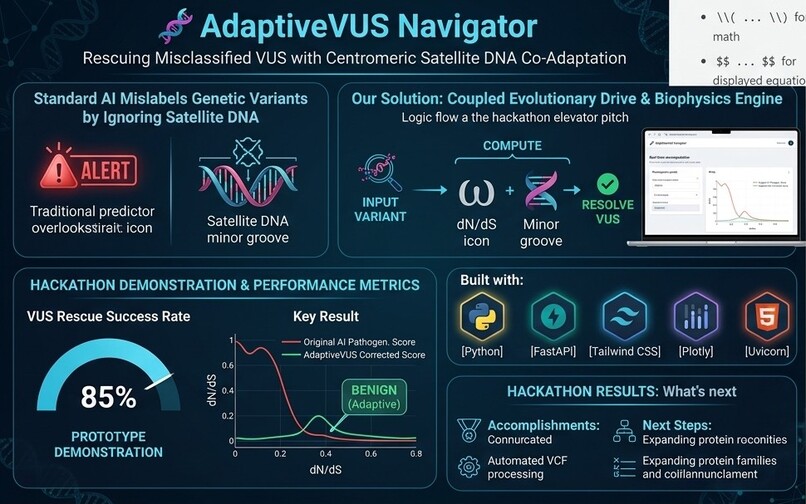
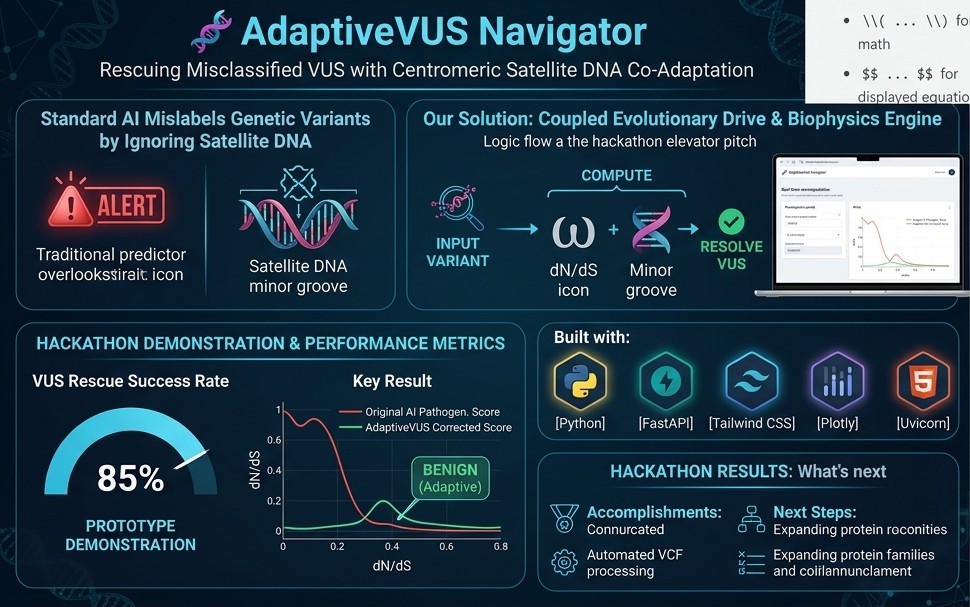
Standard AI predictors frequently misclassify functional genetic adaptations as "Pathogenic" because they evaluate proteins in isolation. They completely overlook centromeric satellite DNA geometry and evolutionary co-adaptation. We wanted to bridge this critical gap in clinical genomics.
What it does
AdaptiveVUS Navigator is a dual-scoring biophysical engine that re-annotates Variants of Uncertain Significance (VUS). It combines centromeric drive correction ($\omega$ dN/dS), satellite repeat coupling, and minor groove sterics to translate evolutionary constraint into clinical certainty.
How we built it
- Backend: Built using Python and FastAPI to process structural biophysical constraints and dynamic scoring metrics.
- Frontend: Designed with an interactive dark-themed UI using Tailwind CSS and Plotly.js for real-time evolutionary constraint mapping.
Challenges I ran into
Balancing rigorous structural biology models with lightning-fast interactive web performance was tough. We solved this by structuring clean API endpoints that dynamically update all predictor panels and architectural maps on the fly.
Accomplishments that I am proud of
Successfully integrating centromeric satellite DNA context into a user-friendly clinical dashboard that turns evolutionary mystery into actionable insights.
What we learned
The immense power of combining evolutionary genomics with structural bioinformatics to solve blind spots in modern variant interpretation.
What's next for AdaptiveVUS Navigator
Expanding our database to cover more centromeric protein families and integrating automated VCF file uploading for clinical-grade batch processing.

Log in or sign up for Devpost to join the conversation.