Inspiration
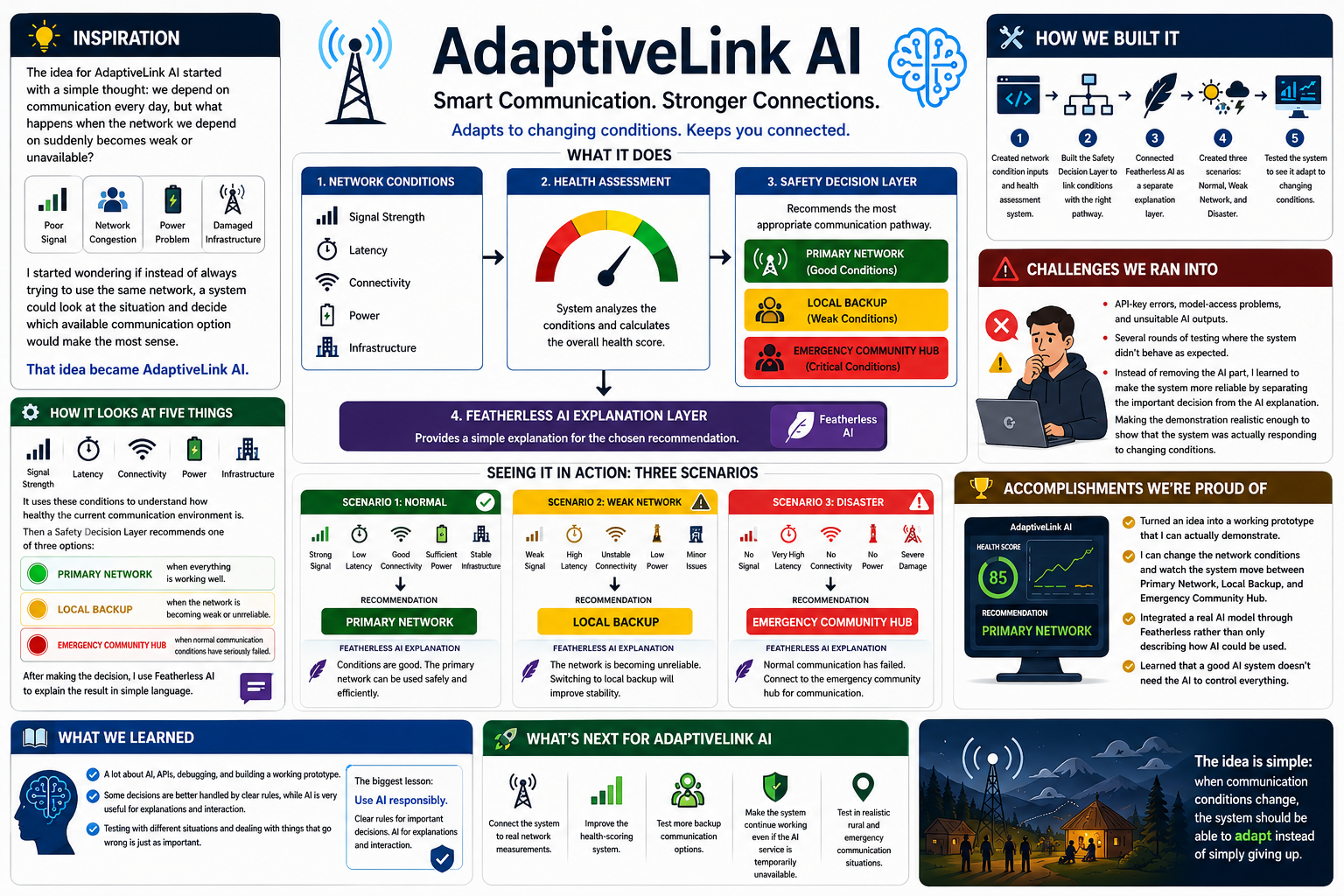
The idea for AdaptiveLink AI started with a simple thought: we depend on communication every day, but what happens when the network we depend on suddenly becomes weak or unavailable?
This could happen because of poor signal, network congestion, a power problem, or damaged infrastructure. I started wondering if instead of always trying to use the same network, a system could look at the situation and decide which available communication option would make the most sense.
That idea became AdaptiveLink AI.
What it does
AdaptiveLink AI looks at five things:
Signal strength Latency Connectivity Power Infrastructure
It uses these conditions to understand how healthy the current communication environment is.
Then a Safety Decision Layer recommends one of three options:
🟢 Primary Network when everything is working well.
🟡 Local Backup when the network is becoming weak or unreliable.
🔴 Emergency Community Hub when normal communication conditions have seriously failed.
After making the decision, I use Featherless AI to explain the result in simple language.
So instead of just saying “use the local backup,” the system can also explain why it made that recommendation.
How we built it
I started by creating the network-condition inputs and a health assessment system.
Then I built the Safety Decision Layer to connect different network conditions with the appropriate pathway. I wanted this part to be predictable, so I didn't make the language model responsible for the main safety decision.
After that, I connected Featherless AI as a separate explanation layer.
I also created three scenarios—Normal, Weak Network, and Disaster—so I could actually see the system change its recommendation when the conditions changed.
Challenges we ran into
Getting the AI part working was probably one of the hardest parts.
I faced API-key errors, model-access problems, and situations where the AI returned information that wasn't suitable to display directly to the user. There were also several rounds of testing where the system didn't behave exactly as I expected.
Instead of removing the AI part, I learned how to make the system more reliable by separating the important decision from the AI explanation.
Another challenge was making the demonstration realistic enough to show that the system was actually responding to changing conditions.
Accomplishments that we're proud of
I'm proud that this started as an idea and became a working prototype that I can actually demonstrate.
I can change the network conditions and watch the system move between Primary Network, Local Backup, and Emergency Community Hub.
I'm also proud of integrating a real AI model through Featherless rather than only describing how AI could be used.
Most importantly, I learned that a good AI system doesn't necessarily need to let the AI control everything.
What we learned
This project taught me a lot about AI, APIs, debugging, and building a working prototype.
But my biggest lesson was about how to use AI responsibly.
I realized that some decisions are better handled by clear rules, while AI can be very useful for things like explanations and interaction. That is why AdaptiveLink AI separates the Safety Decision Layer from the Featherless AI explanation layer.
I also learned that getting something to work is only the first step. Testing it with different situations and dealing with things that go wrong is just as important.
What's next for AdaptiveLink AI
Right now, the network conditions in my prototype are simulated. My next goal is to connect the system to real network measurements.
I also want to improve the health-scoring system, test more backup communication options, and make the system continue working even if the AI explanation service is temporarily unavailable.
Eventually, I would like to test AdaptiveLink AI in realistic rural and emergency communication situations.
The idea is simple: when communication conditions change, the system should be able to adapt instead of simply giving up.
Built With
- api
- artificial-intelligence
- communicationtechnology
- decision-support-system
- featherless-ai
- generative-ai
- machine-learning
- network-resilience
- python
- qwen


Log in or sign up for Devpost to join the conversation.