-
-
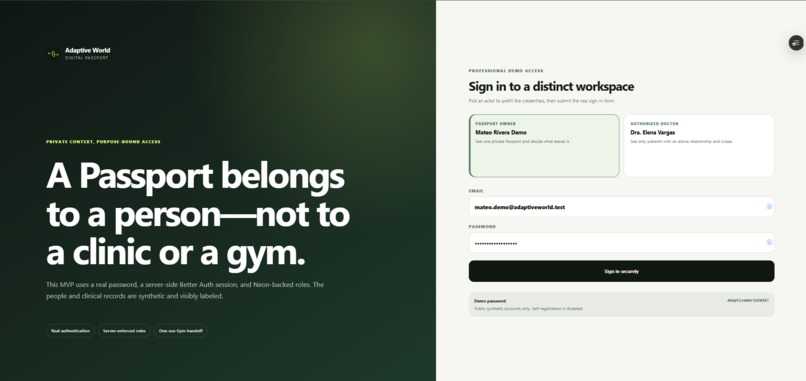
Passport WebMCP
-
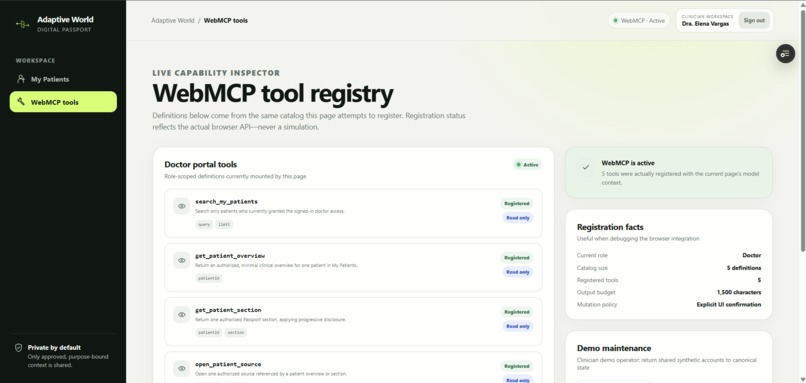
Approved Scope
-
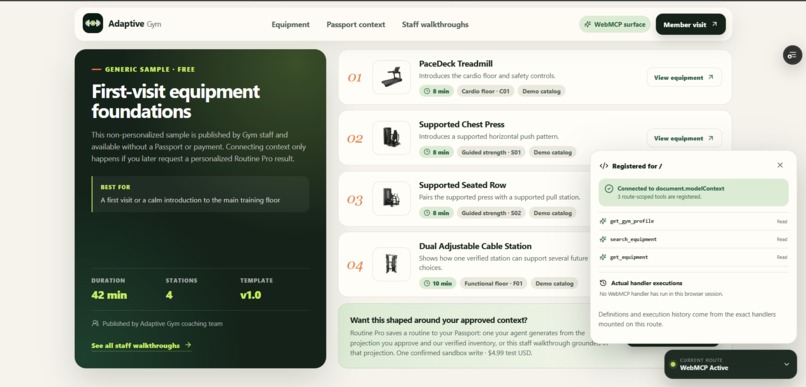
Adaptive Gym
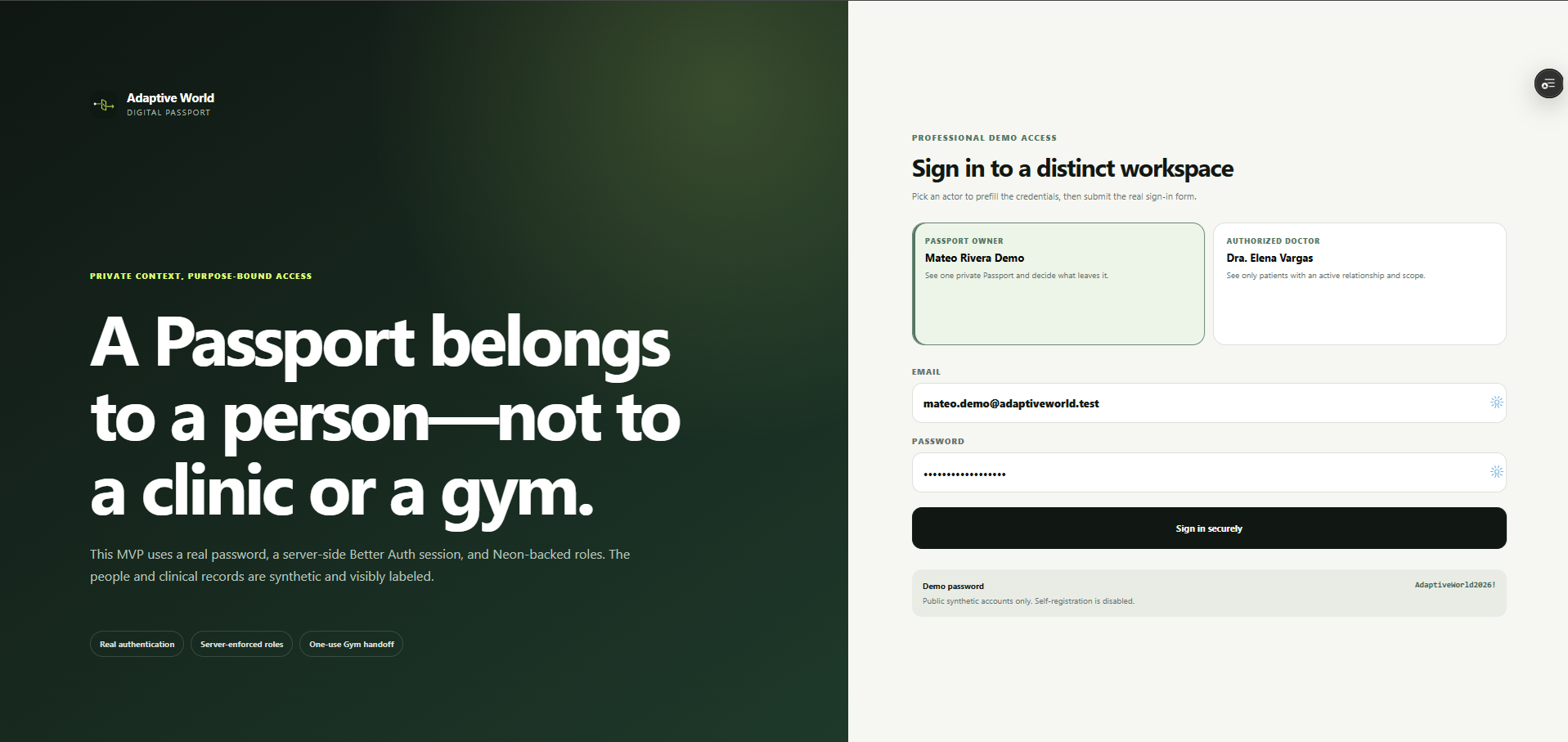
Inspiration
About ten years ago, I experienced a psychotic episode that led me to live on the streets and later to be hospitalized in a psychiatric hospital in Mexico City. My perception of reality had become erratic, and at the time I was told that medication might be something I would need for the rest of my life.
What followed was a very long process of rebuilding myself.
Meditation and activities that forced me to focus my attention became extremely important. Programming became one of them. I say this without exaggeration: software development became one of the things that helped me rebuild my life and my mental health.
For years afterward, however, I lived with an almost permanent state of anxiety. It gradually improved, but my nervous system still felt deeply unbalanced.
Around three years ago, that became physical. I developed a neurological problem diagnosed as Cauda Equina Syndrome. For several months I used a wheelchair and then crutches. I lost sensation in my feet and parts of my legs, and at one point I could not walk normally.
I eventually started a highly personalized Pilates rehabilitation program.
The difference was remarkable. I recovered my mobility, and today I am in what I consider the best physical and mental health of my life; I am not even medicated since many years ago😍.
That experience completely changed the way I think about exercise.
The strange part is that gyms still confuse me.
There is an enormous amount of information online about exercises, machines, routines, recovery, strength, mobility, nutrition, and health. But more information does not necessarily make the decision easier.
If I walk into a gym today, how do I know that a routine someone recommends is actually appropriate for me?
Not for someone approximately my age.
Not for an average person with a similar goal.
For me — considering my history, current mobility, weight, previous injuries, preferences, progress, limitations, and whatever other relevant signals I choose to share.
This was the starting point for Adaptive World.
Interestingly, I had never seriously thought about building this product before the OpenAI WebMCP Challenge.
The challenge made me think about WebMCP in a much broader way:
What if WebMCP eventually becomes a normal layer of web development, in the same way that SEO and accessibility (a11y) became normal considerations for websites and web apps?
Today a website explains itself primarily to humans and search engines.
A WebMCP-enabled website can begin to explain its capabilities to agents.
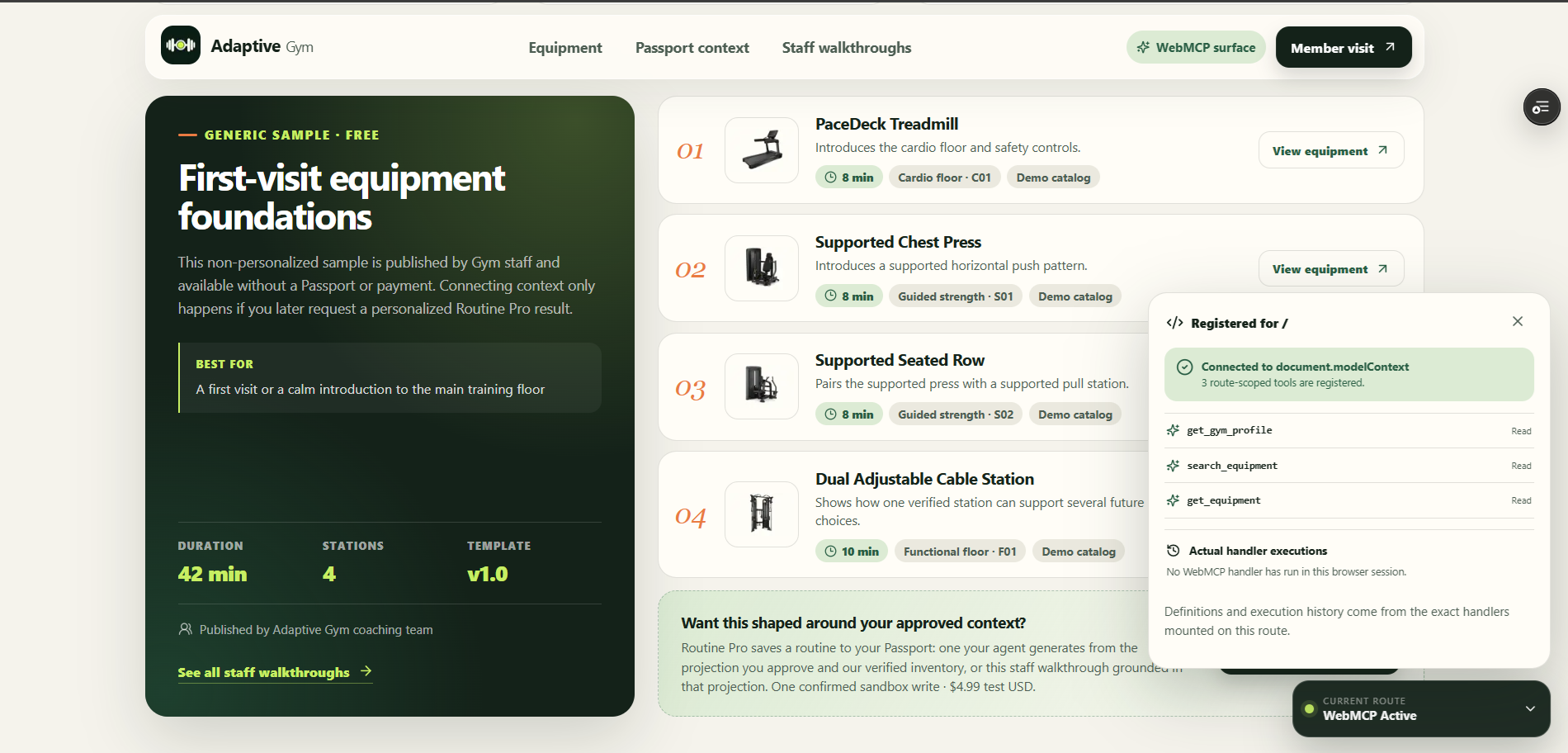
A gym could expose not only that it exists, but what equipment is actually available, what each machine can do, its specifications, what classes are offered, accessibility information, schedules, services, and other structured capabilities.
Then I asked the second question:
What if the agent could understand the person just as well as it understands the place?
That is the idea behind Adaptive World.
What it does
Adaptive World connects two types of context that normally live completely separately:
1. What a person needs
A private, user-controlled Digital Passport can contain relevant context such as goals, preferences, physical characteristics, mobility constraints, previous injuries, rehabilitation progress, wearable data, accessibility requirements, or other information the person chooses to make available.
It is intentionally not a profile that blindly exposes someone's entire medical history to every website.
The user owns the context and decides what can be used for a particular interaction.
2. What the physical world can offer
Businesses and physical environments expose their real capabilities through WebMCP.
For the hackathon MVP, that environment is a gym (and an OpenAI Showcase's website: https://sundaytable.openai.chatgpt.site/that I used it too in the demo).
The gym website exposes structured information about its actual:
- Equipment and machines
- Equipment specifications and capabilities
- Classes and services
- Rehabilitation or mobility options
- Facilities and accessibility features
- Other information an agent needs to understand what can actually be done there
The agent can then reason across both sides:
Personal context + real-world capabilities + feedback = an adaptive experience
Instead of asking an AI:
"Give me a gym routine."
I want to be able to ask:
"Given my goals, my history, my current condition, and what this specific gym actually has available, what makes sense for me today?"
That distinction is fundamental.
Without WebMCP, an AI can recommend exercises.
With WebMCP, it can reason about what is actually possible in the environment where the person will perform them.
For the rehabilitation scenario, the system can identify appropriate equipment and activities while respecting declared constraints, explain why they were selected, and clearly surface situations where professional guidance or medical clearance is appropriate.
And the interaction does not have to end when the plan is generated.
After a session, a person could record progress, discomfort, perceived exertion, mobility, completed exercises, or — eventually — automatically incorporate signals from a smartwatch or other wearable.
The next interaction can therefore start from a better understanding of the person than the previous one.
This creates a loop:
Understand → Match → Act → Measure → Adapt
How I built it
For the hackathon I intentionally reduced a very broad idea to one concrete, testable environment: a gym (+ Sunday Table website interaction https://sundaytable.openai.chatgpt.site/).
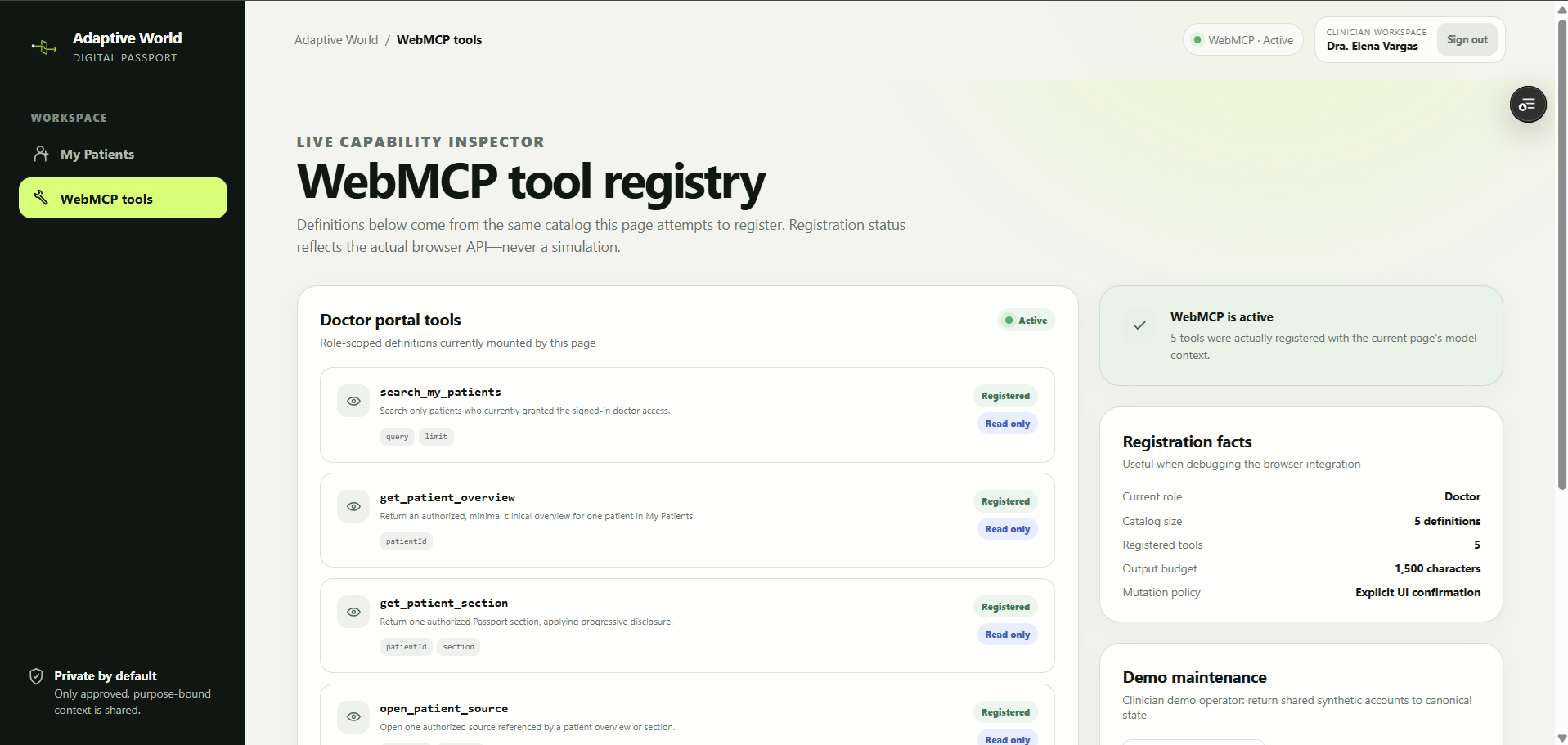
The MVP models a gym website containing realistic equipment, services, classes, and machine specifications and makes those capabilities available to an agent through WebMCP.
Instead of asking the model to assume what a gym probably contains, the agent can discover the environment itself.
The architecture is conceptually divided into three layers:
1. The WebMCP environment layer
The gym exposes structured capabilities that an agent can inspect and use.
This transforms the website from a collection of pages designed only to be browsed into an environment that an agent can actually understand.
2. The Digital Passport
The user provides the personal context relevant to the task.
The important design principle is progressive disclosure: the system should use the minimum context necessary for the interaction rather than treating personal data as something every service should automatically receive.
3. The agent
The agent becomes the bridge between the two.
It can understand:
- Who I am
- What I am trying to achieve
- What constraints matter
- What this specific environment offers
- What happened during previous interactions
It can then generate an experience grounded in both sides instead of producing a generic response from model knowledge alone.
For the demo, the gym and rehabilitation use cases make this interaction immediately visible: change the person, change the available equipment, or change the goal, and the resulting plan should change as well.
That is exactly the behavior I wanted to explore with WebMCP.
Challenges I ran into
The first challenge was actually scope.
Once I started thinking about the combination of WebMCP and a personal context layer, gyms quickly became only one possible implementation.
The same architecture could apply to restaurants, rehabilitation centers, sports facilities, hotels, workplaces, accessibility services, travel, education, or many other parts of everyday life.
But a hackathon project cannot demonstrate the entire physical world.
I therefore made a deliberate decision:
Build the gym. Demonstrate the architecture. Let the implication be larger than the demo.
Another challenge was defining the boundary between personalization and safety.
Especially when health information is involved, "more data" should not automatically mean "give an AI unrestricted access to everything."
The more interesting problem became figuring out how an agent can obtain enough context to be useful while keeping the person in control of what is shared.
A third challenge was grounding.
A generic model can easily invent or assume that a facility has a certain machine or service. For this idea to work, recommendations have to depend on capabilities actually exposed by the environment.
That made WebMCP not an accessory to the project, but a fundamental part of the interaction.
Finally, physical environments are messy. Different manufacturers, businesses, and industries describe similar capabilities in completely different ways. Creating agent-readable representations that remain useful across those differences is one of the larger problems this concept reveals.
Accomplishments that I am proud of
The accomplishment I am most proud of is turning something deeply personal into a concrete technical question about the future of the web.
Adaptive World is not meant to demonstrate that an AI can generate a workout. AI can already do that.
What I wanted to demonstrate is a different interaction model:
An agent that understands both the human and the environment in which the human wants to act.
I am also proud that WebMCP is essential to the idea.
If WebMCP is removed, the agent loses its live understanding of what the environment can actually provide.
And if the Digital Passport is removed, the agent loses the context necessary to understand what is appropriate for the individual.
The interesting experience exists between those two sides.
Finally, I am proud that the gym MVP is understandable in a few seconds while the underlying concept can extend much further.
What I learned
The biggest thing I learned is that I may have initially underestimated what WebMCP represents.
At first it is easy to think of it as another mechanism for exposing tools to an AI.
While building Adaptive World, I started seeing it instead as a possible interface between agents and the capabilities of the real world.
Web pages tell us about places.
WebMCP can help agents understand what those places allow us to do.
I also learned that personalization is not primarily a problem of generating better text.
It is a problem of context.
The quality of an adaptive experience depends on understanding both sides accurately:
the person and the environment.
And perhaps most importantly, I learned that a useful personal AI should not necessarily know everything about us all the time😅.
It should be able to access the right context, for the right purpose, with our permission—so we don't have to retype, copy, paste, or repeat the same information every time, often losing valuable context simply because we want things to happen fast.
What's next for Adaptive World
The gym is only the first environment.
The larger vision is a web where physical businesses and services increasingly expose their real-world capabilities to agents through interfaces such as WebMCP, while people carry a private and portable context layer that helps those agents understand what they actually need.
A restaurant, for example, could expose ingredients, portions, preparation methods, allergens, availability, and menu options. An agent could combine that with the parts of a person's Passport they decide to use.
A rehabilitation center could expose therapies, equipment, specialists, accessibility, and services.
A hotel could expose accessibility features, fitness facilities, room characteristics, food options, and available services.
A sports center could expose facilities, classes, equipment, and activities.
The pattern remains the same:
The place describes what it can offer. The person controls the context describing what they need. The agent connects them.
For Adaptive World specifically, the next steps I would explore are:
- Integrating wearables and real-time signals so experiences can adapt from actual progress rather than only static profiles.
- Building richer permission and consent controls for the Digital Passport.
- Exploring portable schemas so the same personal context can work across different WebMCP-enabled environments.
- Allowing professionals such as physiotherapists, trainers, or clinicians to contribute trusted constraints when the user explicitly authorizes it.
- Expanding from gyms into rehabilitation, sports, accessibility, hospitality, food, and other real-world services.
- Exploring privacy-preserving architectures in which personal context remains under the user's control rather than becoming another centralized dataset.
I do not want Adaptive World to become a system that optimizes every breath, every step, or every decision a person makes😅.
That is not the future I am interested in.
I want technology to disappear into the moments where it is genuinely useful.
For me, one of those moments is extremely concrete:
I want to walk into a gym/environment without feeling lost and know that what I am about to do makes sense for my body, my history, my goals, and the actual environment around me.
Ten years ago, technology became part of how I rebuilt my life.
With Adaptive World, I wanted to explore whether the next generation of the web can make technology better at understanding the lives we are actually trying to live.
Built With
- better-auth
- neondb
- next.js
- vercel
- webmcp


Log in or sign up for Devpost to join the conversation.