-
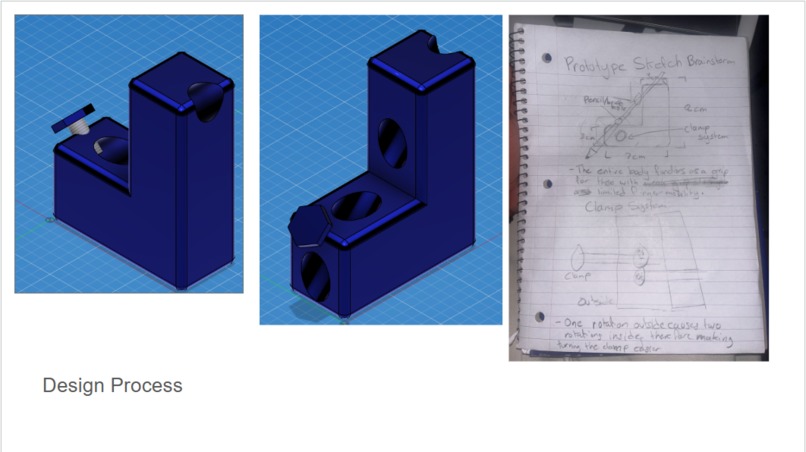
Design Process
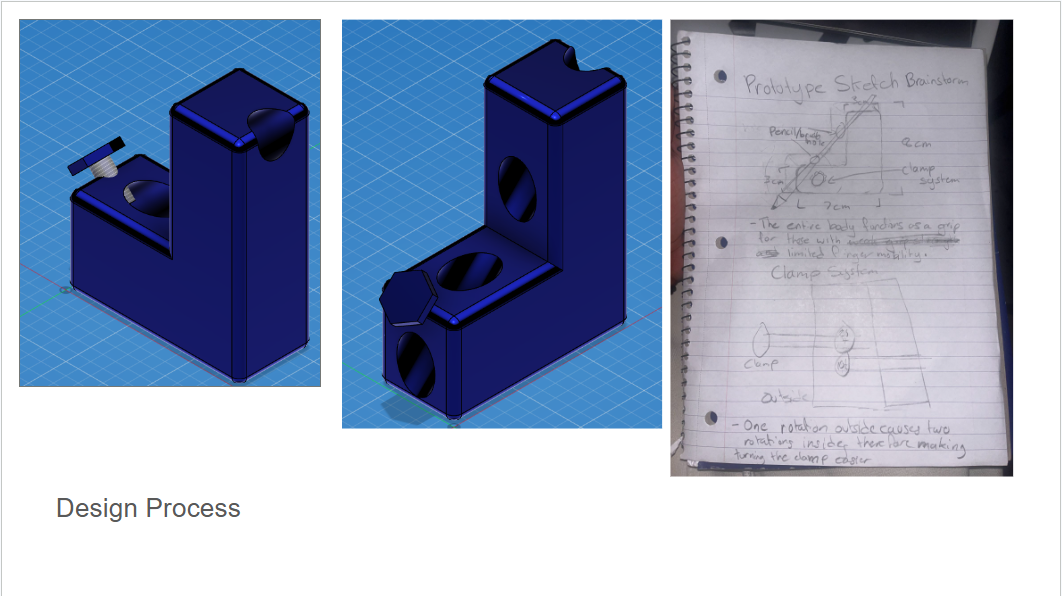
Inspiration: We chose this project because painting is one of the most universally enjoyed hobbies, yet it remains inaccessible to many. People with limited fine motor skills often face immense frustration when trying to paint. Because this disability restricts the small muscles in the hands and wrists, holding a standard, narrow paintbrush is uncomfortable, and making precise, controlled brushstrokes is nearly impossible.The Problem: Traditional paintbrushes require a tight, highly controlled grip. For someone who struggles with micro-movements, gripping a tiny handle leads to rapid hand fatigue and a lack of control over the canvas, stripping away the joy of the creative process. Our Solution: To solve this, we designed an ergonomic paintbrush holder that bridges the gap between disability and creativity. By significantly increasing the handle’s surface area and creating a wider, more accessible grip, our device reduces the need for intense finger strain. This allows the user to leverage larger muscle groups in their hand and arm, giving them the control and comfort they need to enjoy painting freely. Design & Engineering Process: Our design process focused on translating ergonomic needs into a functional, mechanical solution using Autodesk Fusion. The primary objective was to create an adaptive utensil holder that accommodates individuals with limited fine motor skills by shifting control from strained finger muscles to larger muscle groups.Mechanism & Utensil Retention: We engineered a lockable clamping mechanism inspired by a geometry compass. To ensure universal utility, the internal chamber was designed to securely host various art tools, including paintbrushes, pencils, and markers. The clamp physically locks the utensil into a fixed position, preventing slipping during use.Mechanical Advantage & Ergonomics: To make the locking system accessible to users with limited hand strength, we intentionally enlarged the diameter of the clamp’s control knob. Applying basic mechanical principles, increasing the knob's radius provides greater torque. This gives the user a higher mechanical advantage, allowing them to tightly secure the utensil with minimal physical effort.3D Modeling & Iteration: The development transitioned from initial conceptual paper sketches into a digital environment. Using Autodesk Fusion, we built the 3D model through a collaborative, iterative process. We focused heavily on the outer geometry, ensuring the overall grip was significantly larger than a standard pen to maximize surface area and comfort. Key Challenges & Adaptations: Managing Project Scope Under Time Constraints: Our initial concept was a complex camera grip for one-handed photography, featuring integrated buttons and triggers similar to a gaming controller. However, as we began mapping out the technical requirements, we realized the mechanical and electronic complexity was too vast for our limited timeframe. We had to make a swift, strategic pivot to a simpler yet equally impactful device: an adaptive art utensil holder. This taught us the importance of balancing ambitious design with realistic project timelines.Optimizing the Locking Mechanism for Accessibility: Designing a clamp that securely held various utensil sizes presented a mechanical challenge. The locking system needed to keep a paintbrush perfectly still without requiring intense hand strength to tighten it. We overcame this by applying the principle of mechanical advantage. By expanding the diameter of the clamp’s adjustment knob, we increased the available torque, allowing users with limited fine motor skills to lock the device securely with minimal effort.Collaborative 3D Modeling Workflow: Translating our rough paper concepts into a precise digital model within Autodesk Fusion required tight coordination. Because the CAD work was highly centralized, we had to establish a seamless feedback loop. We took turns reviewing the digital model, ensuring that the physical dimensions matched our ergonomic goals before finalizing the design.Accomplishments We're Proud Of: Executing a Successful and Rapid Pivot: When we realized our initial design concept was too complex for our timeline, we didn't let it stall our progress. We are incredibly proud of our team's agility in analyzing the problem, revisiting our brainstorming notes, and pivoting to the adaptive paintbrush holder. Turning a setback into a highly functional, finalized product within a strict timeframe demonstrated our strong problem-solving and decision-making skills under pressure.Integrating Human-Centered Ergonomics with Mechanical Principles: We succeeded in designing a product that directly solves a real-world accessibility issue. A major highlight was engineering the enlarged clamp knob. By connecting a basic physics concept—increasing a radius to maximize torque—with the ergonomic needs of users who have limited hand strength, we created a truly accessible locking mechanism that is both efficient and easy to operate.Seamless Team Collaboration and Multi-Disciplinary Work: From the initial paper blueprints to the final Autodesk Fusion model and comprehensive research documentation, our team worked in perfect alignment. We effectively balanced the workload by playing to each member's strengths—whether it was 3D modeling, technical sketching, or report writing. Bringing a physical product concept to life as a cohesive unit was our greatest success.What We Learned: The Value of Agile Project Management and Scope Control: Our experience taught us that engineering is as much about resource management as it is about design. Through our pivot from the complex camera grip to the adaptive paintbrush holder, we learned how to critically evaluate a project's scope against strict time constraints. We discovered that a simpler, flawlessly executed design is far more valuable than a highly complex idea left unfinished.Applying Mechanical Principles to Assistive Technology: This project deepened our understanding of human-centered design and mechanical advantage. We learned how small engineering adjustments can make a massive difference in accessibility. Specifically, calculation of torque and the relationship between a knob's diameter and physical effort allowed us to see how basic physics principles can directly improve user independence and comfort.Efficient CAD Collaboration and Workflow Management: Translating hand-drawn concept sketches into a highly precise digital prototype in Autodesk Fusion taught us a great deal about a structured design workflow. We learned how to pass tasks smoothly between team members, ensuring that the 3D model accurately reflected our structural and mechanical goals while balancing the workload of documentation and research in parallel. What's Next for Our Project: Real-World User Testing and Iterative Design: Our immediate next step is to transition from a digital prototype to physical user testing. We plan to 3D print our Autodesk Fusion model using varying materials—such as rigid PLA for the structural core and flexible, rubberized filaments (like TPU) for the grip surface. Testing the holder with individuals who have limited fine motor skills will provide critical feedback on the texture, comfort, and actual efficiency of our enlarged clamp knob.Expanding Utensil Compatibility and Quick-Release Mechanisms: While our current compass-style clamp securely locks standard art tools, we want to expand its versatility. In future iterations, we aim to design interchangeable internal collars or a universal quick-release mechanism. This would allow the device to effortlessly accommodate asymmetrical or oddly shaped utensils, such as ergonomic forks, thick paintbrushes, and digital styluses, without needing to manually thread the clamp every time.Integrating Passive Motor Support (Weighting and Stability): To further support users with hand tremors or severe muscle weakness, we plan to experiment with modular weighting systems. Adding customizable, heavy inserts into the base of the holder could help dampen involuntary hand movements, stabilizing the brushstrokes on the canvas. We also want to explore adding a soft, adjustable wrist strap to reduce the grip strength required to keep the device upright.

Log in or sign up for Devpost to join the conversation.