Inspiration
Most trading systems are judged by a single backtest result: profit, return, or Sharpe ratio. We wanted to build something more honest.
The project was inspired by a harder question:
Is a strategy’s edge real, stable, repeatable, robust, and valid out of sample?
Instead of treating a profitable backtest as proof, we designed an observable research pipeline that checks data quality, walk-forward performance, regime behavior, parameter stability, failure patterns, and readiness evidence before making any claim about a strategy.
We also wanted the system to make its uncertainty visible. A blocked data range, an unstable strategy, or insufficient evidence should be shown clearly rather than hidden behind a successful-looking dashboard.
What it does
Adaptive Research Pipeline Observatory is a research-only, multi-asset platform for evaluating systematic trading strategies.
It provides:
- Configurable research runs for different assets, symbols, timeframes, and date ranges
- A Data Integrity Gate that validates market data before research begins
- Walk-Forward Optimization using independent out-of-sample windows
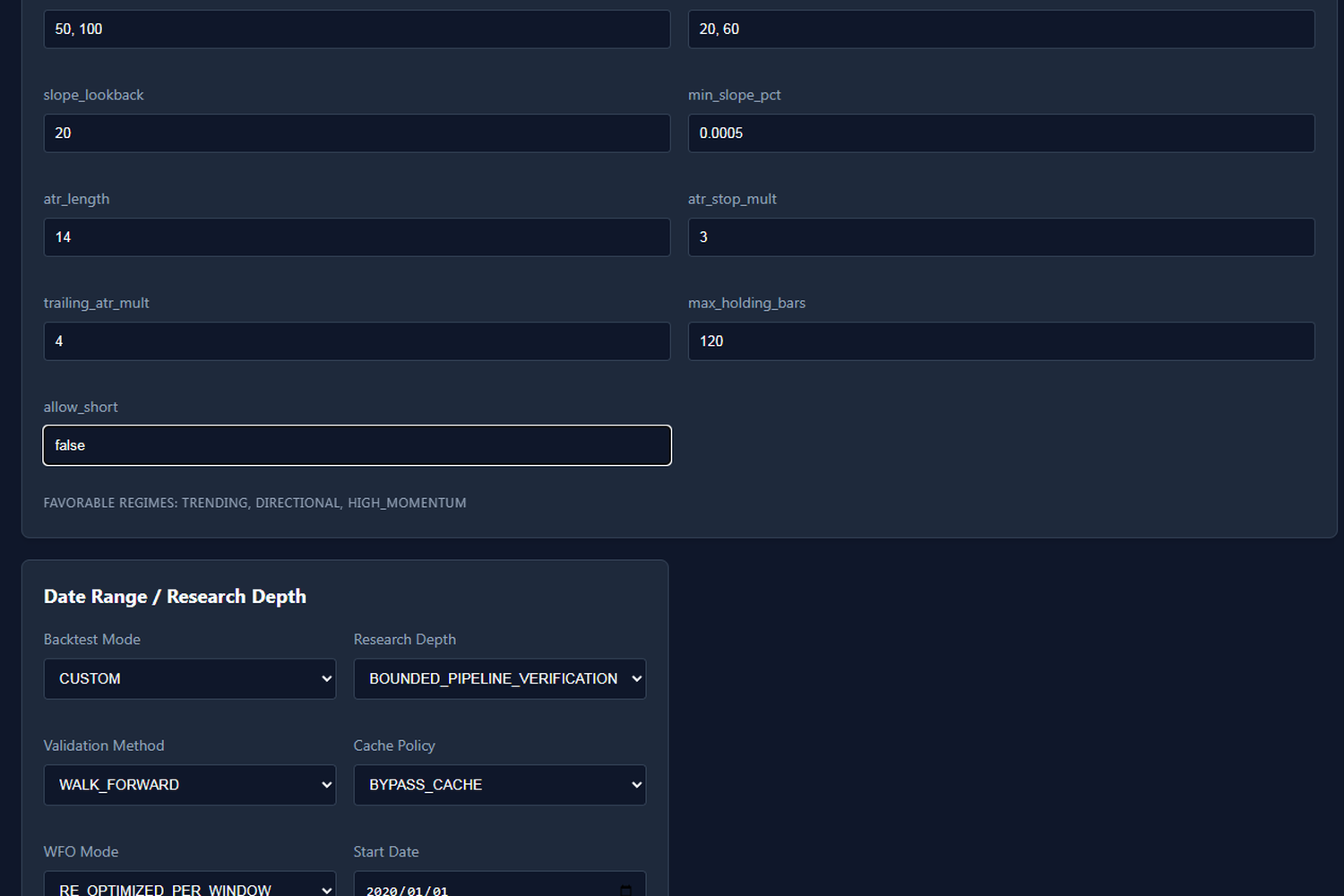
- Registry-driven strategy definitions and parameter spaces
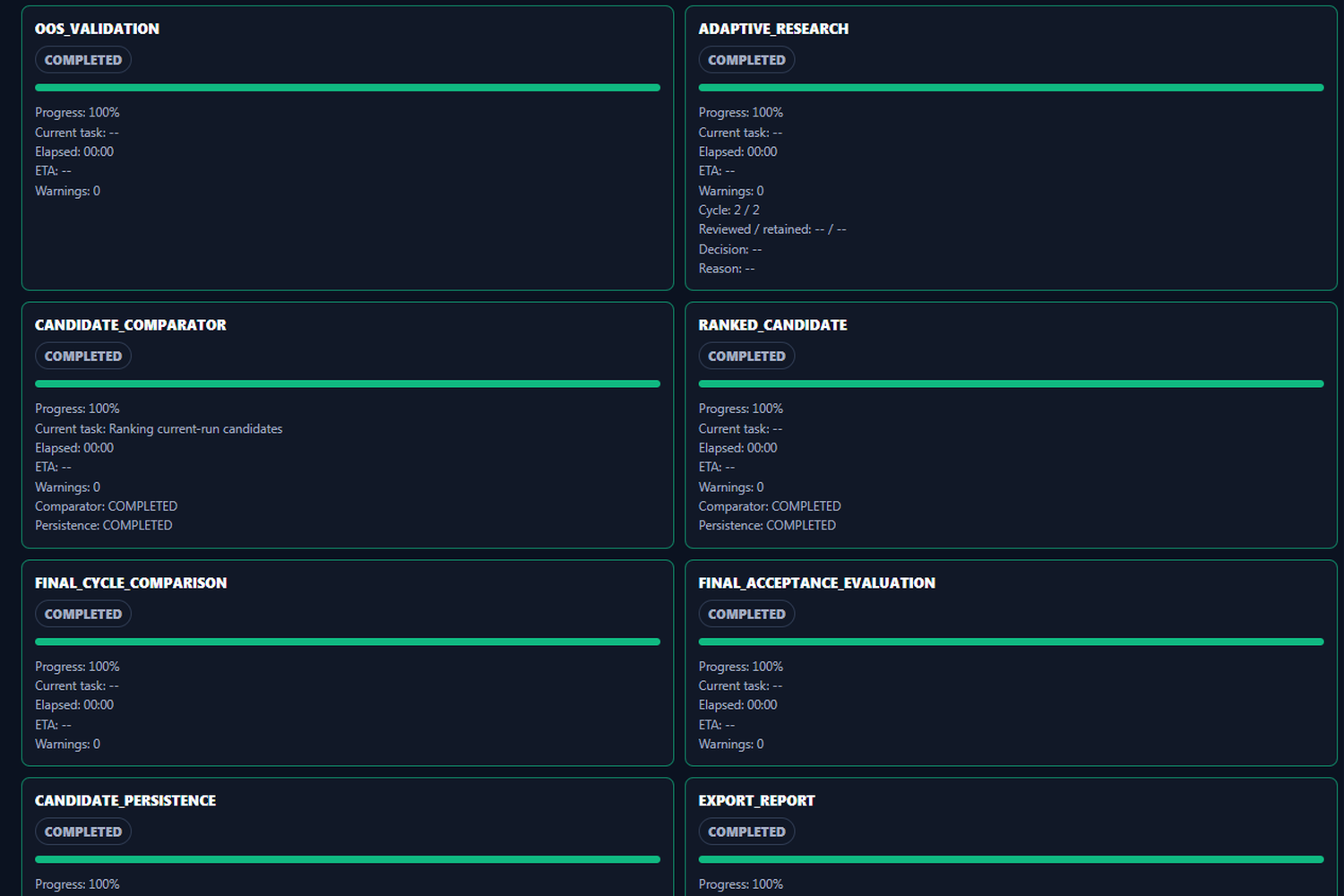
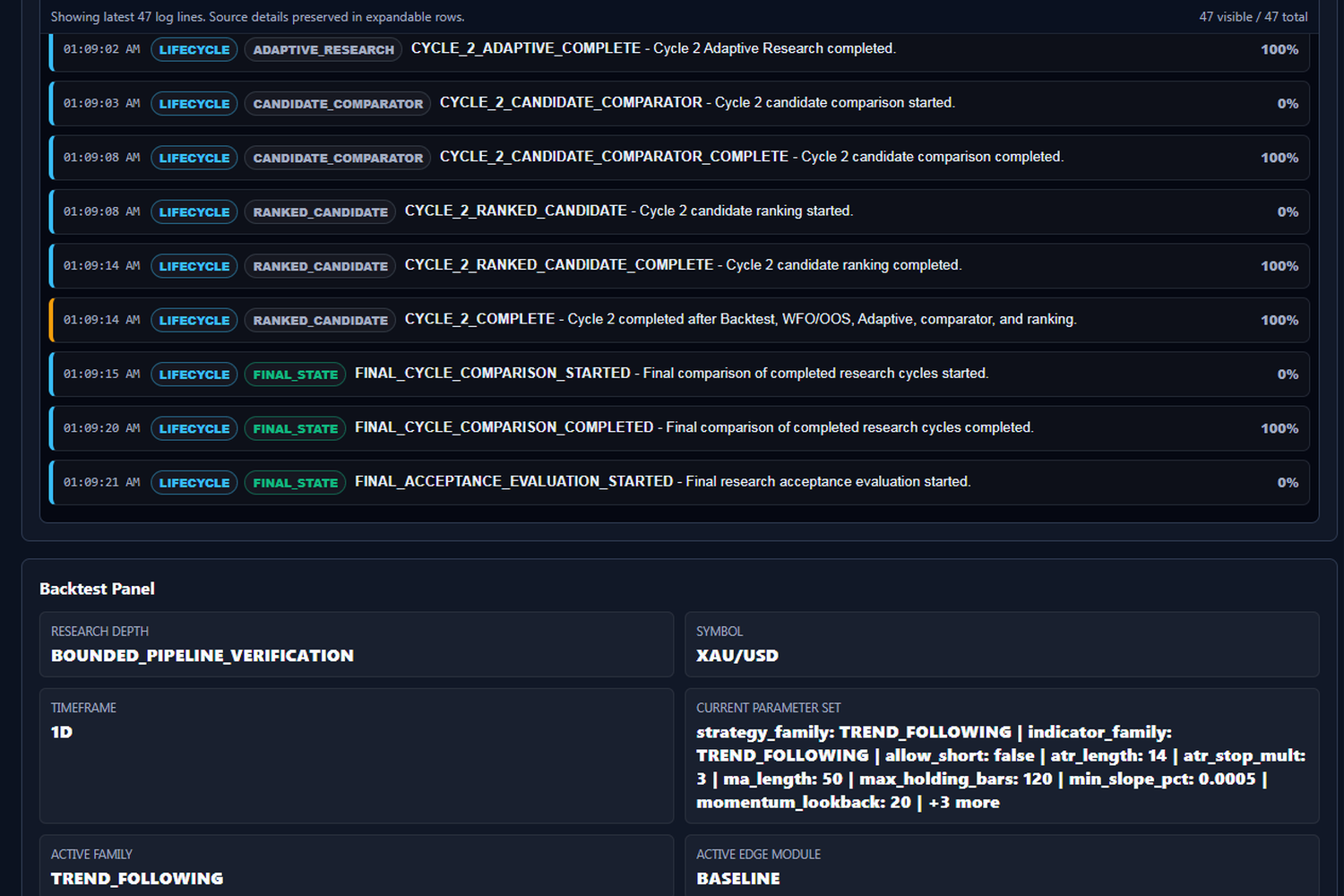
- Adaptive research cycles that test controlled strategy variations
- Edge Habitat Discovery to identify the market conditions where a strategy works or fails
- Environmental and market-regime analysis
- Robustness, stability, drawdown, trade-count, and overfitting diagnostics
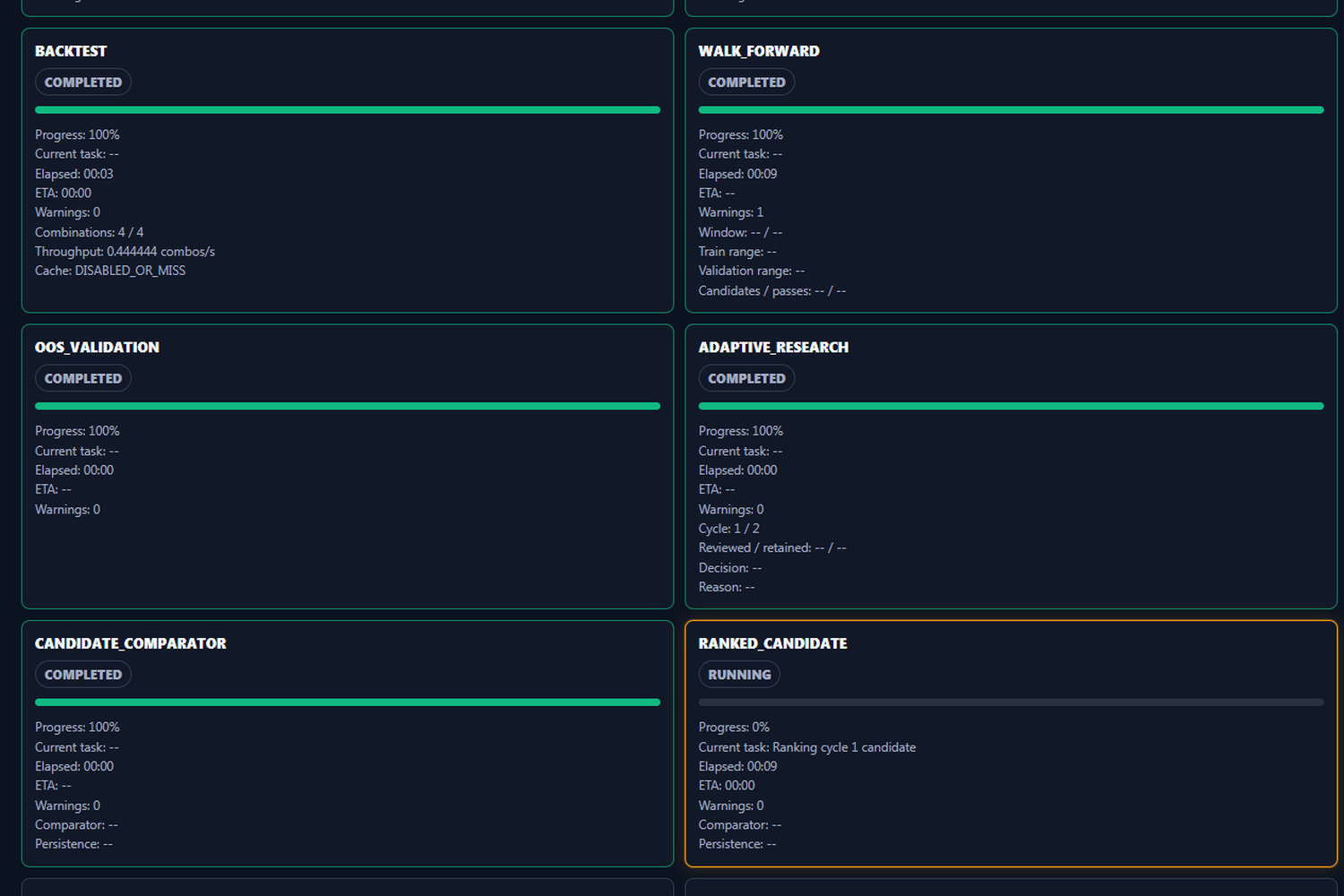
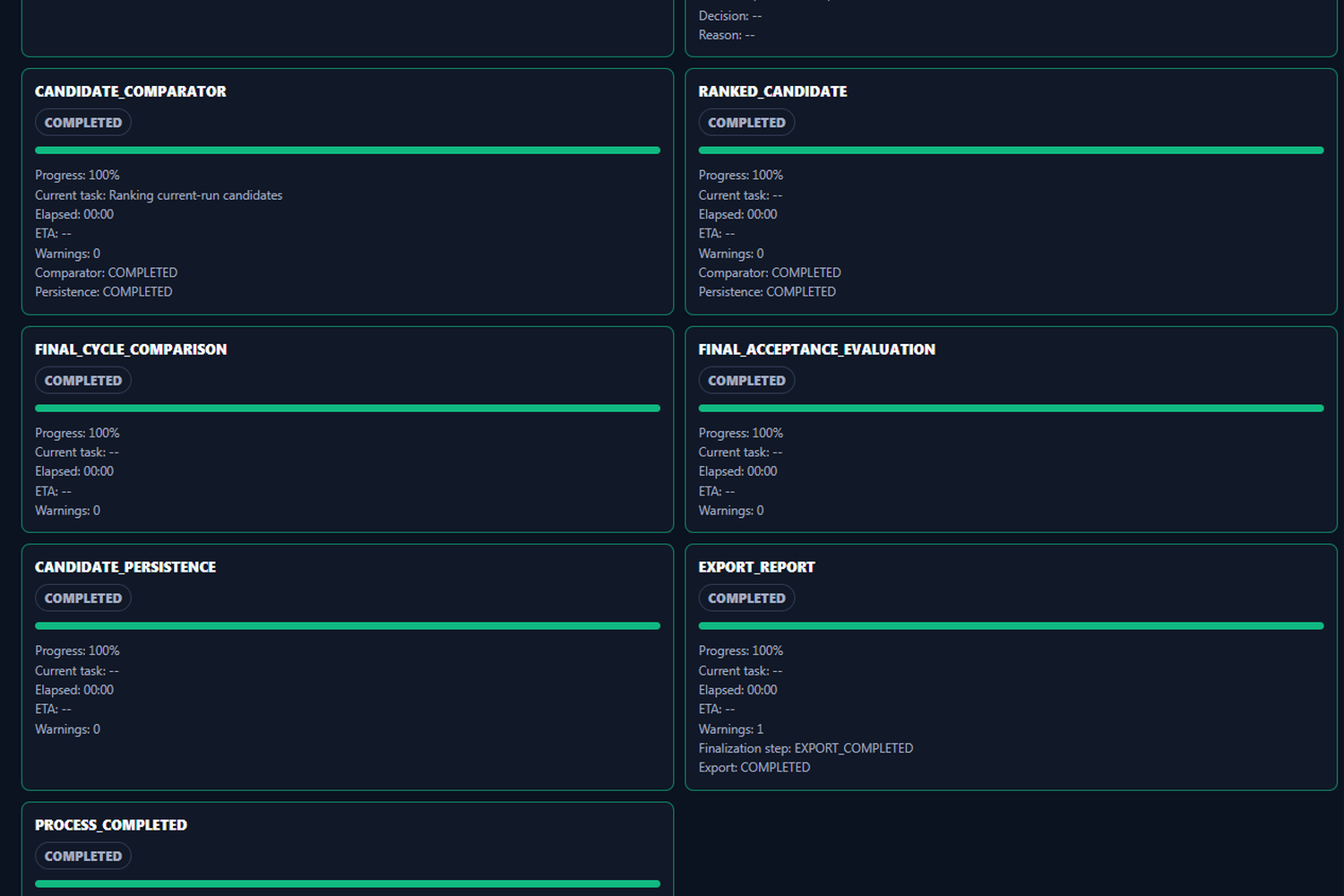
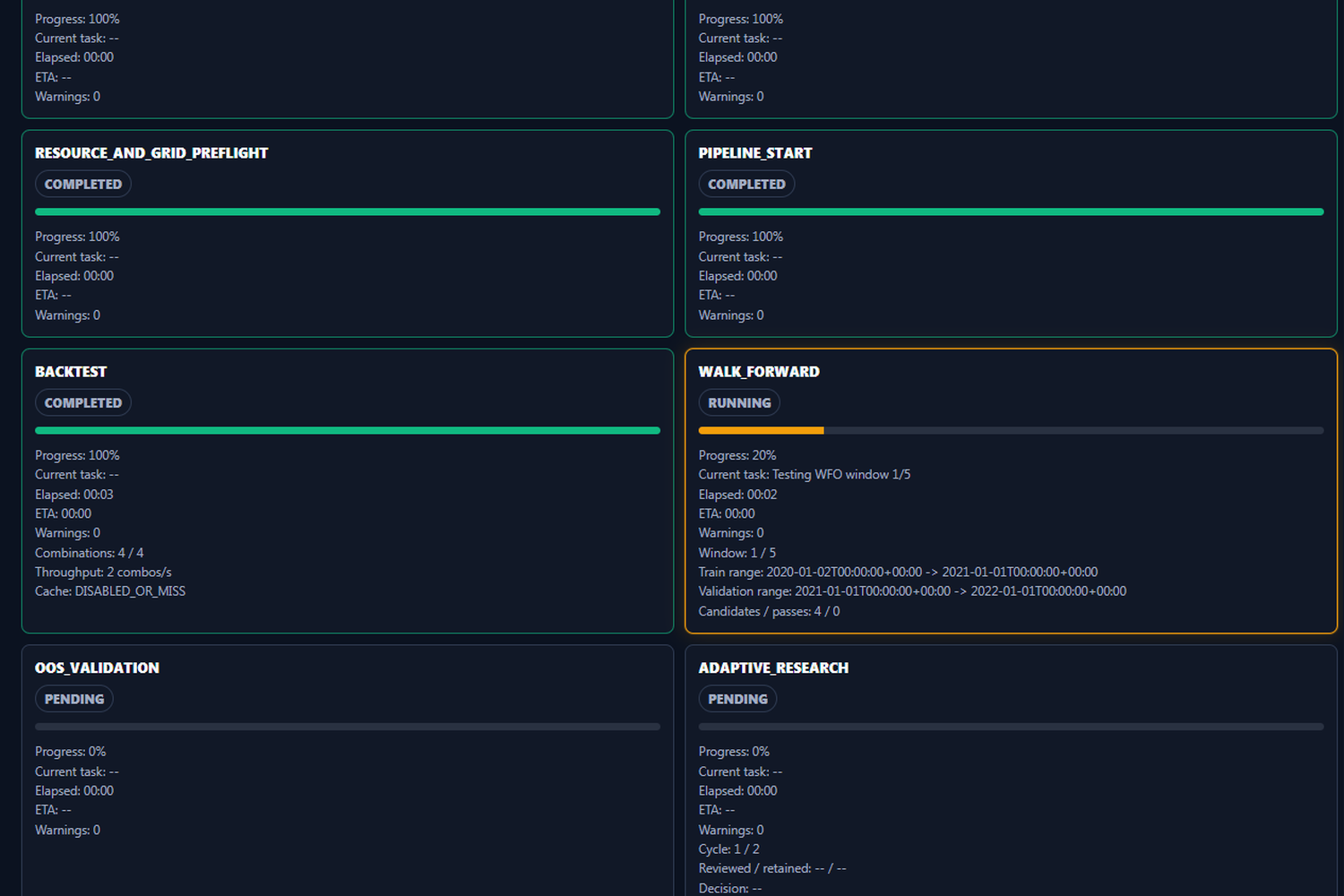
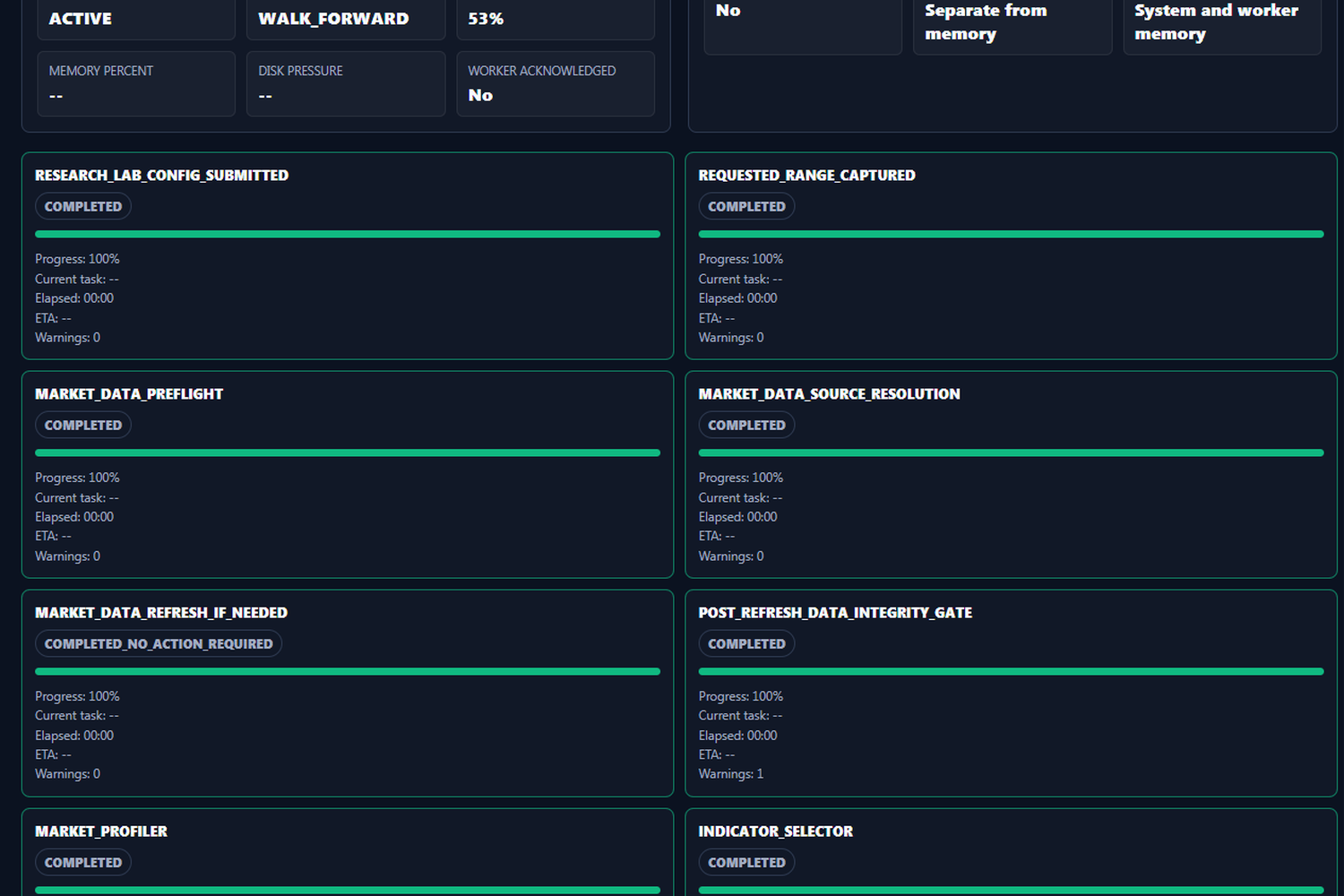
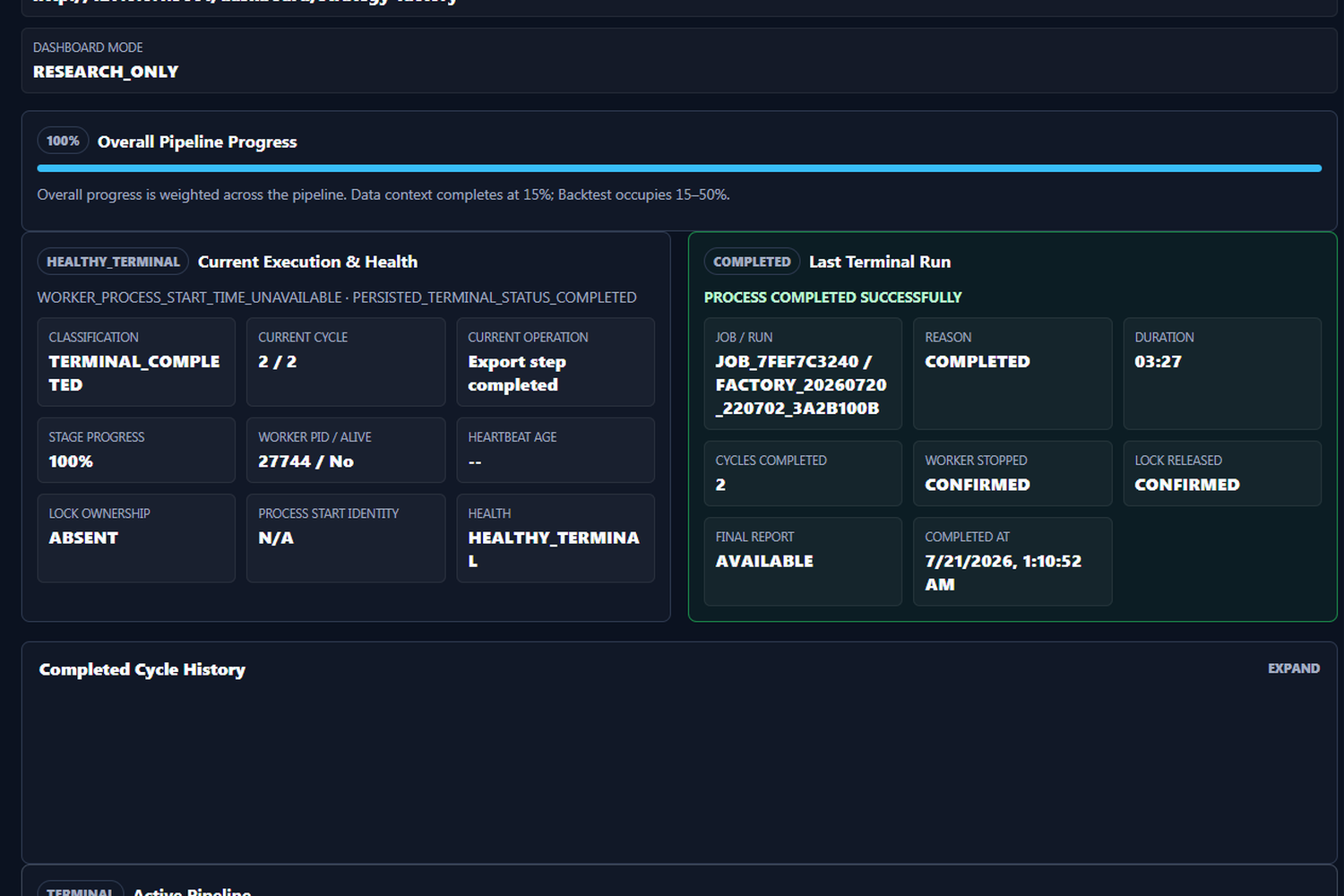
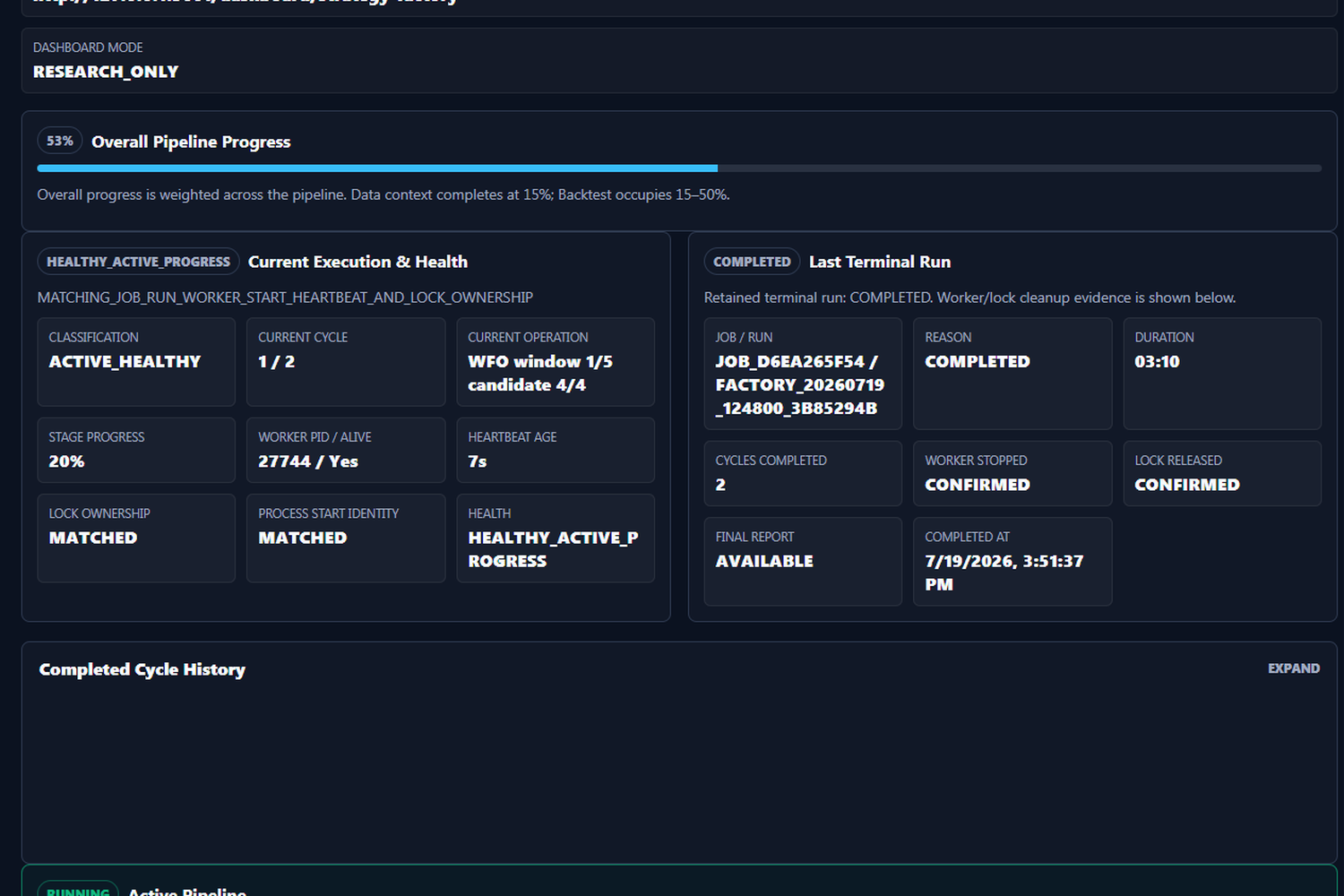
- A Strategy Factory dashboard for observing active research stages and progress
- Explicit readiness gates that separate research completion from actual readiness
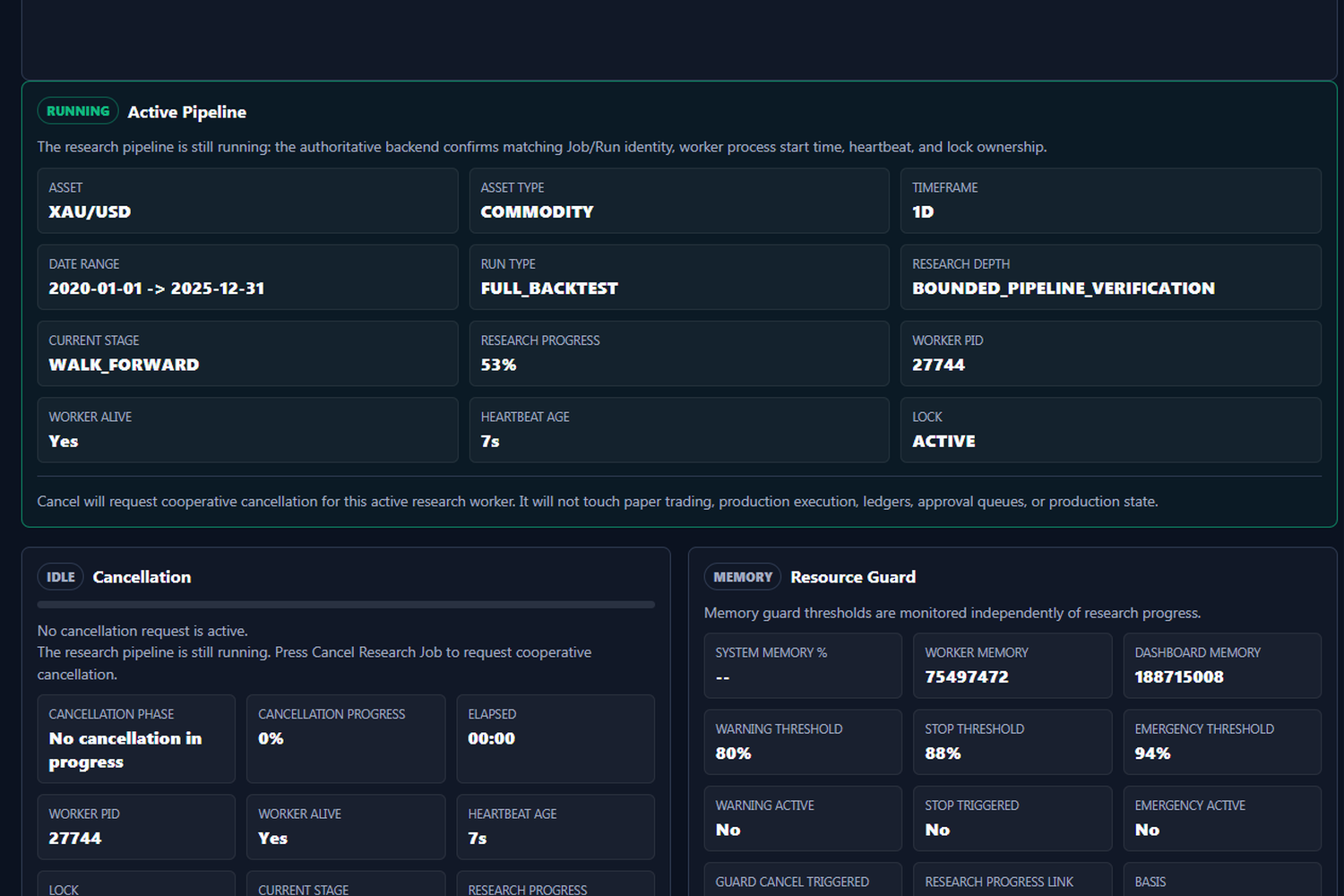
- Safe cancellation, runtime inspection, resource guards, and isolated worker processes
The platform is intentionally research-only and advisory-only. It does not automatically place trades, enable live execution, or treat a completed backtest as production readiness.
How we built it
We built the project as a modular Python platform with a Flask-based observability dashboard.
The main architecture is divided into several layers:
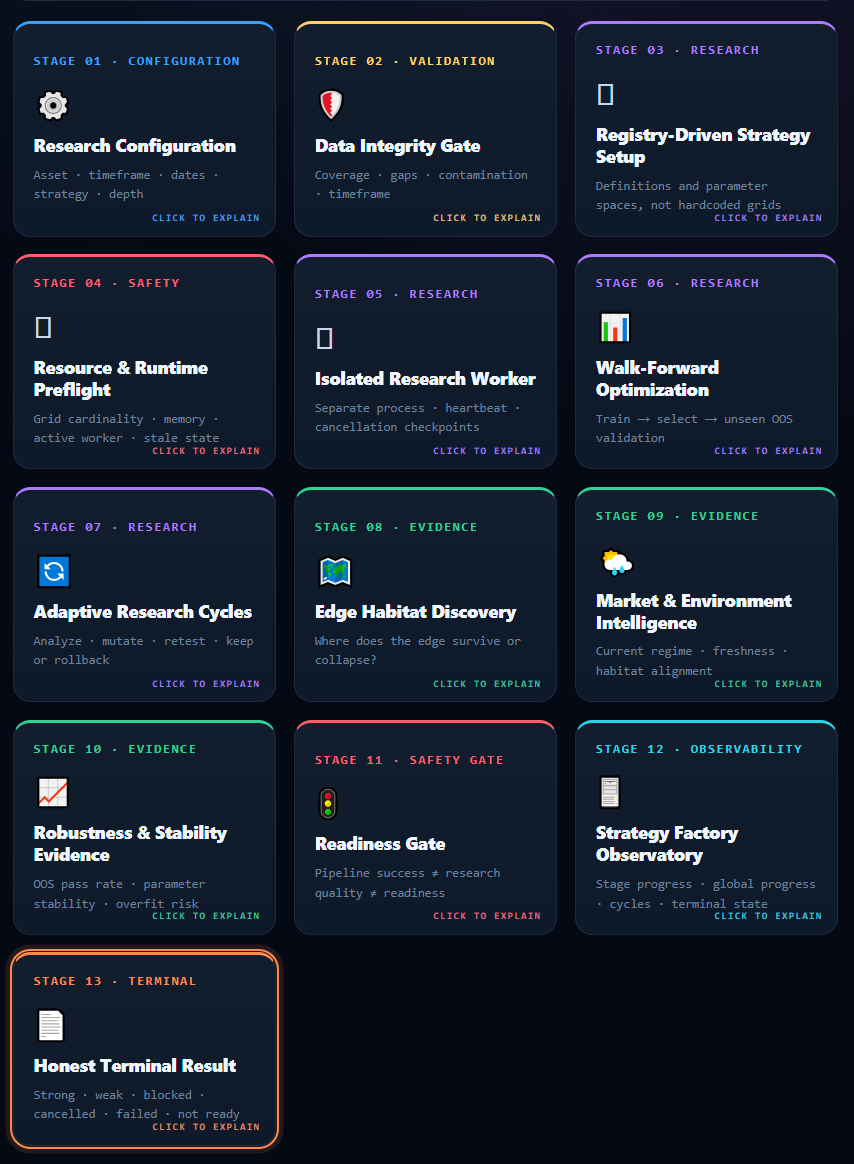
Research configuration
The user selects the asset, timeframe, date range, strategy, validation depth, and optimization ranges.Data integrity
Market data is checked for coverage, contamination, missing values, invalid prices, and timeframe consistency before any expensive research begins.Research engine
Strategies are loaded from a central registry instead of being hardcoded into the dashboard or backtest engine.Walk-forward validation
Parameters are selected using training data and then tested on unseen out-of-sample windows.Adaptive analysis
The system compares candidates, studies failure modes, evaluates parameter stability, and performs controlled research iterations.Environment intelligence
Research results are classified by regime, volatility, momentum, and edge habitat.Observability
The dashboard displays active stages, direct progress, total progress, cycle history, resource state, cancellation state, and the latest terminal result.Safety boundaries
Research workers run in isolated processes, execution-related capabilities remain disabled by default, and no research result automatically becomes an execution decision.
A core design principle is that aggregate profit alone is not enough. For example, a strategy with modest but consistent out-of-sample performance may be more credible than one with a very high total profit that succeeds in only a few windows.
Conceptually:
[ \text{Research confidence} \neq \text{Backtest profit alone} ]
Instead, confidence is built from multiple forms of evidence:
[ C = f(D, O, S, R, H) ]
where:
- (D) = data integrity
- (O) = out-of-sample consistency
- (S) = parameter and performance stability
- (R) = robustness across conditions
- (H) = edge-habitat evidence
Challenges we ran into
One of the biggest challenges was maintaining truthful state across a long-running research pipeline.
Research jobs can fail, stall, be cancelled, lose worker processes, exceed safe resource limits, or leave stale runtime artifacts. We had to build:
- Heartbeat-based worker tracking
- Safe stale-lock detection
- Cooperative cancellation checkpoints
- Idempotent cancellation behavior
- Process-aware cleanup safeguards
- Resource and parameter-grid guards
- Separate stage and global progress tracking
- Honest terminal states such as blocked, failed, cancelled, or not ready
Another challenge was preventing configuration leakage between strategies. Different strategy families use different parameters, so stale parameters from a previously selected strategy could not be allowed to enter a new run. We solved this using registry-driven, strategy-scoped configuration and sanitization.
Market data was also a major challenge. Historical coverage varies by provider, symbol, and timeframe. Instead of silently substituting a shorter range, the system blocks the run and requires explicit acceptance of a valid range.
Finally, preparing the project for public release required separating source code from runtime state, credentials, logs, generated reports, local paths, approval records, and execution-related data. We created a clean public copy with new Git history and environment-based configuration.
Accomplishments that we're proud of
We are proud that the platform consistently prefers an honest negative result over a misleading success result.
Some of the most important accomplishments include:
- Building a complete research lifecycle from configuration to final evidence
- Enforcing the Data Integrity Gate before optimization
- Separating in-sample optimization from out-of-sample evaluation
- Making strategies and parameter grids registry-driven
- Visualizing active research and adaptive cycles in a unified dashboard
- Implementing safe, observable cancellation for isolated research workers
- Blocking extremely large optimization grids before materialization
- Preserving research-only and advisory-only boundaries throughout the system
- Preventing dashboard imports from triggering dependency installation, network workflows, or runtime mutations
- Creating a sanitized public repository with no private Git history or embedded credentials
The system can say:
- Data unavailable
- Insufficient evidence
- Weak habitat
- Overfit risk
- Resource guard blocked
- Cancelled
- Not ready
without converting those outcomes into fake success or readiness claims.
What we learned
We learned that observability is not just a user-interface feature. It is part of research integrity.
A progress bar is only useful when it corresponds to authoritative backend state. A completed pipeline is only meaningful when the data, validation method, and result quality are also valid.
We also learned that:
- Out-of-sample consistency matters more than one exceptional backtest
- Data quality must be checked before optimization
- Cancellation and failure states must be designed as first-class lifecycle states
- Strategy configuration should be registry-driven rather than duplicated across layers
- Resource safety must be evaluated before creating large parameter combinations
- Research evidence must remain separate from execution authority
- Public-source preparation requires a strict allowlist, not only a larger
.gitignore - Secure defaults and truthful limitations make a research platform more credible
What's next for Adaptive Research Pipeline Observatory
The next stage is to make the platform easier to explore, reproduce, and compare across assets.
Planned improvements include:
- Multi-asset research orchestration
- Historical research memory to detect whether an edge is improving or degrading
- Richer regime and market-environment monitoring
- Improved comparison across strategy families
- Reproducible sample datasets and bounded demonstration runs
- More public-safe automated tests
- Interactive visualizations for walk-forward windows and edge habitats
- Better research-report exports
- Stronger experiment lineage and configuration versioning
- A hosted demonstration environment using sanitized sample data
The long-term goal is not to create an autonomous trading bot.
It is to create a transparent research observatory that helps users distinguish a promising hypothesis from a fragile backtest—and understand exactly why.


Log in or sign up for Devpost to join the conversation.