Inspiration
The rapid advancement of artificial intelligence has dramatically increased computational demands and energy consumption. Conventional computing systems based on the Von Neumann architecture suffer from the memory-computation bottleneck, making them inefficient for future low-power AI applications.
Inspired by the remarkable efficiency of the human brain, which performs complex cognitive tasks while consuming only about 20 watts of power, we set out to design a brain-inspired neuromorphic computing framework. This vision led to the development of Adaptive Neuromorphic Computing Fabric (ANCF), a platform that integrates emerging neuromorphic devices into an adaptive, energy-efficient architecture.
What it does
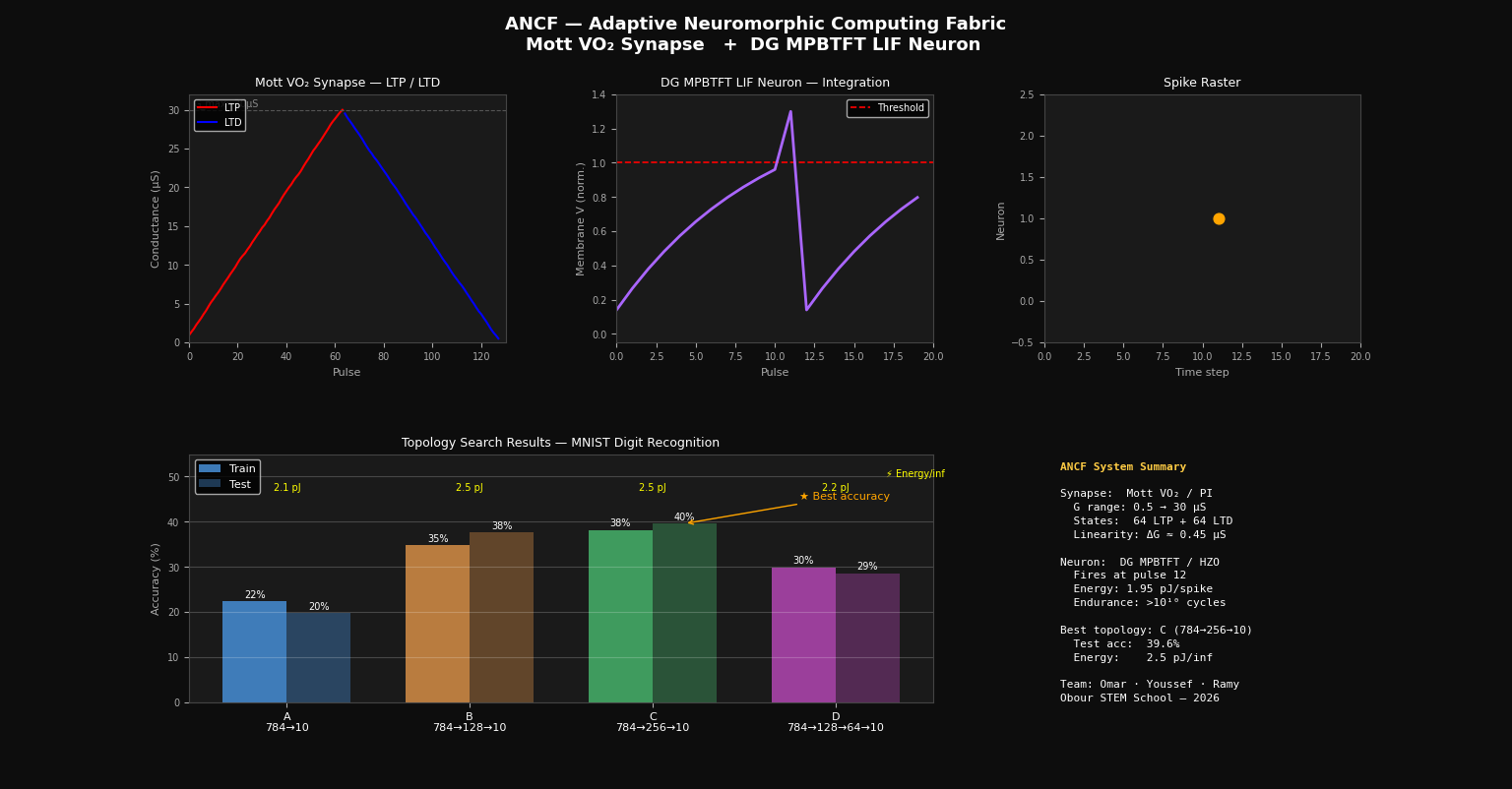
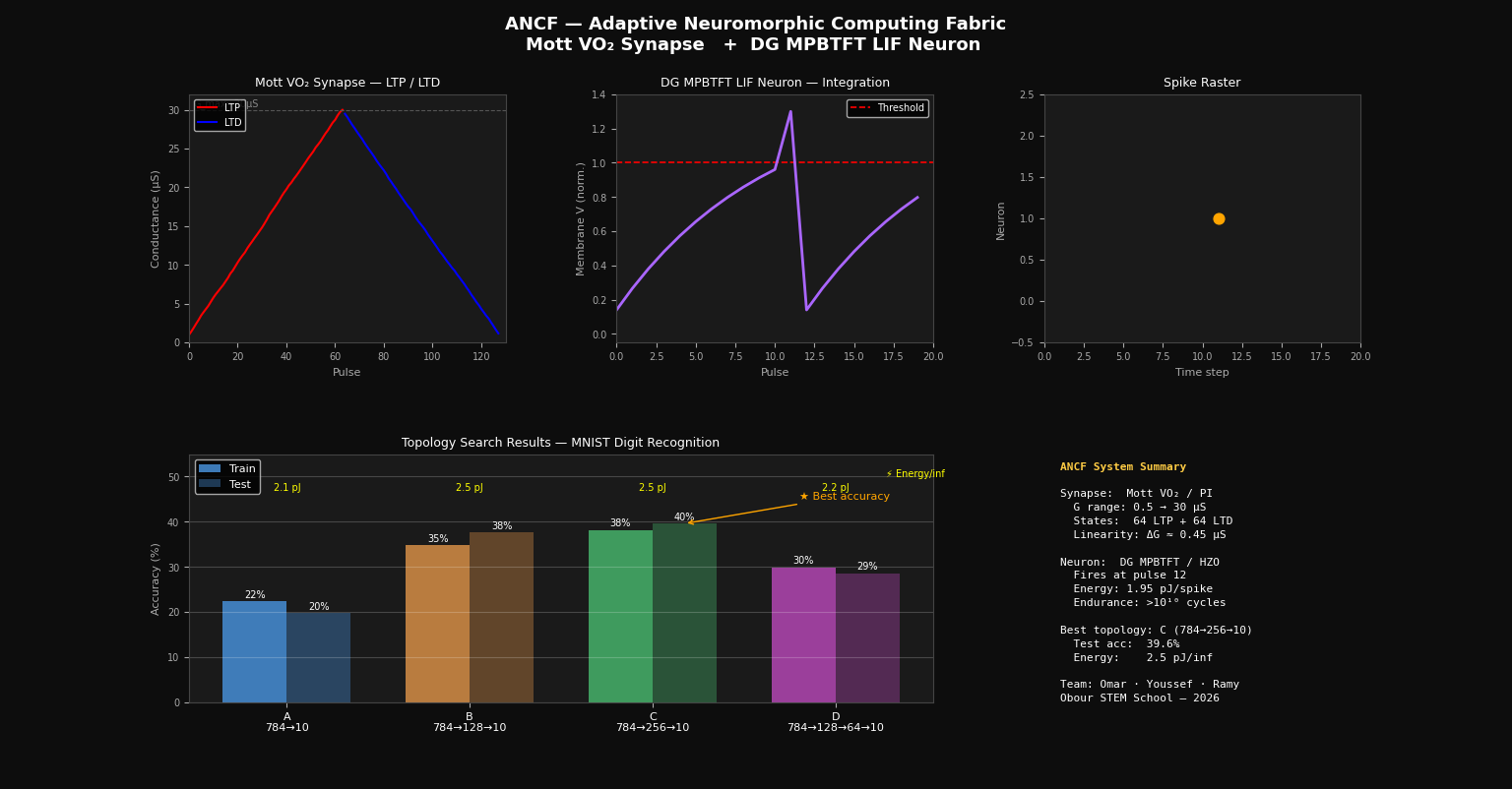
ANCF is a simulation-based neuromorphic computing framework that combines a Mott VO₂ artificial synapse with a DG MPBTFT Leaky Integrate-and-Fire (LIF) neuron to emulate biological neural computation.
The framework performs:
Spike-based information processing. Synaptic learning through Long-Term Potentiation (LTP) and Long-Term Depression (LTD). Membrane integration and spike generation using the LIF neuron model. Network topology optimization to balance classification accuracy and energy efficiency.
The complete system demonstrates how emerging synaptic and neuronal devices can work together within a unified Spiking Neural Network architecture.
How we built it
The development of ANCF followed four engineering stages:
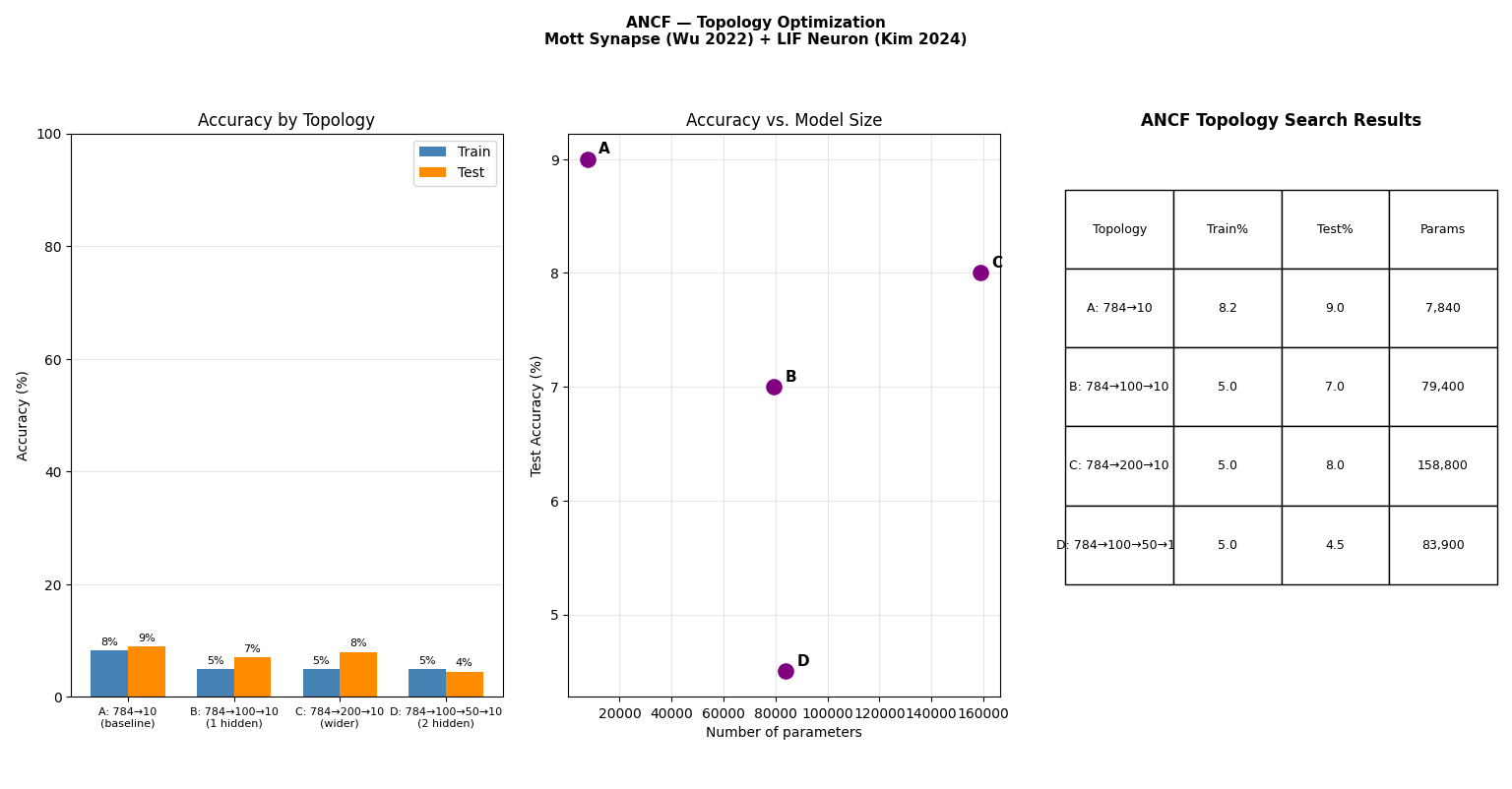
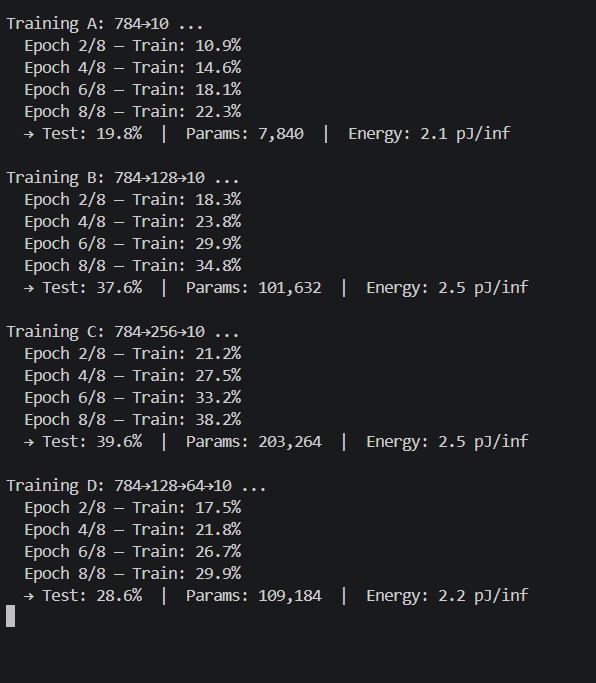
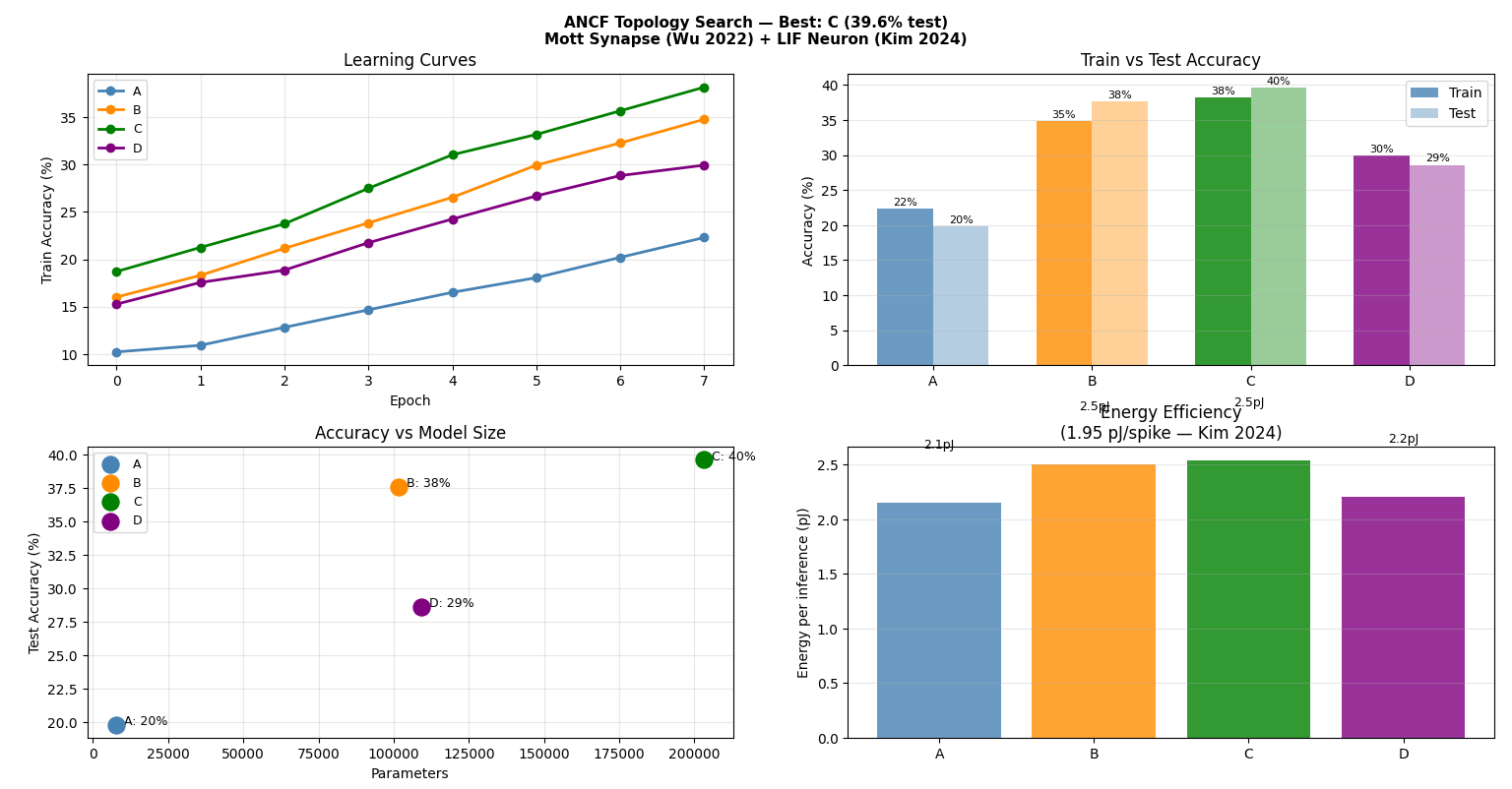
Synapse Modeling: Modeled a Mott VO₂ artificial synapse based on published experimental characteristics to reproduce analog synaptic plasticity through LTP and LTD. Neuron Modeling: Implemented a DG MPBTFT Leaky Integrate-and-Fire neuron capable of membrane integration, threshold detection, spike generation, and reset dynamics. Spike-Based Network Integration: Integrated the synapse and neuron into a complete Spiking Neural Network framework for event-driven computation. Topology Co-Optimization: Evaluated multiple network architectures on the MNIST handwritten digit dataset to identify the optimal balance between classification performance and energy consumption. Challenges we ran into
Developing ANCF presented several technical challenges:
Integrating two independent device models from different research works into one unified framework. Accurately reproducing biological synaptic plasticity while maintaining numerical stability. Simulating spike-based neural dynamics using simplified computational models. Balancing network complexity, energy consumption, and classification performance. Selecting an optimal network topology without sacrificing computational efficiency. Accomplishments that we're proud of
We successfully developed an integrated neuromorphic framework that combines artificial synapses and neurons into a functional spike-based architecture.
Our key achievements include:
Successful modeling of the Mott VO₂ artificial synapse. Functional implementation of the DG MPBTFT LIF neuron. Integration into a complete Spiking Neural Network. Stable LTP/LTD learning behavior. Successful topology optimization. Validation on the MNIST handwritten digit dataset. Demonstration of ultra-low-power neuromorphic computation suitable for future Edge AI systems. What we learned
Throughout this project, we gained valuable experience in:
Neuromorphic computing principles. Spiking Neural Networks. Artificial synapse and neuron device modeling. Spike-based information processing. Neural network optimization. Reading and implementing cutting-edge scientific literature. Scientific research methodology and system integration.
Most importantly, we learned how multidisciplinary concepts from electronics, materials science, neuroscience, and artificial intelligence can be combined to build innovative computing systems.
What's next for Adaptive Neuromorphic Computing Fabric (ANCF)
Our future work focuses on transforming ANCF from a simulation framework into a practical neuromorphic computing platform.
Future directions include:
Hardware implementation of the proposed architecture. Integration of online learning algorithms such as STDP. Evaluation using larger and more complex datasets. Development of deeper Spiking Neural Networks. Real-time deployment on Edge AI devices. Exploration of emerging neuromorphic materials for improved efficiency. Scaling ANCF toward sustainable, low-power AI hardware for next-generation intelligent systems

Log in or sign up for Devpost to join the conversation.