-
-
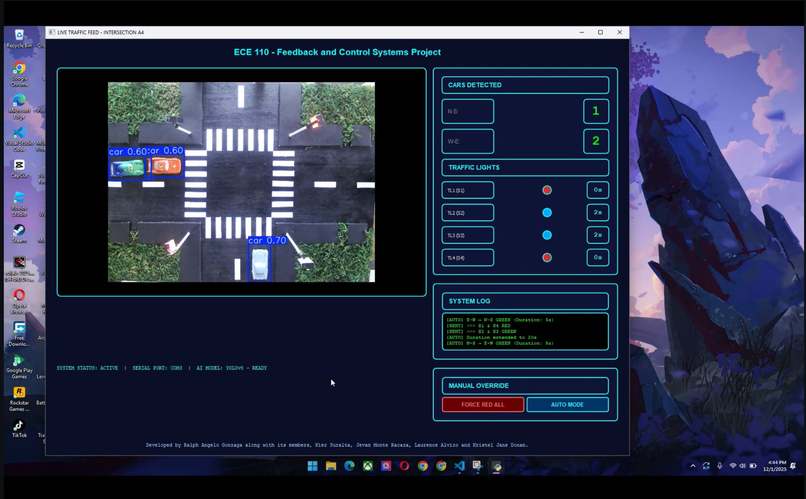
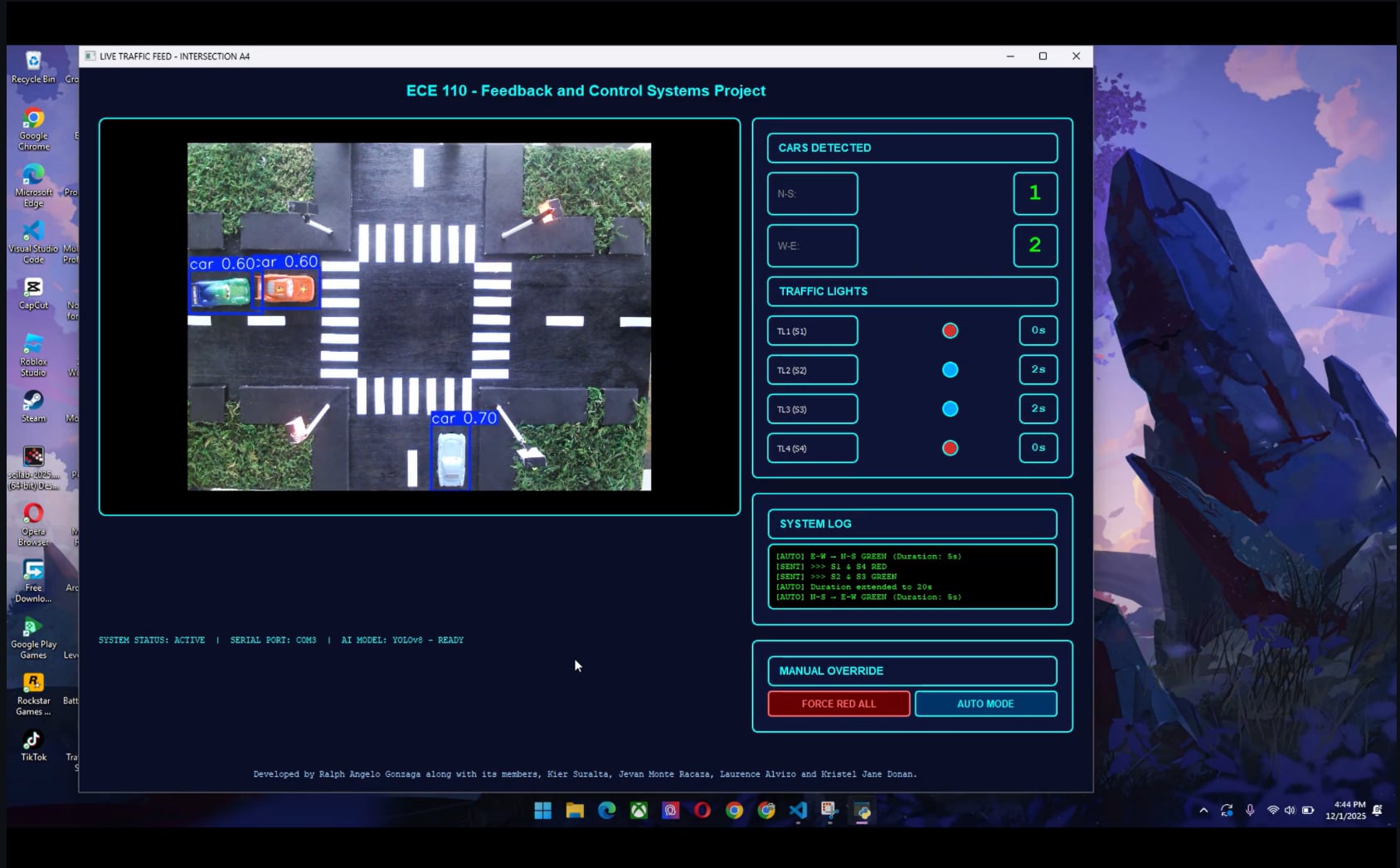
GUI
Inspiration
Developing regions like Butuan City face a traffic crisis caused by outdated, fixed-time signal schedules. Arterial corridors experience heavy congestion that disrupts economic productivity and safety. AGOS was inspired by UN Sustainable Development Goals 9 and 11 to create a data-driven, adaptive solution capable of adjusting traffic flow in real time based on actual demand.
What it does
AGOS is an intelligent traffic controller that replaces rigid timers with a responsive feedback loop. It uses a dynamic object detection pipeline to monitor vehicle density and adjusts green-light durations dynamically. The system features a GUI for real-time monitoring and manual override capabilities for emergency scenarios.
How we built it
The system integrates edge software with embedded hardware. We trained a YOLOv8 nano model on a custom dataset to count vehicles within predefined Regions of Interest (ROIs). Detection data is processed via a Weighted Queue Management Algorithm, which communicates with an ESP32 microcontroller over UART (115200 baud) to actuate LED signal matrices. This architecture keeps operational latency under 100ms.
Challenges we ran into
Key hurdles included computational bottlenecks, where CPU-based inference was capped at 15.7 FPS. Our initial model, trained on toy vehicles in a lab, also faced generalization issues regarding real-world dimensions and weather. Furthermore, the ROI bounding logic is highly sensitive to camera calibration; any tripod displacement introduces structural errors in vehicle counts.
Accomplishments that we're proud of
The YOLOv8 model achieved 98.21% precision and 100% recall in testing, ensuring no vehicle was missed. We successfully demonstrated a sub-second response time to traffic changes and implemented an all-red buffer to ensure safe signal transitions. The entire system is built on accessible hardware totaling under $20, proving it is a cost-effective solution for municipal deployment.
What we learned
We learned that integrating lightweight ML models with edge hardware can solve complex urban problems without expensive GPU clusters. The project highlighted the importance of modular architecture for scalability and the necessity of robust data annotation to handle environmental variables like lighting and physical occlusion.
What's next for Adaptive Green-Signal Optimization System (AGOS)
Future work includes expanding the dataset to include real-world traffic footage and diverse vehicle classes like emergency responders. We aim to implement multi-intersection coordination for "green wave" synchronization and transition to GPU-enabled edge devices for higher throughput. Pilot testing in real urban intersections with local authorities is the final step toward production.


Log in or sign up for Devpost to join the conversation.