-
-
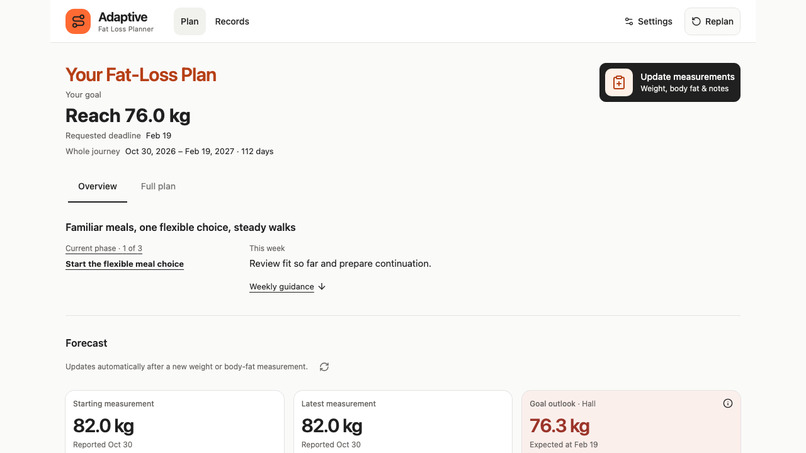
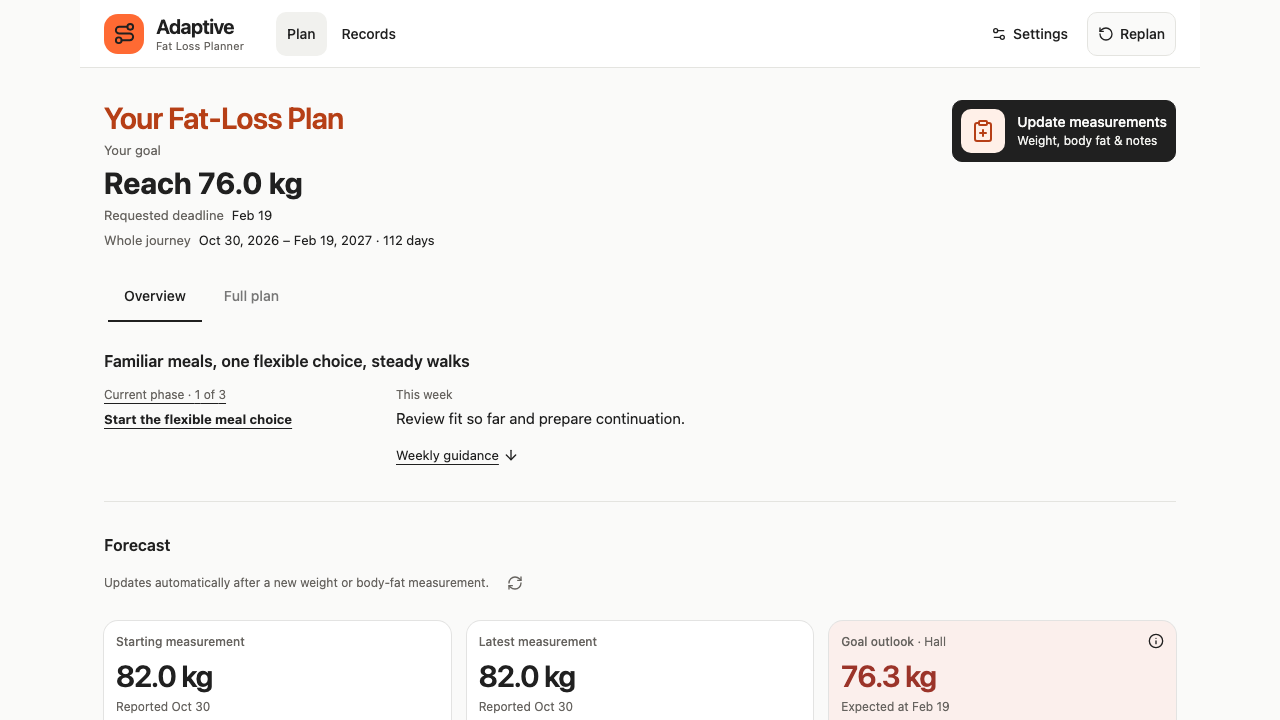
Fictional demonstration: the accepted plan, goal period and current phase.
-
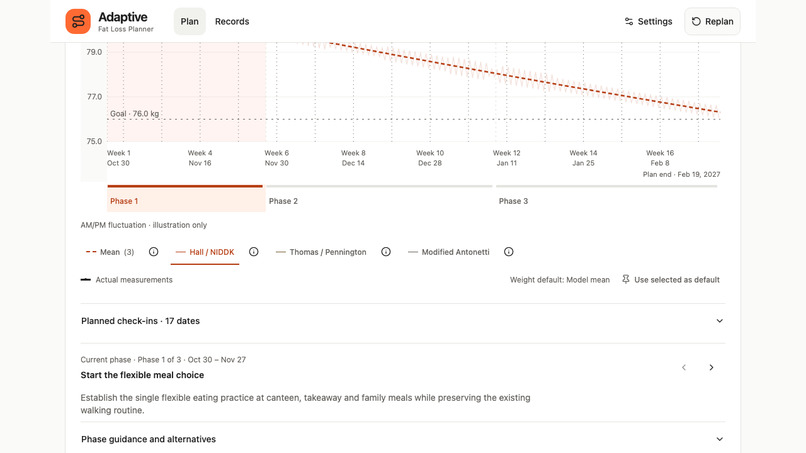
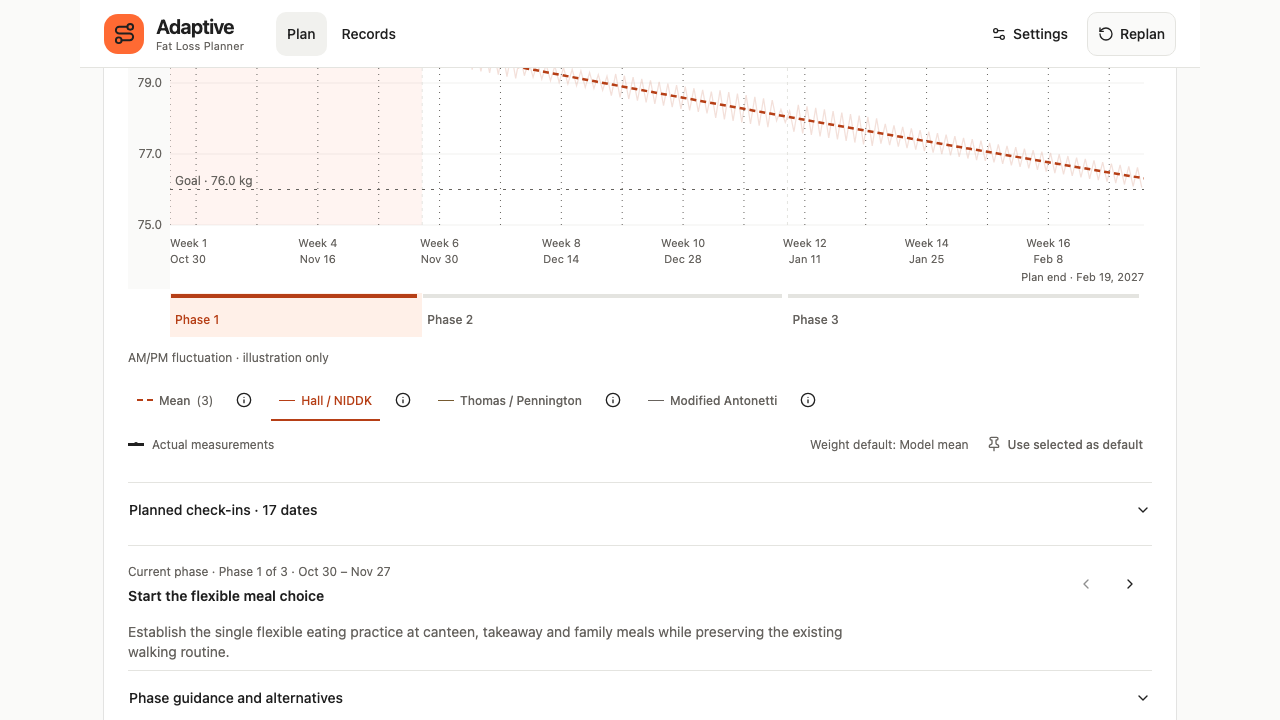
Fictional demonstration: model comparison, phases and measurement checkpoints.
-
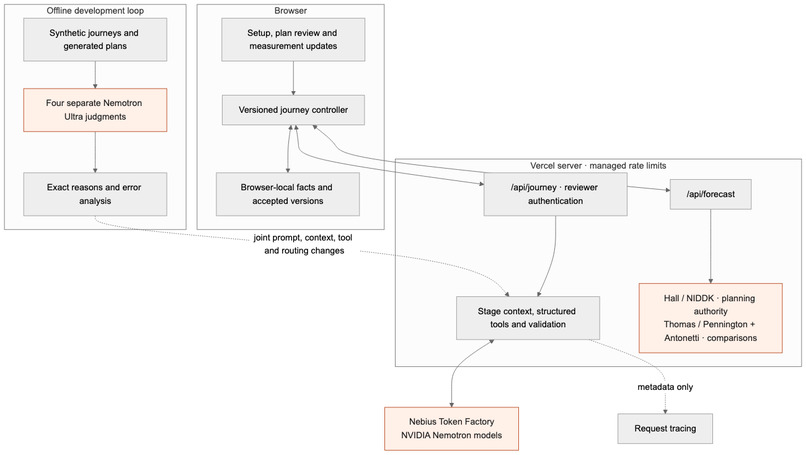
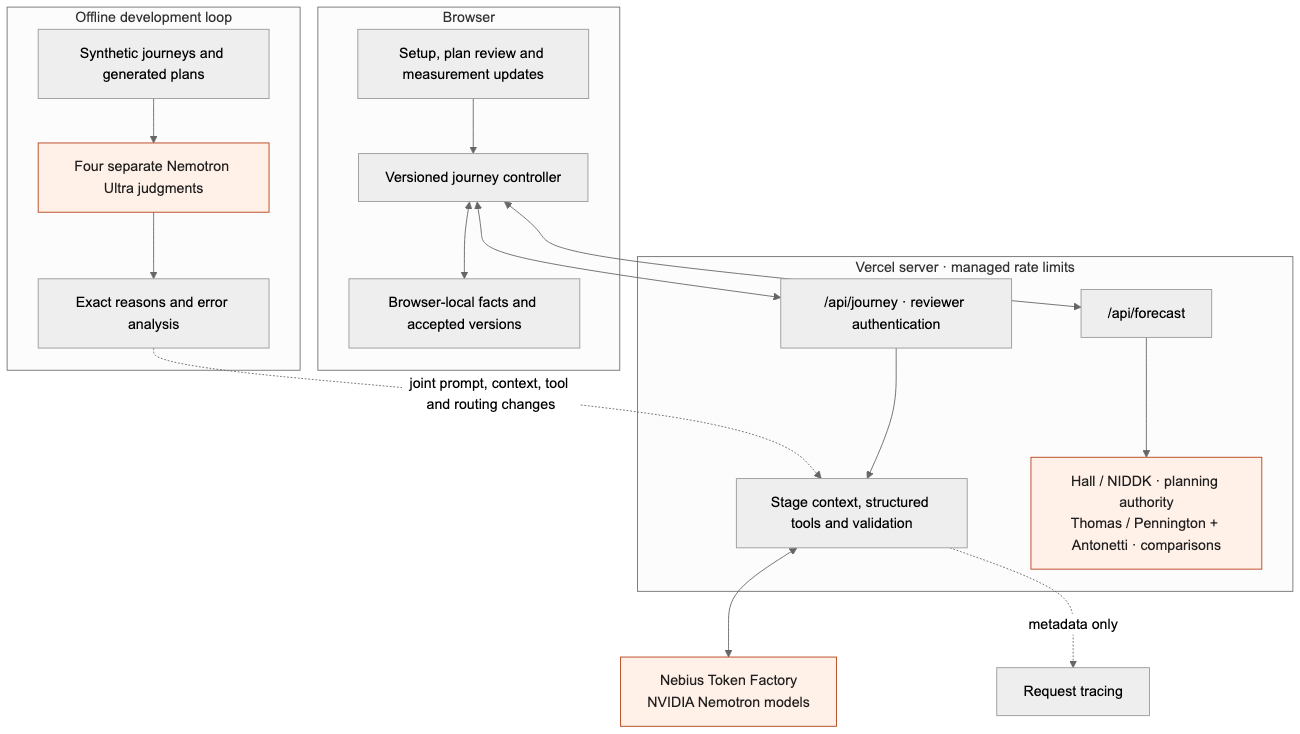
Architecture: Agent stages, physiological prediction models and offline evaluation.
Inspiration
A fat-loss plan needs to keep up with real life. Work gets busier, routines change, and progress may differ from expectations. The challenge is knowing when—and how—to adjust.
Adaptive connects an AI Agent, research-based weight-prediction models and an evaluation loop to make those decisions understandable and reviewable.
What it does
The Agent interprets a person's goals, routines and constraints. Confirmed information feeds physiological calculations; the Agent uses those results to build a complete plan with stages, weekly priorities and measurement checkpoints.
Users can request revisions and explicitly accept a version. Later weight or body-fat readings refresh the forecast. Notes capture changing circumstances. When reassessment is needed or requested, the Agent considers updated predictions and plan history to recommend continuing, measuring again or discussing an adjustment. Users approve replacements.
The interface is English; generated content follows the user's language. Measurement updates are lightweight, without a daily food or exercise diary.
How we built it
NVIDIA Nemotron runs through Nebius Token Factory in four operations:
- Interpret: Lightning explains free-text routines and checks activity assumptions. Code maps confirmed measurements and activity choices into prediction parameters.
- Generate: Super VL combines calculated scenarios with personal circumstances to produce the full plan.
- Revise: Super VL updates the proposal from structured feedback.
- Review progress: Super VL evaluates new predictions and history before recommending a response.
Three mathematical models provide dated physiological scenarios. Hall/NIDDK drives planning; Thomas/Pennington and Modified Antonetti provide comparisons. Antonetti predicts weight only. Forecasts retain explicit assumptions.
Typed tools and validation keep numerical facts, dates and user acceptance under application control. Measurements are saved before calculation; AI failure preserves records and available predictions. Next.js, TypeScript, shadcn/ui and Recharts implement the experience. Vercel hosts the application; Token Factory serves the NVIDIA inference.
Evaluation and what we learned
Our offline module includes six synthetic journeys with 42 dated check-ins. Four separate calls to Nemotron Ultra assess scientific basis/safety, practical feasibility, user preferences and adaptation. Each returns pass/fail and a reason; missing context remains unassessed. Tracing supports error analysis across prompts, context, tools and model routing.
Long-plan consistency, resource assumptions and incomplete tool responses shaped those joint changes. One matched four-operation comparison reduced estimated inference cost from $0.353 to $0.047, including returned repairs. This is a recorded comparison, not a production average, model-only ranking or proof of equal quality.
What's next
Observe real use, whether people return to update measurements, and how well the product supports informed adjustments. Prospective individual prediction accuracy and health outcomes remain unverified.
Links
Built With
- nebius-token-factory
- next.js
- node.js
- nvidia-nemotron
- react
- recharts
- shadcn-ui
- typescript
- vercel
- zod

Log in or sign up for Devpost to join the conversation.