-
-
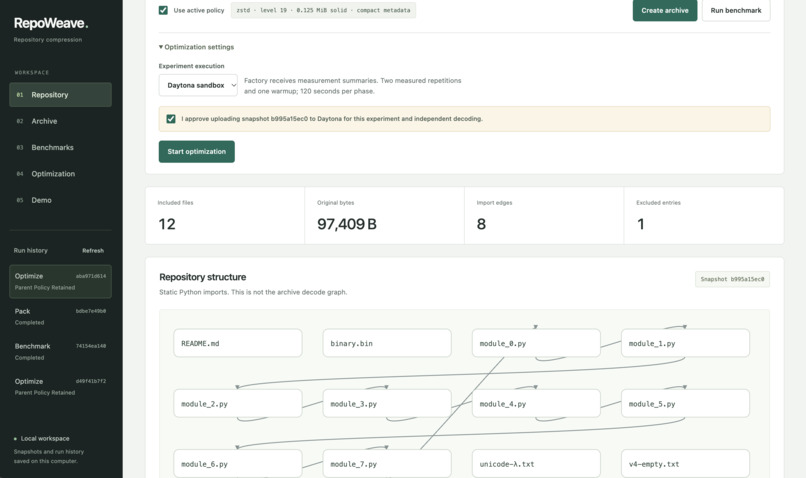
Starting Page
-
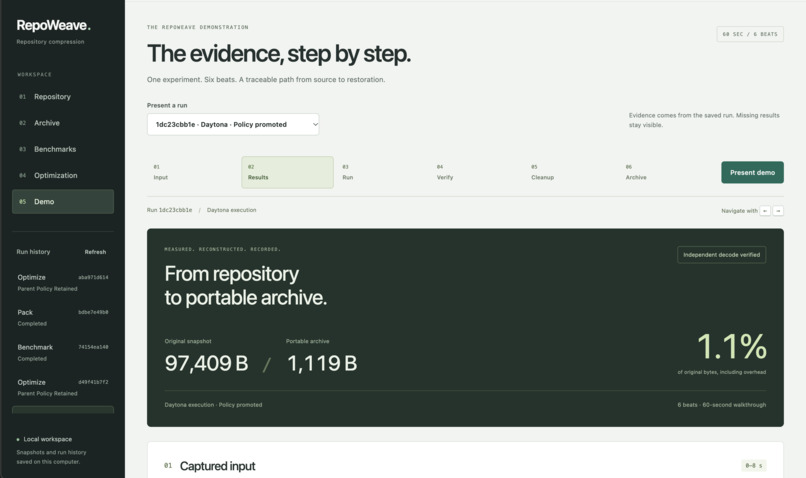
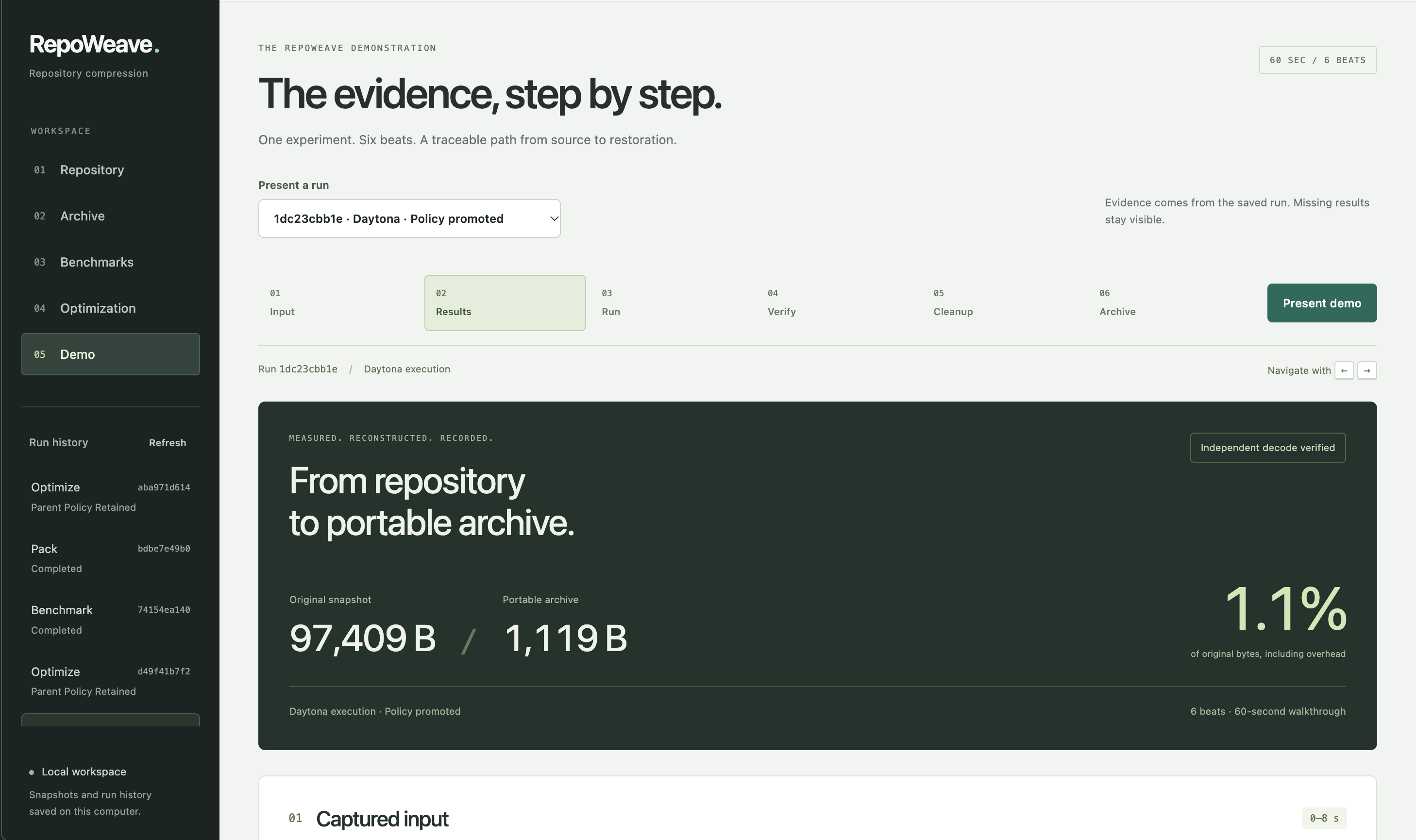
Demo dedicated page showing the outcome
-
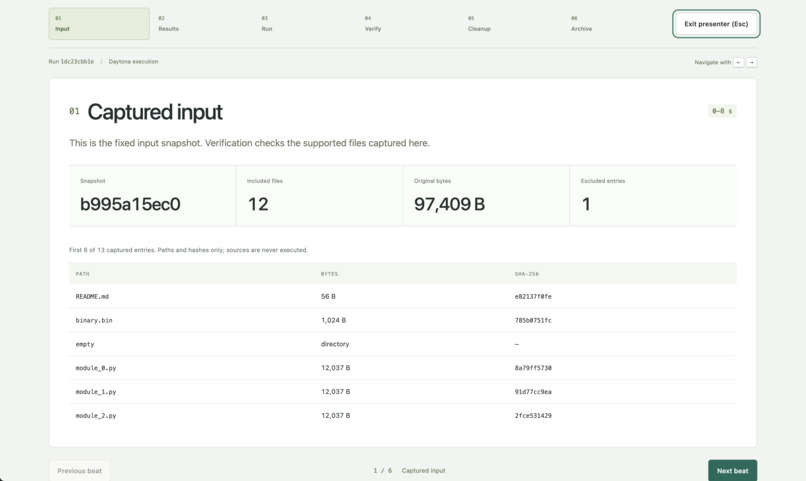
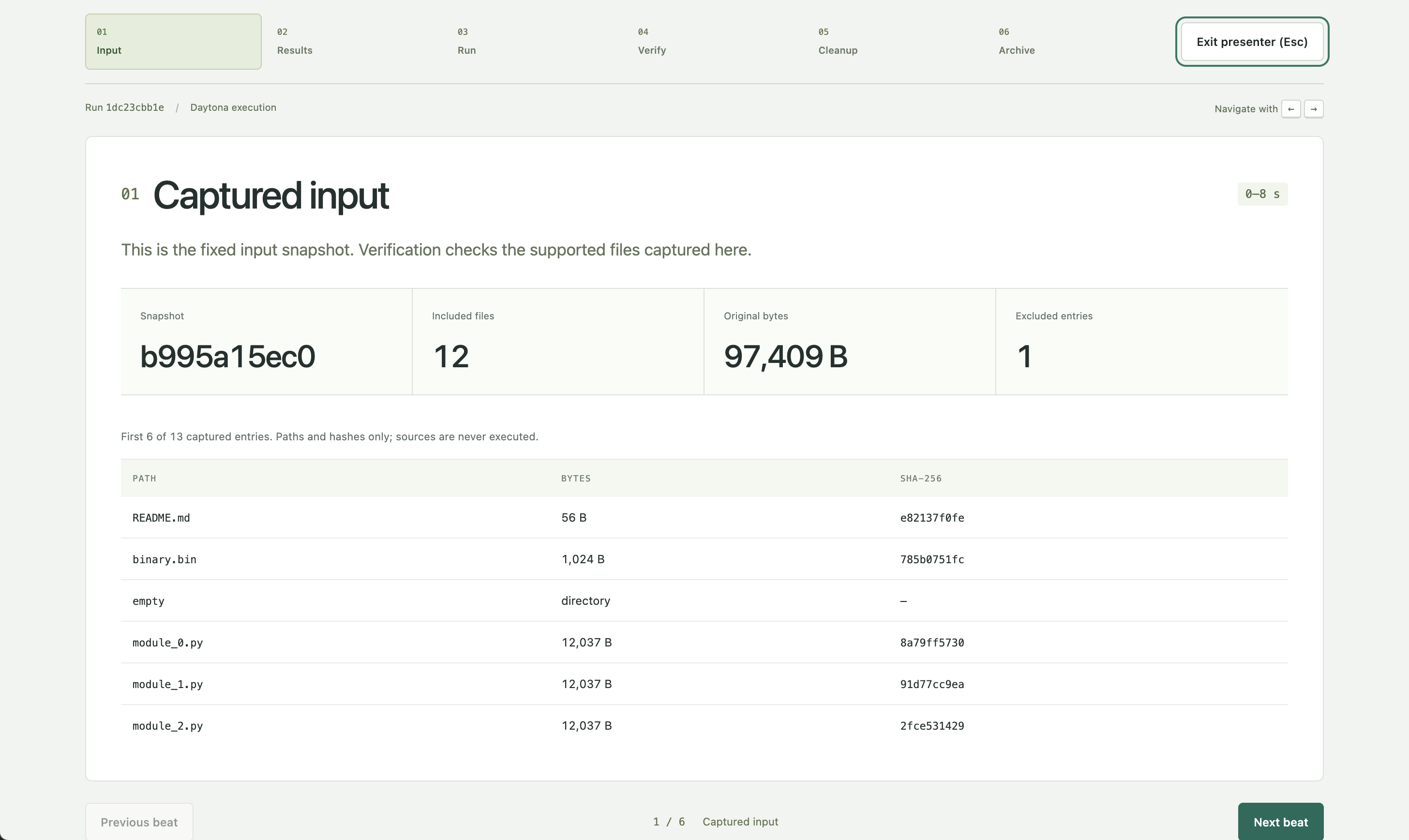
One fixed input, comparable experiments ran
-
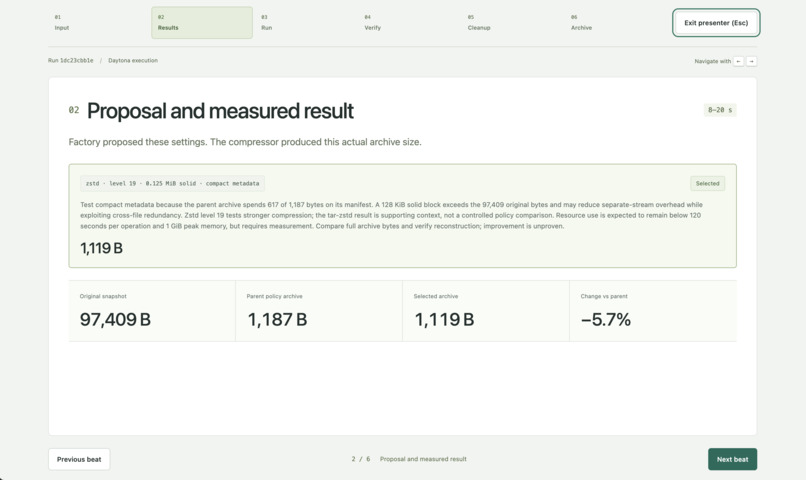
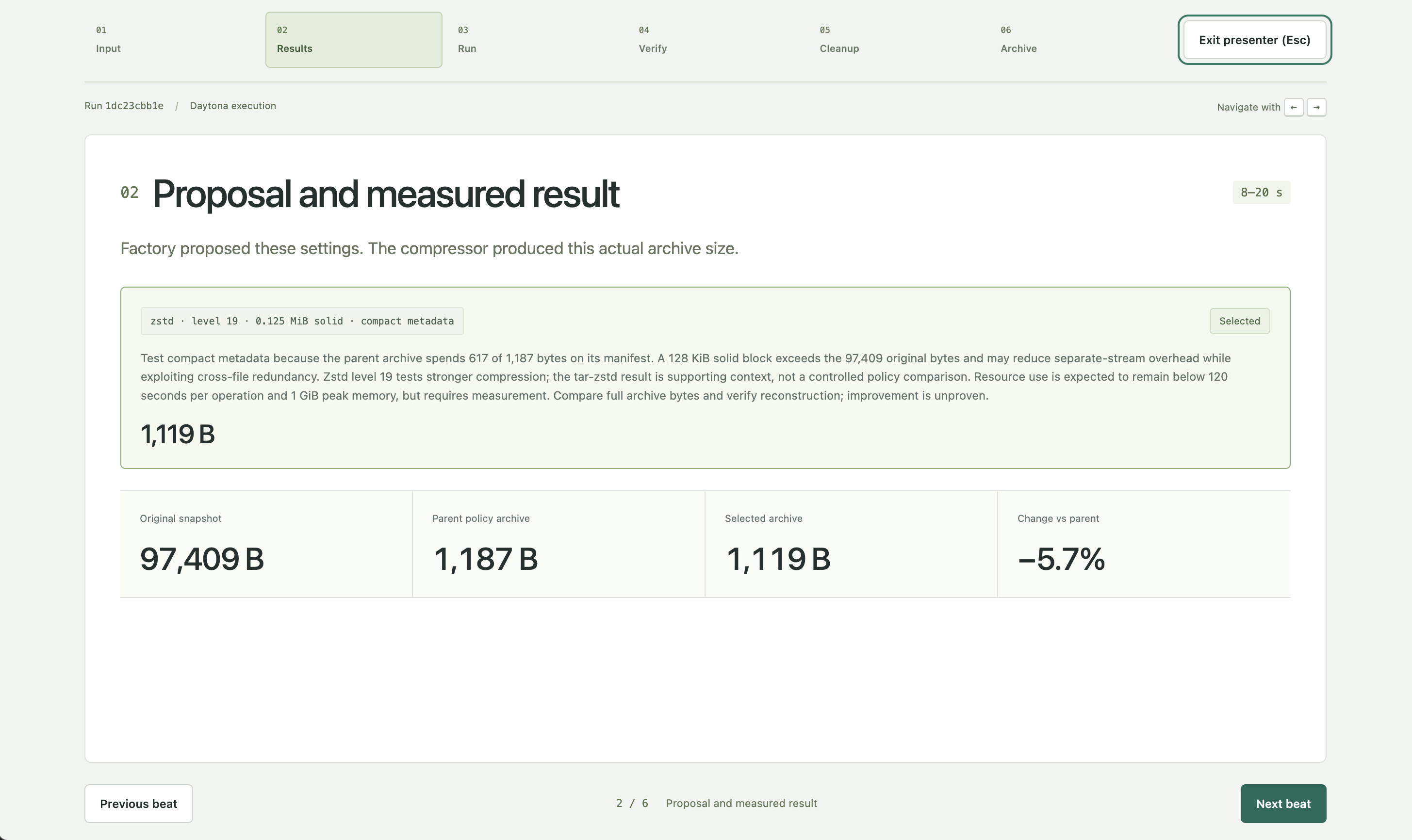
AI proposes -> Engine Measures -> Verification decides eligibility
-
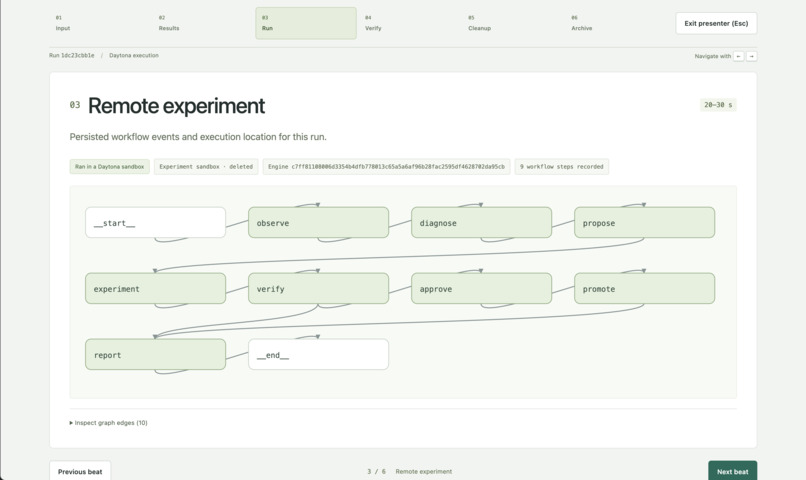
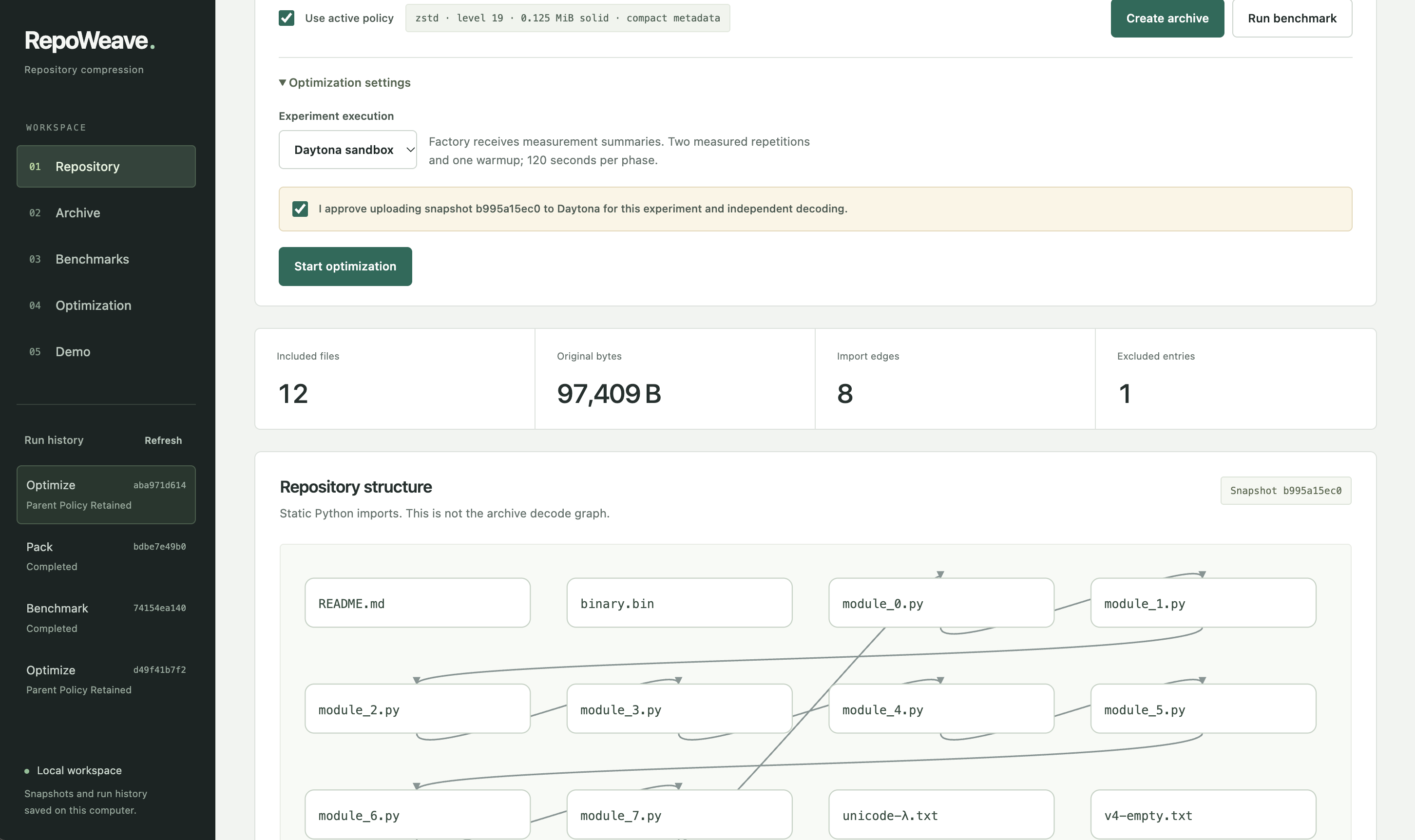
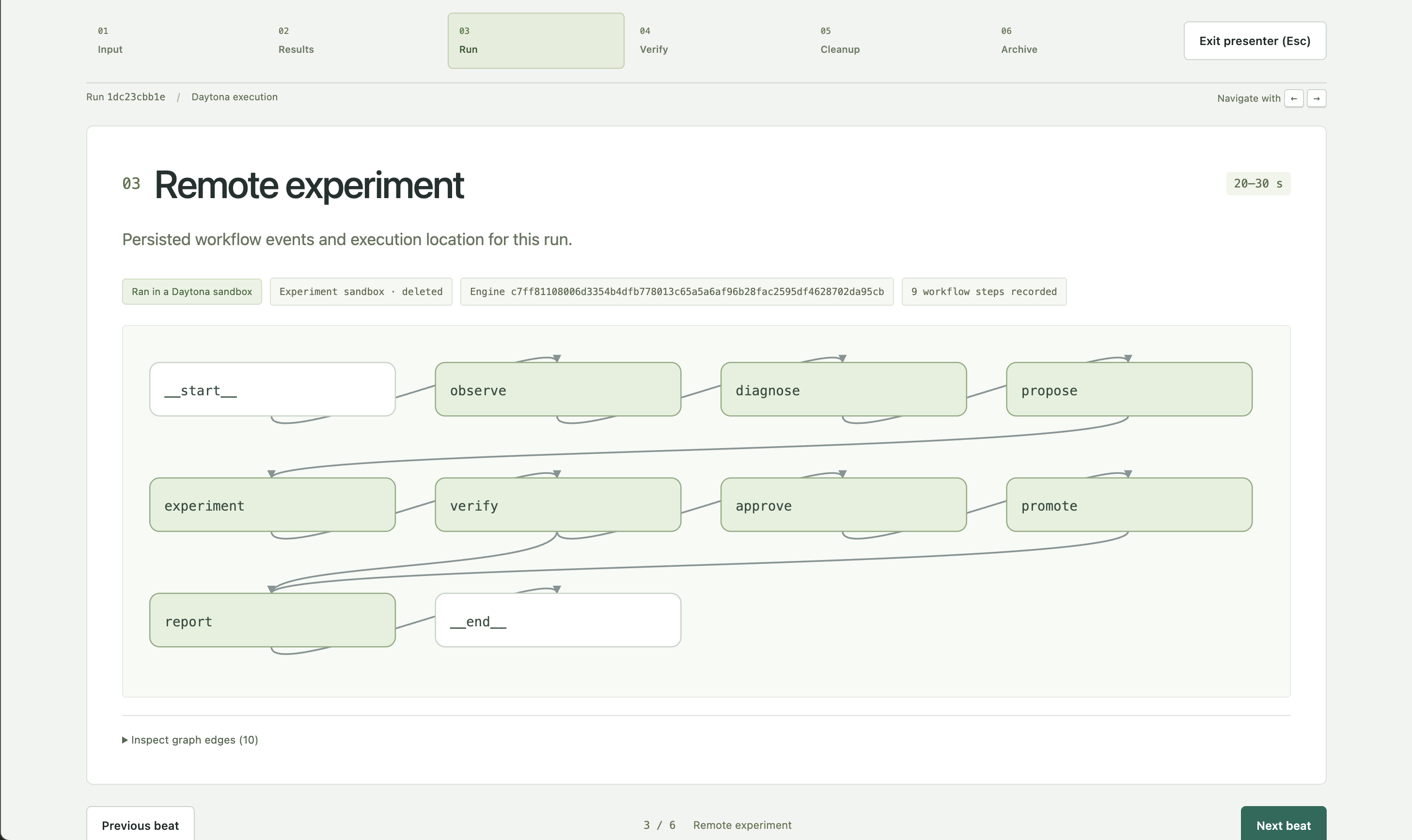
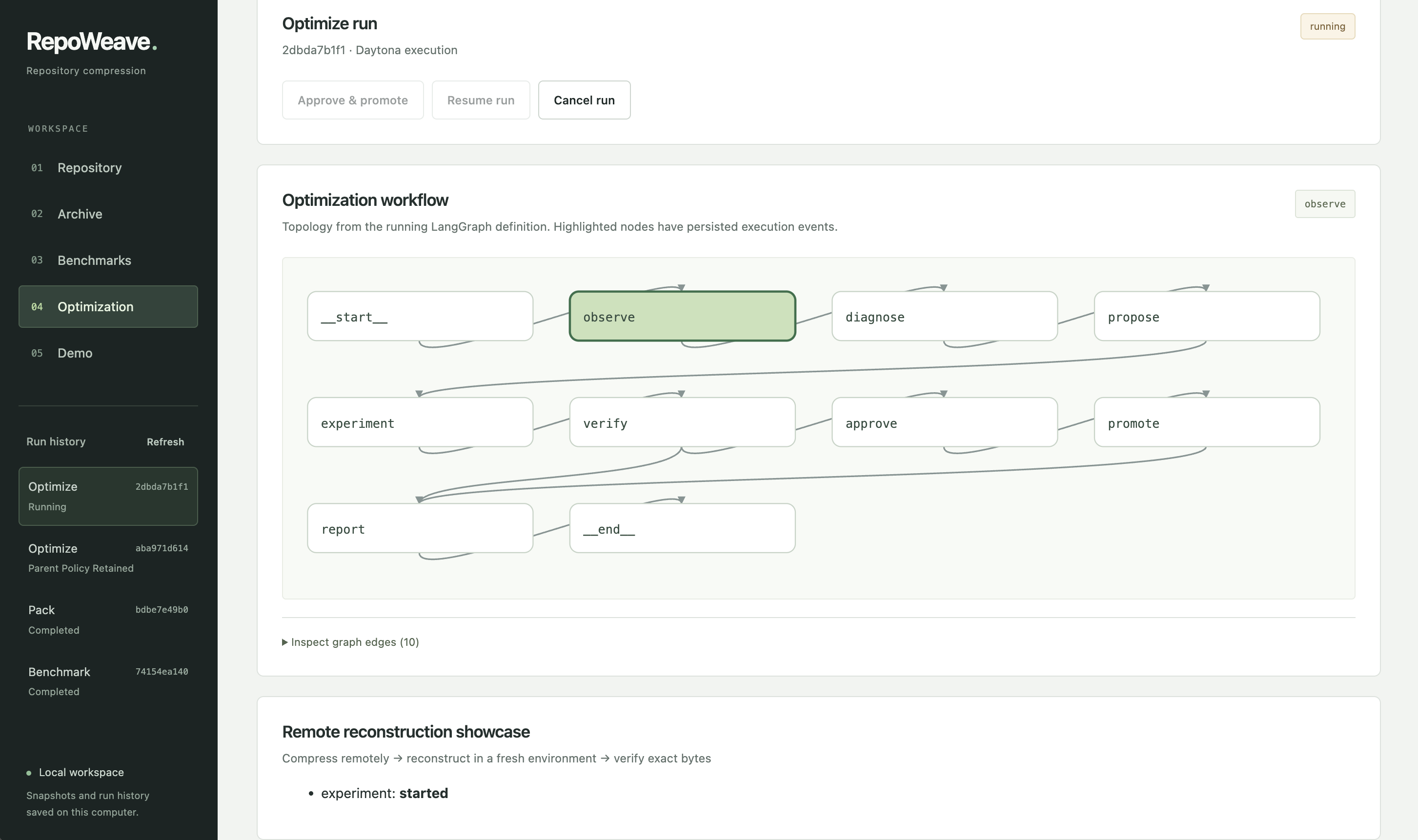
Experiments ran in an isolated Daytona sandbox, workflow records its progress.
-
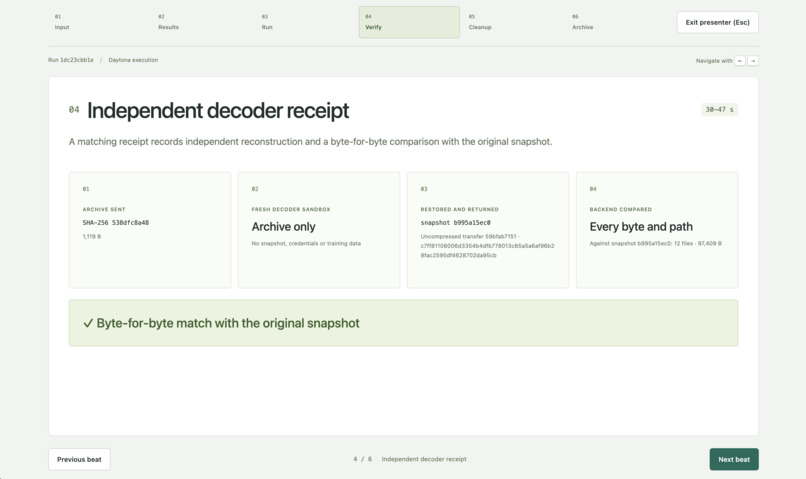
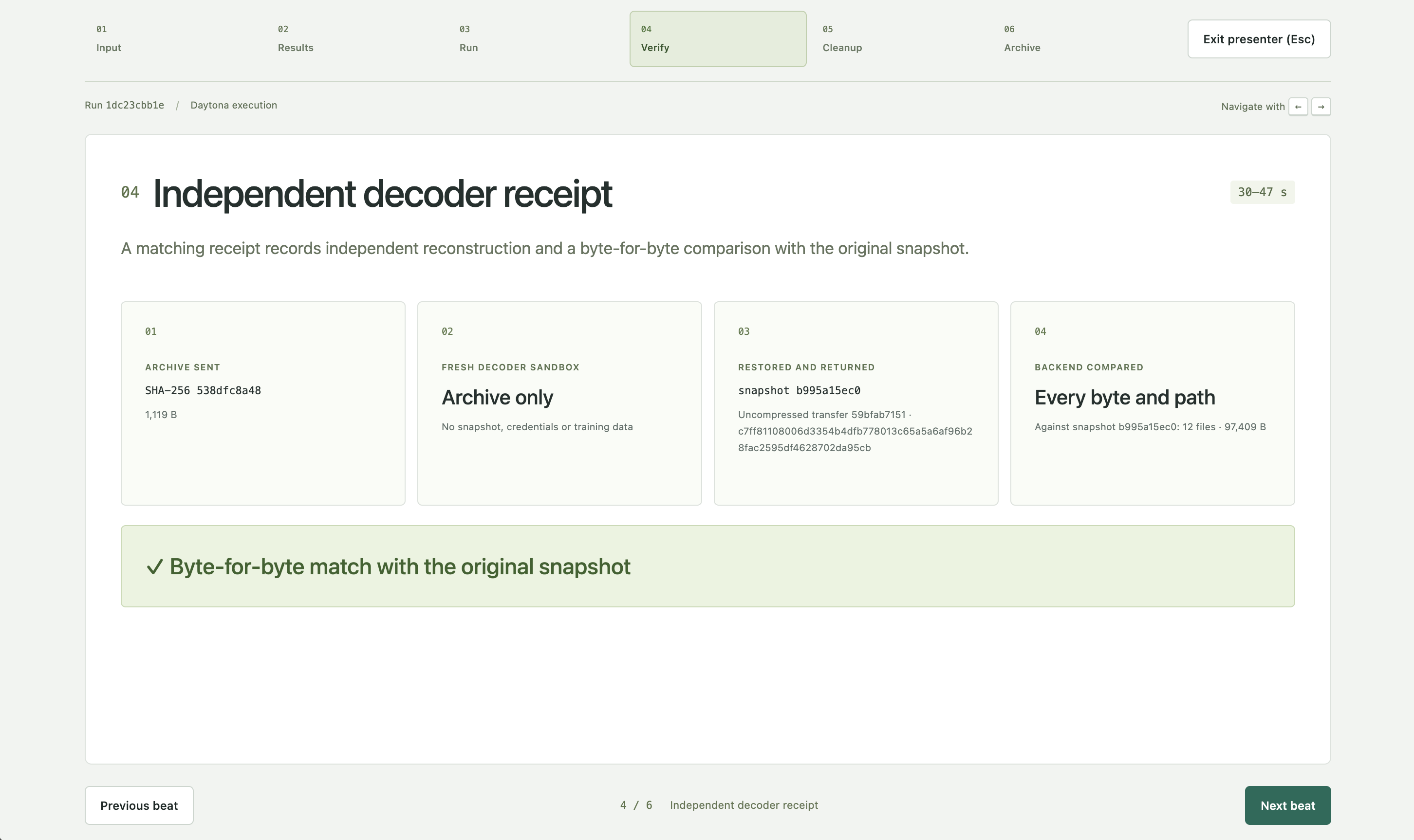
Second, fresh sandbox receives only the archive as input, backend compares every supported byte and path against original
-
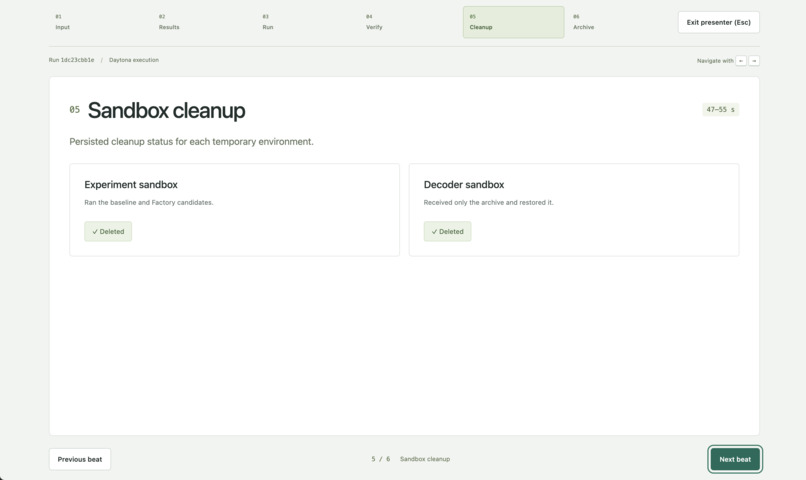
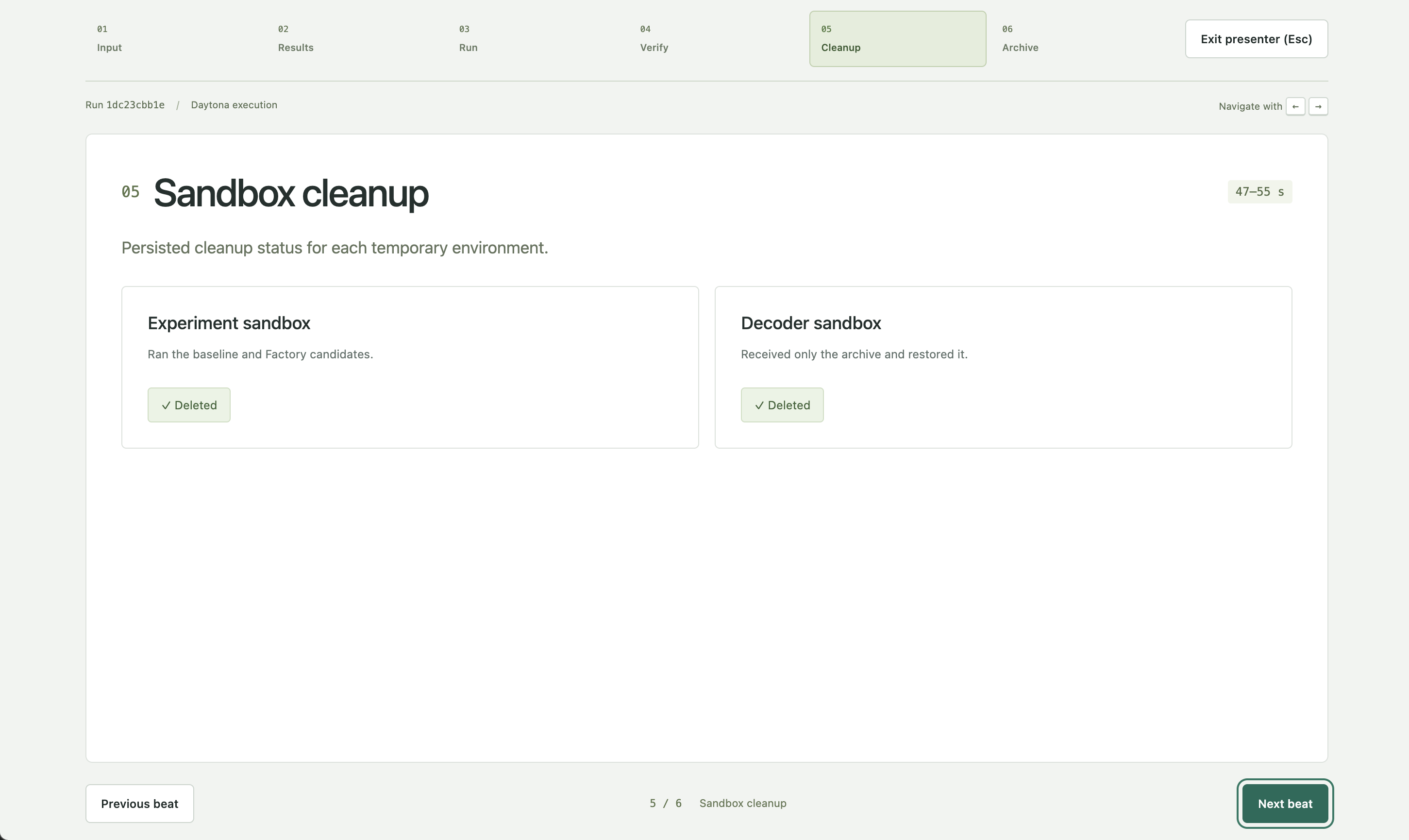
Sandbox gets cleaned up and deleated
-
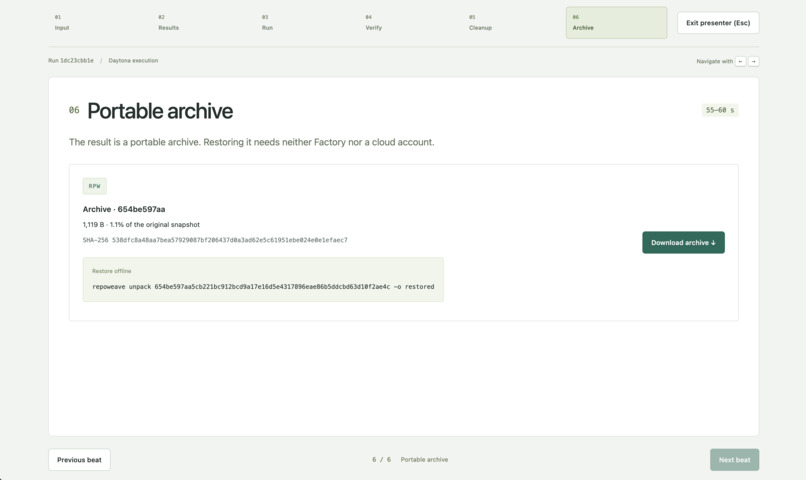
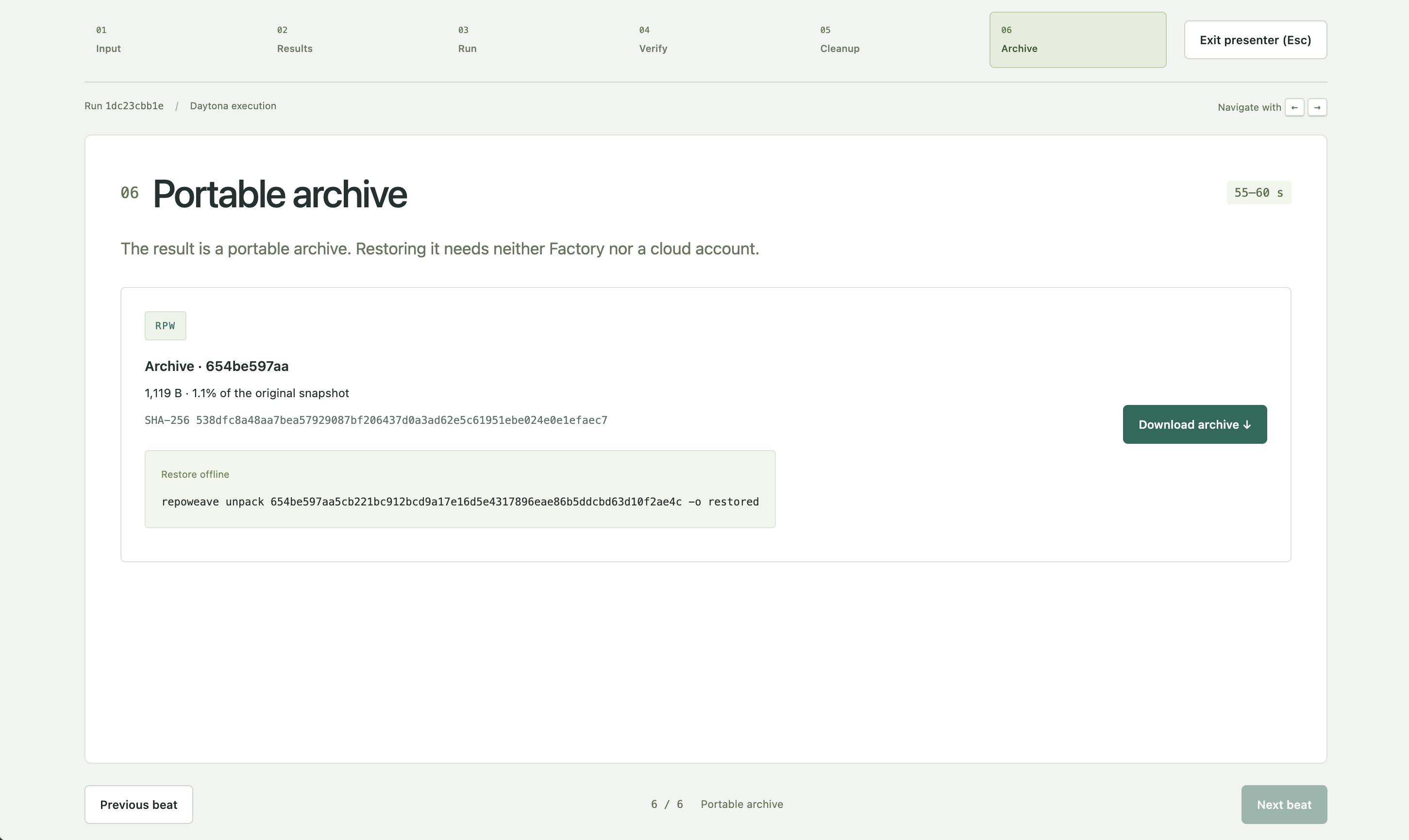
The result becomes portable archive with RepoWeave decoder installed, restoration works online without factory or API call
-
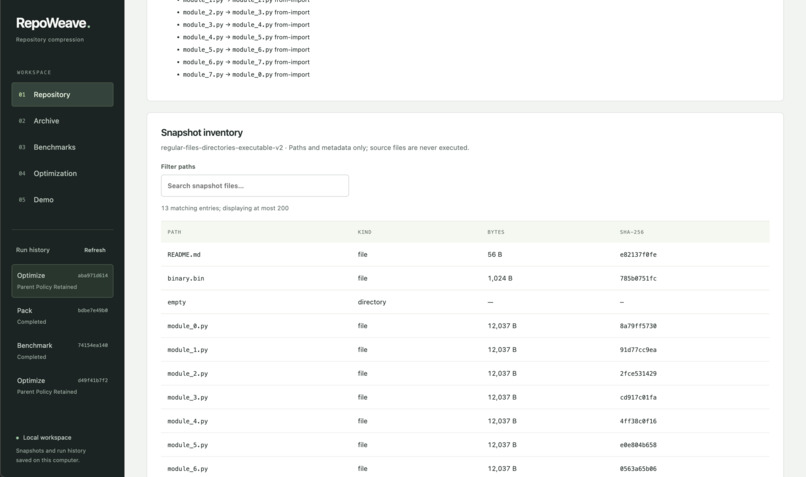
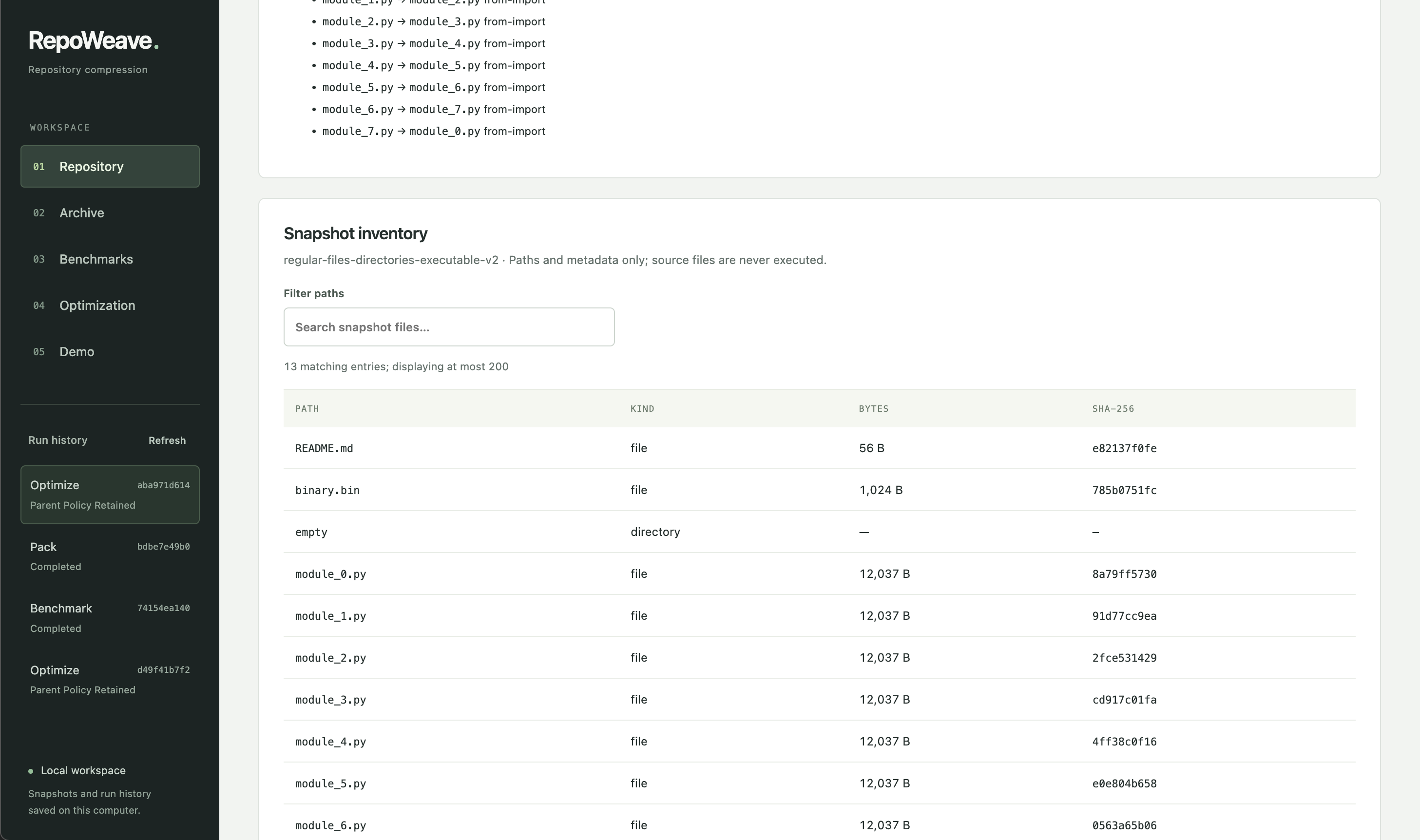
Snapshot inventory
-
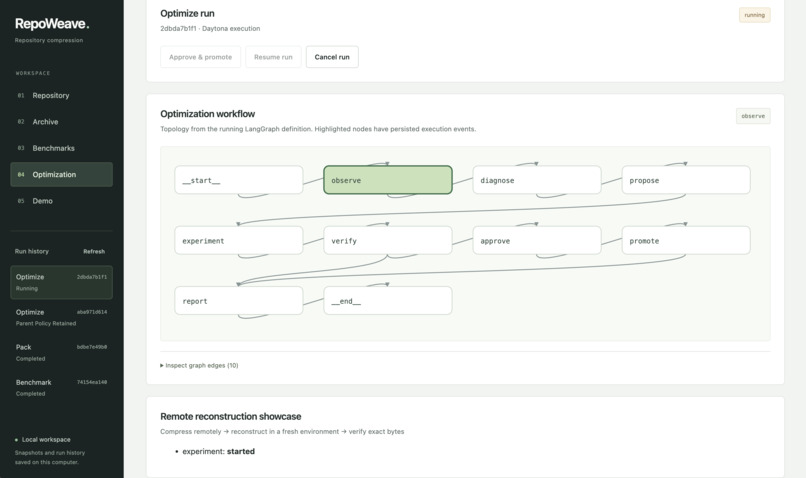
Live running optimization using Devpost sandbox and Factory
-
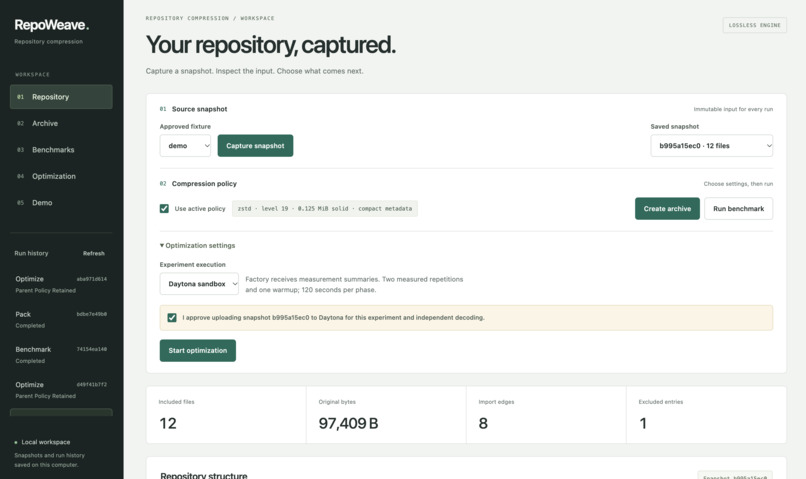
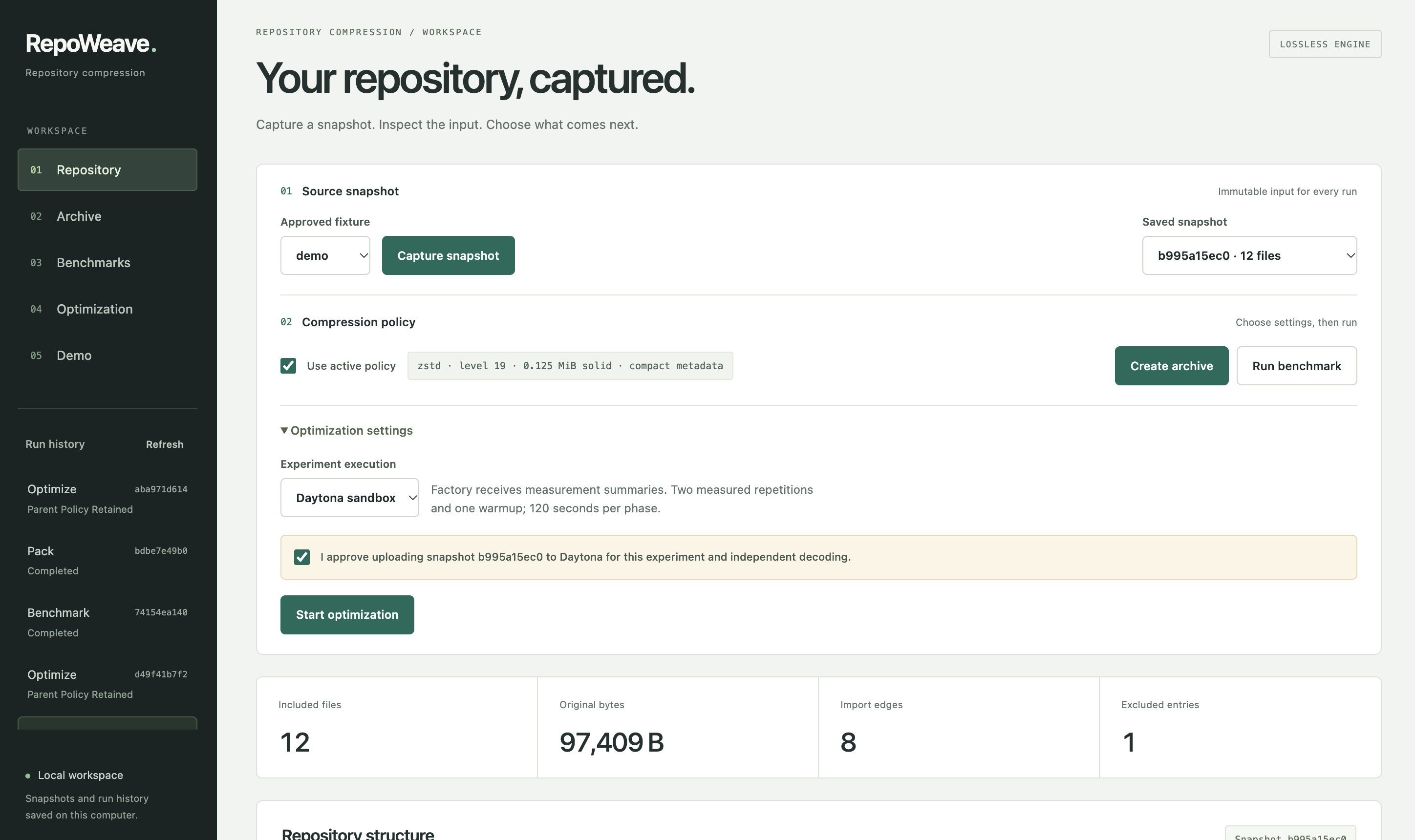
Configuration for live run
-
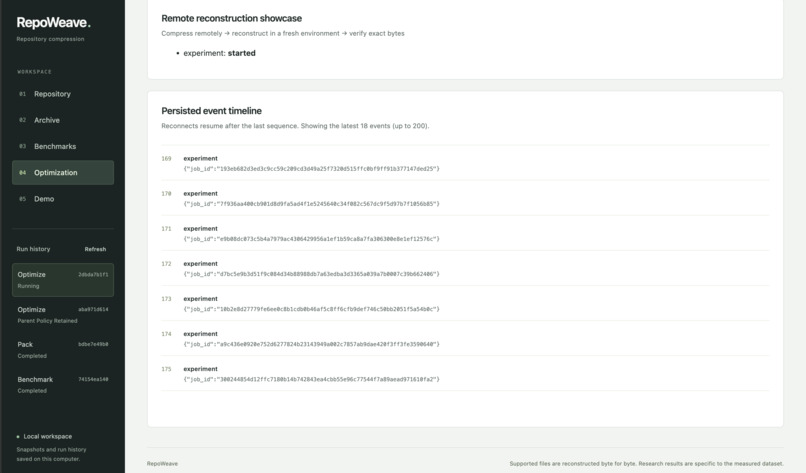
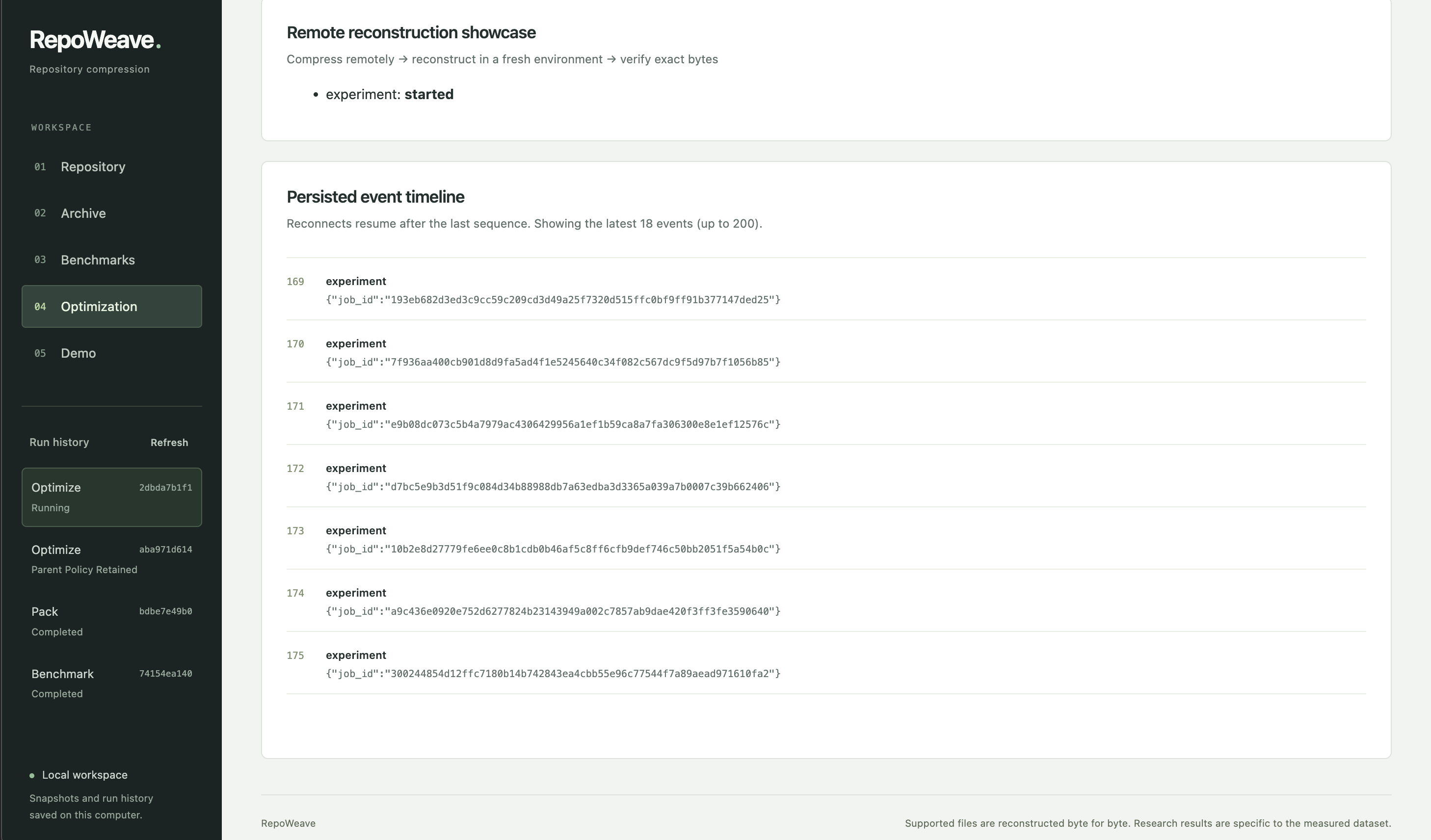
Live persisted event timeline being recorded
Inspiration
A paper titled Compression Represents Intelligence Linearly sparked our curiosity about compression and the patterns it captures. We brought that curiosity to software repositories: could the way files depend on one another help us compress them more effectively?
Files often contain repeated patterns, and grouping them before compression can help a compressor reuse those patterns. RepoWeave explores import relationships as a signal for choosing those groups.
What we built
RepoWeave combines repository analysis with AI-guided compression experiments. An agent proposes candidate groupings and compression settings, and the system tests them within a fixed budget. We measure archive size, processing time, and memory, then verify that every supported file restores byte-for-byte.
We built a pipeline for capturing repository snapshots, running experiments, comparing results, and restoring archives. Factory powers the agent’s proposals, while our dashboard makes the experiments visible. Restoration requires no AI.
Challenges and lessons
Our biggest challenge was defining an improvement: a smaller archive may take longer to create or require more memory. We also learned that import relationships suggest potentially useful groups, but do not guarantee compression gains. Measurements must test that hypothesis.
We started without knowing whether our approach would produce meaningful improvements, so all three of us were surprised by how well the prototype performed. In a recorded experiment, RepoWeave reduced an already-compressed synthetic fixture by 5.7%. Separately, our archive format produced results 0.26–0.35% smaller than tar + Zstd on three public snapshots, at approximately 2.2–2.5 times the compression time. These results encouraged us to keep exploring, although they do not yet isolate the contribution of import-guided grouping.
A first step
To our knowledge, we are among the first groups exploring source-code imports as a signal for compression grouping. RepoWeave is small-scale today, but it gives us a working foundation for further investigation.
We plan to compare grouping strategies under equal experiment budgets and expand across more languages and larger repositories. If the benefits hold at scale, this work could contribute to more efficient storage and transfer of large code archives.
What it does
Built With
- codex
- daytona
- factory
- langgraph
- langsmith
- lzma
- python
- stored
- zstd
